


Leonardo da Vinci once wrote:
Painting is poetry which is seen and not heard, and poetry is a painting which is heard but not seen. These two arts, you may call them both either poetry or painting, have here interchanged the senses by which they penetrate to the intellect.
There may be no better words to prepare you for what you are about to see.
We live in an age of almost unimaginable achievement. We have split the atom, sequenced the genome, built telescopes that can see light from the first galaxies that ever formed. And yet a person can still walk into a gallery, stand in front of a panel painted five or six centuries ago, and feel something the modern world rarely produces: the sensation of looking at a piece of art that should not be possible. There are paintings that test not only what we see, but what we believe we are seeing…
That is the strange power of this art form. At its best, painting is an act of beautiful deception: an invitation to accept a few lines and shapes, made with color and a brush, as a living world. Instead of imitating reality, the greatest painters set out to challenge it. And in a handful of extraordinary cases, they produced things that still baffle us today: a trick of perspective, an illusion stretched across a ceiling, a reflection in an eye, rendered with a precision that even now, with everything we know, is difficult to fully explain.
To see it, though, you have to slow down. These works do not give themselves away at a glance. The longer you look, the more they reveal, and the stranger they become. As Nietzsche once put it:
The voice of beauty speaks softly; it creeps only into the most fully awakened souls.
What follows are 6 artworks that have been haunting people for centuries. Very few things made by humans can do what they do: they ask you to reconsider what you ever believed a single pair of hands could achieve…
REMINDER: Beauty is Truth is entirely reader-funded. There are no ads here, only independent writing devoted to celebrating beauty — and it can only continue with your help.
If you’ve been thinking about supporting my work, becoming a paid subscriber is the most meaningful way to do it:
With the new annual subscription discount, it costs less than a coffee a month, and it is what keeps all of this going.
Gift subscriptions to Beauty is Truth are now available too:
1. The Painting That Was Never Painted
In December of 1531, ten years after the Spanish conquest of the Aztec Empire, an indigenous man named Juan Diego was walking near the hill of Tepeyac, outside Mexico City. According to the account written down in the Nahuatl-language Nican Mopohua, he encountered a young woman, radiant as the sun, who spoke to him in his own language and identified herself as the mother of God. She asked that a church be built on the hill. The local archbishop, Juan de Zumárraga, asked for a sign.
Days later, Juan Diego opened his tilma — a cloak woven from coarse cactus fiber — to let a cascade of out-of-season roses fall to the floor. On the cloth itself, the witnesses saw an image: a dark-haired, olive-skinned woman, head bowed, hands joined in prayer.
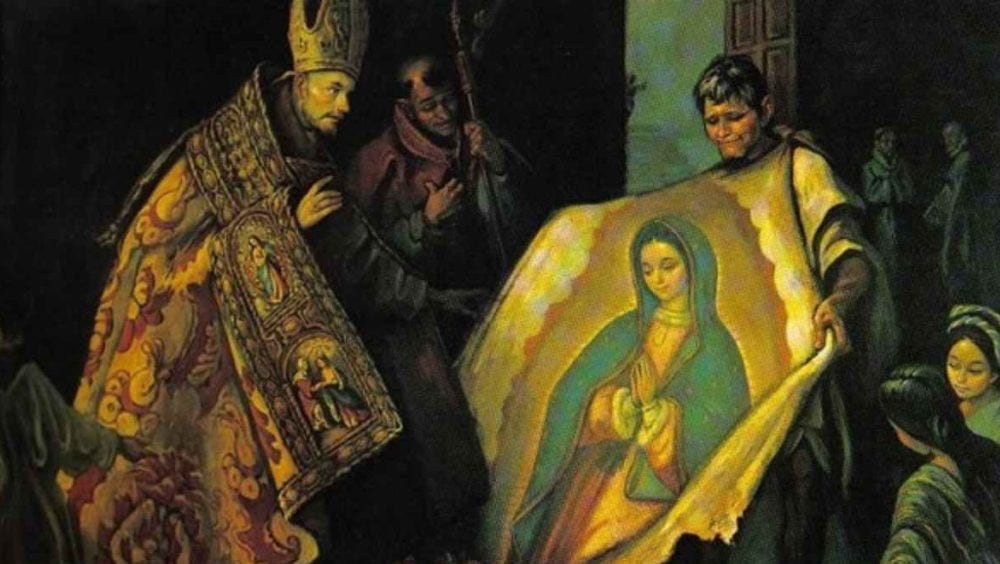
That cloak still exists. It hangs today above the altar of the Basilica of Our Lady of Guadalupe in Mexico City — the most-visited Catholic shrine on earth.
And for nearly five centuries, it has resisted a simple question: who painted it?
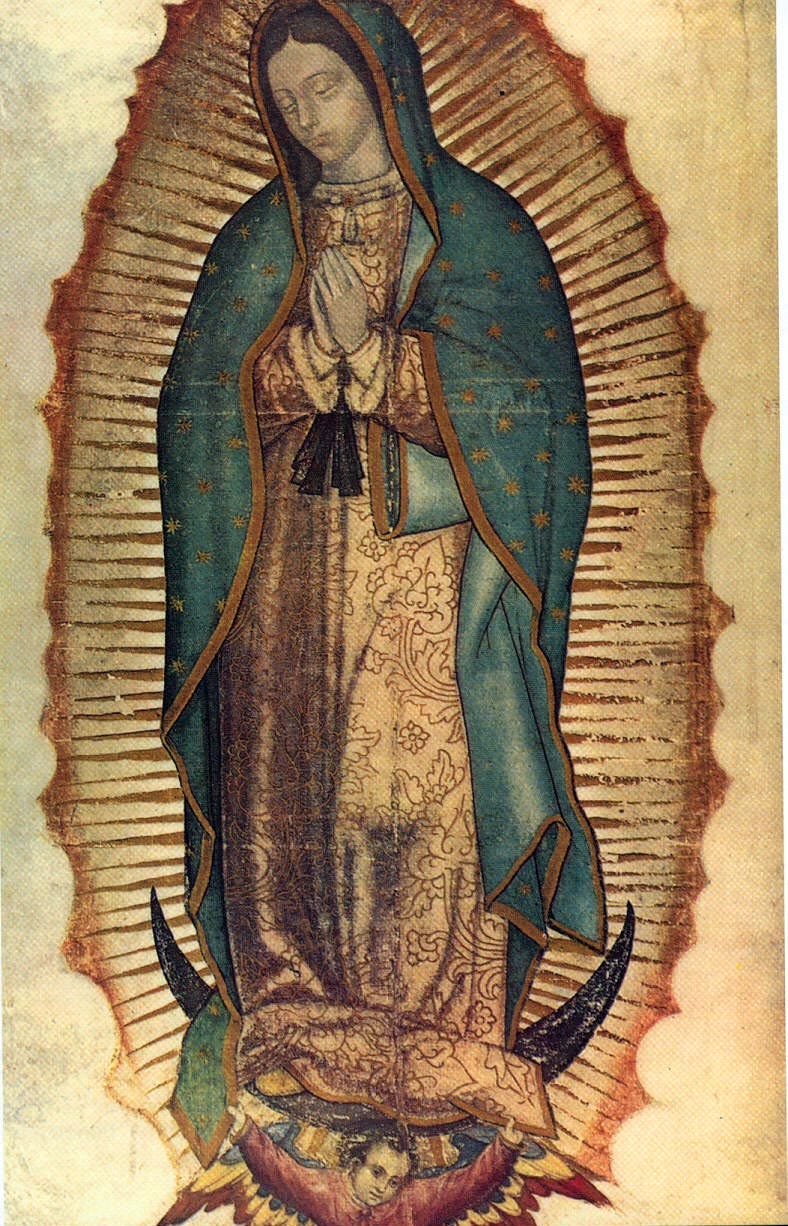
The image has been examined again and again. In 1666, as part of a formal Church inquiry, seven professional painters studied it and testified that it seemed impossible for any human artist to have produced something so refined on fabric so rough.
In 1979, the biophysicist Philip Callahan photographed it under infrared light and reported that, in the original portions of the figure, he could detect no preparatory sketch and no visible brushstrokes. He documented numerous later additions and touch-ups, much of which had cracked or deteriorated over the centuries — but concluded that the original image, in his words, could not be explained and that after more than four hundred years it showed no fading or cracking of any kind.
The strangest aspect, however, concerns the eyes:
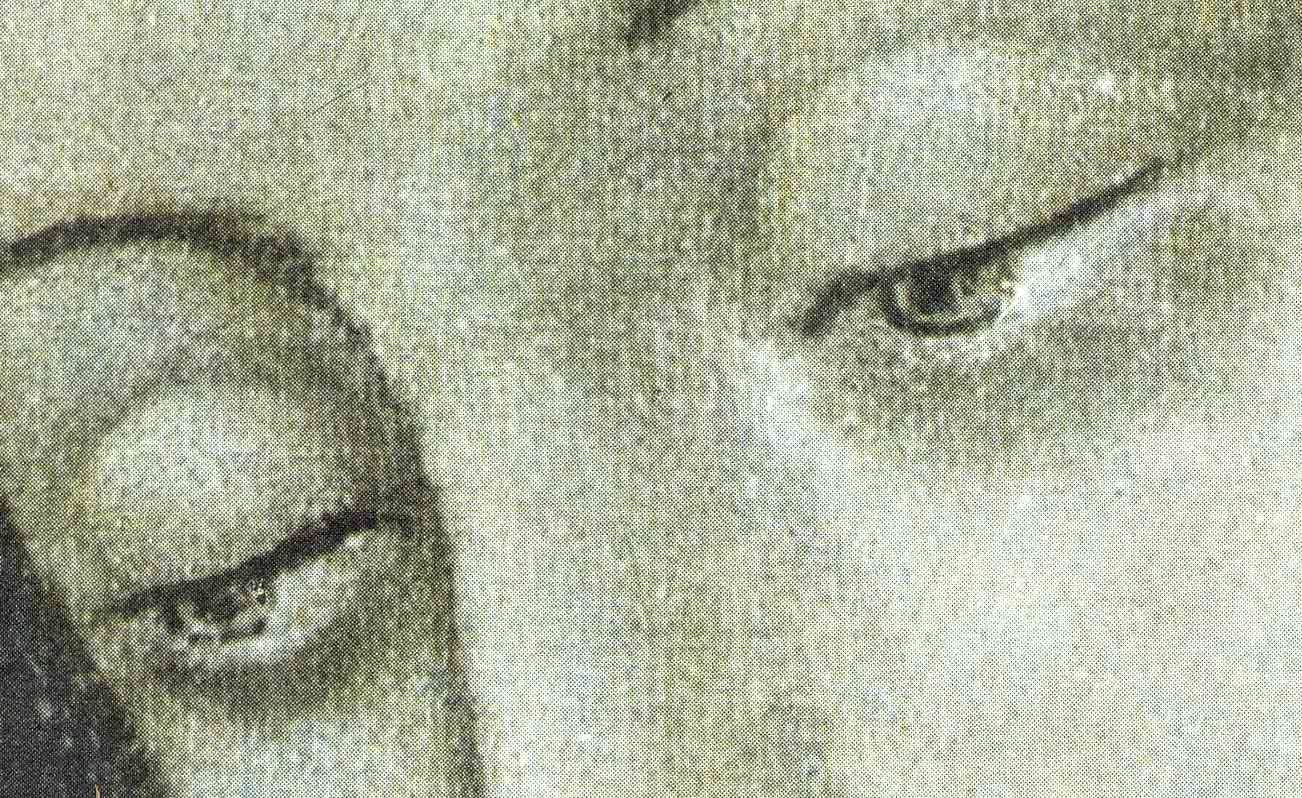
Beginning in 1956, ophthalmologists examining the Virgin’s eyes with magnification reported what they described as tiny human figures reflected in the corneas — and claimed these silhouettes behaved like Purkinje–Sanson images, the reflections that light naturally produces on the curved surfaces of a living human eye.
Decades later, the engineer José Aste Tonsmann, using digital image enhancement, claimed to have identified as many as thirteen figures in the eyes, which he interpreted as the scene in the bishop’s room at the moment the cloak was first opened in 1531.
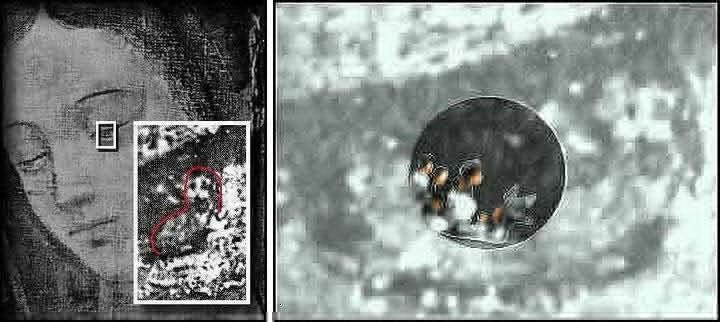
It is important to be honest about all of this. Not every examination has reached the same conclusion. A 1982 study by José Sol Rosales, for instance, found that the image had been painted with ordinary sixteenth-century materials and techniques. And there is an older complication still: in 1556, just twenty-five years after the apparition, a senior Franciscan friar named Francisco de Bustamante delivered a furious public sermon in Mexico City, in which he stated plainly that it had been painted — “the work of an Indian painter,” he said, naming a native artist called Marcos.
The image has, in other words, been contested almost since the moment it first appeared.
But that is exactly what makes the tilma so extraordinary. It has survived nearly five centuries of candle smoke, incense, humidity, and a nitric acid spill in the late 1700s. It also endured a bomb detonated directly beneath it in 1921, which bent a brass crucifix and shattered marble, yet left the cloth itself completely untouched. It is one of the most examined images in human history — and after five hundred years, the examinations still do not agree. Whatever you believe about how it came to exist, the tilma remains a masterpiece that has never fully surrendered its secrets…
2. The Skull That Hides in Plain Sight
In 1533, the German painter Hans Holbein the Younger completed a double portrait of two young Frenchmen: Jean de Dinteville, the French ambassador to the court of Henry VIII, and Georges de Selve, the Bishop of Lavaur. The painting, known simply as The Ambassadors, now hangs in the National Gallery in London.
At first glance, it is a triumph of pure technical realism. The longer you look, the harder that triumph becomes to comprehend…
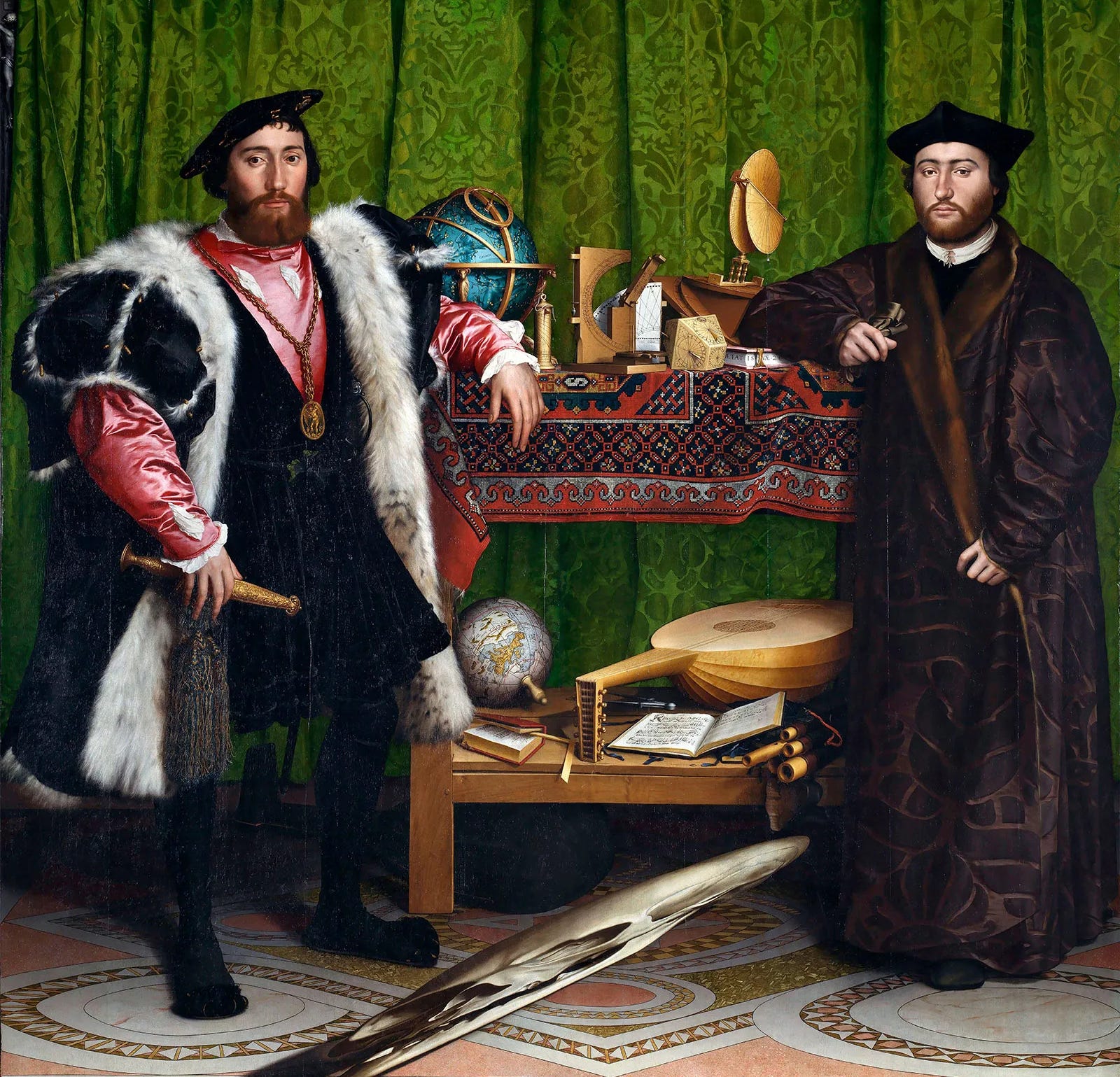
Holbein renders fabric the way a modern camera renders it. The black satin, the pink silk, the white fur lining, the soft individual hairs of the two men’s beards — each surface has its own distinct weight and sheen.
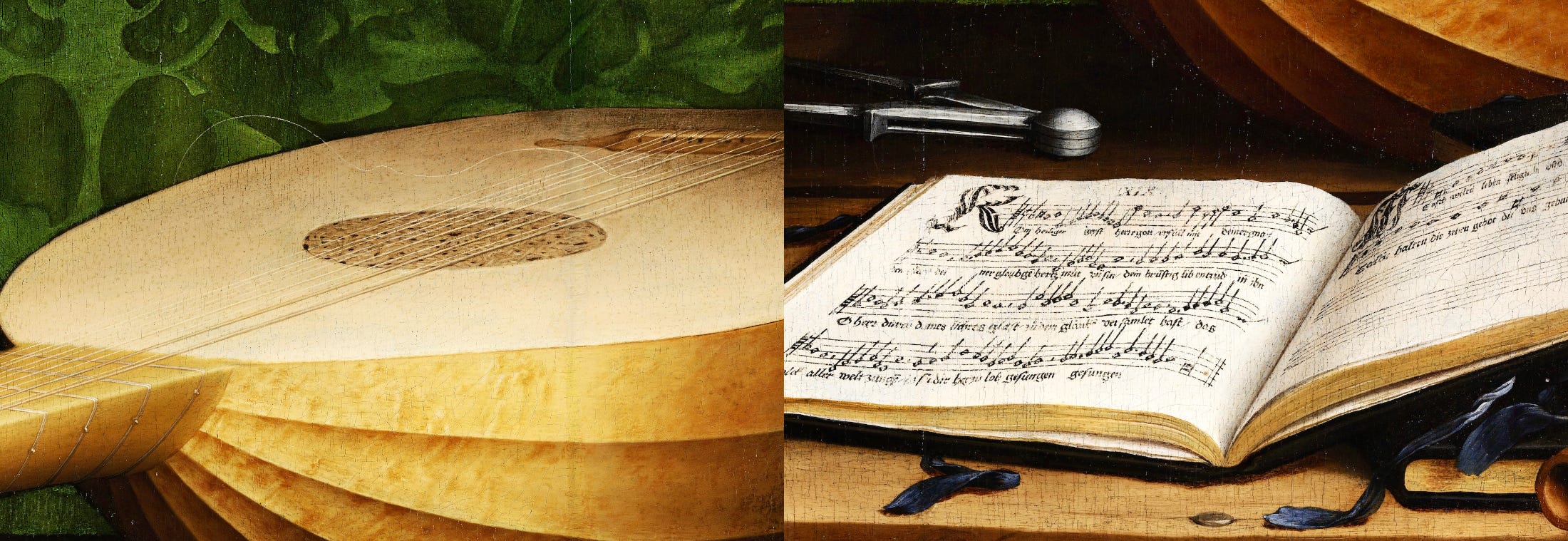
But the two ambassadors are not really the heart of the painting. The heart of it is the shelf between them, and Holbein paints every object on it with the precision of a scientific instrument-maker. On the upper level are the tools of the celestial realm: a celestial globe, a sundial, a torquetum and other astronomical instruments. On the lower level are the objects of the earthly one: a terrestrial globe, a lute, a case of flutes, an open hymn book, a book of arithmetic.
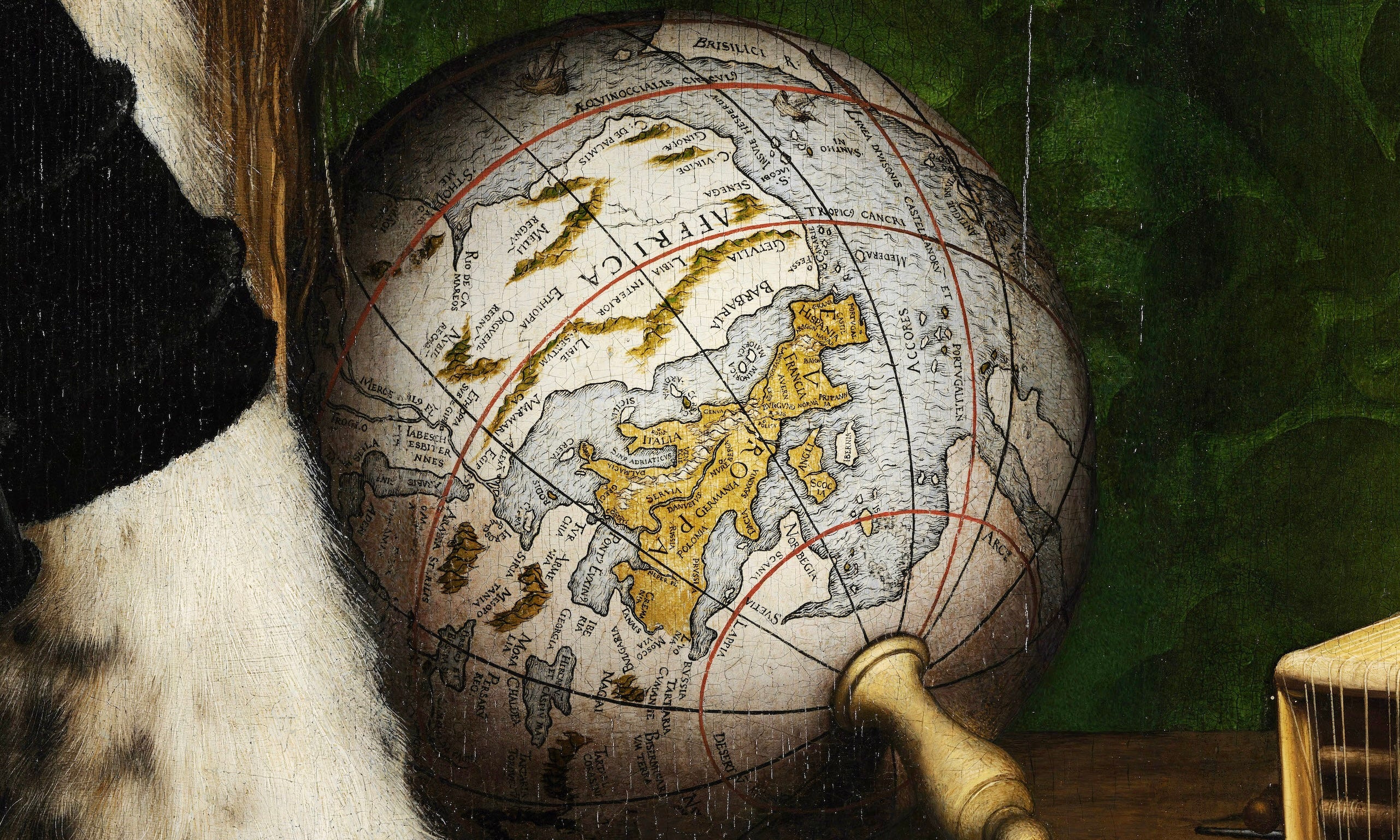
Each is rendered so exactly that scholars have been able to identify the arithmetic text as a real published manual by the German astronomer Peter Apian and even locate, on the terrestrial globe, the position of Dinteville’s own château at Polisy. The objects are a portrait in their own right — a display of everything these two men have measured, mastered, and understood.
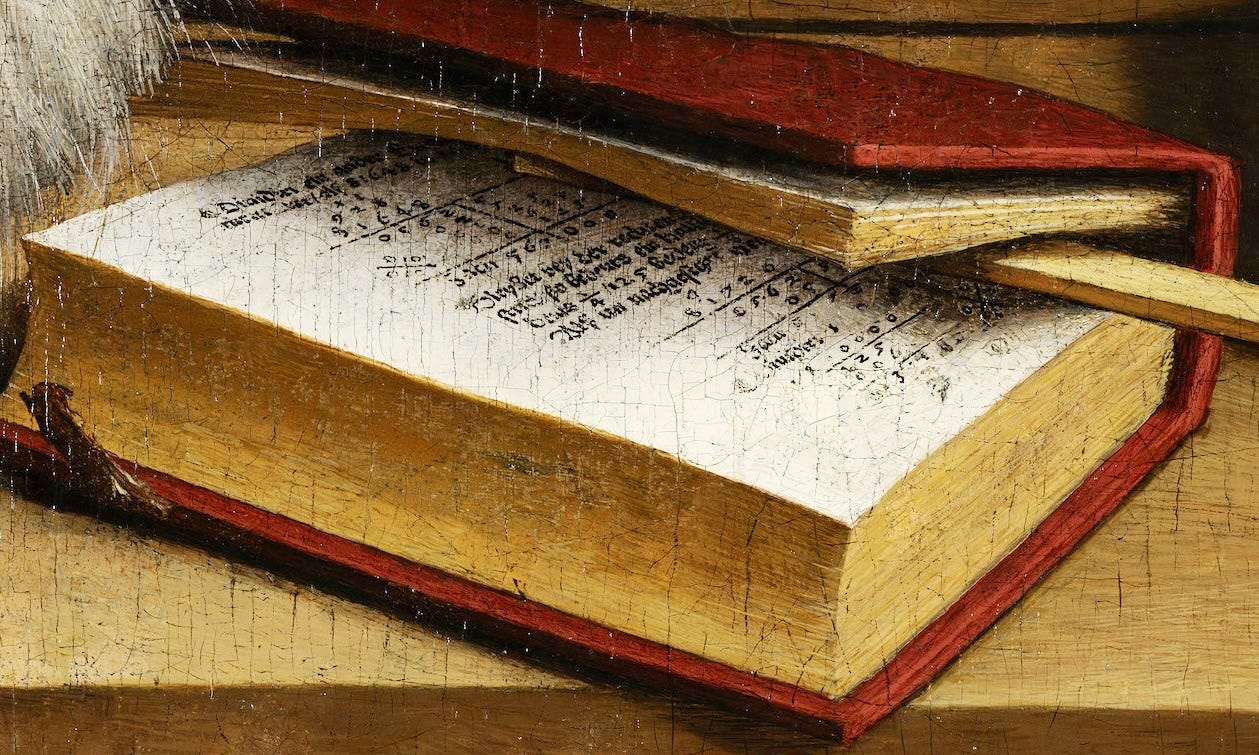
But Holbein’s cleverness runs deeper than display. Look closely at the lute, and you will see that one of its strings is broken — a symbol of discord, of something fractured. The hymn book beside it is open to a translation by Martin Luther: the painting was made as the Protestant Reformation was tearing Europe in two, and Holbein lets the tension whisper through the objects rather than state it.
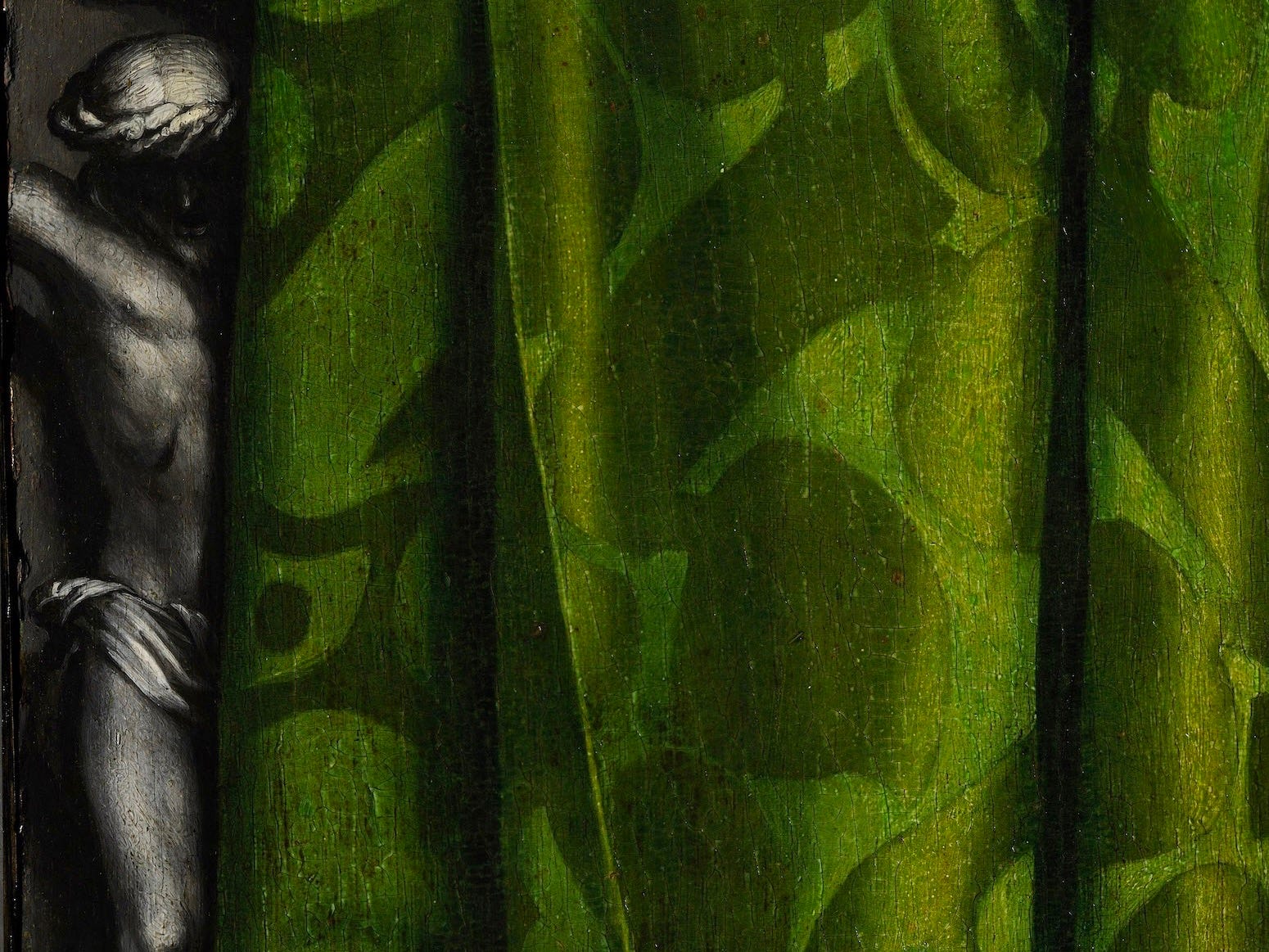
And there, half-hidden behind the green curtain in the upper left corner, almost lost, is a small silver crucifix. The placement is deliberate. For all the human power gathered on that shelf — the ability to chart the heavens and map the earth — the painting suggests that true meaning lies outside it, in something the instruments cannot measure.
And then there is the thing that, at first, you cannot see at all.
Stretched diagonally across the floor at the men’s feet is a strange, pale, smeared shape. From directly in front of the artwork, it looks like a flaw, a blur, something gone wrong. It is not. It is a human skull, painted in anamorphic perspective — a distortion so extreme that the image only resolves into its true form when the viewer stands close to the painting and looks at it from a sharp angle to the right.
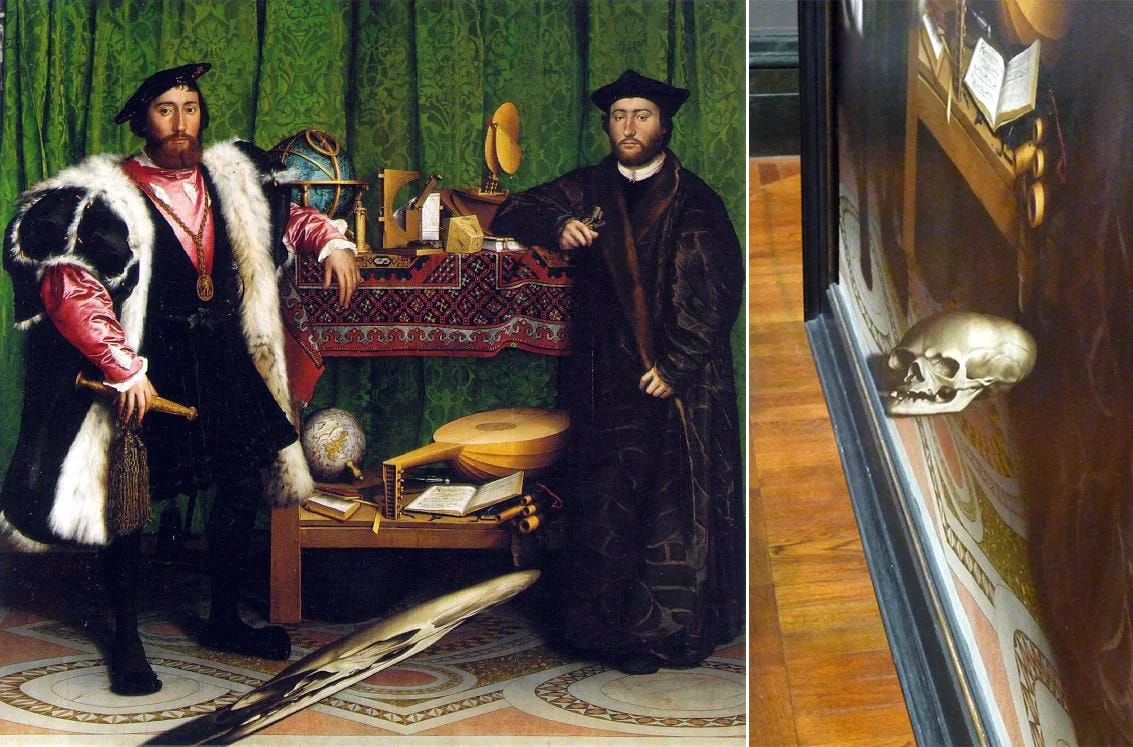
There is a genius in this beyond the technical feat. We cannot see the skull at first — just as we spend our lives not quite able to see, or accept, the transience of everything we are looking at.
Holbein painted earthly reality so vividly that we refuse to believe it is only pigment, and then hid death inside it, in plain sight, waiting for each viewer to step to the side and find what was there all along…
3. A Painting Full of Other Paintings
Around the year 1620, an unknown Flemish artist painted something astonishing. The work, housed in London’s National Gallery, is called Cognoscenti in a Room hung with Pictures. At first it looks straightforward: eleven elegantly dressed men — connoisseurs, collectors, dealers, the cognoscenti of the title — stand in a vast room, inspecting and discussing art.
But look closer at the walls and zoom in…
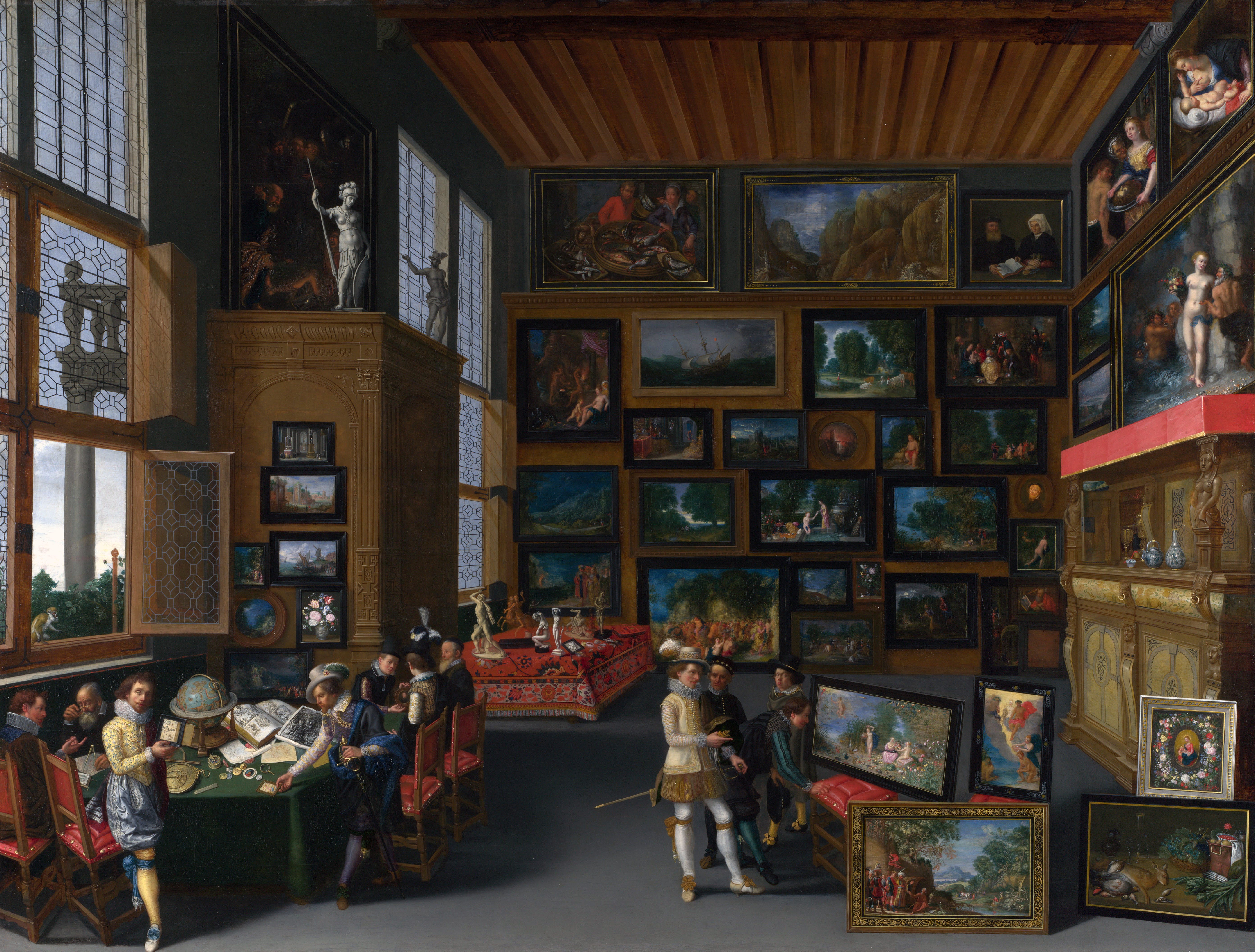
The room is crowded, floor to ceiling, with dozens of paintings, sculptures, prints, and astronomical instruments. And nearly every one of them is a meticulous miniature reproduction of a real, identifiable work of art by sixteenth- and seventeenth-century masters, most of them active in Antwerp.
The artist painted, by hand, a gallery’s worth of other artists’ paintings in perfect miniature — each with its own composition, its own subject, its own style faithfully copied, all within a single canvas. It is a painting that contains an entire museum.
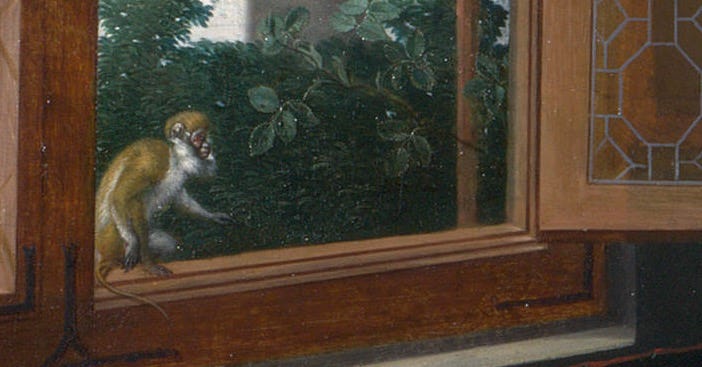
And on the windowsill, almost hidden, the artist placed a small monkey — a traditional symbol of human folly and a reminder of how foolish it is to spend your life chasing the ownership of expensive things, while missing the bigger picture.
4. This Mirror Reflects the Whole Room
In 1434, the Flemish painter Jan van Eyck completed a small oil painting, barely 80 centimeters tall, that would become one of the most studied works of art ever made. It is known as The Arnolfini Portrait, and it is also part of the collection at the National Gallery. It shows a richly dressed couple — most likely the Italian merchant Giovanni di Nicolao Arnolfini and his wife — standing together in a private room in the city of Bruges.
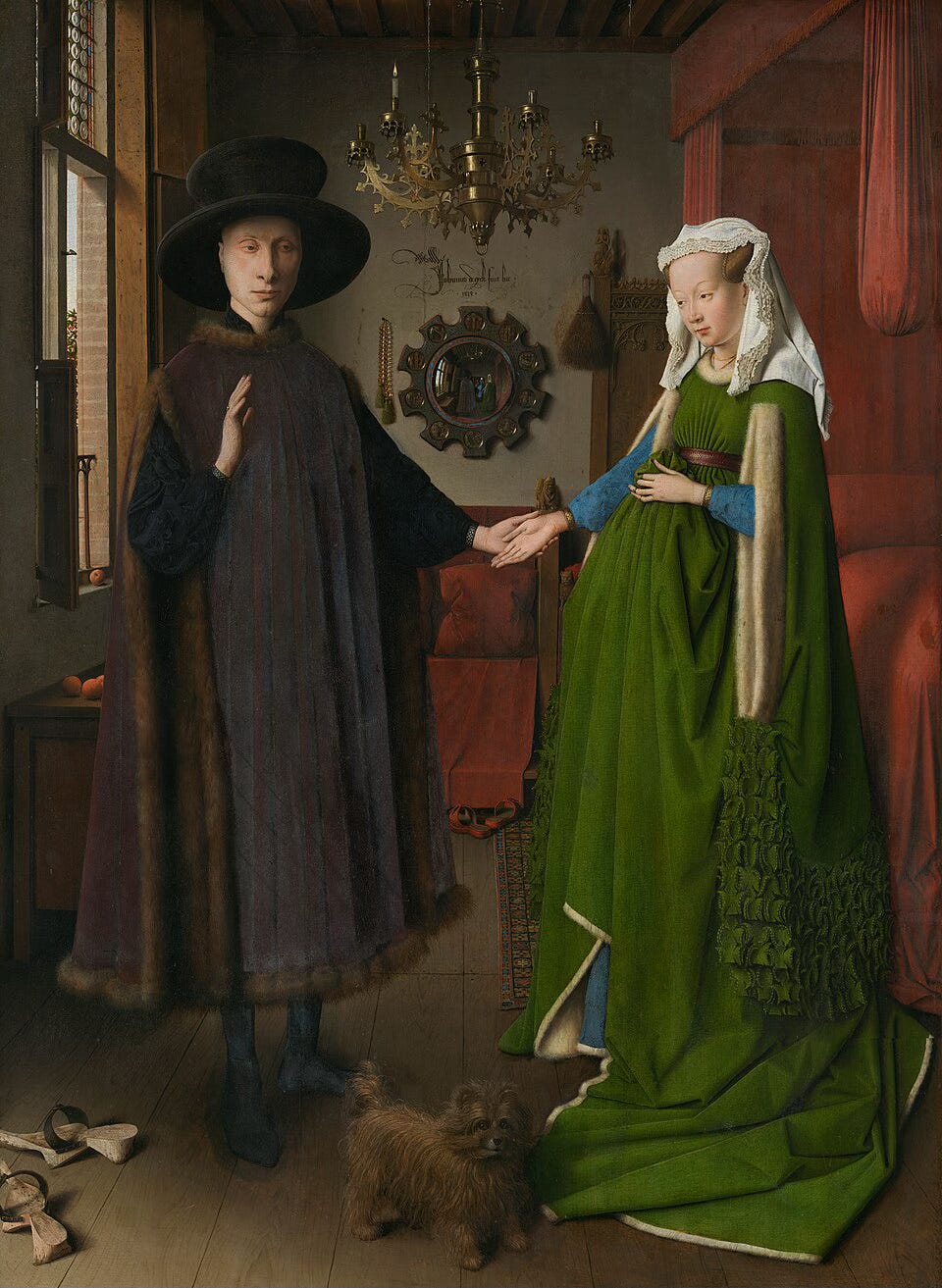
What makes the painting extraordinary is van Eyck’s command of oil paint, a medium he helped pioneer. Working with translucent layer upon translucent layer, he achieved a level of detail that, in 1434, simply did not exist anywhere else in European art. Every surface in the room is rendered with almost unsettling precision: the soft fur trimming the clothing, the brass of the elaborate chandelier with its single lit candle, the oranges by the window — a luxury import, painted so convincingly you can sense their weight.
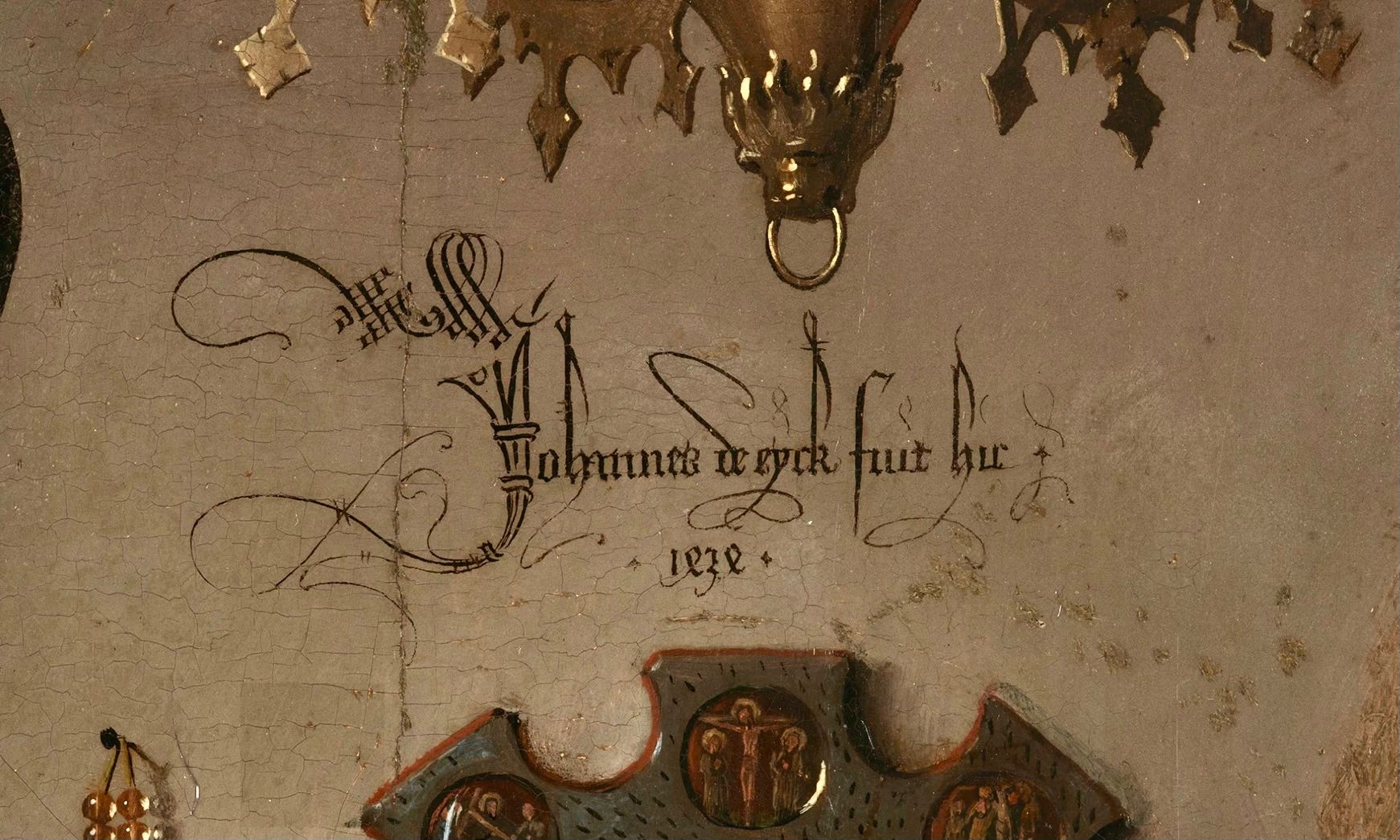
Van Eyck signed the work not in a corner, but boldly on the back wall, in elegant script: Johannes de eyck fuit hic 1434 — “Jan van Eyck was here. 1434.”
But the heart of the painting — and the detail that has astonished viewers for almost six hundred years — is the convex mirror on the back wall.
It is small, round, and at first easy to overlook…
Its curved glass reflects the entire room in miniature — the backs of the couple, the windows, the ceiling beams, the whole space compressed into a sphere a few centimeters across. And it does not stop there. In the mirror, you can see two more figures, people standing roughly where you, the viewer, are standing, entering the room through a door that is not otherwise visible.
One of them may be van Eyck himself.
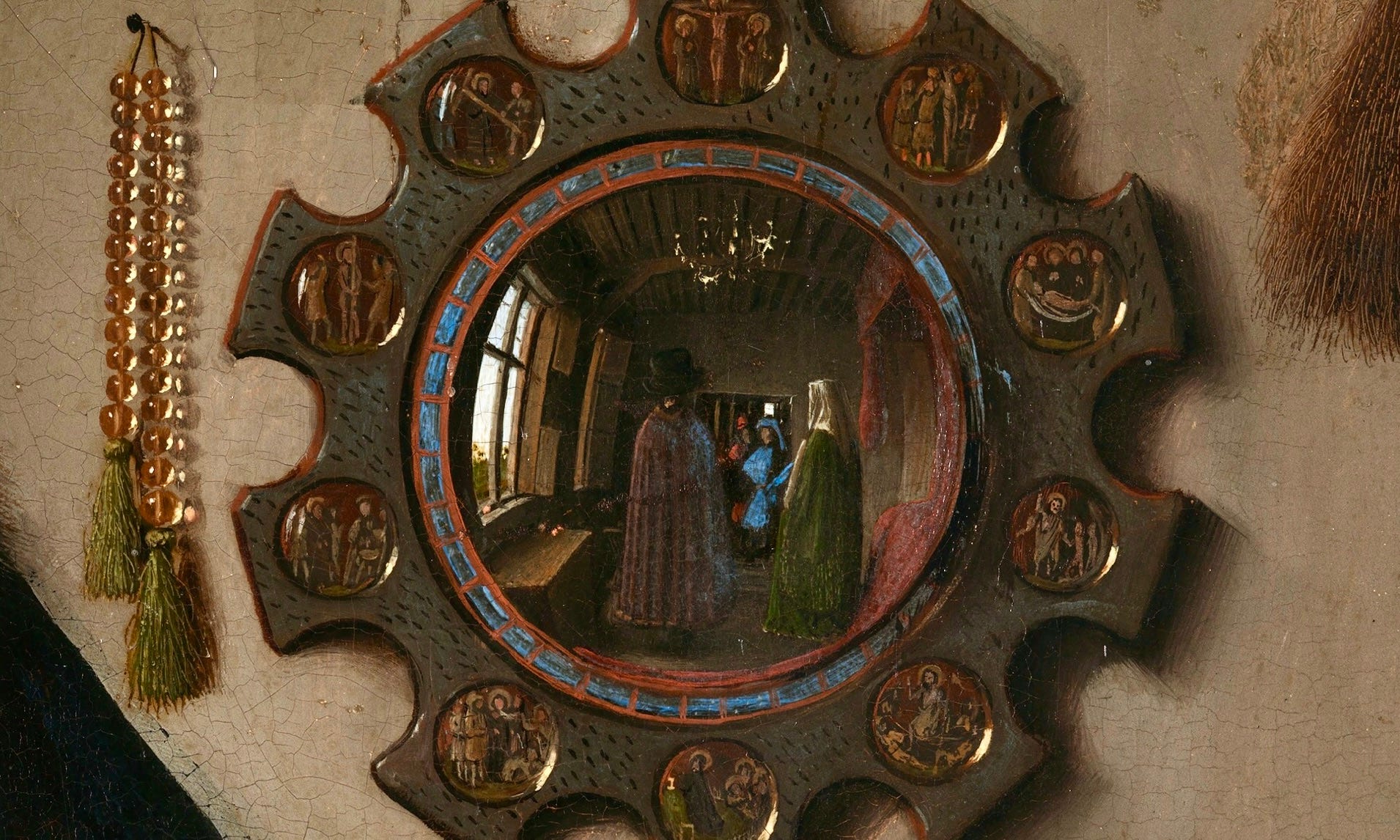
The wooden frame around the mirror is studded with ten tiny scenes from the Passion of Christ — and each of those scenes, painted in a space barely a centimeter and a half wide, is still individually recognizable.
Van Eyck painted a mirror, inside a painting, that reflects a world larger than the painting itself, and he did it nearly six centuries ago, with a mastery of oil paint that no-one alive could yet match.
5. A Ceiling That Opens Into the Sky
When the Jesuit Church of Sant’Ignazio in Rome was being completed in the seventeenth century, it was meant to be crowned with a magnificent dome. The money ran out. The dome was never built, leaving a flat, empty ceiling where the grandest feature of the church should have been.
So the Jesuits turned to Andrea Pozzo — a lay brother of the order, a painter, and a master of mathematical perspective. Between 1685 and 1694, Pozzo solved the problem in the most audacious way imaginable. He simply painted the dome. On a flat canvas, using nothing but perspective, light, and shadow, he created the illusion of a soaring ribbed cupola opening into the sky above the church — complete with curving architecture, receding columns, and streaming light.
Stand on the small marble disc set into the floor of the nave, look up, and the dome is there: deep, three-dimensional, utterly convincing.
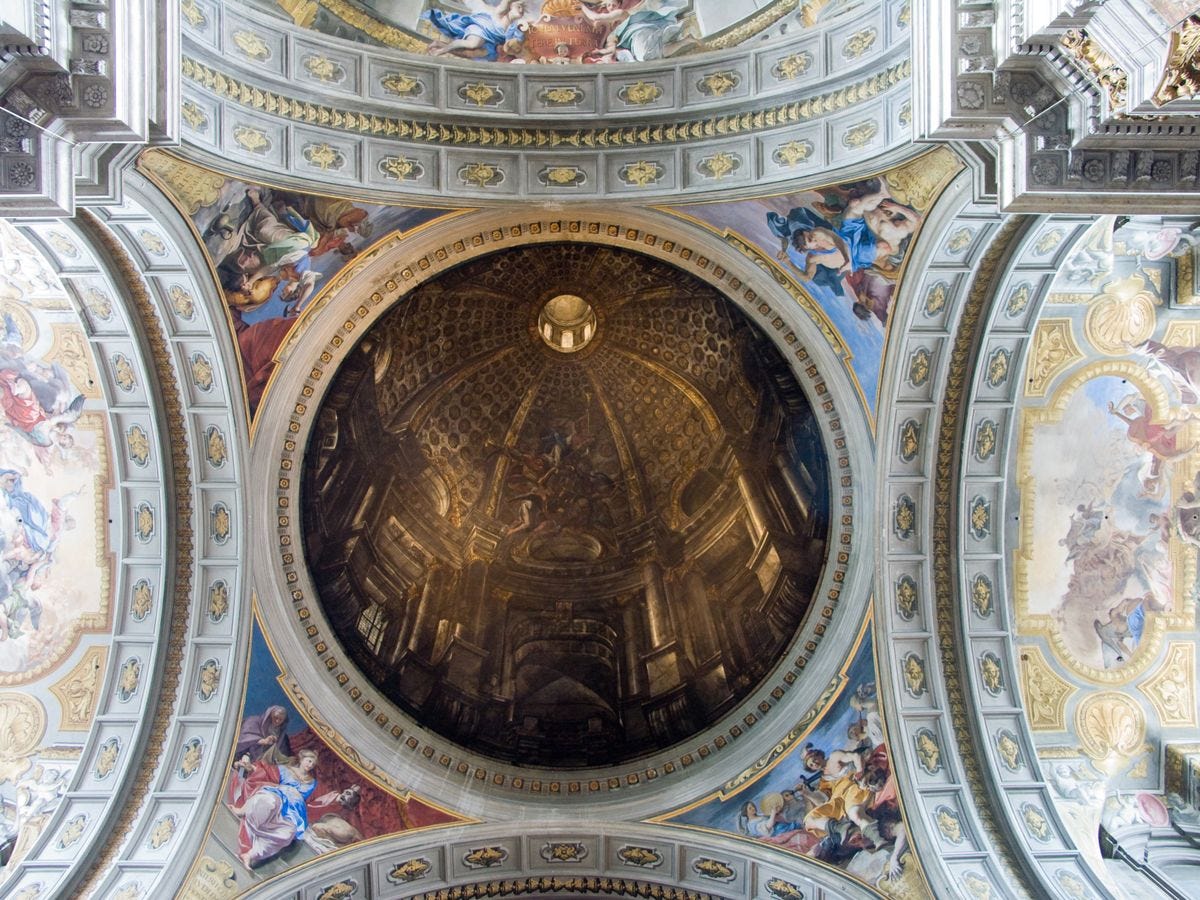
Then walk forward: as you move away from that one marked spot, the illusion begins to warp, and when you stand directly beneath it, the dome collapses entirely into what it always was — a flat painting on a flat ceiling.mo
Pozzo did the same with the nave ceiling itself, painting the whole vault as though the roof of the church had dissolved and figures were rising endlessly into heaven.
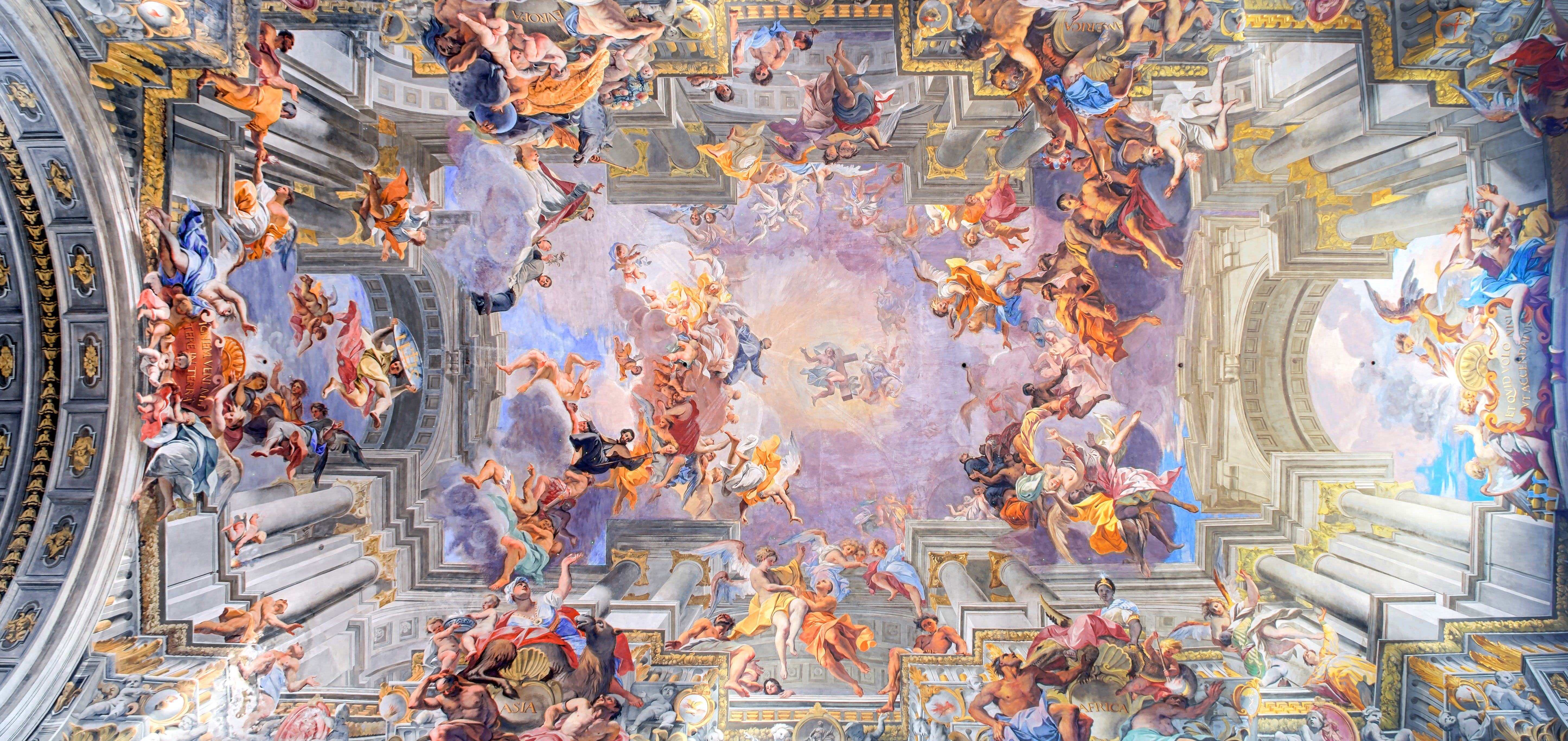
It is one of the greatest optical illusions ever committed to paint: an entire piece of architecture that exists only in two dimensions, and only from the right point of view.
6. This Painting Is Looking at You
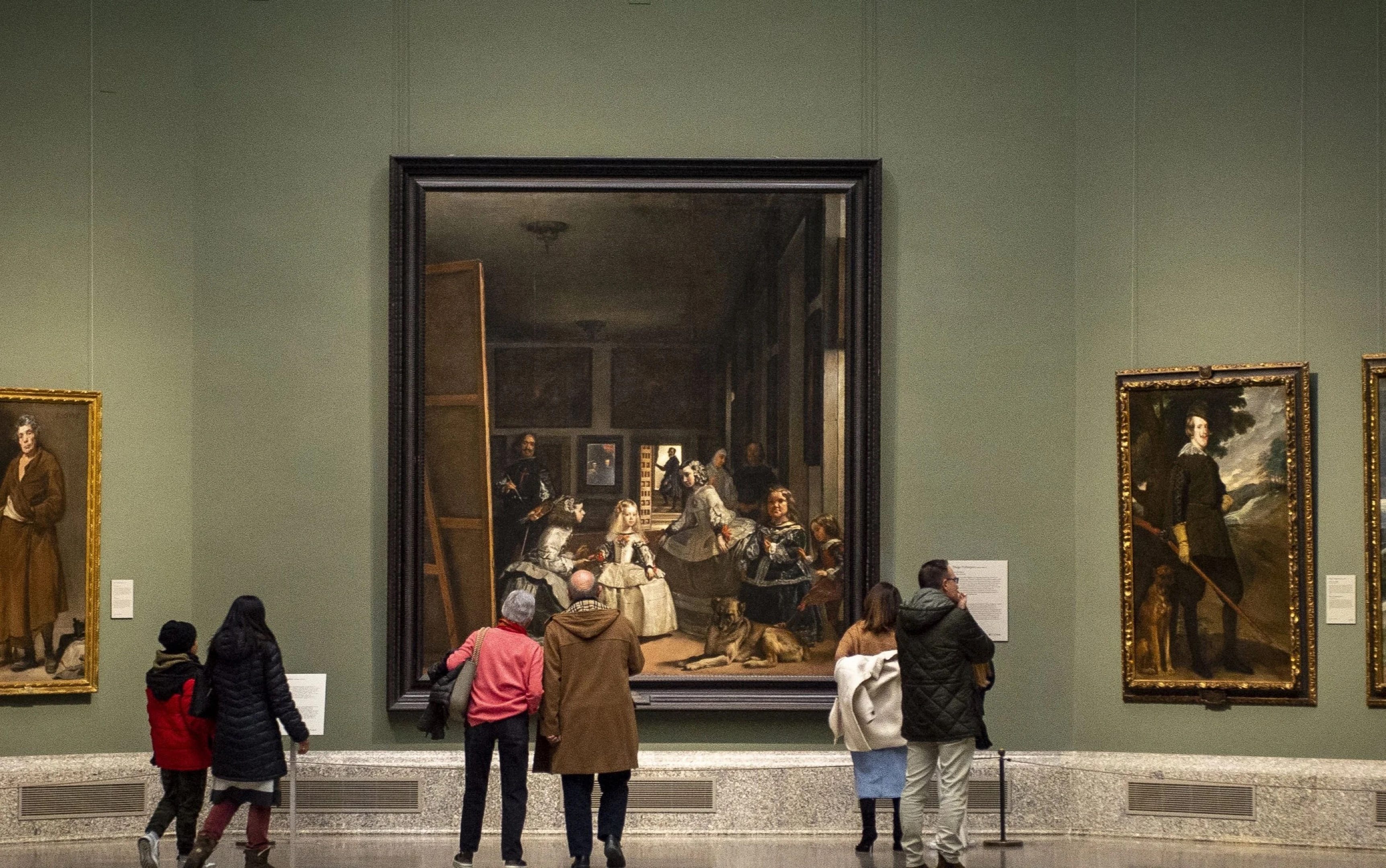
In 1656, the Spanish painter Diego Velázquez completed a canvas that would become, in the centuries since, perhaps the most analyzed painting in the entire history of Western art. It is called Las Meninas — Spanish for “the ladies-in-waiting” — and it is displayed at Museo del Prado in Madrid.
It is enormous: 318 by 276 centimeters, which means the figures inside it are nearly life-size and the canvas portrayed within the painting is about the same size as Las Meninas itself. Standing before it feels less like looking at an artwork than like looking through a doorway into a room that happens to exist in 1656.
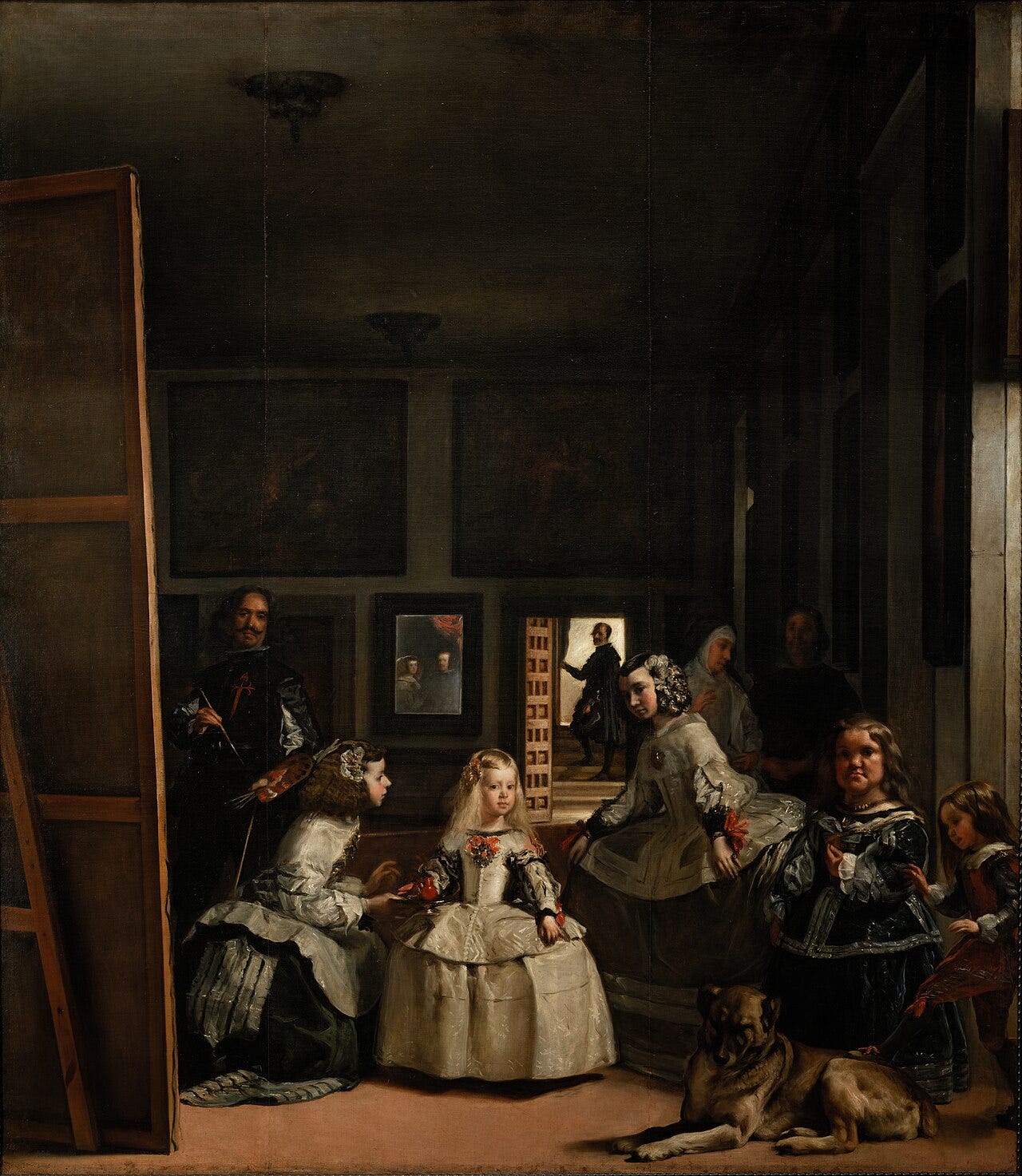
At the center stands the five-year-old Infanta Margarita Teresa, daughter of King Philip IV. She is surrounded by a small crowd: two meninas attending to her, two court dwarfs, a chaperone, a bodyguard, a large dog dozing in the foreground.
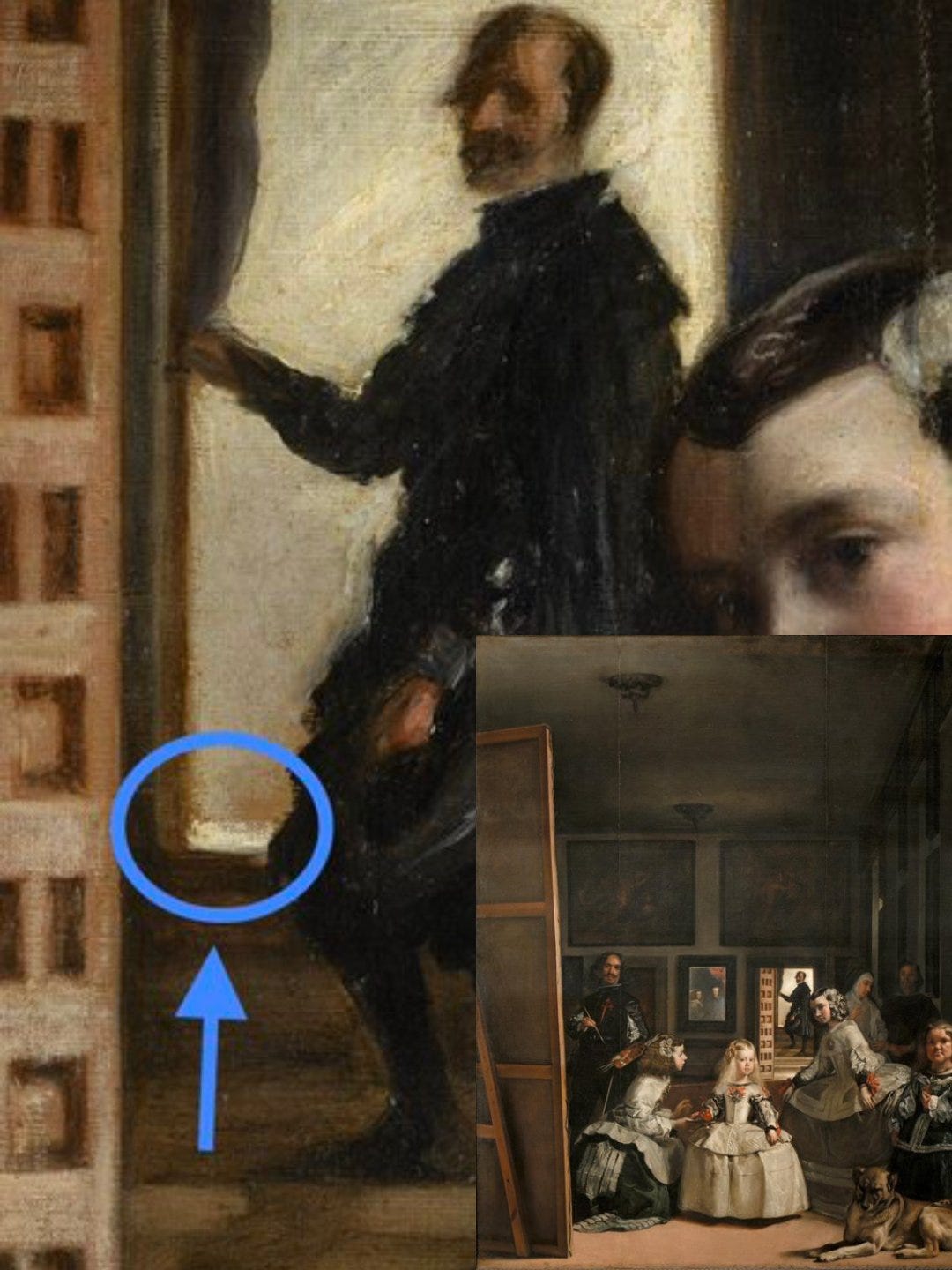
A man pauses on a staircase in a lit doorway at the back, and a delicate brushstroke beside him adds a gentle glow, enriching the depth of the composition.
And on the far left, standing before an enormous canvas turned away from us, is Velázquez himself — brush in one hand, palette in the other — in the act of painting. It was an extraordinarily bold thing to do in the seventeenth century: to insert your own self-portrait, at full height, into a royal commission, mingling your own likeness with that of the king’s family.
The painter's chest bears the red cross of the Order of Santiago, which he received years after this masterpiece was finished. According to Palomino — known as the “Spanish Vasari” — the king ordered this to be added after his death, “and some say that his Majesty himself painted it”.
And then there is the mirror…
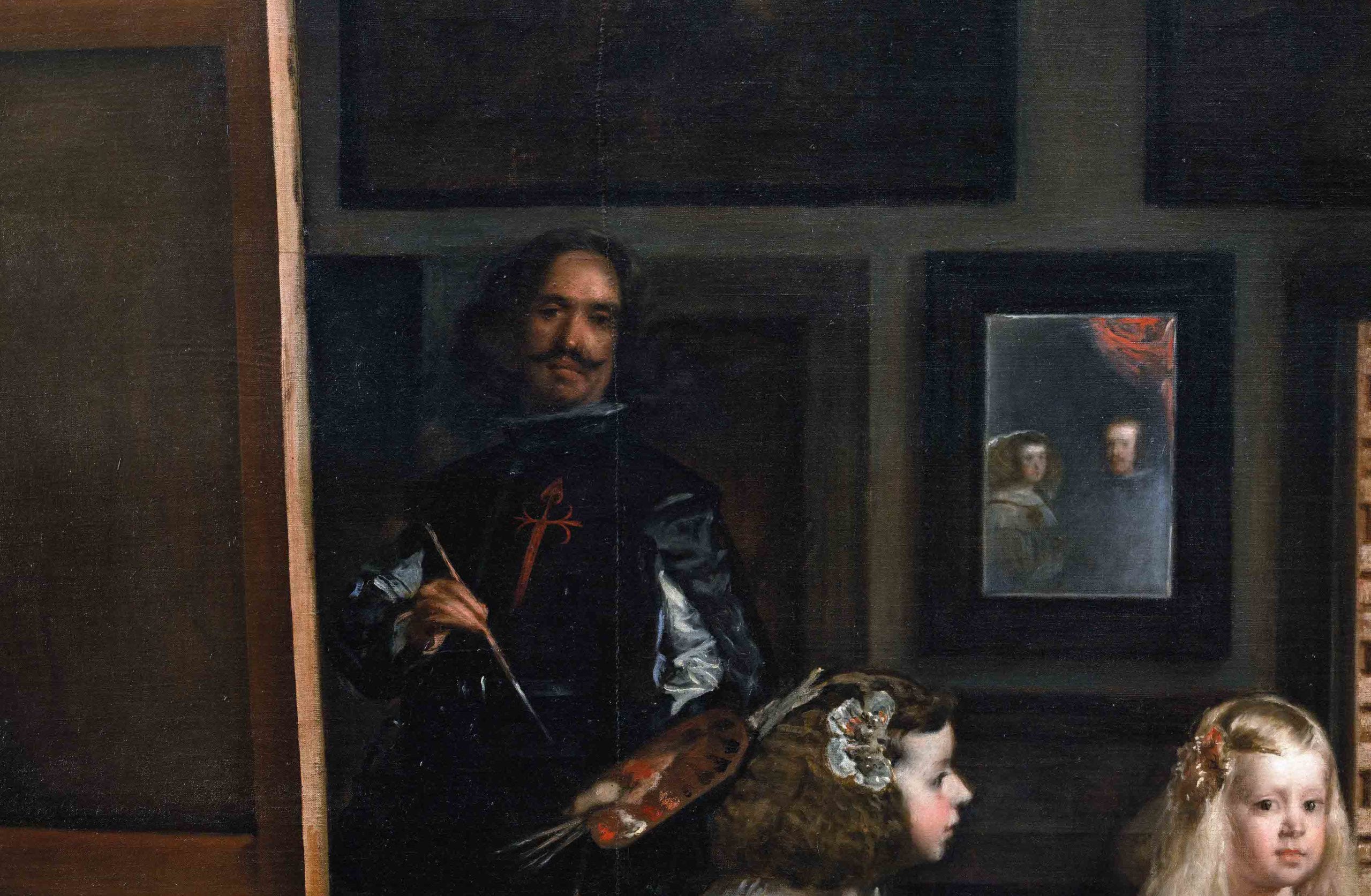
On the rear wall, between the figures, hangs a small mirror, glowing softly with reflected light. Look into it, and the entire painting silently reorganizes itself around you. The mirror reflects two people who appear nowhere else in the scene: King Philip IV and Queen Mariana. They are standing precisely where you, the viewer, are standing. Which means the empty space in front of the canvas — your space — is not empty at all. You are occupying the position of the king and queen of Spain. Everyone in that room who is looking out at “you” is in fact looking at the monarchs.
The painting is, by the way, the only known double portrait of the royal couple Velázquez ever made — and they appear in it only as a reflection, a few centimeters wide, on a distant wall.
Velázquez built a picture with no fixed center and no settled meaning — a picture that watches the person watching it, that folds the viewer bodily into its own subject, and that turns a simple court portrait into an endless loop of looking. For nearly four centuries, scholars, philosophers, and painters have stood in front of it and tried to pin down exactly what they are seeing. But they have never fully succeeded…
Salvador Dalí once said:
I’m a very bad painter. To be a good painter you’ve got to be a bit stupid, with the exception of Velázquez, who is a genius, whose talent surpasses the art of painting.
We tend to believe that progress moves in a single direction — that the present always knows more, sees more, can do more than the past. And in so many ways it does. But beauty has never obeyed that rule. These works were made by people with no machines to do the difficult part for them, only pigment, patience, and an unreasonable refusal to accept what a flat surface was supposed to be capable of.
We live quickly now. We glance, and we move on. But these paintings cannot be received that way, and they never could. They ask for the one thing we rarely offer anymore: our stillness. And in that stillness, something extraordinary happens. A stranger who is long gone, and you, who are here, meet for a moment that transcends the centuries between you. Go and stand in front of a painting this weekend, if you can. Wait there, patiently, long enough to be met by the human being who traded their time on earth to leave a little beauty behind…
Thanks for reading! This newsletter is completely independent and ad-free — and it can only keep going with your help. Please consider contributing a few dollars today, and get access to exclusive articles and the full archive:
Every subscription genuinely makes a difference. Thank you for making this work possible.
This is the most beautiful thing I’ve read in a long time 💫
Descriptions, works of art, details, equisit knowledge, and genius are marvelous and engaging.. thank you