


Someone once asked David Lynch what he was trying to do with his films. His answer was simple:
I wanted the mood of the painting to be expanded through film, sort of a moving painting.
Sit with that for a second, because it turns out to be the secret history of an entire art form. We tend to think of cinema as something new, a little over a century old. But the image on the screen has a much older parent...
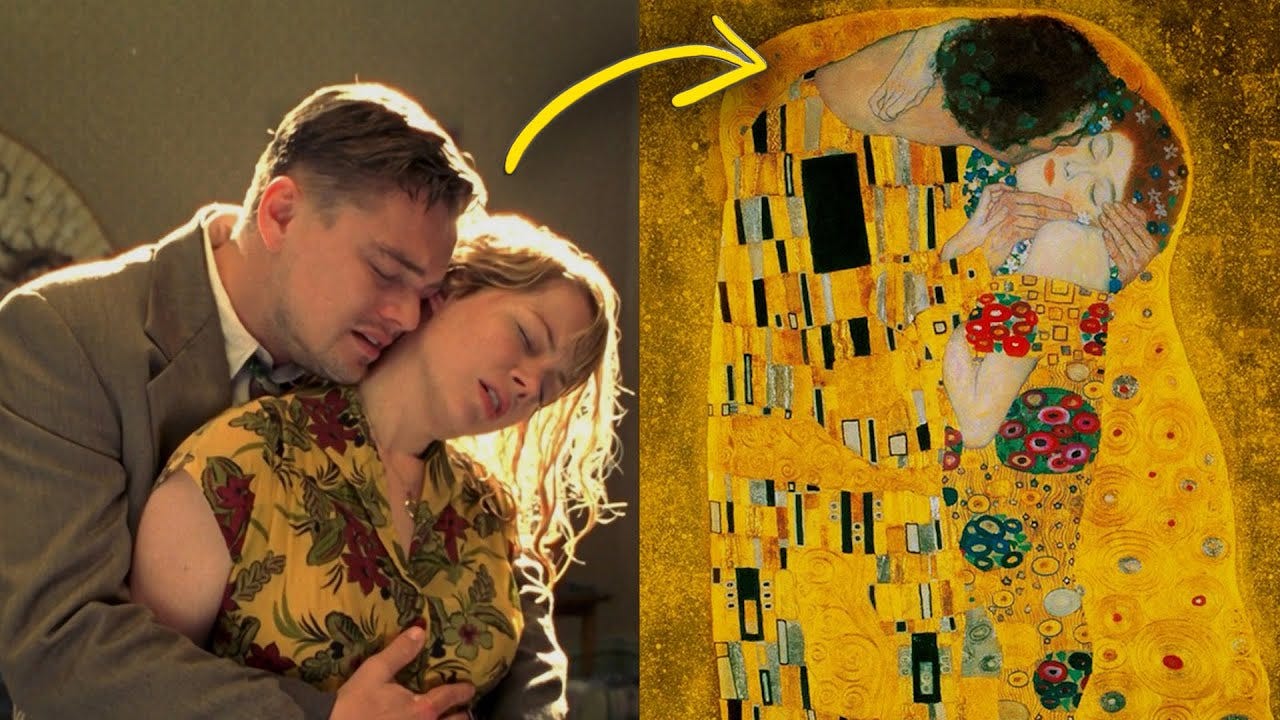
Some of the very first films ever made, back in the 1890s, were built around famous paintings: a well-known canvas chosen as the starting point, then staged with actors and costumes and brought to life in motion. One French battle painting, Les Dernières Cartouches, was restaged as a film by Lumière, by Méliès, and by Pathé, all within a few years of each other.
Before cinema knew how to tell a story, all it wanted was to make a painting move.
That instinct never left, and the word itself explains why: “Cinema” comes from the Greek kinema, meaning “movement”, and motion is the one thing film had that painting never did.
More than a century on, directors are still drawing on art history, and far more often than you would ever guess. Once you learn how to look, you start seeing it everywhere: a shot that lingers a beat too long, a face arranged just the way a painter arranged it centuries ago, a whole scene that feels older than the film around it. Sometimes it’s a bow to a master the director loves. Sometimes it’s outright theft, assuming no one will notice. And every so often a director loves a painting so much that they build the entire film around it.
The first film critics, watching those flickering images move, sensed where it had all come from and reached for the only words that fit: they called cinema “painting in motion.” They had no idea how right they were…
What follows are 10 films that did it best, set beside the paintings and sculptures hiding inside them.
REMINDER: Beauty is Truth is entirely reader-funded. There are no ads here, only independent writing devoted to celebrating beauty. And it can only continue with your help.
If you’ve been thinking about supporting my work, becoming a paid subscriber is the most meaningful way to do it:
With the new annual subscription discount, it costs less than a coffee a month, and it is what keeps all of this going.
Gift subscriptions to Beauty is Truth are now available too:
1. The Painting That Became a Movie
Most films borrow a painting for a scene. This one owes a painting its entire existence.
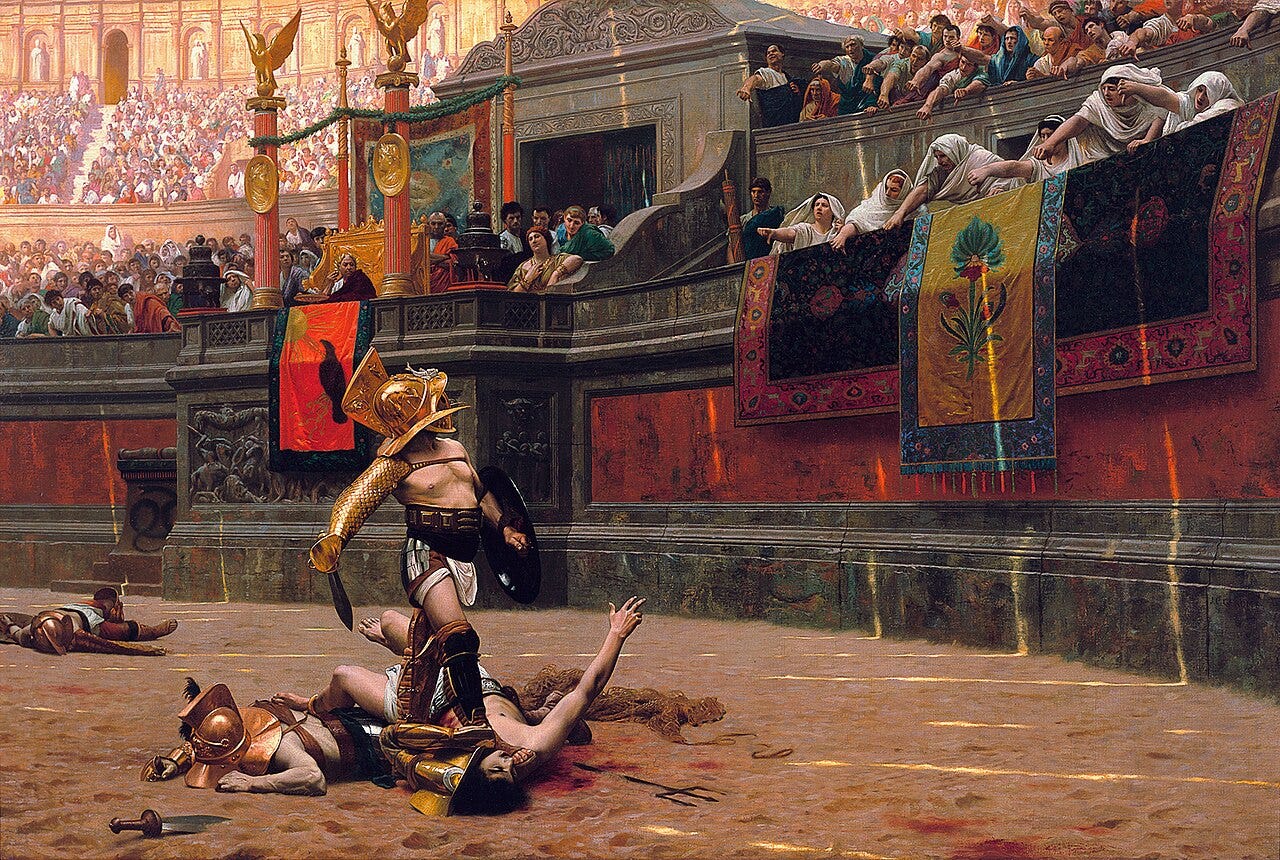
When DreamWorks wanted Ridley Scott to direct their Roman epic, they didn’t hand him a script... they handed him a picture: Jean-Léon Gérôme’s Pollice Verso, painted in 1872, in which a victorious gladiator stands over his fallen opponent and looks up at a roaring crowd, waiting to be told whether to kill him.
According to Russell Crowe, Scott took one look and said:
No matter what is in the script, I want to make this movie.
The painting was the pitch, and it worked.
You can feel Gérôme in nearly every frame of the Colosseum. The dust, the height of the stands, the emperor in his box, the terrible intimacy of a crowd deciding a man’s death for sport, all of it is lifted from that one canvas. Even the film’s most famous gesture comes from the painting’s title. Pollice verso is Latin for “with a turned thumb,” and the Romans believed the thumb, the pollex, took its name from polleo, “to have power”: the one finger that held a life in its balance, and could tip it either way.
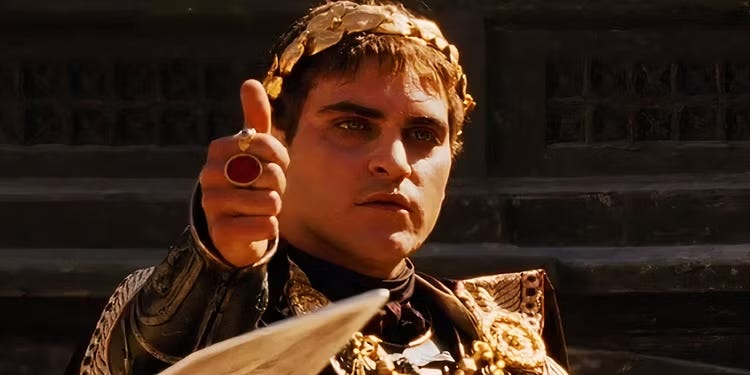
There is a small twist though. Gérôme painted the crowd’s thumbs pointing down, the signal for death. In the Gladiator, when the moment finally comes for Maximus, the emperor Commodus must grudgingly turn his thumb up to spare him, bending to the very crowd whose bloodlust the painting had captured a century before.
2. A Painting About Love, Used for the Opposite
In Shutter Island, Leonardo DiCaprio’s tormented Marshal keeps dreaming of his dead wife, Dolores. In the film’s most beautiful and unbearable moment, he holds her from behind in a wash of warm golden light, her flowered yellow dress glowing against the dark, the two of them merged into a single shimmering shape.
Anyone who has seen Gustav Klimt’s The Kiss knows where this image came from: it’s the same embrace, the same gold, the same flowers, and the same two bodies dissolving into one.
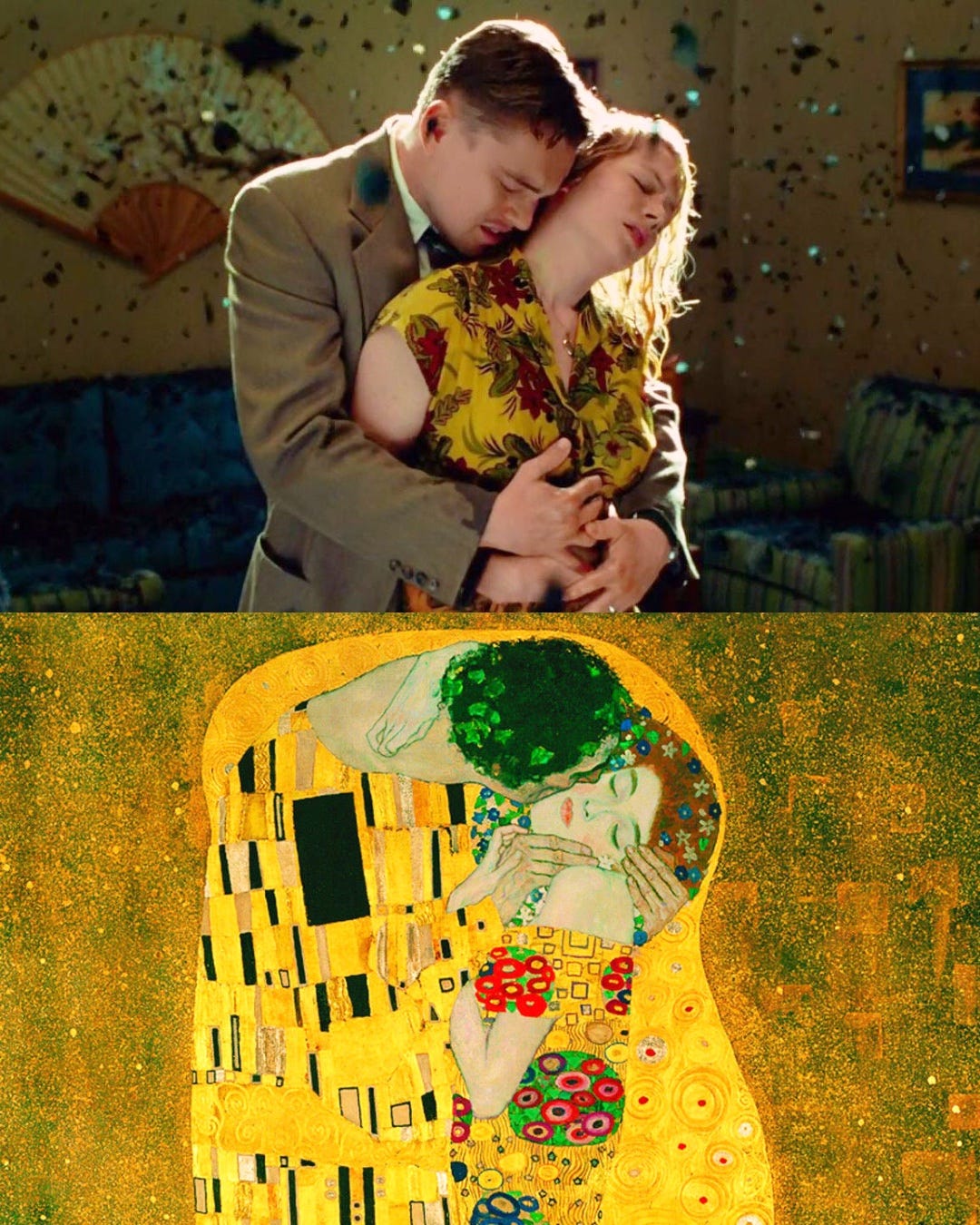
It is the most famous painting of romantic love ever made, and Klimt built its shimmer from real gold leaf, inspired by the Byzantine mosaics he had seen in Ravenna.
But Scorsese does something devastating with it. In Klimt, the gold means love made eternal. Here, as the Marshal holds his wife in that same golden glow, she crumbles to ash in his arms, because the embrace is not a memory but something his mind has built to survive a grief he cannot face…
The resemblance has never been officially confirmed, but between the pose, the gold, and that yellow dress, it is almost impossible to see as an accident.
3. They Rebuilt the Loneliest Painting in America
Some directors nod to a painting. Herbert Ross literally reconstructed one, and had his actors climb inside it…
Pennies from Heaven is a Depression-era musical, and at one point Steve Martin and Bernadette Peters step into a late-night diner that any American will recognize instantly: the green-walled corner café, the wraparound glass, the two customers and the lone figure with his back to us, all bathed in that cold electric glow.
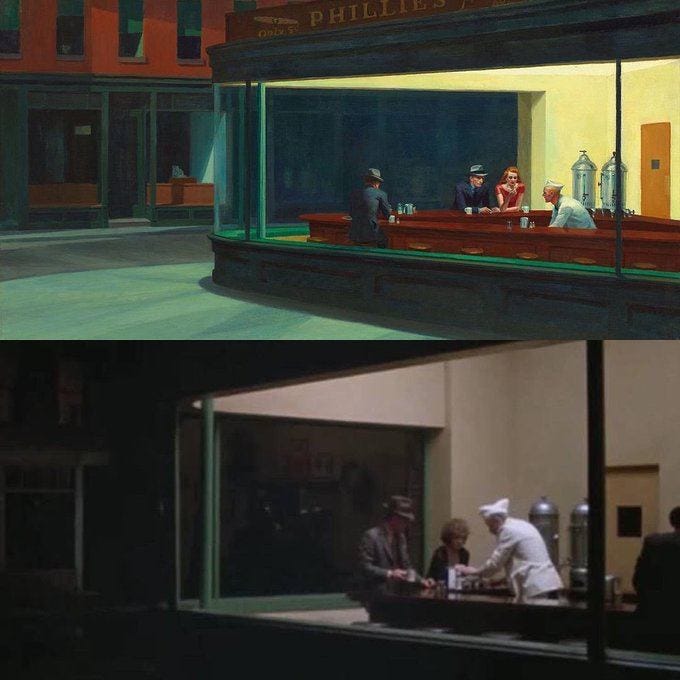
It is Edward Hopper’s Nighthawks, the most famous painting of loneliness ever made, rebuilt as a set. The production designer, Ken Adam, said that Ross “was very much influenced by the paintings of Edward Hopper,” and folded them straight into his designs. Shot by the great Gordon Willis, the tableau is close enough to make you do a double take.
And here’s the thing that makes the choice perfect: Hopper’s diner is a painting about people sitting inches apart and utterly alone, and that is exactly what this film is beneath its song and dance.
4. The Most Famous Horror Image Ever Made Was a Surrealist Painting
If you have never seen The Exorcist, you have still seen the image below.
A priest steps from a cab and stands at a garden gate at night, a single streetlamp glowing through the mist while an unearthly light pours from an upstairs window. It became the film’s poster, and one of the most recognizable images in cinema. But its author is not the director William Friedkin. It is the Belgian Surrealist René Magritte.
Friedkin was completely open about it. The scene came from Magritte’s The Empire of Light, a series of paintings showing a house on a darkened street lit by one lamp, beneath a sky that is, impossibly, broad daylight.
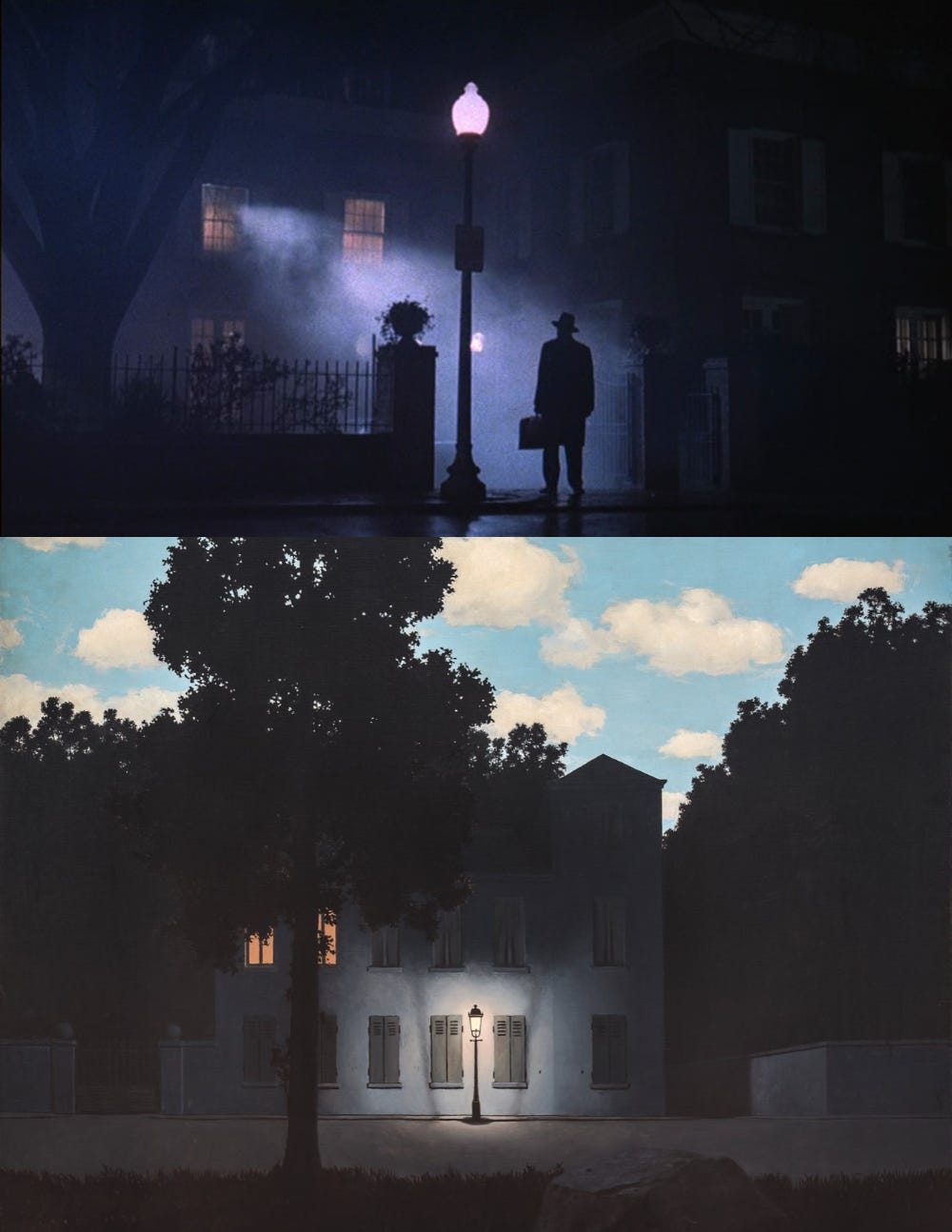
As Friedkin recalled:
I saw it in the Museum of Modern Art in New York. I chose the house to match the Magritte painting, the streetlamp, the shaft of light.
He spent an entire day lighting that single shot and filmed it on the second night, chasing the exact uncanny glow the painter had found.
What makes the borrowing so right is what Magritte’s painting is about: it puts two things that cannot coexist, day and night, in the same frame, and the result is a scene your eye accepts and your mind refuses. That is precisely the feeling Friedkin needed at the threshold of that house, where something impossible is happening in an ordinary suburban bedroom. He borrowed a painting about the collision of two worlds to mark the door where two worlds were about to collide…
5. The Man Who Climbed Into the Sky
Magritte turns up twice in this piece, and that is no accident. No painter ever understood better how to make an ordinary world feel slightly wrong, which is exactly the sensation The Truman Show is built on.
Truman Burbank has spent his whole life inside a television set without knowing it, the star of a show he never agreed to be in. At the end, having finally understood, he sails his little boat across his fake ocean until the bow strikes the wall of the world, a blue dome with clouds on it. He finds a staircase, climbs it, and stands at a door cut into the sky. That final image is Magritte’s Architecture au clair de lune: a staircase set impossibly against the open sky.
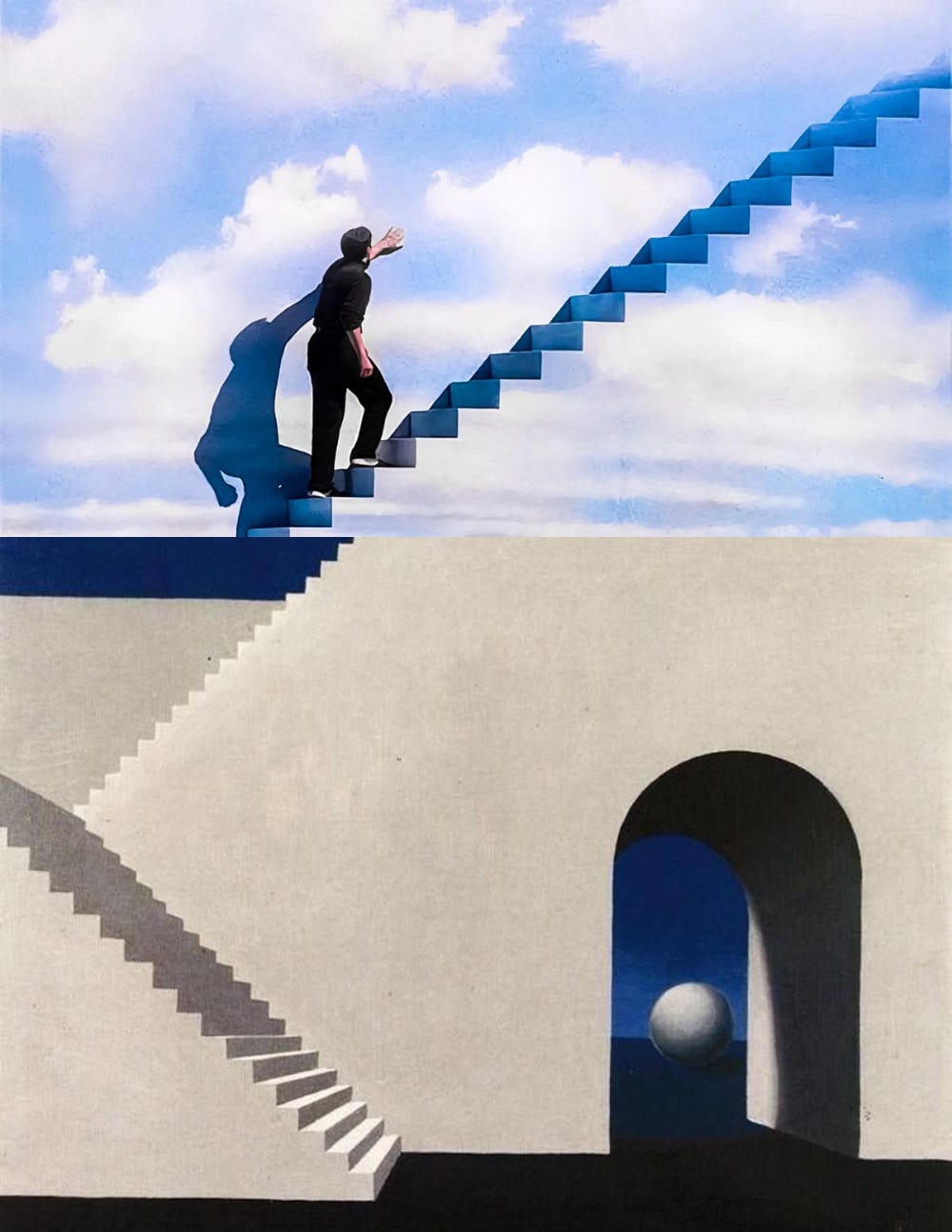
Unlike the Exorcist scene, Peter Weir never confirmed the reference, but it is hard to imagine a more fitting source. Magritte spent his career painting a reality that looks normal until you notice it cannot be real: doors that open onto nothing and skies that behave like walls. That is Truman’s entire life. So when he climbs those steps and reaches for the door in the sky, he is, in a sense, stepping out of a Magritte, out of the beautiful lie, and into whatever waits on the other side.
6. A Circle of Men Going Nowhere
In A Clockwork Orange, Kubrick’s ultra-violent delinquent Alex is sent to prison, and there is a shot of the inmates taking their daily exercise: a line of men in uniforms trudging in a slow, endless circle around a high-walled yard, heads down, going nowhere. It is composed almost exactly like Vincent van Gogh’s Prisoners’ Round, a canvas of prisoners shuffling in that same hopeless ring. And with Kubrick, almost nothing is accidental. In a 1982 interview, Jack Nicholson said of working with him:
He gives new meaning to the word meticulous.
A man that exact did not stumble into a van Gogh by chance.
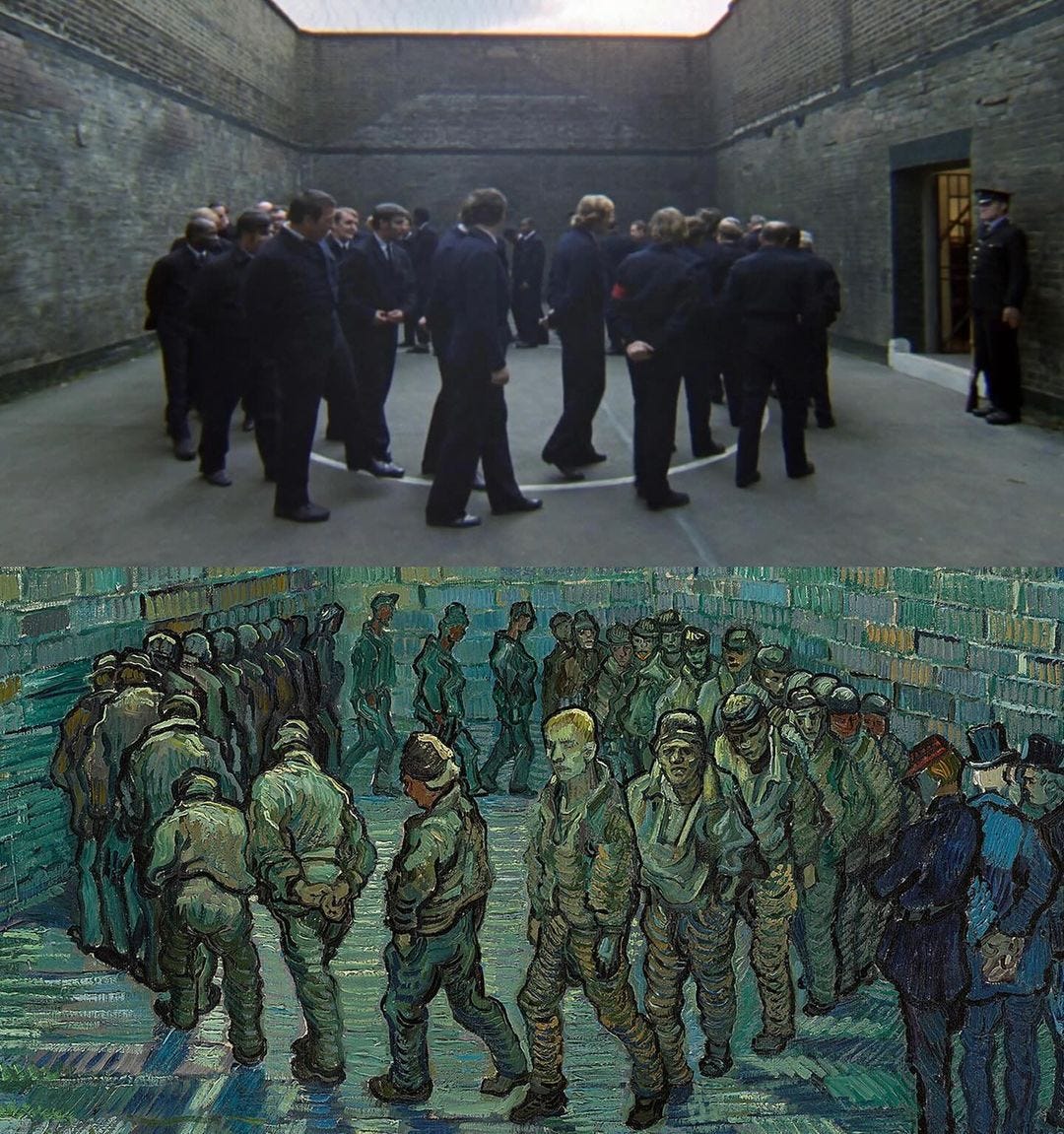
Vincent made it in 1890, during his confinement in the asylum at Saint-Rémy, when he was too unwell to go outside and paint the world, and desperate to be let out. Trapped indoors, he copied an old engraving of a London prison yard, and everyone who has looked closely believes he put himself into it: one prisoner near the front, capless, face turned toward us, is thought to wear van Gogh’s own features. He was a man locked away, painting a picture of men locked away, and slipping his own face into the crowd.
7. The Statue That Steps Off Her Pedestal
Every film so far has borrowed a painting. This one borrows a sculpture, and it does it with almost nothing but a black background and a pair of gloves…
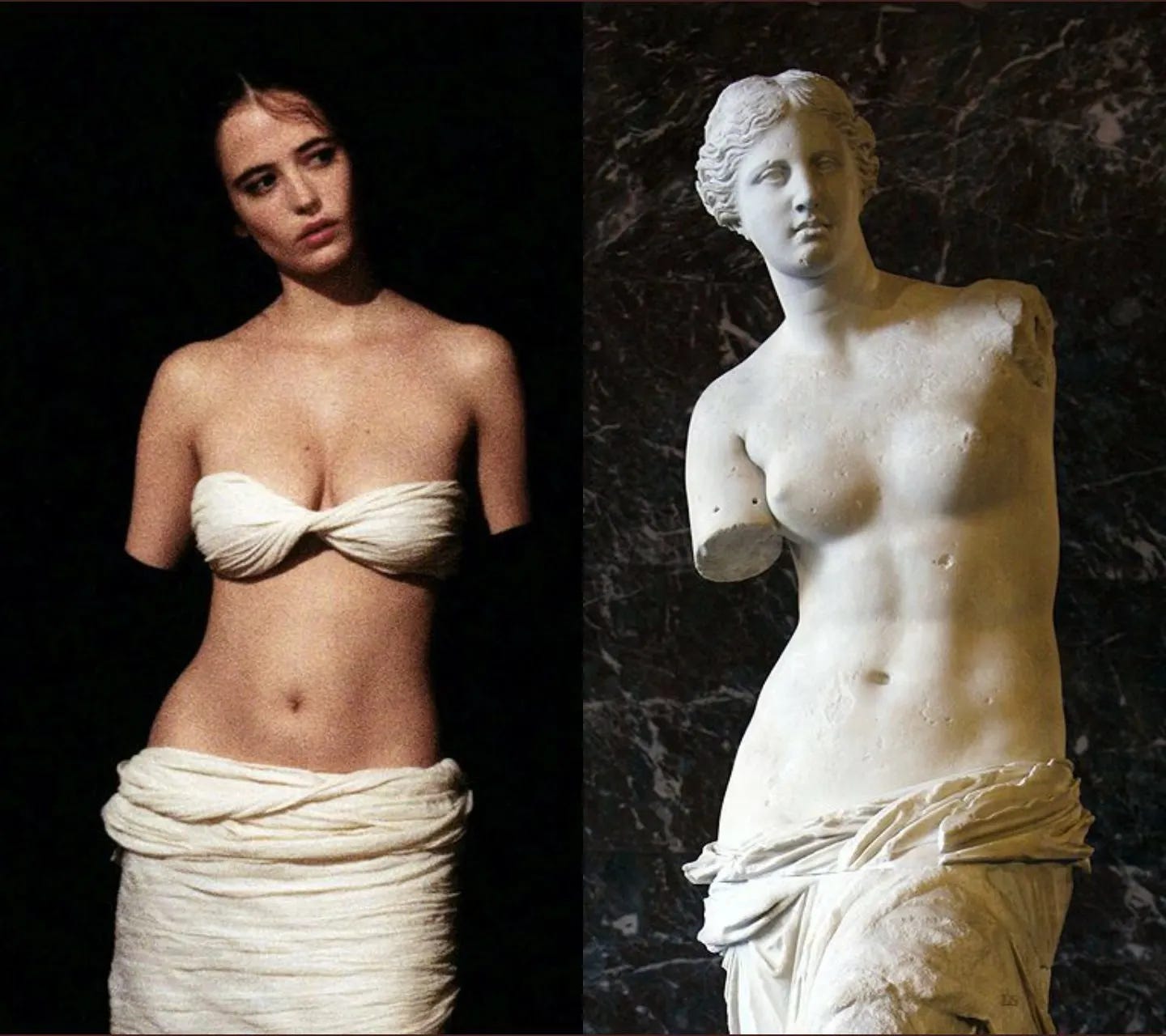
In Bernardo Bertolucci’s The Dreamers, set among three young cinephiles in Paris in 1968, there is a moment when Isabelle, played by Eva Green in her very first film role, walks into a dark room wearing a sheet knotted at her waist and long black opera gloves that reach past the elbow. Behind her, everything is black. Her bare arms disappear into the darkness, and for a second she is not a young woman at all but the Venus de Milo: the famous Greek marble in the Louvre, missing both her arms.
Matthew, the American who has fallen for Isabelle, looks at her and says:
I’ve always wanted to make love to the Venus de Milo.
The clever part is how simple it is: there are no special effects, just light, a black backdrop, and two black gloves. Out of them Bertolucci conjures one of the most recognizable sculptures in the world.
8. Ophelia, Waiting for the End of the World
You might remember this painting from last week’s article on the Pre-Raphaelites. Here it is again, floating into a film about the end of everything.
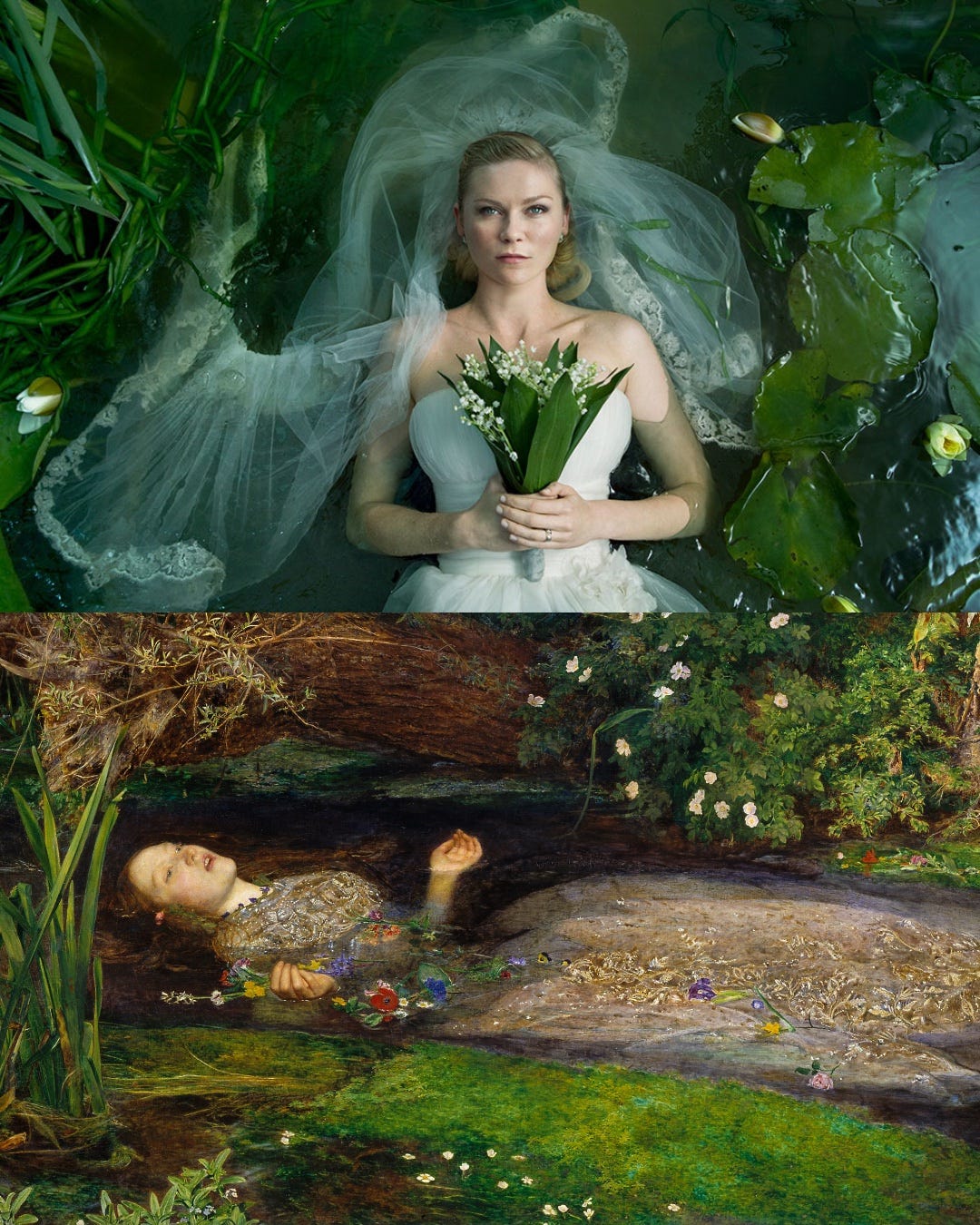
Melancholia opens with one of the most beautiful sequences in modern cinema: eight minutes of dreamlike, slow-motion images set to Wagner, previewing everything the film is about to do to you. In one of them, Kirsten Dunst drifts down a dark stream in her wedding dress, pale and serene, with flowers in her hands. It is John Everett Millais’s Ophelia brought to life, the masterpiece of Shakespeare’s drowned girl, recreated so faithfully that von Trier used the image on the film’s poster.
The movie is about depression, an illness director Lars von Trier knows firsthand, and it ends with a planet colliding with the Earth and destroying all life. Millais painted a young woman singing as the water closes over her, meeting death with an eerie, dreadful calm. That is exactly the state von Trier gives his heroine: as the world races toward annihilation, she is the only one not afraid, floating toward the end with the same terrible serenity as Ophelia going under.
He borrowed a Victorian painting of one girl’s death and used it to foretell the death of everything…
9. The Angel With the Tear
Alexandre Cabanel painted the most beautiful gaze in the history of art, and it may be where George Lucas found the birth of Darth Vader.
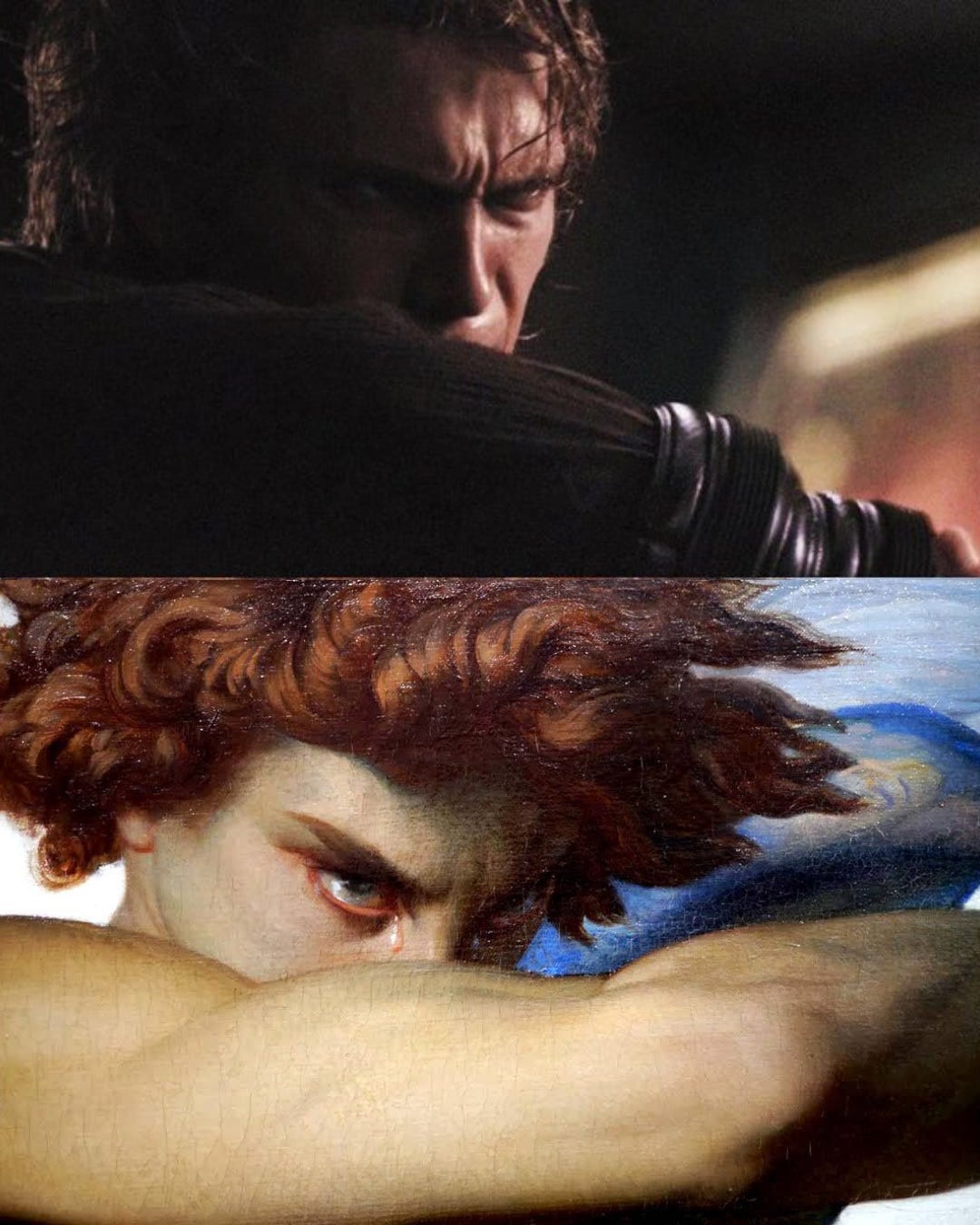
Cabanel’s The Fallen Angel, made in 1847, shows Lucifer moments after his fall from heaven. A gorgeous, muscular angel, his face half-buried behind his arm, and above it a single eye glares out at us. A tear trembles just below it, about to fall, but it is not a tear of repentance. The look is grief and fury and wounded pride all at once, the face of someone who has lost everything and blames the one who cast him out.
Revenge of the Sith is the story of Anakin Skywalker’s fall, and it is impossible to watch Cabanel’s artwork without seeing the similarities. Lucas never confirmed the connection, but the two stories rhyme: both are gifted beings who fall not through simple wickedness but through pride. Anakin is Milton’s Lucifer in another costume, the chosen one who reaches for forbidden power and, in grasping it, destroys the very thing he was trying to save. Cabanel painted that fall in 1847, drawing on Paradise Lost, a long time before a galaxy far, far away gave it a black helmet and a new name.
10. Walking Into the Painting
In Dreams, Akira Kurosawa filmed eight of his own dreams, and the most astonishing is called “Crows.” A young painter stands in a gallery, studying the canvases of Vincent van Gogh. He leans close to one, and then he is simply there, inside it, walking through van Gogh’s world. He wanders from one painting into the next, until he finds the artist himself at his easel in a field, straw hat, bandaged ear, played, in a detail almost too good to be true, by Martin Scorsese.
Van Gogh disappears down a path through a golden wheatfield, a flock of black crows explodes into the sky, and we recognize it: Wheatfield with Crows, one of the last things van Gogh ever painted, made in the weeks before he walked into a field much like this one and shot himself.
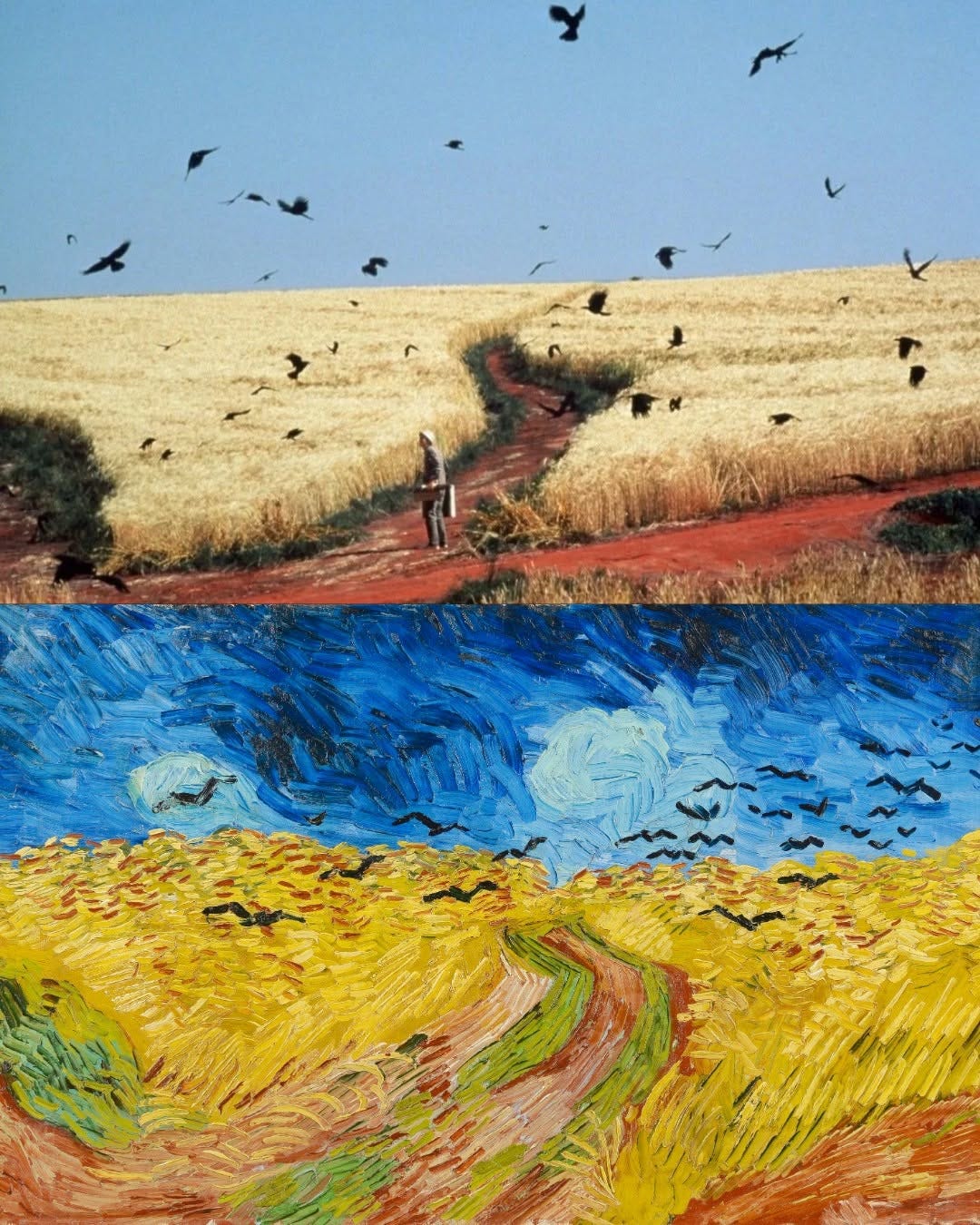
The dreamer stops before the finished canvas and takes off his hat. And I cannot think of a better image to end on than that one: a man loved a painting so much that he climbed inside it, walked through it, followed its maker to the edge of his own death, and came out changed.
Vincent van Gogh sold almost nothing during his life and died sure he had failed. But he once wrote down the only thing he ever wanted from his work:
I want to touch people with my art. I want them to say, he feels deeply, he feels tenderly.
He has been gone more than a century. And still, every time a director builds one of his paintings again on the screen, and every time your throat tightens at an image and you can’t say why, his wish is coming true, one stranger at a time. Maybe that is the only kind of forever any of us get in this life. Not to last, but to make one true thing, and have someone we will never meet lean in, years later, and whisper back: “Yes. Me too.”
Thanks for reading. Everything here, the research, the writing, all of it, is made by one person, with no team and no company behind it, and no ads or sponsors influencing a single word. That independence is only possible because of my readers. If these pieces mean something to you, please consider becoming a paid subscriber for a few dollars a month, and unlock the full archive:
Every subscription genuinely makes a difference.
Thank you for helping keep this work alive.
What a tremendously informative article. I know more than half of those films quite well and had no notion of their link to the fine arts.
What a wonderful study of both special art and good movies--I had never thought of any of this!