


A thing of beauty is a joy for ever.
So begins one of the most famous poems in the English language, written by John Keats, who died at twenty-five and became a kind of patron saint to a group of young painters who would take those words as something close to a religion.
They called themselves the Pre-Raphaelites, and for a few short years in Victorian England they took on one impossible task: make the most beautiful paintings the world had ever seen…
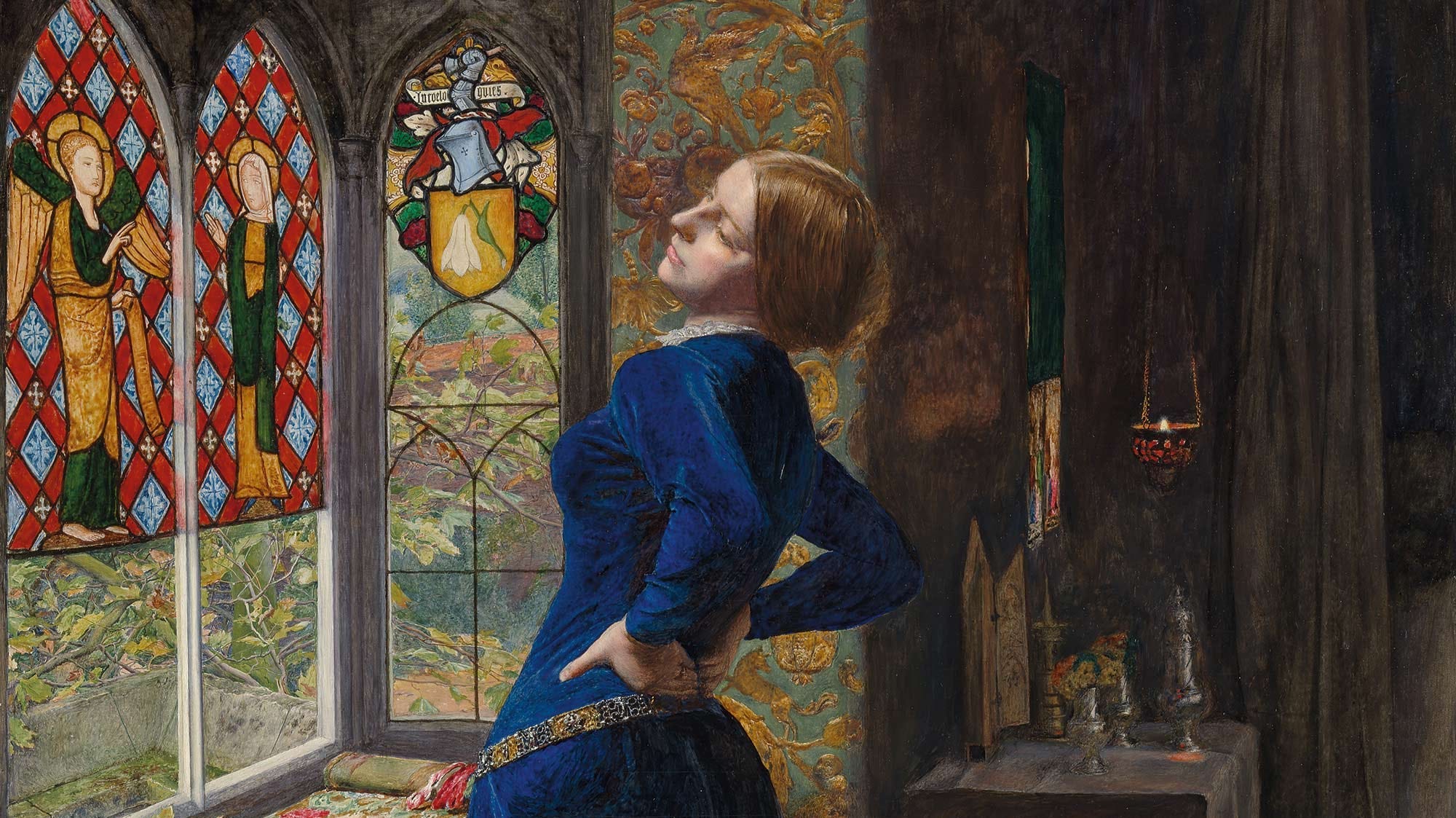
If you’ve ever scrolled past one of these and felt something in your chest, you already know what they were after. The beauty hits you before you have time to think, and for most people it’s the only thing they ever notice.
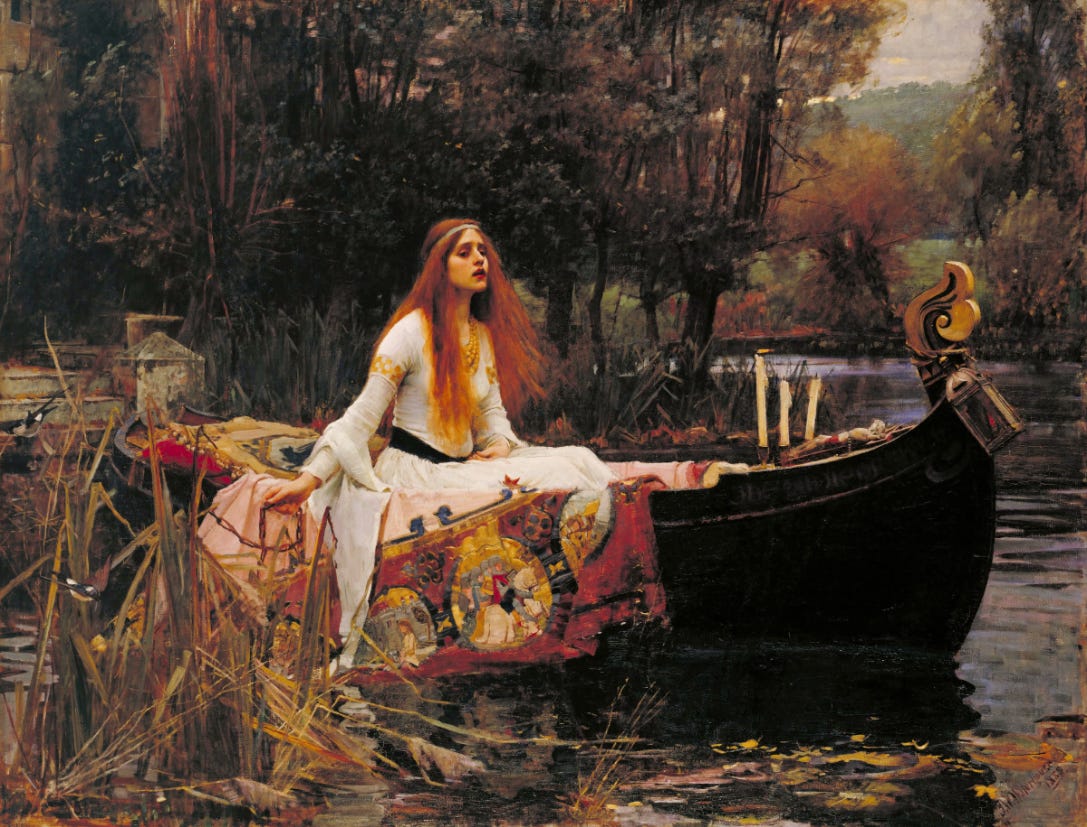
There’s an old word for this. Before “glamour” meant red carpets and magazine covers, it meant a magic spell, an enchantment cast over the eyes to make a thing appear lovelier than it really is. Look at the painting above and you fall under it. You take in the blue velvet dress and the stained-glass light, and you stop right there, enchanted, and miss what the painter buried in plain sight...
Because there is almost always something hidden: a doomed love, a secret grief, a guilt that never healed. These painters often took the worst things that ever happened to them and wove them inside the most beautiful things they could create, knowing it was the one place they stood a chance of surviving.
What follows are 7 of these paintings. Once you know what they are really about, you will never see them the same way. It was Keats, again, who put it best, in the line that gave my newsletter its name:
Beauty is truth, truth beauty, that is all ye know on earth, and all ye need to know.
He was right. It’s just that the truth beneath all that beauty is almost never the one you’d expect to find…
REMINDER: this is a teaser for my subscriber-only articles.
Beauty is Truth is a reader-funded publication. There are no ads here, only independent writing devoted to celebrating beauty.
If you’ve been thinking about supporting my work, becoming a paid subscriber is the most meaningful way to do it:
With the new annual subscription discount, it costs less than a coffee a month — and it’s what keeps all of this going. Gift subscriptions to Beauty is Truth are now available too:
1. The Painting That Predicted a Death
We begin with the most famous of them all, and the one that started everything.
You are looking at Ophelia, from Hamlet: the young woman who loses her mind after the man she loves murders her father, and drowns in a stream while singing and gathering flowers. John Everett Millais painted her in the instant before she goes under, her hands open, her lips still parted in song, her gown pulling her down.
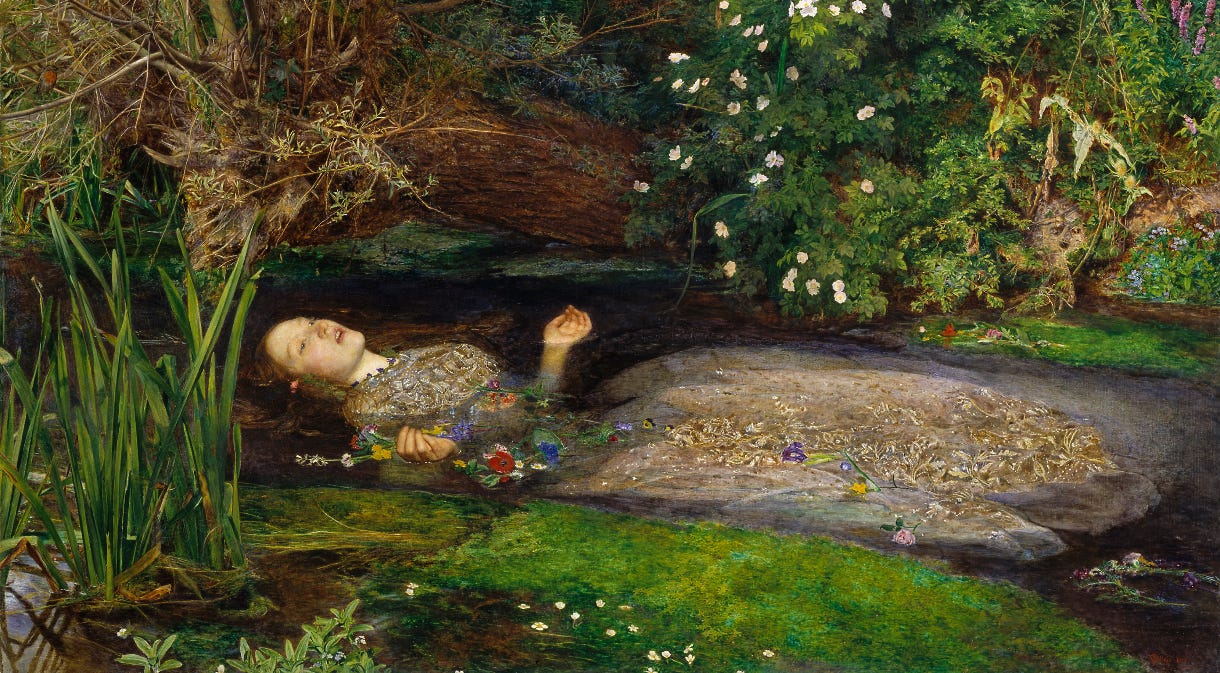
In the play, her death is almost a throwaway. It happens offstage, and the queen simply reports it afterward:
There is a willow grows aslant a brook... When down her weedy trophies and herself fell in the weeping brook.
A few more lines, and the story moves on. Millais took that half-second and spent the better part of a year on it.
Every flower in the water is real, painted with the obsessive botanical precision the Pre-Raphaelites were famous for, and almost every one carries a hidden meaning. The pansies floating on her dress stood for love in vain. The violets around her neck meant faithfulness. The daisy near her hand, innocence. The weeping willow leaning over her was the old symbol of forsaken love. And bright against her gown, one red poppy: the flower of sleep and death, which Shakespeare never mentioned, and which Millais added himself. He built the whole tragedy into the foliage, in a language his Victorian viewers could read like text, and which we drift right past today.
To get the water right, Millais did something extraordinary: he painted the river first, outdoors, on the banks of a stream in Surrey, sitting there for five months, recording every leaf and reed. Then, through the following winter, he painted the girl. Her name was Elizabeth Siddal. She was twenty-two, discovered working in a hat shop, and she would become the great tragic figure of this whole story.
To pose as the drowning Ophelia, Siddal lay for hours in a bathtub of water in Millais’s studio, wearing an antique silver gown he had bought for the purpose. It was winter, so he set oil lamps beneath the tub to keep the water warm. One day, absorbed in his work, Millais did not notice that the lamps had gone out. Siddal, the perfect model, said nothing and did not move, and lay there in the freezing water until the session ended. She caught a severe cold that turned to pneumonia.
She recovered, but never fully, and she never posed for Millais again. And here is the detail that turns this painting into something almost unbearable to look at: ten years later Elizabeth Siddal died of an overdose of laudanum, the opium drug that Victorians took by the spoonful. She was thirty-two.
Look again at that single red poppy Millais slipped into the picture, the flower that has always meant both sleep and death, and that opium is made from.
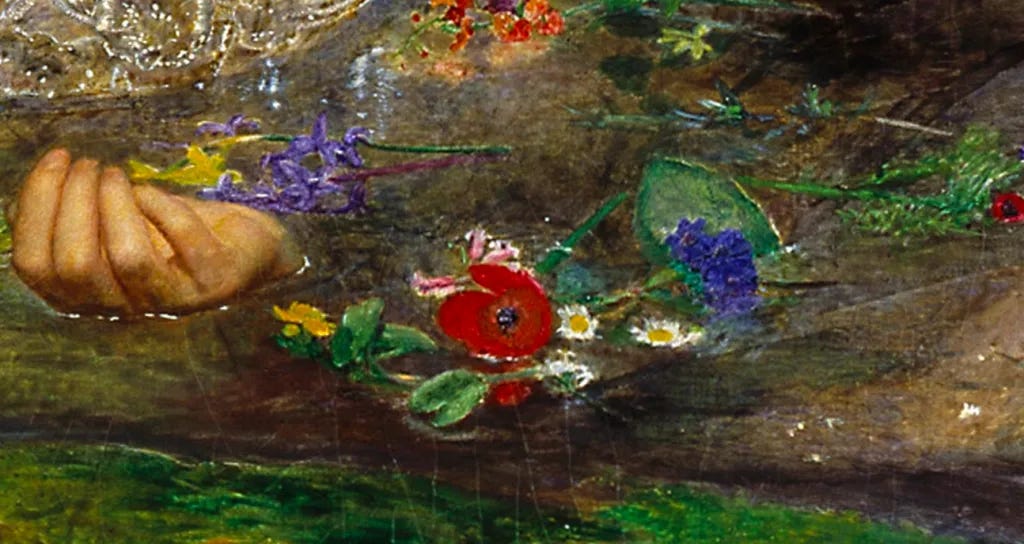
He painted a beautiful young woman playing a girl who drowns. He could not have known he was also painting her fate.
Some paintings do not stay inside their frames…
2. The Second Her Conscience Woke
At first glance, this is a pleasant domestic scene. A young couple at a piano in a sunlit sitting room, mid-song. That is exactly what most Victorians saw, and what the painter wanted them to see first, so that the truth would land harder when they finally noticed it…
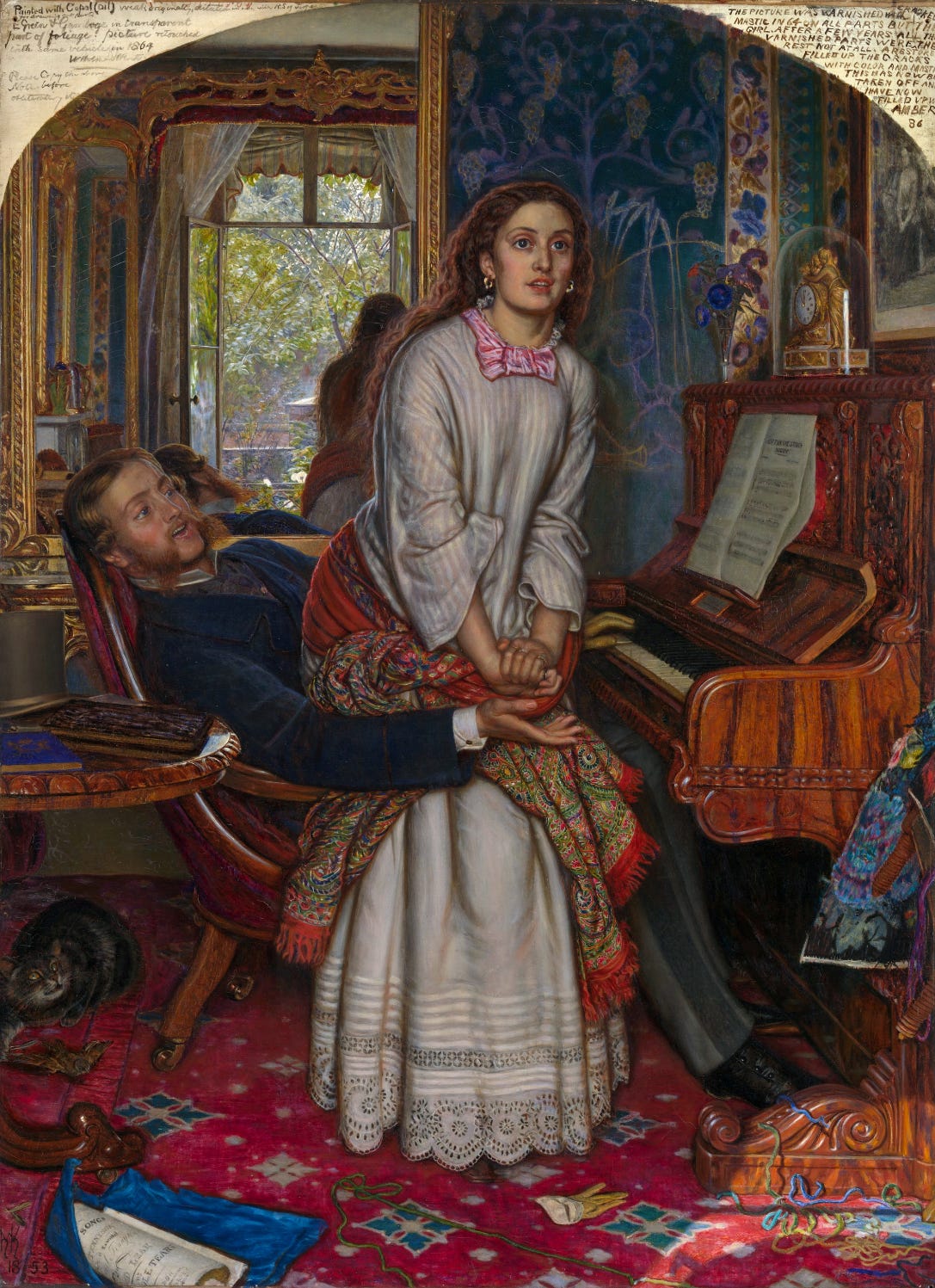
They are not married. She is his mistress, kept in this gaudy little room, and the painting captures one precise instant: the moment her conscience wakes. A phrase in the song they are singing has struck her, and she is rising off his lap, mid-thought, staring out the window at a purer life she has suddenly remembered she could still choose. He hasn’t noticed. He is still playing.
The painter was William Holman Hunt, and it helps to know who he was. In 1848, three young men in London, Hunt, Millais, and Dante Gabriel Rossetti, formed a secret society they called the Pre-Raphaelite Brotherhood. The name was a rejection: they thought art had gone soft and artificial ever since Raphael, and they wanted to go back past him, to a time when painting was truthful, detailed, and sincere. So they painted from nature, obsessively, and packed their canvases with meaning. All three men appear in this article, and Hunt was the most fiercely moral of them. He believed a painting should be read like scripture.
So he filled this room with clues for anyone patient enough to look. Under the table, a cat toys with a broken-winged bird, exactly what this man is doing to this woman. On the floor lies a tangled skein of yarn, the web she is caught in. A single glove has been thrown down, a warning of the fate of a discarded mistress...
But the key to the whole thing is behind her, in the mirror. It reflects what she is looking at: the open window, the green garden, the light. She has spent her life with her back to it. And Hunt has caught her in the one second she turns around, when a woman the world had written off decides she might still be saved.
3. What Is Worth Dying For?
Here is one of the most beloved paintings in Britain:
And almost no one who loves it knows what she is actually doing, or what it cost her…