


Two thousand years ago, in the Metamorphoses, Ovid told the story of a sculptor, Pygmalion, who fell in love with the woman he had carved. He did not dare ask the gods to bring her to life. He only prayed, at the altar of Venus, for a wife like his ivory girl. And Venus, understanding what he truly wanted, granted it:
The ivory grew soft to his touch and, its hardness vanishing, gave and yielded beneath his fingers.
It is the oldest daydream in the history of art, and every sculptor since has been chasing it in one form or another. But Ovid needed a goddess to pull it off. The artists we are about to meet had only a chisel and years of their lives to devote to their craft.
And it is worth understanding what they were up against. Marble is a metamorphic rock, born under crushing pressure deep in the earth. It is heavy, cold, and brittle, and it does not forgive: cut too deep, and years of work fall to the floor in pieces. Everything it is by nature, hard, rigid, unyielding, is the exact opposite of what these sculptors demanded it become. Skin. Water. Cloth so fine you could pinch it between your fingers…
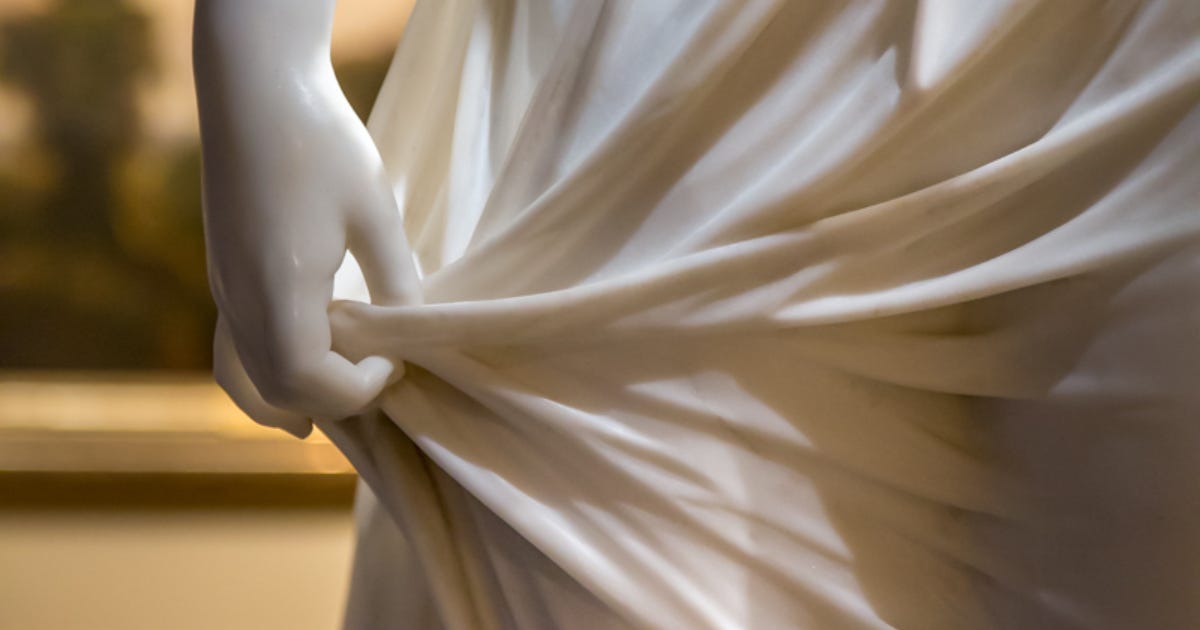
There is a word for what happens when the illusion holds. We say we are fascinated, and we have forgotten how strong that word once was. It comes from the Latin fascinare: to bewitch, to cast a spell, to hold a person motionless with nothing but a look.
What follows are 5 sculptures that do this to everyone who sees them. And knowing the truth does not help. You can be told, plainly, that all of it came out of a single block of stone. You will understand the words, but you will still not believe them…
REMINDER: Beauty is Truth is entirely reader-funded. There are no ads here, only independent writing devoted to celebrating beauty. And it can only continue with your help.
If you’ve been thinking about supporting my work, becoming a paid subscriber is the most meaningful way to do it:
With the new annual subscription discount, it costs less than a coffee a month, and it is what keeps all of this going.
Gift subscriptions to Beauty is Truth are now available too:
1. The Veil That Isn’t There
We begin with a bust that has been astonishing people for nearly two centuries, and that almost nobody gets to see anymore…
It is called The Veiled Virgin, carved in Rome in the early 1850s by the Milanese sculptor Giovanni Strazza. The Virgin Mary is shown with her eyes closed, her head bowed in prayer. And over her face lies a veil.
Except there is no veil. There is only marble.
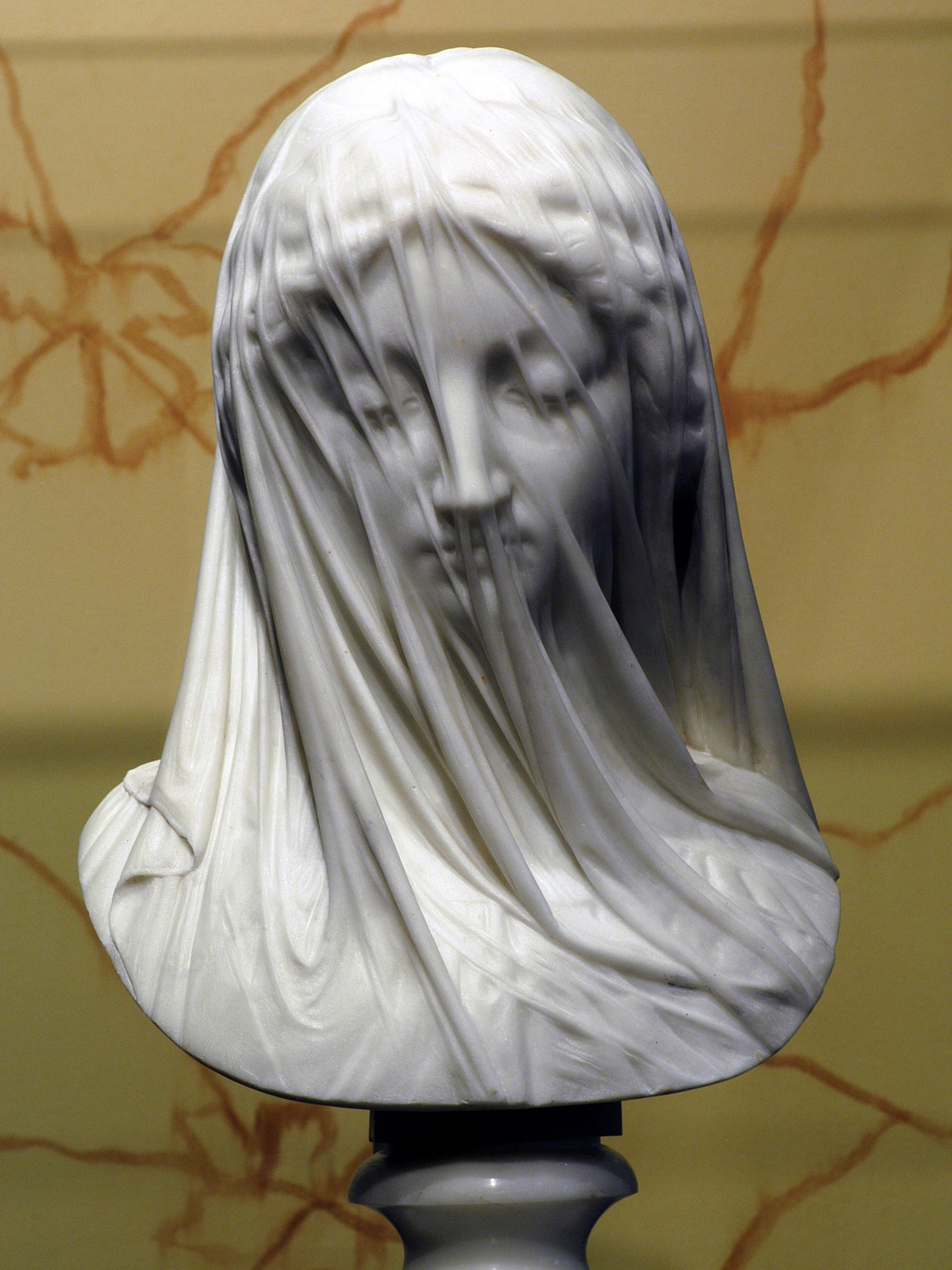
Strazza carved the cloth and the face beneath it out of the same block, and somehow the veil appears transparent. You can see her closed eyelids through it. You can see the line of her nose, her lips, the plait of her hair. The fabric clings, gathers, and falls in folds so fine that the eye simply gives up and accepts what it is being shown, that there must be a real veil there, laid over the stone, and that at any moment someone could lift it away.
When the statue arrived in St. John’s, Newfoundland, in December 1856, Bishop John Thomas Mullock opened the crate from Rome and wrote a single line in his diary that says everything:
The face is veiled, and the figure and features are all seen. It is a perfect gem of art.
That is the whole miracle in one sentence.
There are other veiled busts scattered across Europe and North America, and Strazza was working in a tradition, veiled women were a favorite subject of Italian sculptors in his day. But none of the others come close to this one. And here is the strangest part of all: this masterpiece is not in Rome, or Florence, or the Vatican. In 1862 the bishop gave it away to a convent in Newfoundland, on the far edge of the North Atlantic, where it has remained ever since, in the care of the Presentation Sisters, not on public display, viewable only by appointment.
One of the most astonishing objects ever carved by human hands is sitting in a convent at the end of the world, behind a veil that does not exist…
2. A Woman Made of Water
A veil is one thing. Now watch what happens when a sculptor decides to carve water:
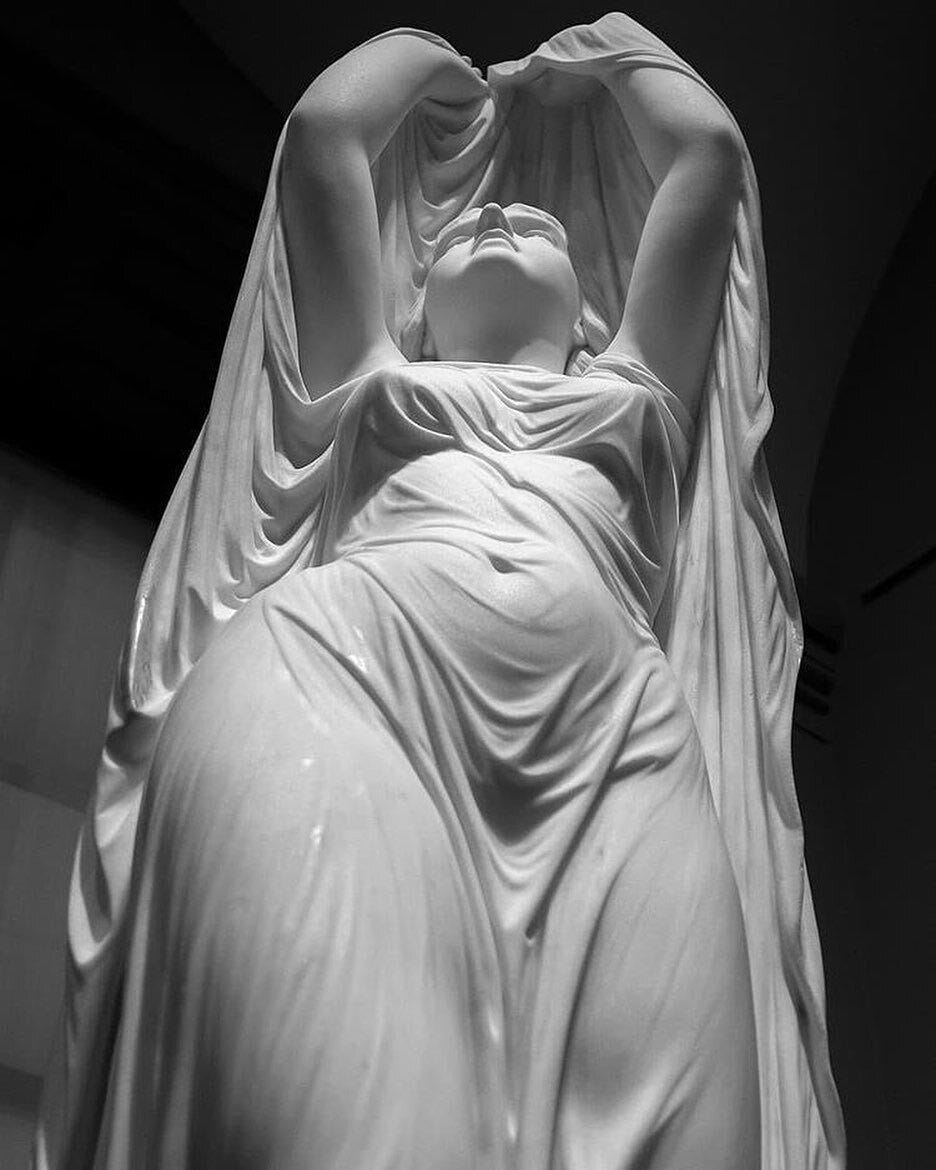
Her name is Undine, and she comes from a German novella of 1811 that half of Europe wept over. She is a water spirit, born without a soul, who can only gain one by being loved by a mortal man. So she marries a knight, and she gets her soul, and with it she gets everything a soul brings: love, grief, and the capacity to be destroyed. Then he betrays her. And the law of her own people is absolute, if her husband is unfaithful, she must be the one to kill him.
The American sculptor Chauncey Bradley Ives chose to carve the instant she rises out of the fountain.
In the book she appears “like a white column of water,” and that is precisely what he made: a woman ascending, wrapped head to foot in a veil that is soaking wet, water streaming off her, the fabric clinging to her body exactly the way real cloth clings when it is drenched.
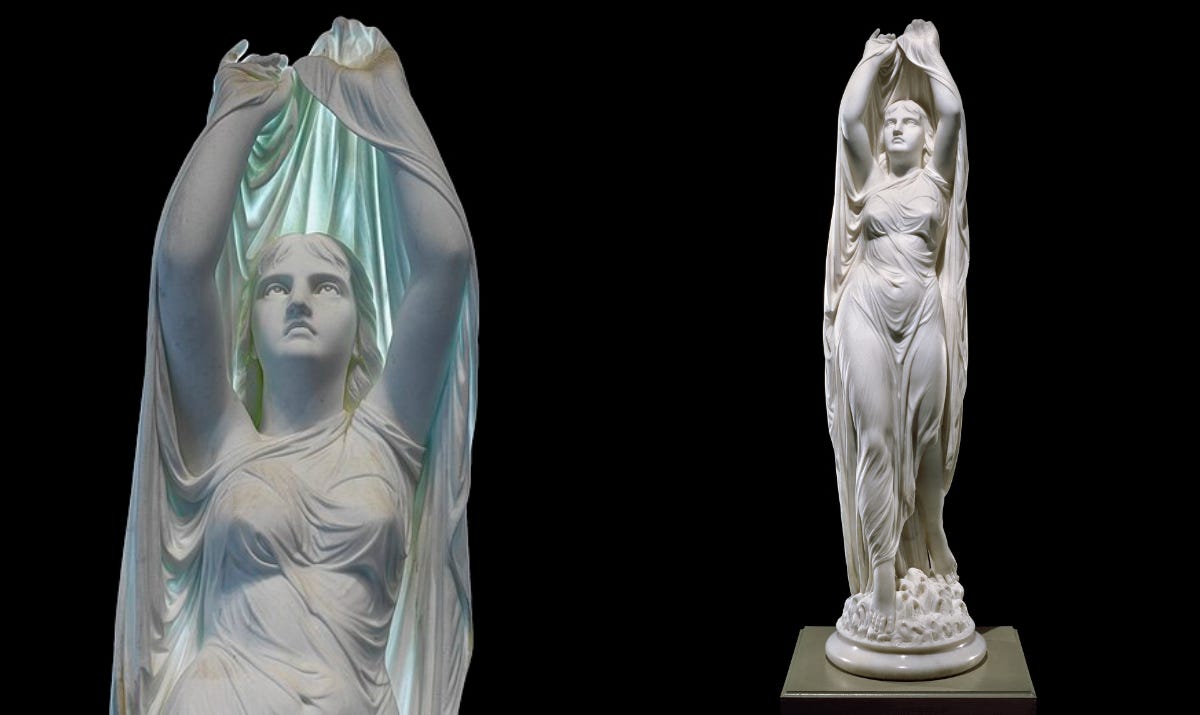
But look at her face. In nearly every other version of this story, Undine comes back vengeful, a woman returning to punish the man who wronged her. Ives saw it differently. His Undine is not angry. She is grieving. She rises through the water with her arms lifted and her face full of sorrow, on her way to kill the man she loves, because the law of her kind gives her no choice at all.
She kills him, in the end, with a kiss, weeping as she does it…
And so the wet marble was never just a show of skill. Ives carved a woman made of the same water that now demands she kill the love of her life. He built the tragedy directly into the material, and that is the difference between a clever trick and a masterpiece.
3. Carving the Wind
Cloth is difficult. Water is harder. But how do you carve something that has no shape at all?
The West Wind depicts a woman caught in a gust. Her drapery lifts and streams out behind her. She is up on her toes, half turned, her eyes fixed on something far off, and she looks as though the next breath of wind will take her off the ground entirely. Everything in her body says motion. Everything about the material says the opposite.
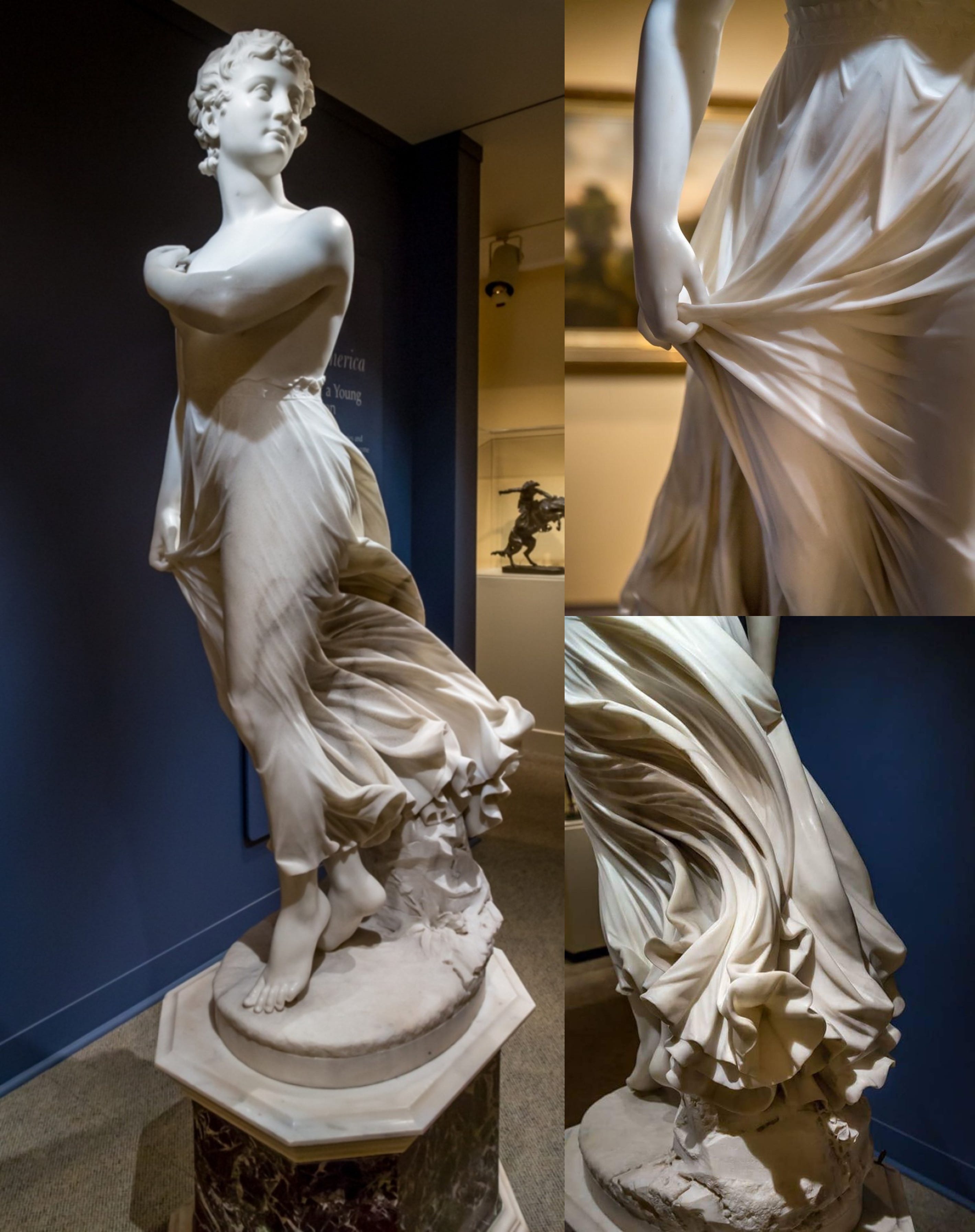
What Thomas Ridgeway Gould was actually attempting here is truly unique. The subject of this sculpture is not the woman. It is the wind, and wind has no substance, no edges, and no form. It cannot be carved. So he did the only thing a sculptor can do: he carved the effect of it, the hair thrown back, the fabric flying, the body leaning into it, and he did it so convincingly that you can feel the gust hitting her, in a room with no air moving at all.
The critics of the day were beside themselves. The Chicago Tribune, in 1871, described her as “erect, listening, just ready for flight, with hair and drapery floating in the air.”
There is one more thing, and it is my favorite detail in the piece. She is standing on tiptoe. Hundreds of pounds of solid marble, balanced on the ends of a woman’s toes, which is a physical impossibility, stone is heavy and brittle and would snap in an instant. So Gould cheated, beautifully. He carved the drapery so that it flies back and touches the rock behind her, and that whisper of trailing fabric is secretly holding up the entire statue.
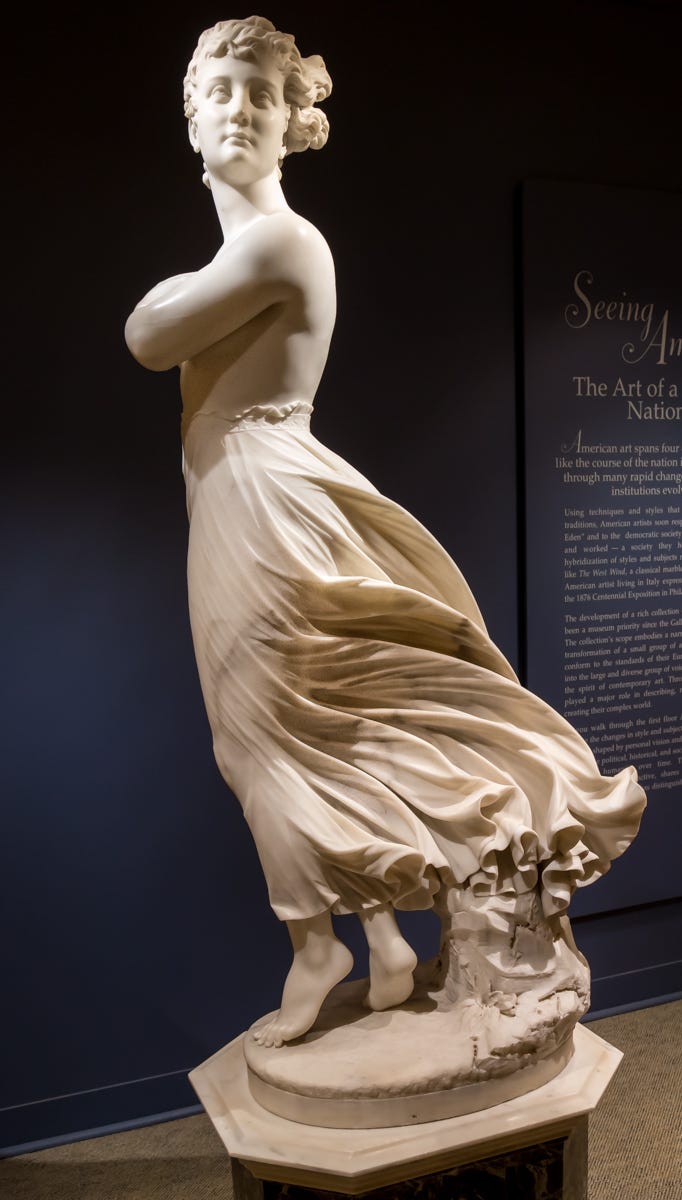
The thing that looks lightest in the whole sculpture, a piece of cloth caught in the breeze, is the thing bearing all the weight.
And the man who carved her sold fabric for a living. Gould was a Boston dry-goods merchant who had been modelling clay for years when the Civil War wiped out his business. It was the ruin that freed him. At forty-nine, with nothing left to lose, he moved his family to Florence, and the merchant who had spent his life measuring out bolts of cloth began carving it in marble.
4. The Man Dante Sent to Hell
Until now, the marble has been asked to be beautiful. Watch what happens when it is asked to horrify…
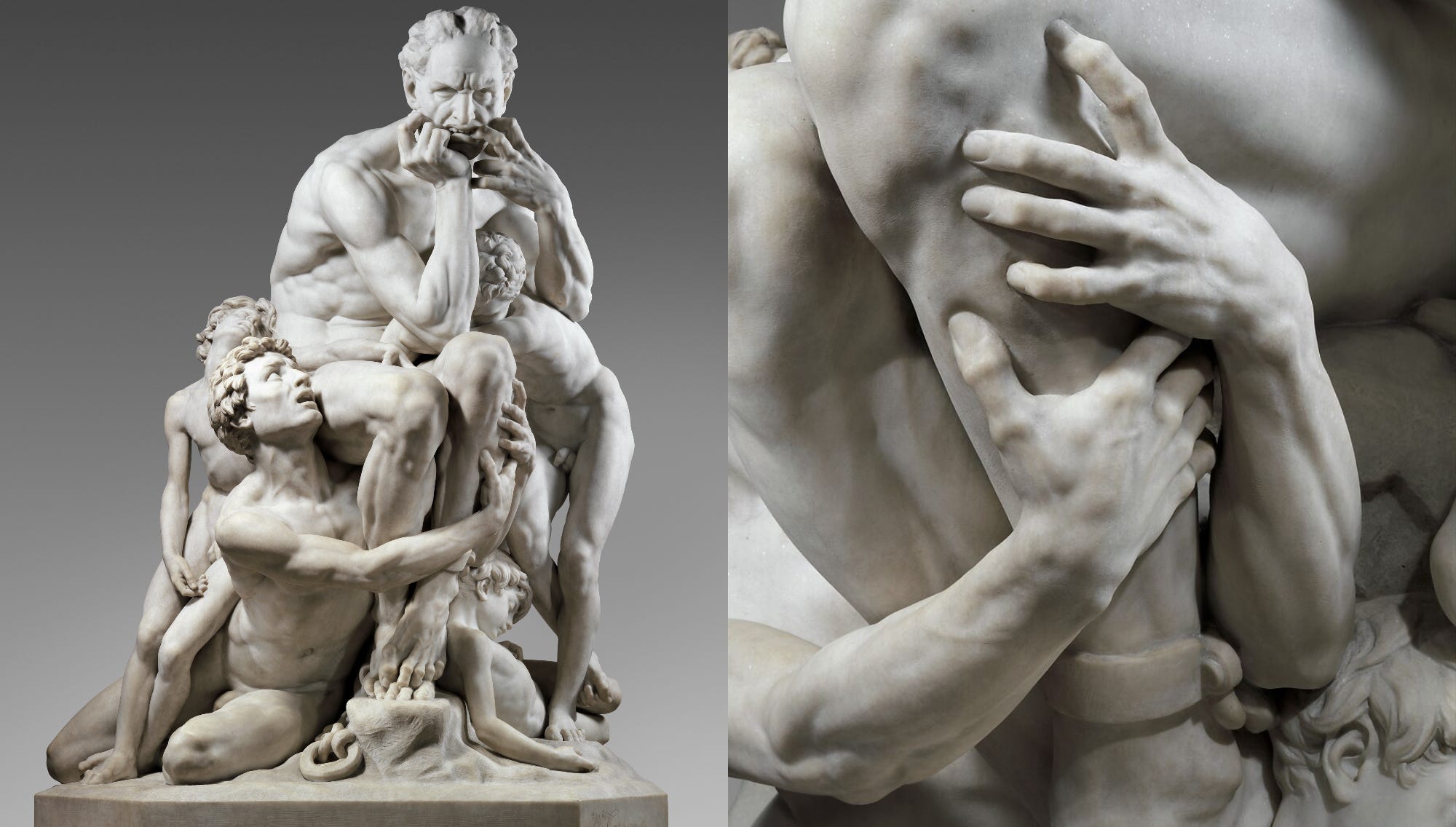
In 1288, in Pisa, a nobleman named Count Ugolino della Gherardesca was accused of treachery and locked in a tower with his children. The door was nailed shut, and no one ever came back for them. It should have ended there, as one more cruelty in a brutal age. But Dante froze him at the bottom of hell, in the ring reserved for men who betrayed their own country, and then did something worse: he let him tell his own story. Ugolino describes the days passing, the light through the slit in the wall, the children weakening. In his grief he bites down on his own hands. And his sons, watching their father gnaw at his fingers, misunderstand. They think he is starving.
So they offer him their bodies.
Father, it would hurt us far less if you ate us. You dressed us in this wretched flesh. Now take it back.
And then Dante stops. He never tells us what Ugolino did. The last thing the Count says is a line that scholars have been arguing over for seven hundred years: “then fasting had more power than grief”. It may mean he starved to death. Or it may mean that, in the end, hunger won.
That unanswered question is exactly where Jean-Baptiste Carpeaux placed his chisel.
Nearly five thousand pounds of Saint-Béat marble, and he turned it into flesh. This is the one thing marble can do that nothing else can. Bronze is dark, it holds the light on its surface. Marble lets the light sink in, so that the pale, polished stone reads as skin, soft and human, and the horror of it lands somewhere in your own body. When it was unveiled at the Paris Exposition of 1867, it caused a public sensation and made Carpeaux famous overnight.
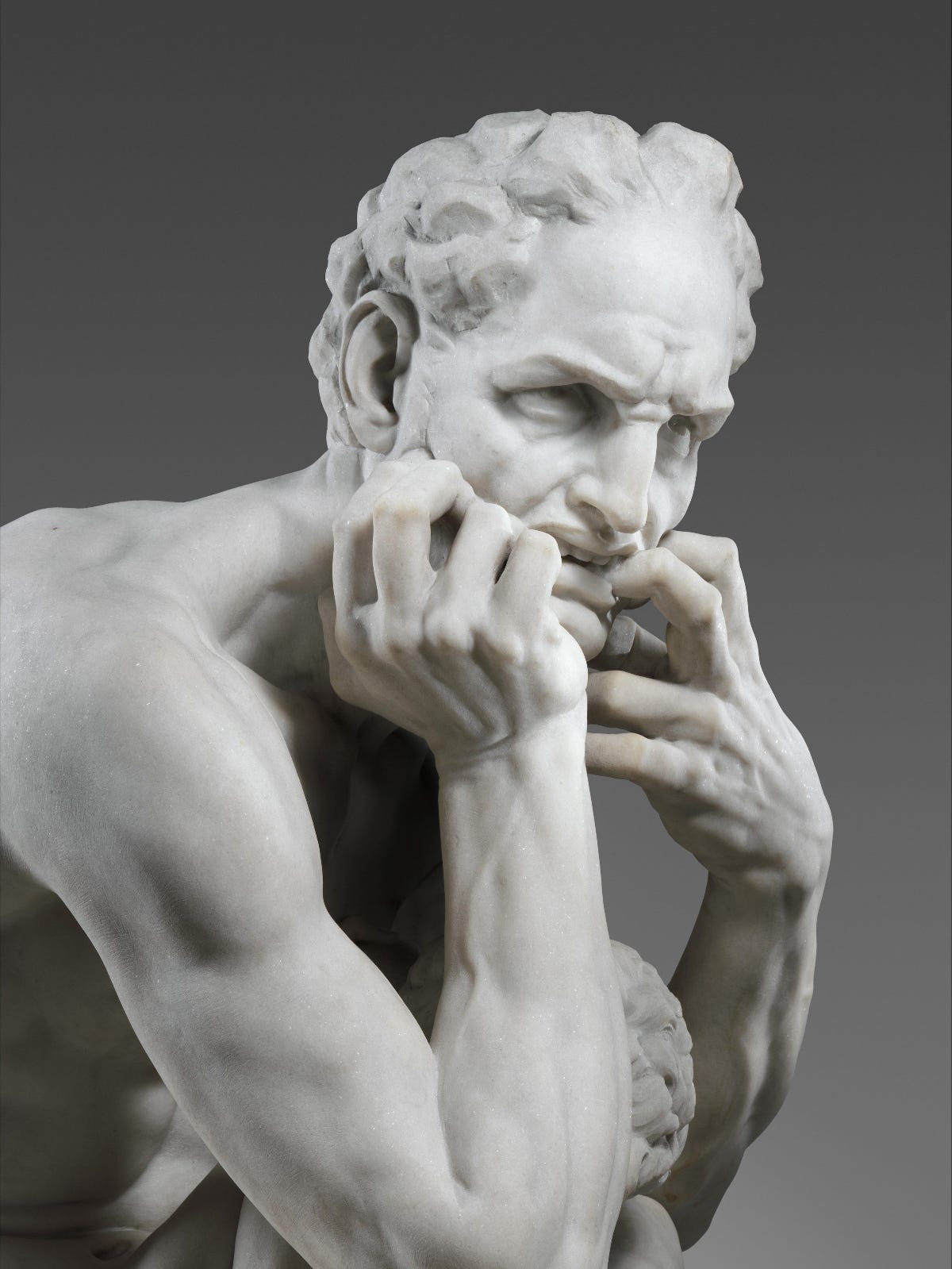
And they were all looking at what you are looking at now: a father, in stone, frozen at the exact moment Dante refused to describe…
5. The Thing You Are Fighting Is Not Outside You
A naked man is bent double, twisted almost in half, every muscle locked hard as metal. His arms are stretched down and out in front of him, and his hands have taken hold of something and are ripping it up out of the ground.
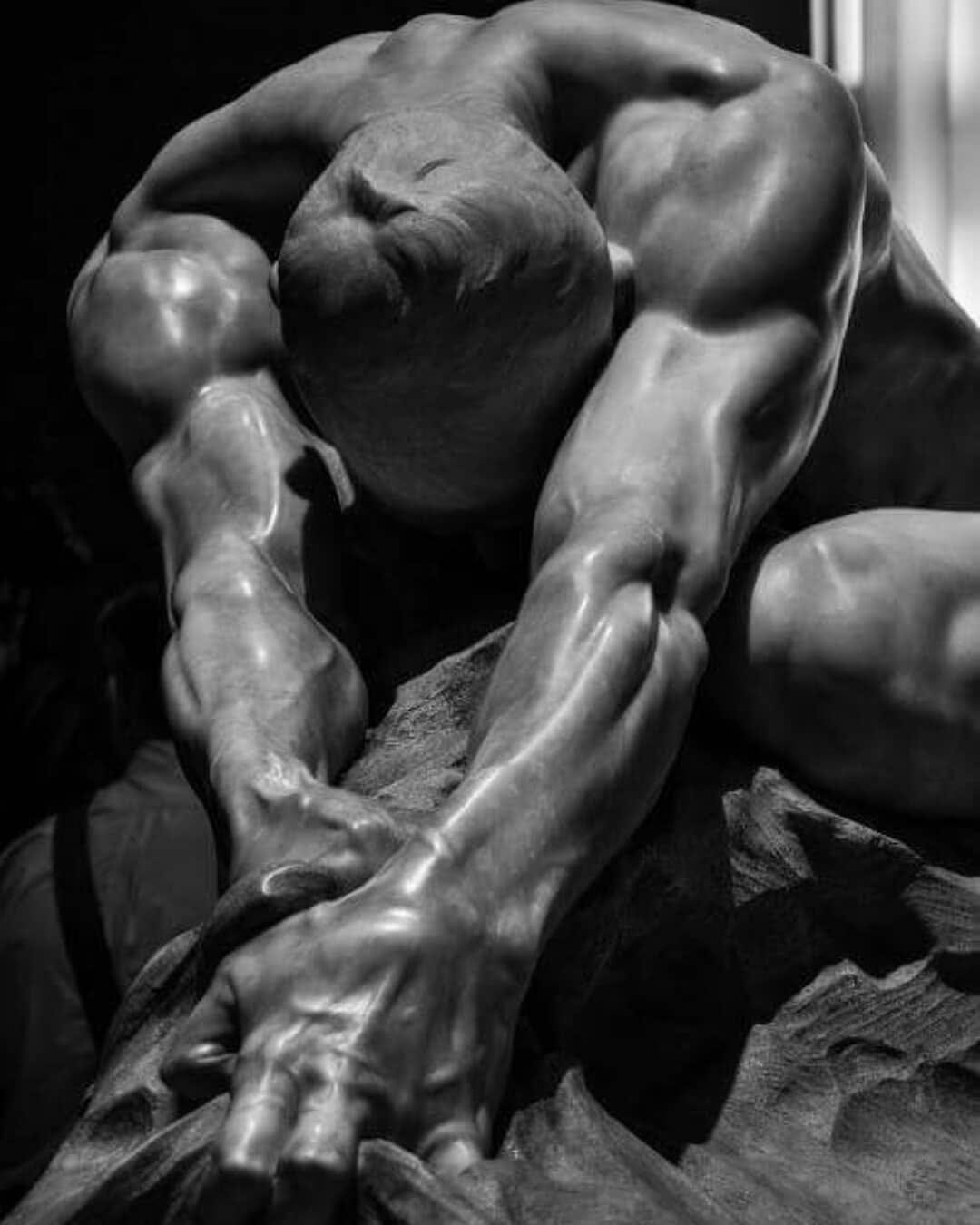
You look for the monster, and there isn’t one. What he is straining against is a veil: a dark shroud spread across the earth itself, covering the ground like a burial cloth. That is how the sculptor chose to show us evil…
It is called L’umanità contro il male, “Humanity Against Evil.” Gaetano Cellini first exhibited the plaster at the Milan Exposition of 1906, where it won the Brera Academy’s Fumagalli Prize, and completed the marble in 1908. It stands today in the National Gallery of Modern Art in Rome, and it is Rodin and Michelangelo fused into a single block.
Now notice what he did with the stone. The man’s body is polished to the softness of living skin. The shroud he fights is carved as heavy cloth, and here, at the very end, the marble comes full circle: the same illusion that gave us a transparent veil over a praying face now gives us evil itself. And where his body meets the ground, it turns into the shroud beneath him. He is rising out of the very darkness he is trying to tear away.
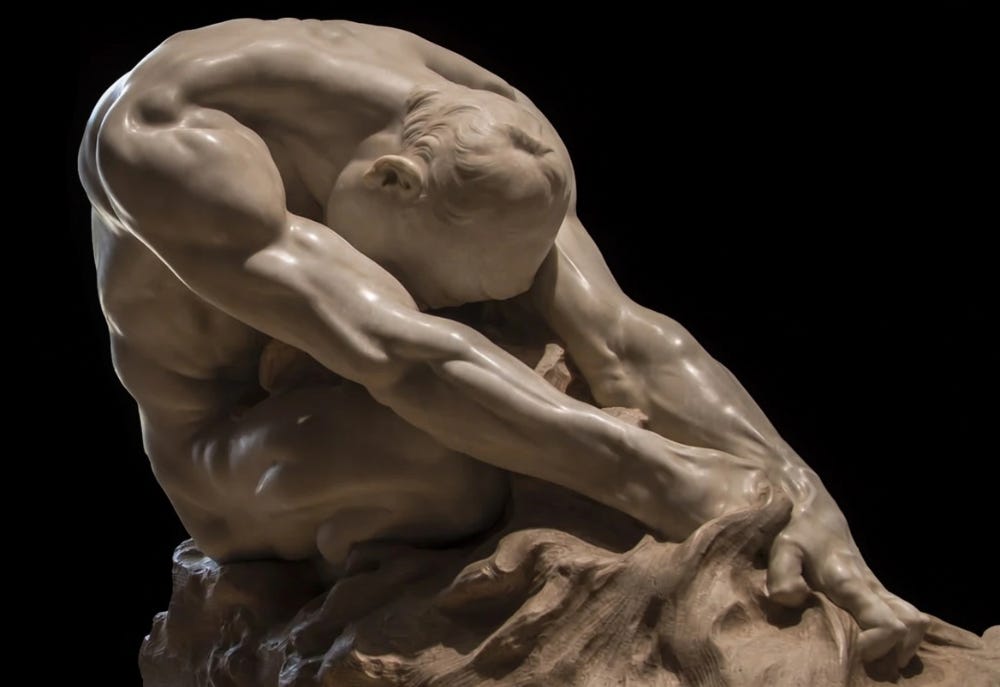
Cellini hid his face, too. He buried the head between the arms, so you never see the expression. Every writer who has stood in front of it says the same thing: he did it so that the man could be anyone. So that he could be you.
Then he cut two lines into the base:
Thus I will tear you out with my teeth and my nails, eternal pain that stabs at my heart.
The thing he is ripping from the ground is not out in the world. It is inside the man. What we are watching is not humanity fighting some external evil. It is a human being wrestling with the thing that lives in his own chest.
We would all prefer it were otherwise. It is far easier to believe that evil is something that happens elsewhere, done by other people, people who are nothing like us. Aleksandr Solzhenitsyn, who had every reason to believe that, having watched an entire system built on the idea, wrote this in The Gulag Archipelago:
If only it were so simple! If only there were evil people somewhere insidiously committing evil deeds, and it were necessary only to separate them from the rest of us and destroy them. But the line dividing good and evil cuts through the heart of every human being. And who is willing to destroy a piece of his own heart?
Cellini carved his answer decades before Solzhenitsyn asked the question. This man is willing. Look at him. He is not standing in triumph over a slain monster, he is clawing at a darkness he is himself made of, and refusing to stop.
And that is what makes this the right place to end. Because private struggle is never only private. What lives in one heart eventually finds its way out into the world, and once it does, it gathers power, it takes on a life of its own, and it turns into regimes that crush people. That was true in 1908, it was true when Solzhenitsyn was writing about the Gulag, and it is true right now, in ways most of us can see and few of us have the courage to name. And Cellini understood something we would rather not hear: evil is committed by the wicked, yes, but it triumphs through the rest of us. To keep spreading, it needs our silence, our fear, our small daily willingness to look away…
So there is only one question left, and this sculpture has been asking it for over a century: when it comes for you, will you go along with it, or will you fight?
Thanks for reading. Everything here, the research, the writing, all of it, is made by one person, with no team and no company behind it, and no ads or sponsors influencing a single word. That independence is only possible because of readers like you. If these pieces mean something to you, please consider becoming a paid subscriber for a few dollars a month, and unlock the full archive:
Every subscription genuinely makes a difference.
Thank you for making this work possible.
Actually James...I love what you wrote towards the end of this Substack about how private struggle is never private and what can happen when it finds its way out into this world. Will it be used for good or evil. I keep pondering on the words you wrote in the last two paragraphs.
The Veiled Virgin was my first thought, but all of these are truly breathtaking. Thank you for this lovely theme. I didn't know how starved I am for real art.