


From today, painting is dead!
That’s what French artist Paul Delaroche is supposed to have said in 1839, the year photography was announced to the world. No one has ever been able to prove he said it, and he kept painting until the day he died. Either way, you can see the point: for all of human history, every picture had been made by hand, and suddenly a machine could make one in a few minutes.
The new invention even got its name that same year, from the English scientist Sir John Herschel, who built the word photograph from two Greek words: phos, “light,” and graphê, “drawing.” Drawing with light. Painters had been doing exactly that for centuries, and a handful of those who kept at it after 1839 made pictures so precise that people still mistake them for photographs. What amazes me most is that the cameras of their own time couldn’t have produced anything like them. For most of the nineteenth century, photographs were black and white, and color photography was still an experiment.
People often lump these painters together with today’s hyperrealists, but to me they come from different worlds. The Photorealists who emerged in the late 1960s worked from photographs by definition, usually projecting them onto the canvas or copying them square by square through a grid. It takes enormous skill, but the camera has already done the hardest part for them.
The nineteenth-century masters you’re about to see had no color photograph to lean on. A black-and-white print or an optical device might help with the outline of a building or a row of trees, but the color, the light, and the feeling of the scene had to come from their own eyes.
I also hear, often, that what they did was just craft, a matter of patience and a steady hand. I couldn’t disagree more. Nobody paints the world this precisely without first spending years learning how to see it, and loving it enough to give it that much of their life. By the end of their century, the art world had begun to dismiss this kind of precision as old-fashioned. I have never understood why, perhaps because I’ve always believed that paying close attention to the beauty of our world never goes out of style...
In 1843, a twenty-four-year-old critic named John Ruskin gave young painters a piece of advice. He later admitted that following it meant “infinite labor and humiliation,” and that most of them ignored it. The 6 artists below lived by it:
Go to Nature in all singleness of heart... rejecting nothing, selecting nothing, and scorning nothing.
REMINDER: this is a teaser for my subscriber-only articles.
Beauty is Truth is entirely reader-funded. There are no ads here, just independent writing devoted to celebrating beauty. And it can only continue with your help.
If my posts have meant something to you, becoming a paid subscriber is the most meaningful way to support this work. With the new annual subscription discount, it costs less than a coffee a month. Join here:
Gift subscriptions to Beauty is Truth are now available too. Beauty is best when it’s shared, so if a friend or family member comes to mind, consider passing a little of it into their inbox:
1. The Moonlight Nobody Could Explain
In the autumn of 1880, people in St. Petersburg stood in line on the street for hours to see a single painting. That alone was strange. Exhibitions showed dozens of works, sometimes hundreds, and here was one canvas hanging by itself in a room. Its creator, Arkhip Kuindzhi, had the curtains drawn over every window, so the room was nearly dark, and aimed a single electric light at the picture…
What the crowd saw when they finally got inside was the Dnieper River at night:
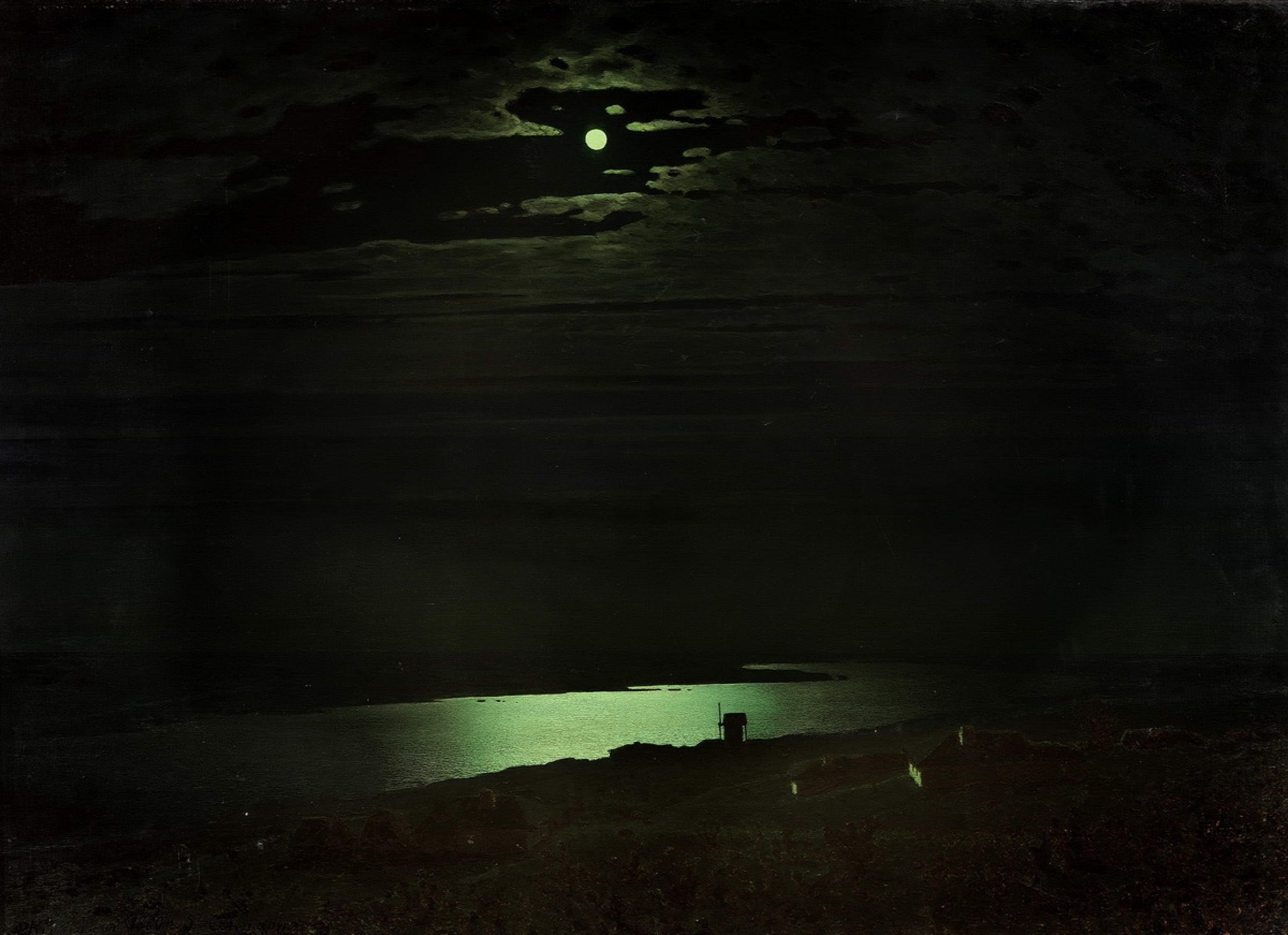
The moon has just broken through a bank of clouds, and the river below catches its light in a greenish, silver sheen that seems to come from inside the water itself. The land around it has fallen into deep shadow, except for a few pale houses on the bank. There is no one in the picture. There is only the night, and the glow.
It was too much for some of the visitors: they refused to believe that paint alone could shine like that, and according to accounts of the exhibition, a few went looking behind the canvas for the lamp they were sure was hidden there. There wasn’t one. There was only a painter obsessed with how light works.
Kuindzhi was a regular at the weekly gatherings of the chemist Dmitri Mendeleev, the man who created the periodic table, and he spent his life studying light, color, and the way the eye perceives them.
All that study produced a painting everyone wanted, but it had already found its owner before the exhibition even opened: Grand Duke Konstantin Konstantinovich, a member of the imperial family, had bought it straight from the artist’s studio for 5,000 rubles, and he loved it so much that he refused to be parted from it, even taking it with him on his voyages at sea. Kuindzhi’s friend, the painter Ivan Kramskoi, had already worried that such an unusual combination of colors might not last, and he was right. Over the years, the damp salt air and the paints themselves took their toll, and the canvas darkened.
The Moonlit Night on the Dnieper that hangs in the Russian Museum today is dimmer than the one that stunned St. Petersburg in 1880. And still, people stop in front of it and stare. Imagine what it must have looked like when it was new, in a dark room, lit by a single beam, with a crowd behind you convinced there had to be a trick…
2. Someone Is Missing From This Painting
Look at this forest for a few seconds and you can almost feel it: the cold, damp air of early morning, the smell of pine, the mist still hanging between the trees.
It is one of the most convincing forests ever painted.
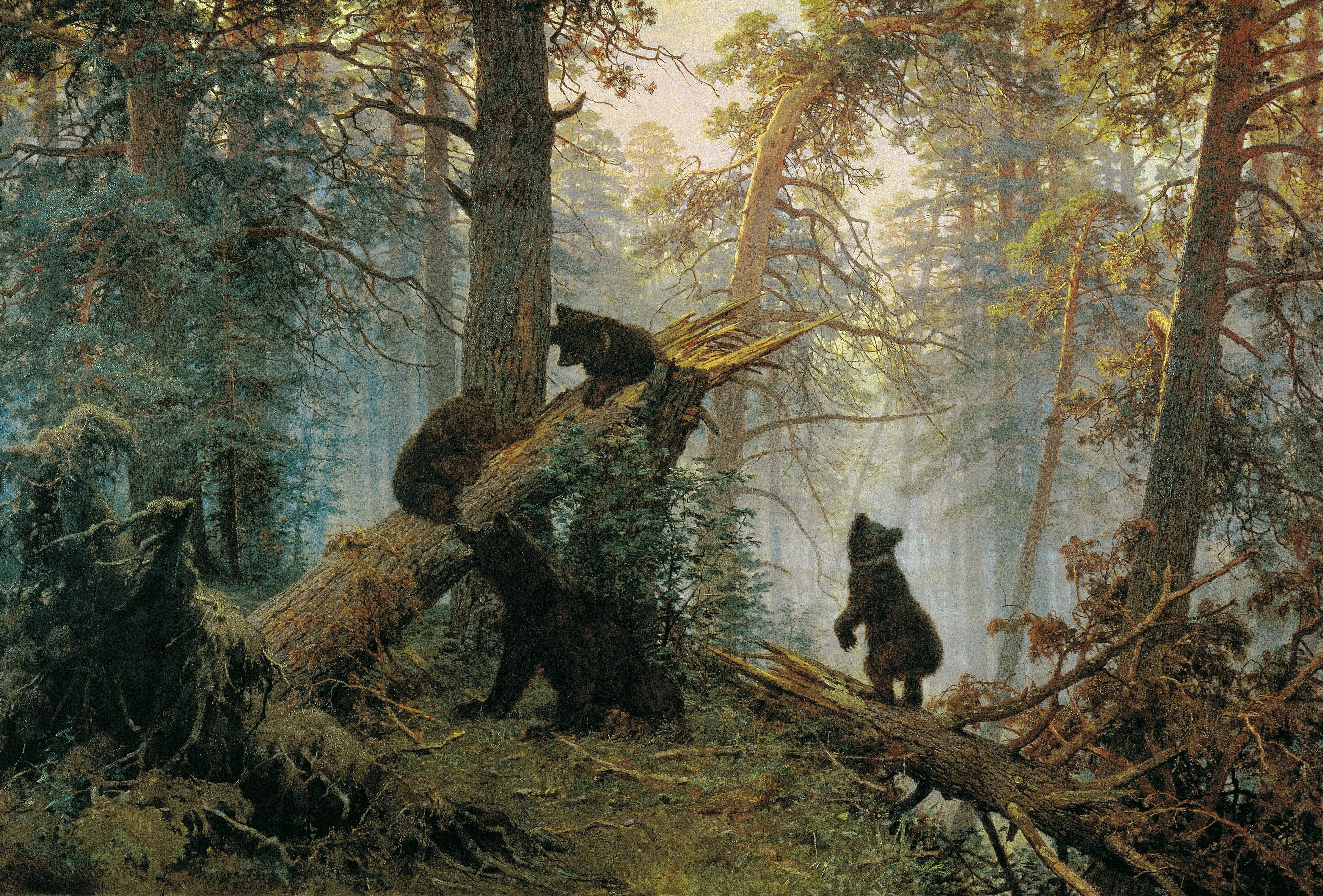
But this canvas once carried a detail you won’t find on it today. Not long after it was completed, someone took a rag soaked in turpentine and wiped it away forever…