


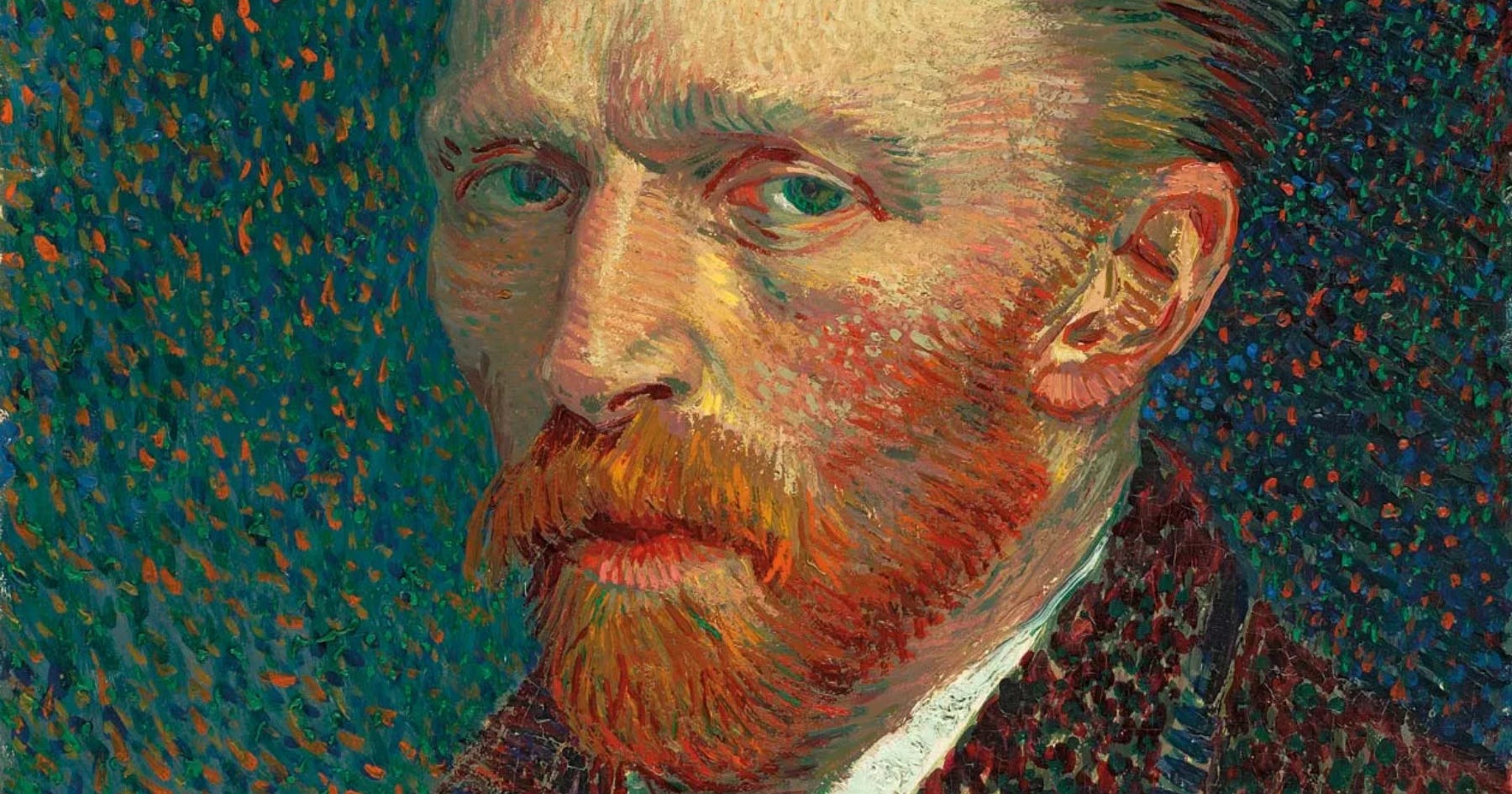
In the summer of 1882, a failed art salesman, failed teacher, and failed preacher, a man who had disappointed nearly everyone who had ever believed in him, sat down to write his younger brother a letter. He was not yet a painter, not really. He had no money, no wife, and nothing anyone would have called a life. And he wrote this:
What am I in the eyes of most people? A nonentity, an oddity, a disagreeable person — someone who has and will have no position in society, in short a little lower than the lowest.
His name was Vincent van Gogh, and he was right about how the world saw him. What the world did not know at the time, what it would not find out until he was dead, was that this nobody had inside him one of the most extraordinary souls that ever lived, and that he was about to spend the last few years of his life pouring it onto canvas…
He was twenty-seven when he decided to become a painter. Twenty-seven, with no training and a decade left to live. Almost everything you picture when you hear his name he made in a single feverish burst near the end, a body of work most artists could not produce in fifty years, painted in fewer than ten. He sold, in all that time, essentially nothing. He lived on money his brother Theo sent him and on a faith in his own work that almost no one shared. And he died at thirty-seven, in a small French village, believing he had failed.
He could not have been more wrong…
Within a generation of his death, the world fell completely in love with his paintings. The man who could not sell a canvas became one of the most beloved and imitated artists in the history of the world, his pictures worth more than he could have earned in a thousand lifetimes. He changed the course of art forever, and he never knew he had done it.
This is the story of that man, told through 8 of his paintings and, wherever possible, in his own words, because he left us thousands of them in hundreds of letters, mostly to his brother, where he wrote down exactly what he felt as he painted. In that same 1882 letter, right after he called himself the lowest of the low, he wrote down what he wanted his life to be for. It is the promise the rest of this article will watch him keep:
Through my work I’d like to show what there is in the heart of such a nobody.
REMINDER: Beauty is Truth is entirely reader-funded. There are no ads here, only independent writing devoted to celebrating beauty. And it can only continue with your help.
If my posts have meant something to you, becoming a paid subscriber is the most meaningful way to support this work. With the new annual subscription discount, it costs less than a coffee a month, and it is what keeps all of this going. Join here:
Gift subscriptions to Beauty is Truth are now available too:
1. The Potato Eaters
Before the sunflowers and the swirling skies, there was this: a dark little room, five peasants, and a plate of potatoes.
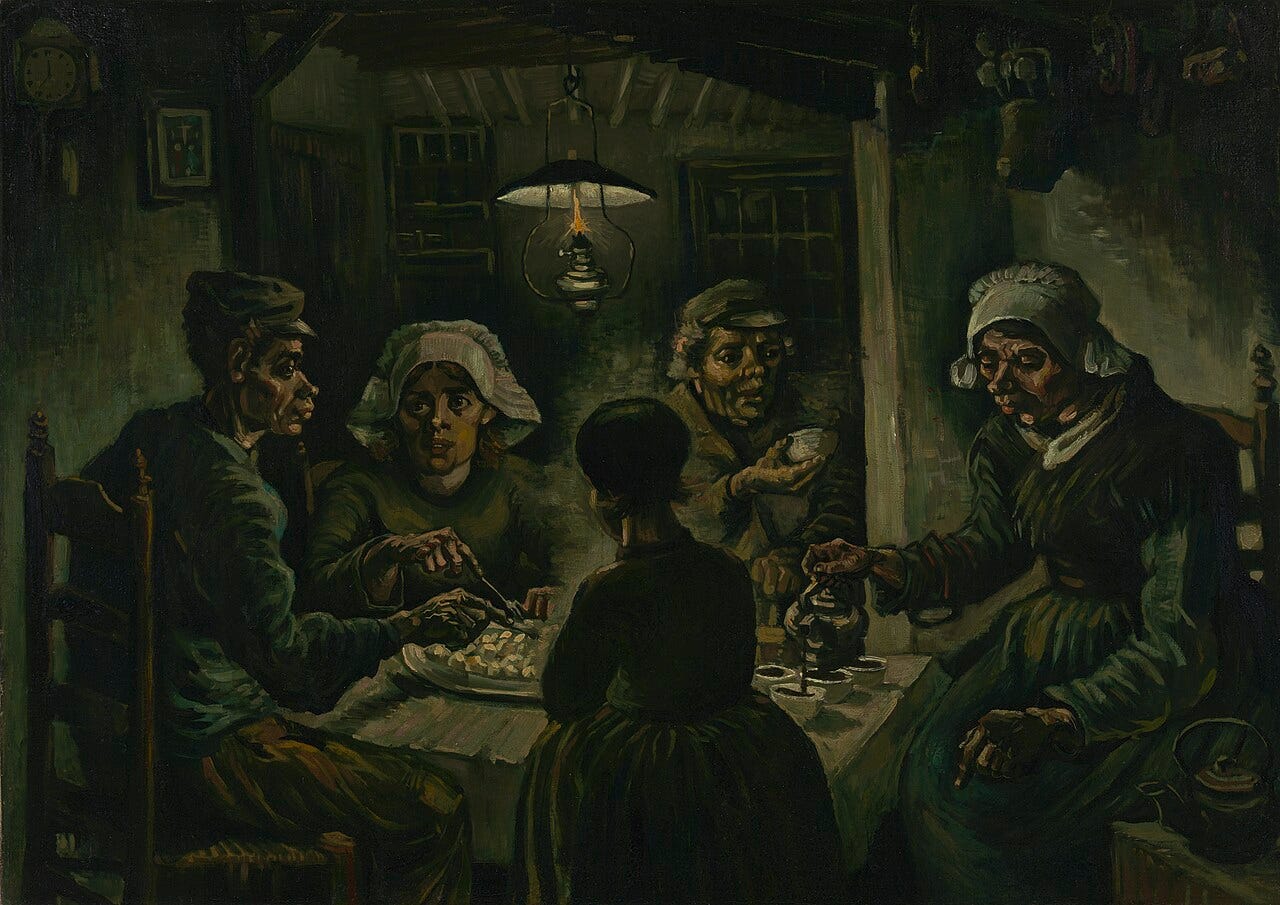
Five members of a farming family sit around a wooden table in the evening, lit by a single hanging oil lamp. They are sharing a meal of potatoes and coffee, the only things they have. Their faces are knobbled and plain, their eyes deep-set, their hands, and Vincent wanted you to look hard at those hands, are huge, gnarled, and coarse from a lifetime of digging in the dirt.
Everything is the color of earth and shadow. There is nothing pretty here, and that was the entire point. Other painters of the day liked to dress peasants up into something charming and picturesque. Vincent refused. He wanted the grime and the exhaustion and the dignity all at once, and he wanted you to understand exactly what you were seeing. He explained it to Theo in words that tell you everything about the kind of artist, and man, he intended to be:
You see, I really have wanted to make it so that people get the idea that these folk, who are eating their potatoes by the light of their little lamp, have tilled the earth themselves with these hands they are putting in the dish, and so it speaks of manual labour and — that they have thus honestly earned their food.
He wanted the people who had grown the food to be seen as the ones who deserved it. That was the whole ambition of the painting: to give the poorest, least noticed people he knew their full weight as human beings, and to make the comfortable world look at them and not turn away.
Almost no one liked it. When he sent it out into the world, it was met with something close to universal disapproval, the colors too dark, the figures clumsy, the faces, one critic complained, all wrong. Even his own brother had doubts. It was the first great statement of his life as a painter, and it fell flat. But here’s the thing that tells you who he was: he never stopped believing in it. Years later, sick and far from home, he still called it the best thing he had ever done.
He had set out to make the world feel something for people it preferred not to see, and whether or not anyone applauded, he knew he had done exactly that…
2. The Yellow House
Three years later, everything had changed. The earth tones were gone, burned away by the sun of the south of France, and in their place was the most hopeful color he ever painted: a little house, glowing yellow, under a sky of pure cobalt blue.
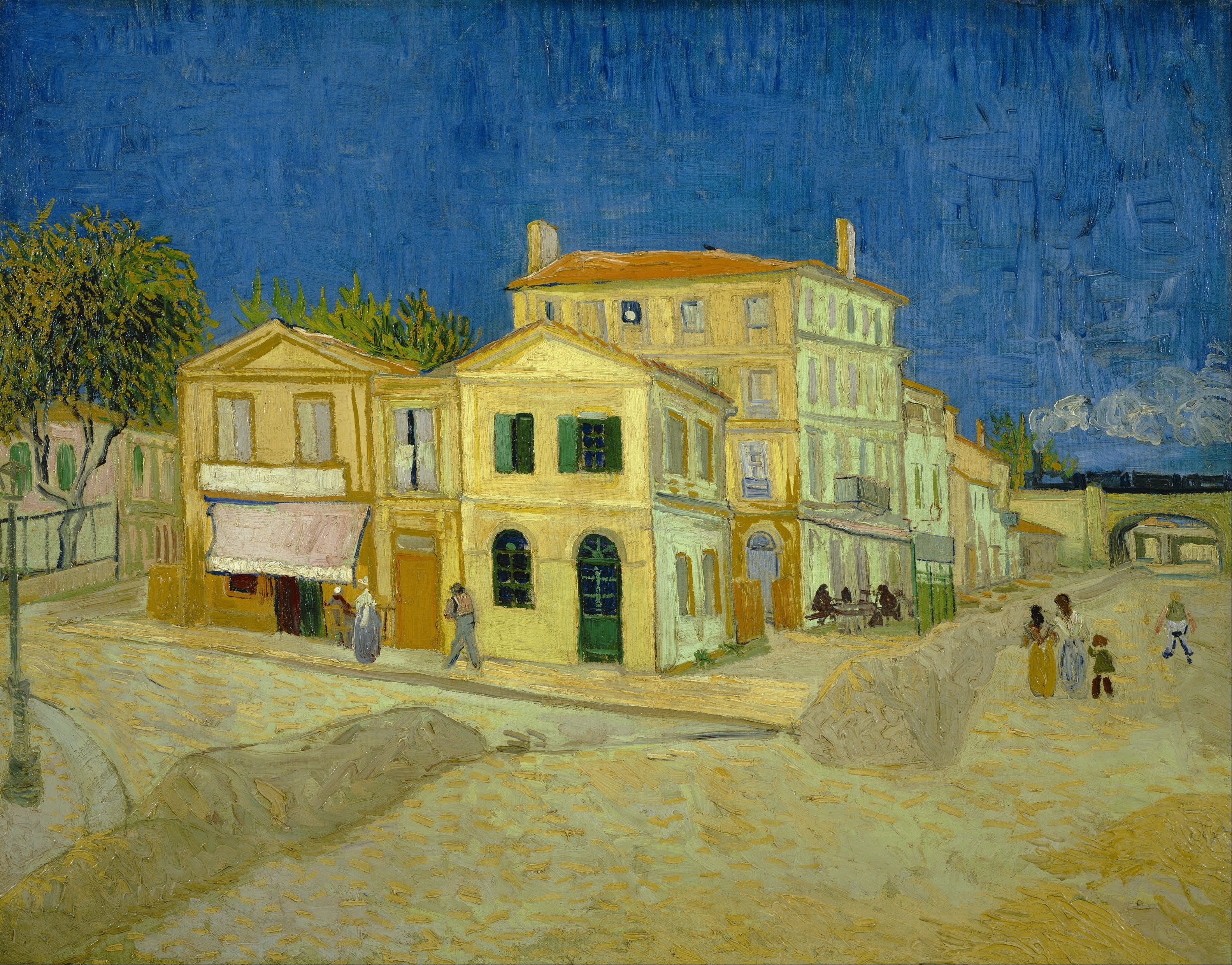
In the spring of 1888 he moved to Arles, a town in Provence, and rented four small rooms in this building on a corner square. He painted it in the colors of a man in love with his own future, the whole scene flooded with light. What he was really painting wasn’t the house at all, but everything he hoped would happen inside it: Vincent wanted to start a colony, a “Studio of the South,” a place where painters could live and work together, share meals and ideas and canvases, and keep each other company. For a man who had spent his whole life on the outside of things, this was the dream beneath all his dreams. He said why to Theo with a plainness that breaks your heart a little:
You know I’ve always thought it ridiculous for painters to live alone. You always lose when you’re isolated.
So he furnished the rooms, and he painted canvas after canvas of sunflowers to hang on the walls, getting the house ready the way you would for someone you love, because someone was coming. He had persuaded the painter Paul Gauguin to join him, and he waited for his arrival with more hope than he had let himself feel in years, certain that this was the beginning of the community he had wanted his entire life.
He was right that the Yellow House would change everything. He was only wrong about how: Gauguin would be the first artist to come and live with him there, and he would also be the last…
3. Café Terrace at Night
The dream of the Yellow House was, at its heart, a dream about not being alone. And in the same season he was waiting for Gauguin, Vincent walked out into the Arles evening and painted the feeling itself: a warm, lit café, full of people, glowing against the blue of the night.
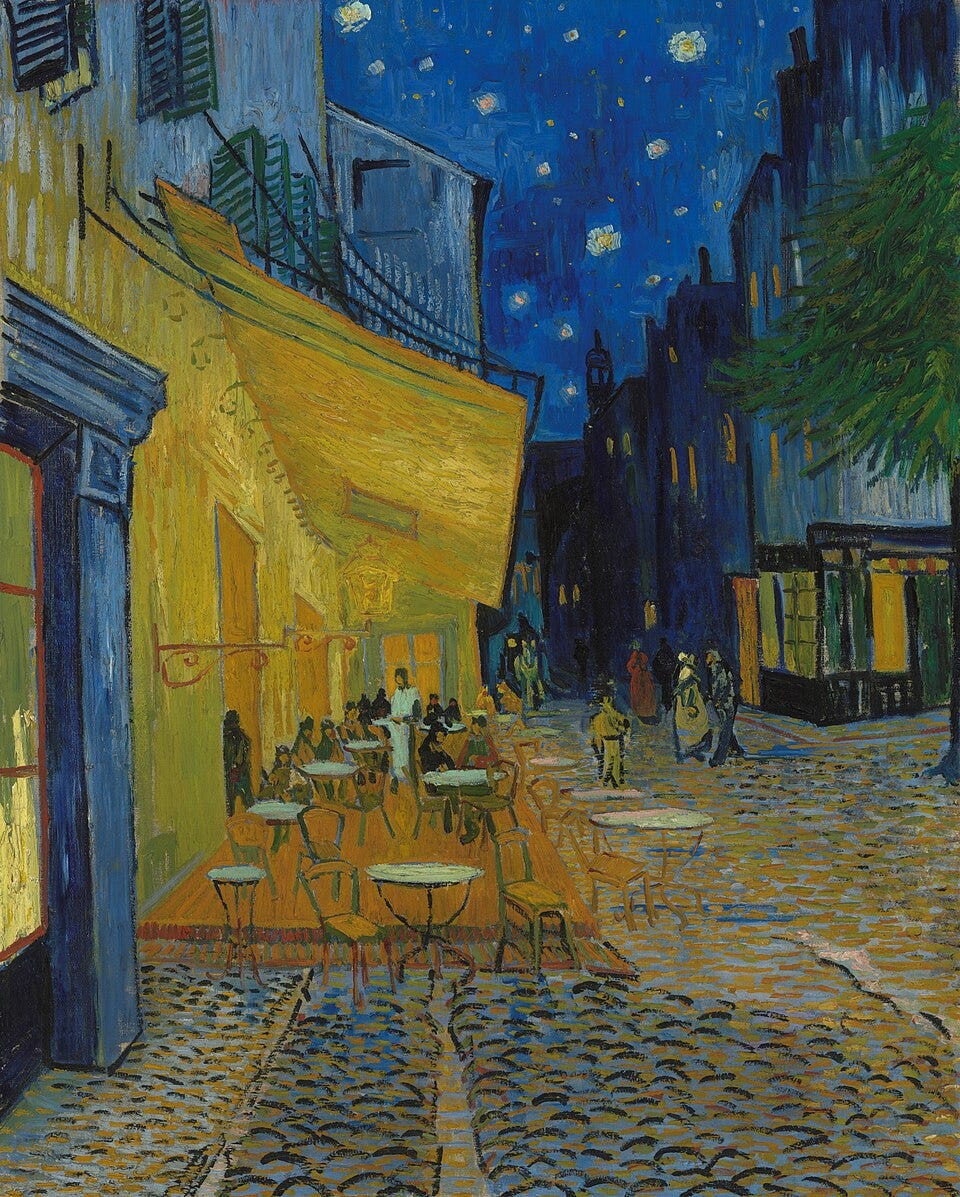
It is a corner café on a cobbled square, its terrace spilling golden light onto the street from a single great lantern. People sit at the tables under the awning, in no rush to go home. Above them the sky is deep blue and scattered with stars, and the warmth of the café below seems to hold the darkness at a distance.
This was one of the first times Vincent painted a sky full of stars, the thing that would soon make him immortal, and he did it here, over a scene of ordinary people enjoying an ordinary night out. To him, the lit café was the thing worth painting: human beings gathered in the warmth, the exact companionship he longed for.
There is a detail here that tells you how his mind worked, and how relentlessly he pushed toward light even in the dark. Look at the sky in this painting. For a scene set at night, there is no black in it at all. He was thrilled by this, and wrote to his sister about it:
There’s a painting of night without black. With nothing but beautiful blue, violet and green.
Think about what that means, coming from him. He was painting the night, the dark, and he found a way to do it without a single stroke of blackness, building the whole evening out of blues and violets and that pouring golden light instead. It is the most Vincent thing imaginable. Even when he painted the darkness, he could not help filling it with color and warmth, reaching, always, for the light.
He wanted so badly to believe the night could be beautiful, that a person could sit out under the stars in the glow of a warm café and not be cold, and not be alone. So he made it true the only way he could: he painted it.
4. Starry Night Over the Rhône
That same autumn, a minute’s walk from the Yellow House, Vincent set up his easel on the bank of the river at night and painted one of the most enchanting pictures he ever made…
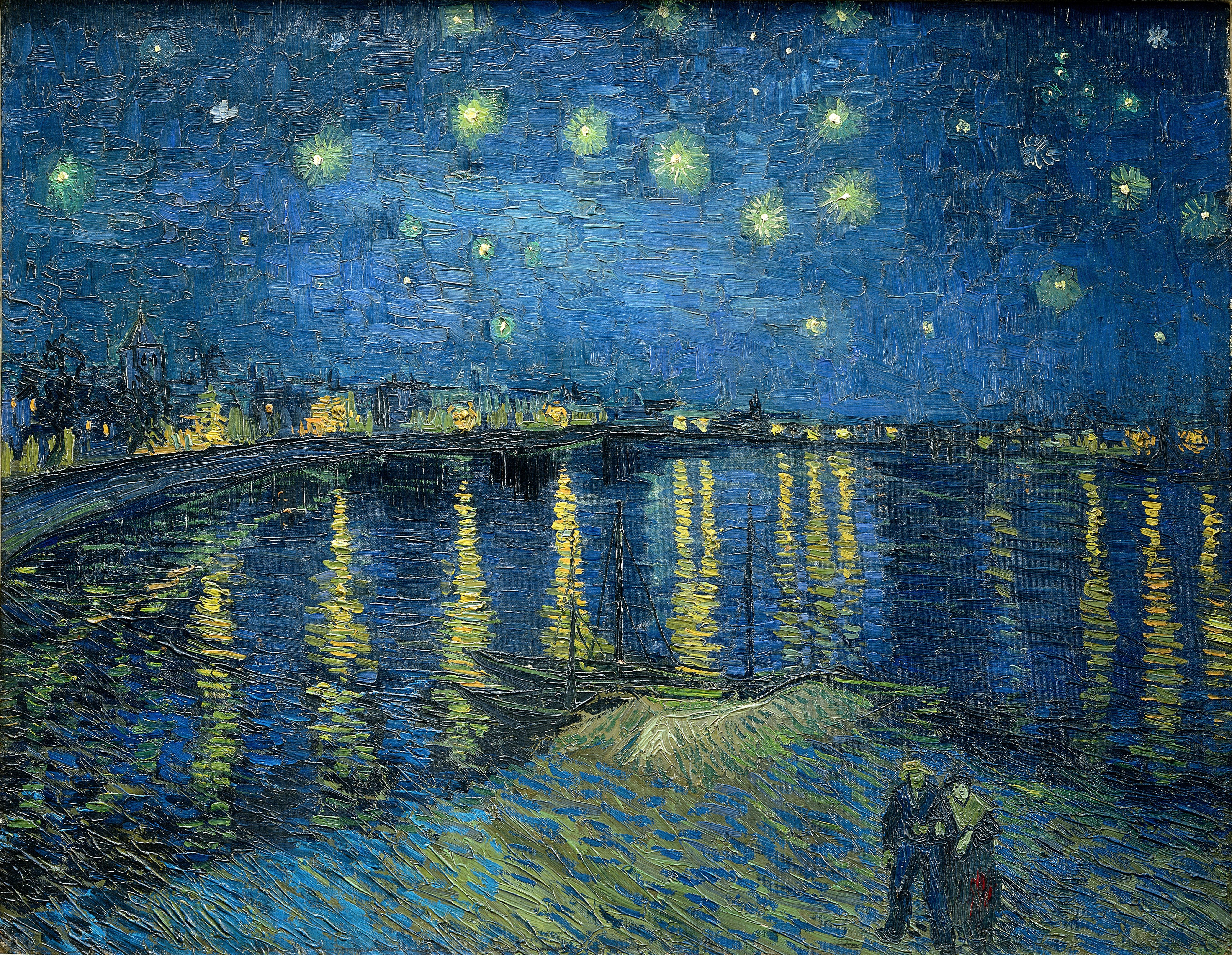
It is the town of Arles seen across the water, its gas lamps burning along the far shore and throwing long trembling ribbons of gold down into the river. Above it all, the night sky is enormous and alive, the Big Dipper hanging over the town, the stars not as the swirling furnace they would later become but as soft, radiant points, glowing like lamps of their own.
And then, if your eye travels down to the very front of the scene, you find the heart of the whole painting: a couple walking together along the near bank, arm in arm, small against the vast lit night.
Vincent described this canvas to Theo in a letter so vivid it reads like a poem, cataloguing every color with care, the aquamarine sky, the royal blue water, the gaslight coming down in russet gold. And he ended his description not with the stars, but with them:
Two colorful figurines of lovers in the foreground.
That is where his eye came to rest, and that is what the painting is truly about. Not the river, not even the stars, but the two of them. Here was a man who had almost never known romantic love, and he stood alone in the dark by the river, painting a tenderness he had never been given: someone to walk beside, so that the vast night felt warmer and survivable.
It is the last time we will see him this at peace…
5. Self-Portrait with Bandaged Ear
Gauguin arrived in October, and for a few weeks the dream held. Two painters under one roof, working side by side. But they were too different and too raw, and as the weather turned cold and shut them indoors, they quarreled, bitterly and often. On the night of December 23rd, 1888, after a final argument, Vincent picked up a razor and cut off most of his own left ear. Gauguin fled to Paris and never saw him again. Vincent was carried to a hospital, and when he came home a couple of weeks later, the Yellow House was empty. Gauguin was gone. The studio of the south, the family of artists, the whole shining dream, was over.
A week after leaving the hospital, in the dead of winter, he did something that tells you everything about the size of his spirit. He stood in front of a mirror and painted himself…
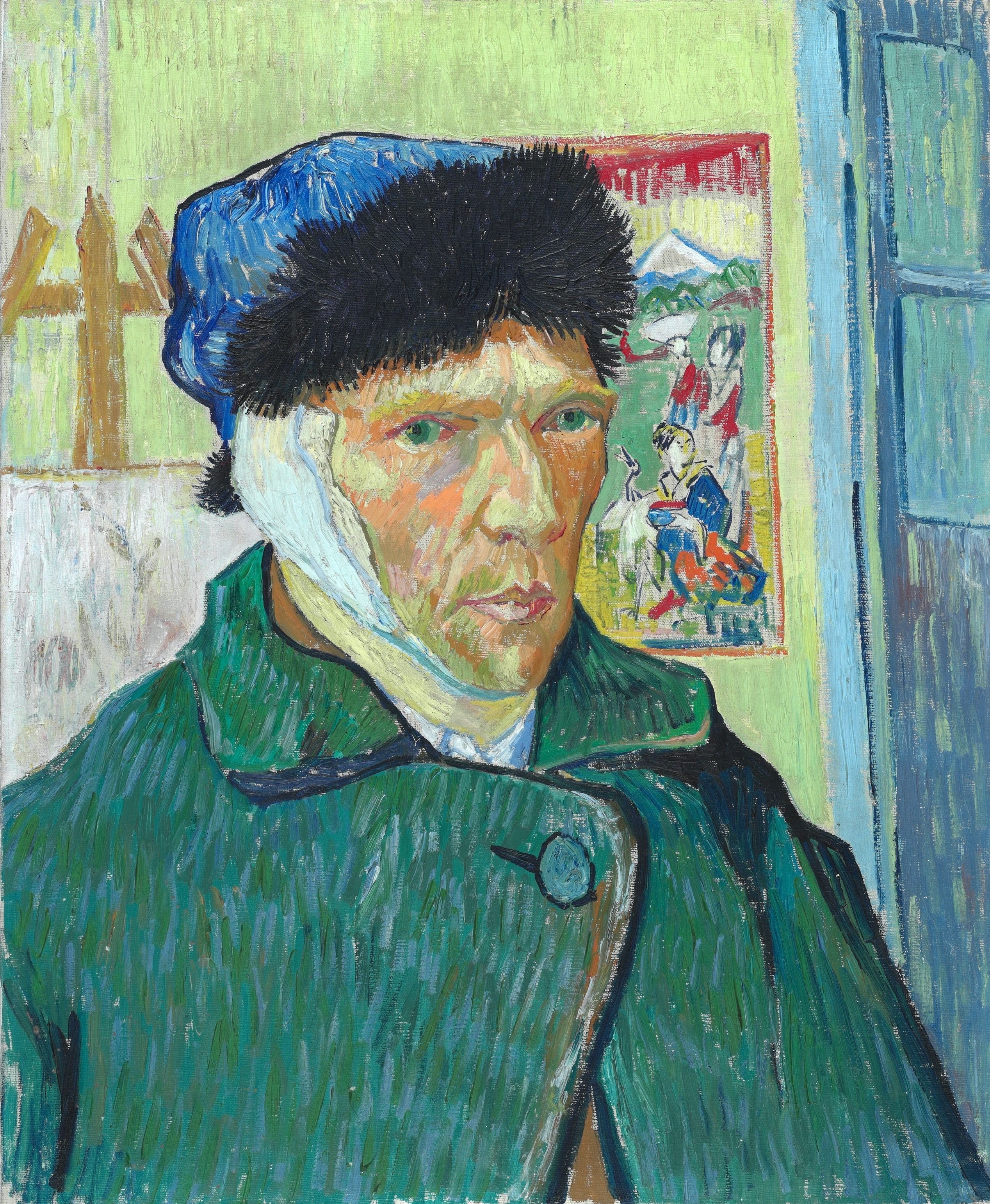
Here he is: gaunt, drawn, a heavy fur cap pulled down over his head, a thick white bandage covering the wound where his ear had been. His face is unbearably sad, and he looks not quite at us but slightly past us, like a man still trying to understand what has happened to him.
But look at what he put behind himself in the picture. Over his shoulder he painted two things: a fresh canvas waiting on its easel, and one of the Japanese prints he loved. Think about that choice. He had just lost his friend, his dream, and a piece of his own body, and he chose to paint himself not as a broken man in an empty house, but as a painter, at work, surrounded by the tools and images of the thing he lived for.
The bandage is what the world had done to him. The canvas waiting on the easel behind it is what he meant to do about it: pick up the brush, and start again.
6. The Starry Night
I took this photograph four years ago standing in front of it at the MoMA in New York, and I can tell you that no reproduction can prepare you for it: seeing this painting in person remains one of the most magical things art has ever done to me…
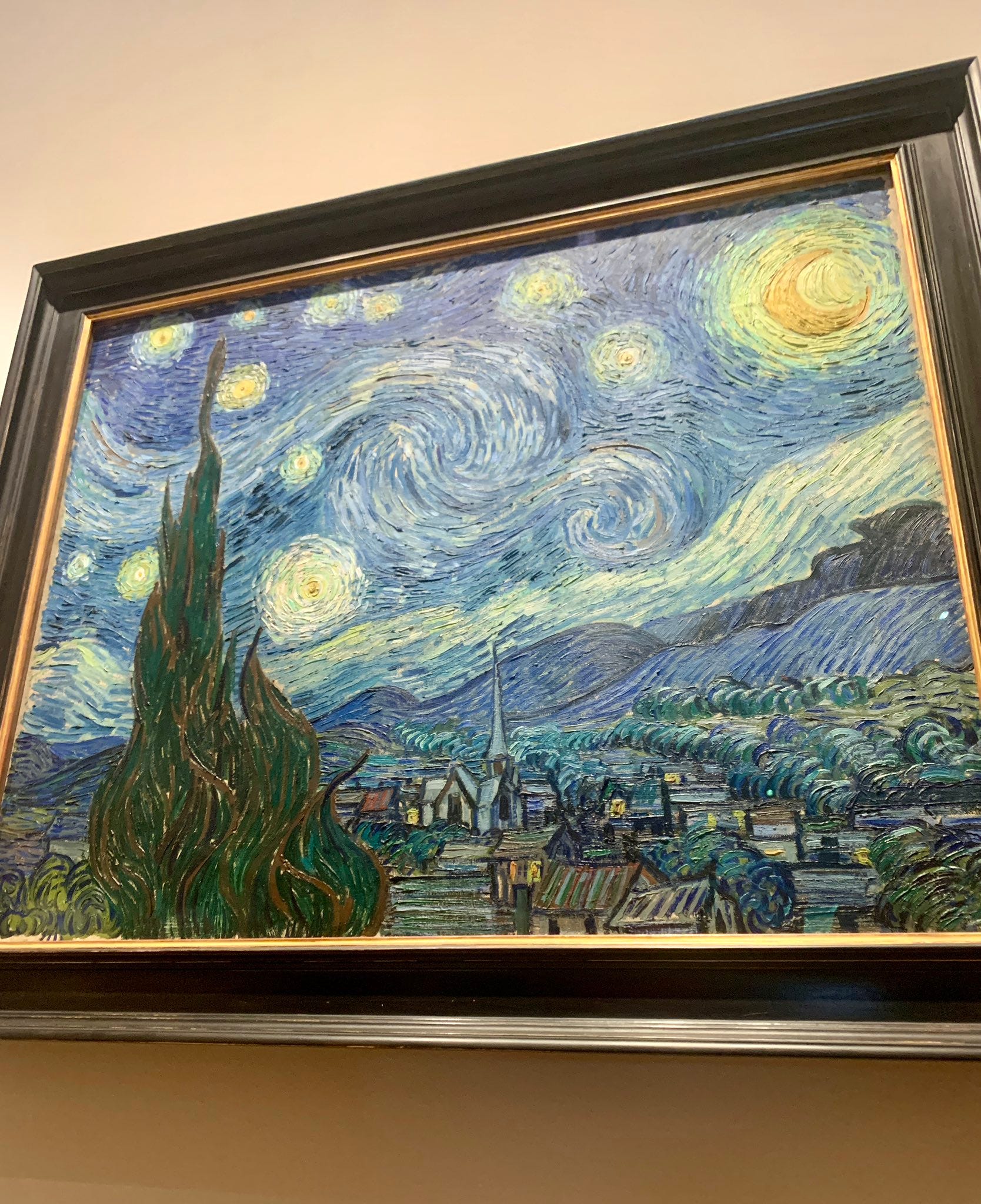
He had painted the night before. But he had never painted it like this, because he had never been this far down, or reaching this far up.
After the breakdown, Vincent voluntarily committed himself to an asylum at Saint-Rémy, a former monastery for the mentally ill. He was thirty-six, and he knew, now, that his mind was not something he could trust. From the window of his room, behind iron bars, he could see a wheatfield and a strip of sky. He described it to Theo in a way that sounds like a man finding something to hold onto:
Through the iron-barred window I can make out a square of wheat in an enclosure, above which in the morning I see the sun rise in its glory.
And out of that window, that narrow view from inside a mental institution, he made one of the most famous paintings of all time:
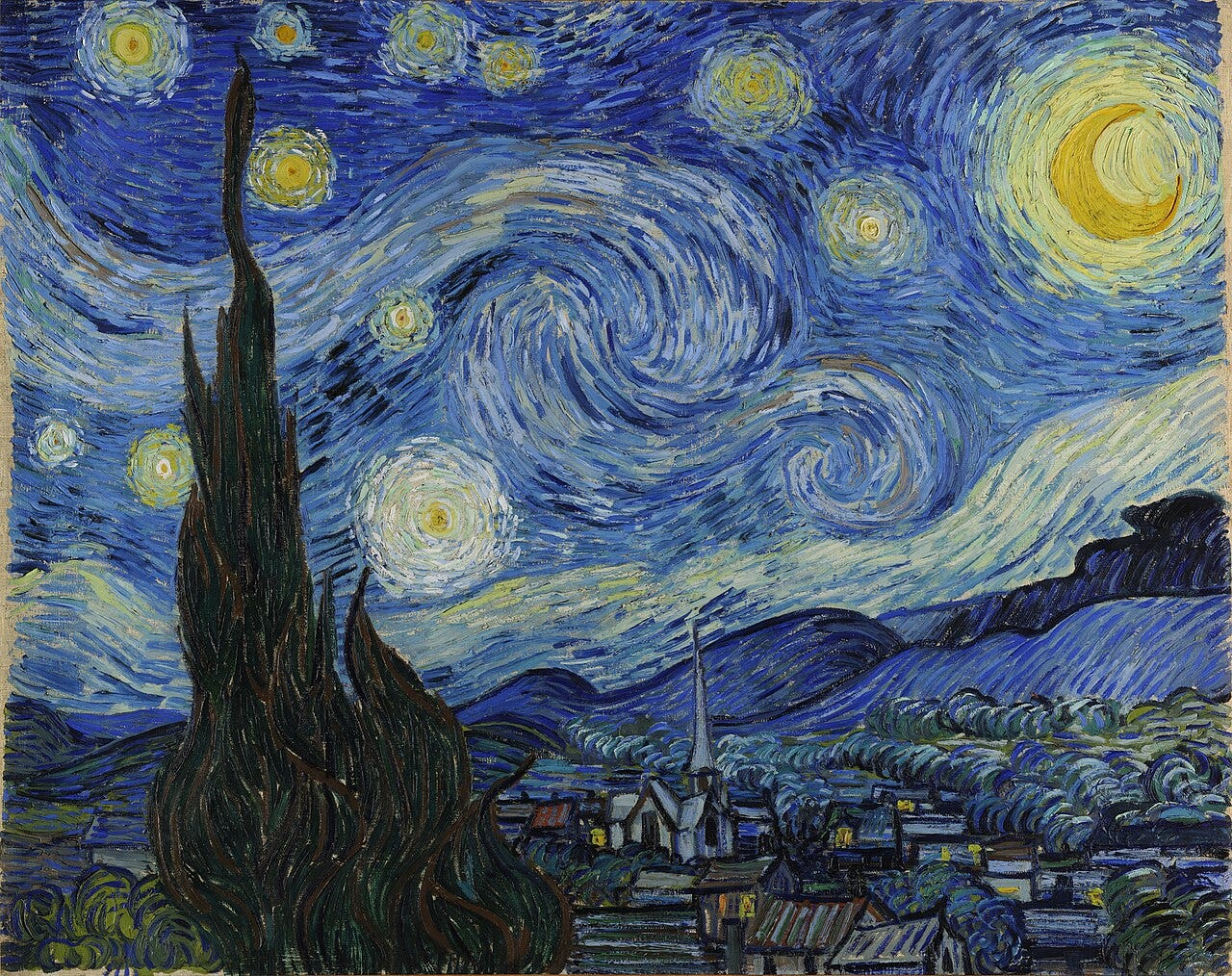
The night sky rolls and swirls like a living sea, eleven stars and a blazing crescent moon burning and turning in currents of blue, the whole heavens surging with a power that feels almost too big for the canvas to hold. Beneath it a small village sleeps, its church steeple pointing up. And on the left, a great cypress, the tree that in that part of the world grows in graveyards, rises from the sleeping town all the way into the churning stars, like a bridge between the earth and the sky.
Vincent had trained as a preacher once, and though he had long since broken with the church, he never stopped longing for something larger than himself. He once wrote Theo a line that explains this whole painting:
I have a tremendous need for, shall I say the word, religion, so I go outside at night to paint the stars.
That is what he was doing here: reaching for the divine the only way he had left, through a brush and a sky full of light. He made this locked away, ill, and more alone than he had ever been, and instead of despair he gave us what may be the most beautiful thing anyone has ever painted. The lower he sank, the higher his work climbed, until he turned the view from a barred asylum window into the closest thing we have to heaven…
7. Portrait of Dr. Gachet
In the last summer of his life, out of the asylum at last, Vincent came to a village near Paris called Auvers, and there he painted a portrait of the man who was supposed to make him well.
Dr. Paul Gachet, a melancholy widower and amateur painter, was the physician assigned to watch over him. And here is the first sad thing: Vincent looked at this man and saw, almost immediately, himself. “He is sicker than I am, I think,” he wrote to Theo, “or shall we say just as much.” But two days later, writing to his sister, that wariness had softened into something else: he had found in Gachet, he said, “a true friend, something like another brother, so much do we resemble each other.”
So he painted him:
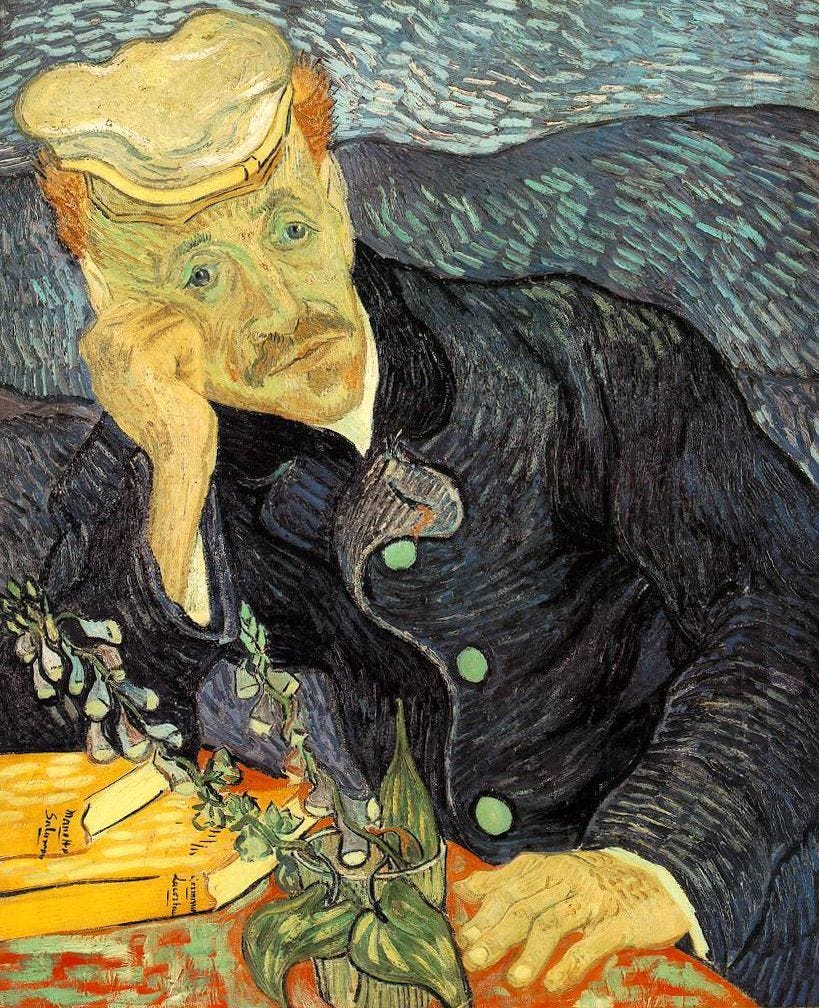
Gachet sits leaning his head on his hand, in the age-old pose of melancholy, his blue eyes tired, his expression heavy and gentle at once. Vincent said he had tried to give the doctor’s face “the heartbroken expression of our time.” He was no longer painting people, or places, or the world outside. He was painting sadness itself, the particular ache of being a sensitive soul in a hard age, and he had found the perfect face for it in the man meant to cure him.
He wrote something about this painting that reaches out of 1890 and puts a hand on your shoulder. He wanted to make portraits, he said, that people would look at a century later “with longing,” as if the sitter were an apparition. He was hoping a stranger in the future would look into this sad man’s eyes and feel something. He had no idea we would line up by the millions to do exactly that.
He painted it about six weeks before the end…
8. Wheatfield with Crows
And so we come to the last of it: a golden wheatfield under a stormy sky. A flock of black crows scatters up out of the grain, flying in no clear direction. And three rough paths cut through the wheat, one to the left, one to the right, one straight up the middle, and every single one of them leads nowhere, vanishing into the crop or the horizon without arriving anywhere at all.
It was one of the last things he ever painted, made in his final weeks in Auvers.
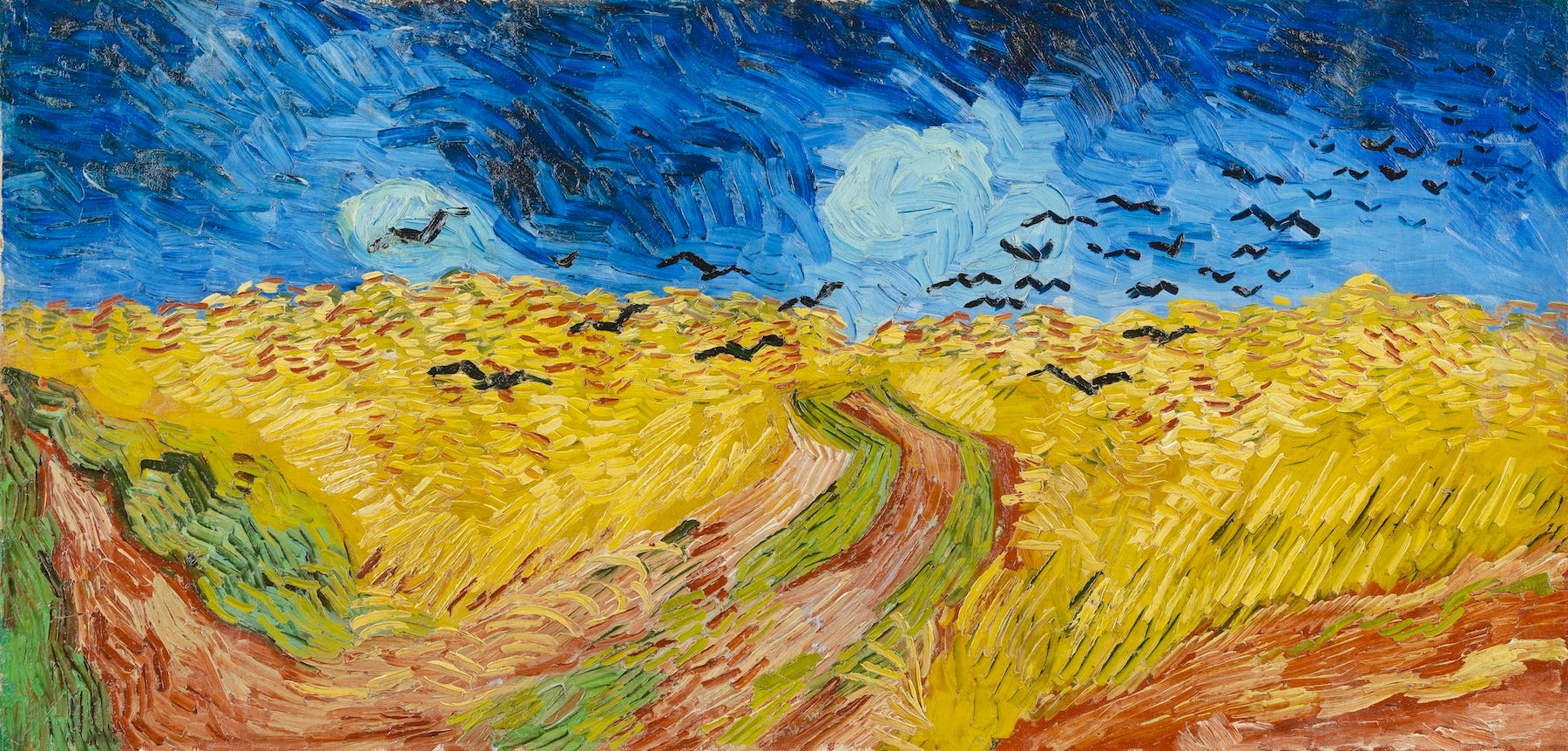
He told Theo and Jo what he was doing, and it is almost unbearable to read, because you can hear how tired he is:
The brush almost falling from my hands... I made a point of trying to express sadness, extreme loneliness.
But even here, the old fight was not entirely gone. In the very same breath, he added that he hoped these fields under the troubled sky could also say something he could not put into words, something he found “healthy and fortifying about the countryside.” That was Vincent to the very end, painting his own loneliness with the brush falling out of his hand, and still trying to show you that the world was beautiful.
It was here, in late July of 1890, that he walked out with his paints one last time. Two days later, at the age of thirty-seven, he was dead.
For a hundred years the story ended the same way: alone under that wide sky, he raised a revolver to his own chest. But it may not be that simple. In 2011, after years of research, two biographers put forward a different account. In their telling, Vincent did not shoot himself at all. He was shot, probably by accident, by one of a group of local boys who had been tormenting him that summer, a teenager with a malfunctioning pistol, playing at cowboys. And Vincent, they argue, knowing he was dying and having nothing left to lose, chose to protect him, telling everyone he had done it to himself so that no child would be blamed.
Most experts still believe he took his own life, and we will probably never know for certain. But sit with that second possibility for a moment: if he pulled the trigger, it was the final act of a man who had run out of hope, and that is sad enough. If a boy pulled it, then Vincent spent the last conscious days of his life shielding the child who had killed him, so that no one so young would carry the blame. That is the act of one of the most tender souls who ever lived, giving, right to the end, more than he ever got back. The manner of his death does not change the meaning of his life. He gave everything, and he never knew what was coming…
Because here is what was coming: Vincent died believing he was a failure, and he very nearly vanished from history, another obscure painter dead before forty with a pile of unsold canvases. That we know his name at all we owe, more than to anyone, to a woman most people have never heard of: Johanna van Gogh-Bonger, Theo’s wife.
Theo died just six months after his brother, and Jo, widowed at twenty-eight with a baby son, was left with hundreds of paintings the art world did not want and hundreds of letters no one had read. Everyone advised her to let it go. She refused. She spent the rest of her life organizing exhibitions, publishing Vincent’s letters so the world could finally hear his voice, and stubbornly making people see what she had seen. Her son, named Vincent after his uncle, would one day help found the museum in Amsterdam that bears the family name. The love of a brother, and then the devotion of that brother’s wife, is the reason a lonely man’s paintings ever reached us at all.
It took the world only a few decades to realize what it had thrown away. His paintings now hang behind glass in the greatest museums on earth, and every day people stand in front of them and feel their eyes sting, and cannot quite say why. Every honor a painter can be given, he has been given, and all of it arrived after he was gone. Long before the end, he had described his own life in a single sentence:
There may be a great fire in our soul, but no one ever comes to warm himself by it, and the passers-by see only a wisp of smoke.
They see the fire now, Vincent. The whole world came to warm itself at it. It only came too late for you to feel it.
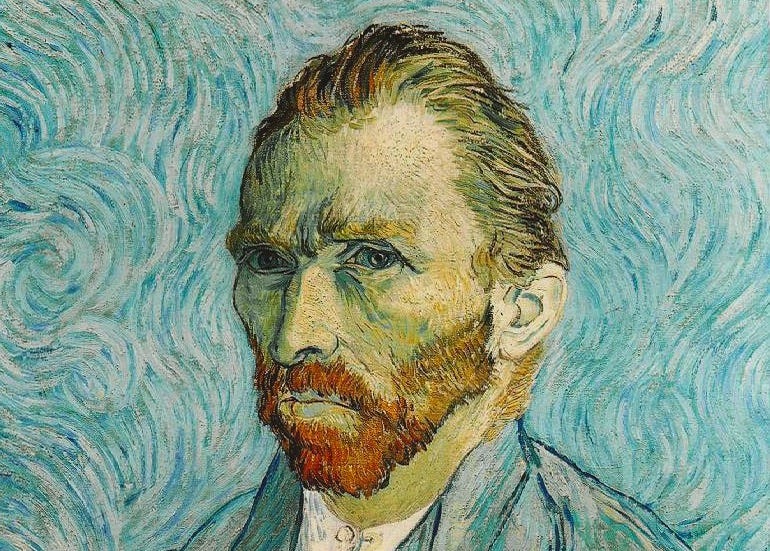
And maybe, just maybe, it is not too late after all. I have never watched Doctor Who, but I once saw a single episode of it, called “Vincent and the Doctor,” and it ends with a miracle I have never forgotten. Vincent is carried forward through time into a modern museum, where he stands in a crowded room and hears a man explain that this painter the world ignored is now the most treasured artist who ever lived. And you watch him understand, at last, that he mattered. I think about that scene more than I would like to admit. Because none of us truly knows what becomes of a soul when the body gives out, whether some spark of who we were goes on somewhere, out among the stars he loved. And if it does, then perhaps Vincent finally knows the thing he needed to hear his whole life: that he was never a nobody, and that he is loved now beyond anything he could have imagined.
Vincent believed, with all his heart, that death was not an ending but a passage, that we reach the heavens the way we take a train to another town. He said it himself, and I can think of no better words to leave you with, or to send up to him, wherever that irreplaceable soul has gone:
Why, I say to myself, should the spots of light in the firmament be less accessible to us than the black spots on the map of France. Just as we take the train to go to Tarascon or Rouen, we take death to reach a star.
Rest well, Vincent. You got there. And we love you.
Thanks for reading. Everything here, the research, the writing, all of it, is made by one person, with no team behind it, and no ads or sponsors influencing a single word. That independence is only possible because of my readers. If these pieces mean something to you, please consider becoming a paid subscriber for a few dollars a month, and unlock the full archive:
Every subscription genuinely makes a difference.
Thank you for helping keep this work alive.
I can now feel what he meant when he wrote:
If I am worth anything later, I am worth something now. For wheat is wheat, even if people think it is a grass in the beginning.
— Vincent van Gogh
Goosebumps, 💔.
That episode of Dr Who just made me weep. It intensified the sadness of his life and the beauty of his work. I too have stood in front of Starry Night consumed by the colors and brushstrokes. Thank you for this wonderful reminder of his life and work. I had never truly realized the role his sister in law played and the debt we owe her.