


On a family farm near Matamata, in New Zealand, forty-four front doors are set into the hillsides, and only a few of them open. For most people, especially those who haven’t read the books, that film set is what the Shire looks like, and the rest of Middle-earth comes from the movies too. We rarely stop to wonder how it looked to the man who dreamed it up...
Luckily, the answer is in his own hand, because Tolkien had been drawing and painting since he was a boy, and his estate describes him as “an accomplished amateur artist.” He sometimes broke off from writing to sketch, “in order to visualize the imagined scene more clearly,” something anyone who has paused over a book to picture a place will understand.
He was also fiercely particular about how his world should look, and he did not mind saying so: when his publisher felt that The Hobbit needed nothing but maps, Tolkien disagreed, and it went to press with his own drawings.
Yet The Lord of the Rings began appearing in 1954 with almost none of his art, and it took until 2021 for an edition to include thirty of his illustrations. For sixty-seven years, millions of readers followed Frodo all the way to Mount Doom without once seeing the places as Tolkien had seen them...
Today, his pictures feel like a glimpse over his shoulder, even for fans who have been there and back again many times. Before Middle-earth belonged to everyone and grew dear to so many hearts, it belonged to an Oxford professor with a paintbrush, who was working out what lay over the next hill before his characters got there.
So let’s begin in the Shire, with a warning Frodo remembered from Bilbo as he left home: “It’s a dangerous business, Frodo, going out of your door,” he used to say. “You step into the Road, and if you don’t keep your feet, there is no knowing where you might be swept off to.”
REMINDER: Beauty is Truth is entirely reader-funded. There are no ads here, only independent writing devoted to celebrating beauty. And it can only continue with your help.
If my posts have meant something to you, becoming a paid subscriber is the most meaningful way to support this work. With the new annual subscription discount, it costs less than a coffee a month. Join here:
Gift subscriptions to Beauty is Truth are now available too. Beauty is best when it’s shared, so if a friend or family member comes to mind, consider passing a little of it into their inbox:
1. In a Hole in the Ground
One day, while marking exam papers in what he called “the everlasting weariness of that annual task forced on impecunious academics with children,” Tolkien found a blank page and wrote:
In a hole in the ground there lived a hobbit.
“I did not and do not know why,” he later confessed to the poet W.H. Auden, and for a long time the line led nowhere, until it became The Hobbit in the early 1930s. Even then, the story offers few details of Hobbiton itself, so he had to find its shape on paper, trying out the Hill and Bag-End again and again before he settled on this view. It first appeared in black and white, and he soon redid it in watercolor for the book’s American debut:

The Bodleian, which holds the original, notes that by capitalizing the Hill and the Water, Tolkien gently teases a people who think their own small corner is the whole world… their land doesn’t even have a name yet, and it took The Lord of the Rings to reveal it as the Shire.
The fields around Hobbiton are the countryside he loved as a child: he was born in South Africa and only arrived in England at three, but between the ages of four and eight he roamed Sarehole, a village outside Birmingham. “I was brought up in considerable poverty,” he recalled, “but I was happy running about in that country.” The great mill in the foreground, with its little tower, is modeled on the one there, whose miller would chase Tolkien and his brother away and earned the nickname “the White Ogre.”
Inside the Hill is Bilbo’s hall, and the second sentence of The Hobbit tells us what to expect: “it was a hobbit-hole, and that means comfort.”
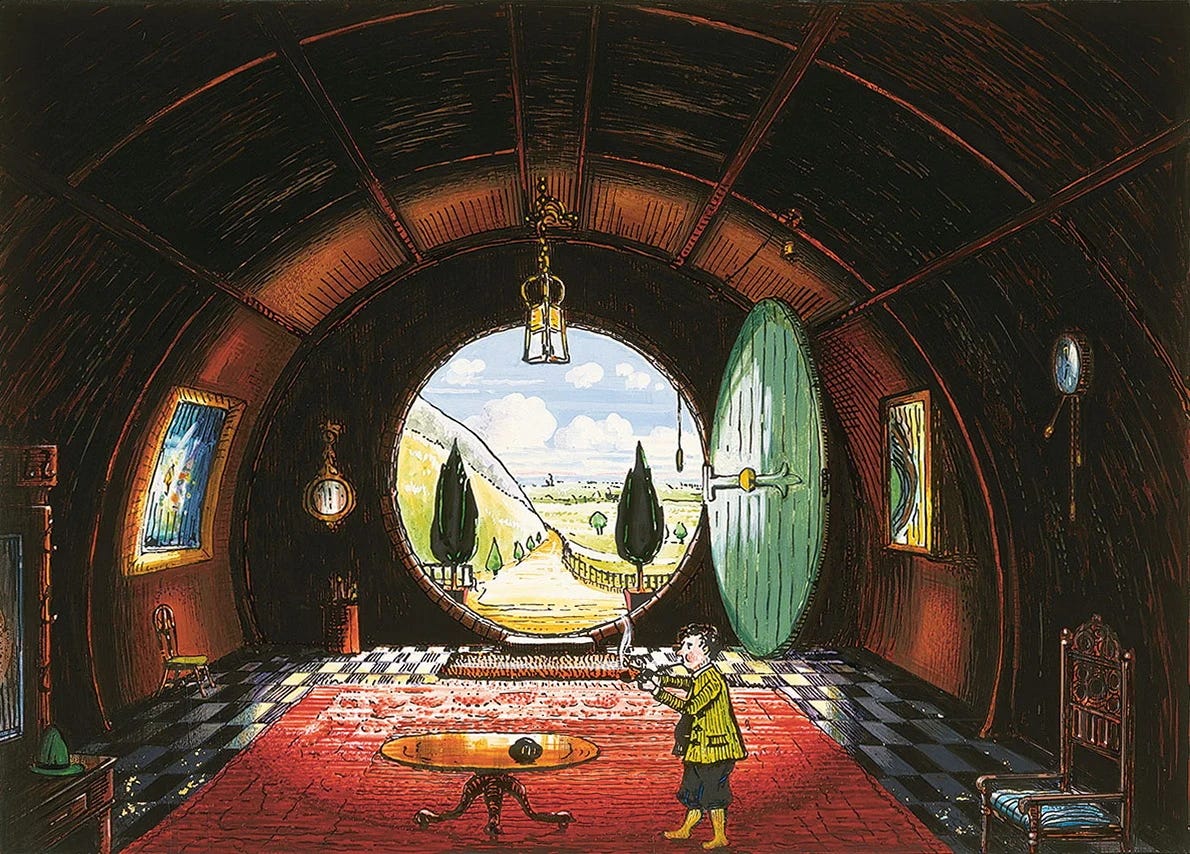
Tolkien furnished it as the hallway of a well-to-do English household of the 1930s, with one difference: it is perfectly round. Even the name Bag End was borrowed from his aunt’s house in Worcestershire, so the comfort of this hall is built from places Tolkien himself knew. Before sending Bilbo out into the wild, he gave him every reason to stay...
2. The Silvertine of His Dreams
On the way east, Bilbo and the thirteen dwarves of Thorin’s company stop at Rivendell, the Last Homely House, hidden so well that strangers could easily miss it. “Evil things did not come into that valley,” Tolkien promises, and he produced five versions of it, before reaching this composition:
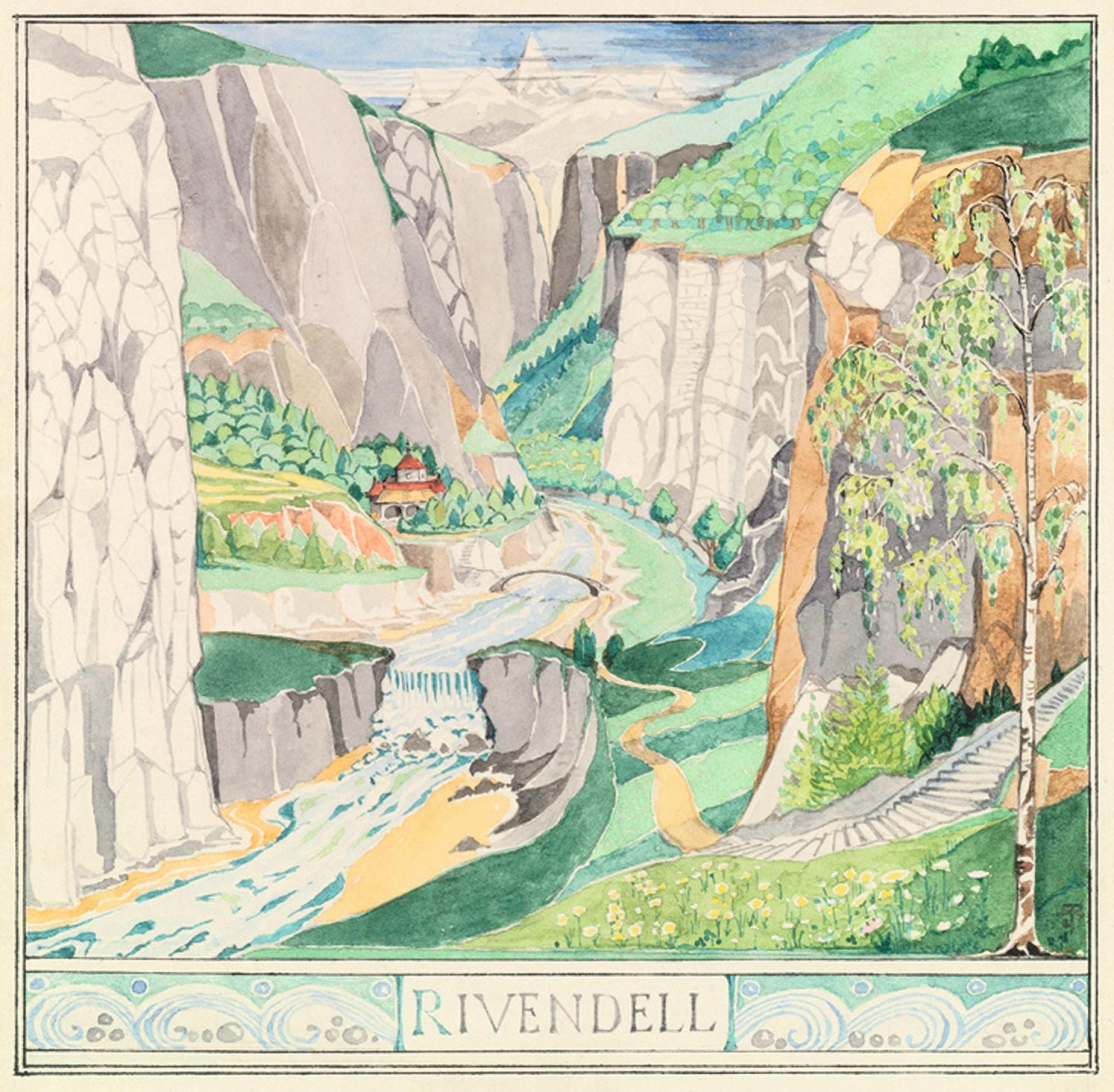
The word “Rivendell” says exactly what we see, a “riven dell” carved out by the river, and in this final version he pulled the mountain walls closer together to deepen the chasm that shelters Elrond’s hideaway. Its cliffs belong to the Misty Mountains, and Tolkien had stood among peaks like them himself…
In the summer of 1911, which he would hail as “the annus mirabilis of sunshine,” a nineteen-year-old Tolkien walked through the Swiss Alps with “a party of 12,” sleeping rough, “often in hayloft or cowbyre.” On the way he saw “the Silberhorn sharp against dark blue: the Silvertine (Celebdil) of my dreams.”
In his seventies, he told his son Michael that Bilbo’s crossing of that range, “including the glissade down the slithering stones into the pine woods, is based on my adventures.” In The Hobbit, that slide ends with wolves trapping the travelers up the pines before the eagles lift them to safety. In the morning, “Bilbo woke up with the early sun in his eyes. He jumped up to look at the time and to go and put his kettle on,” and then realized he was miles from his kitchen:
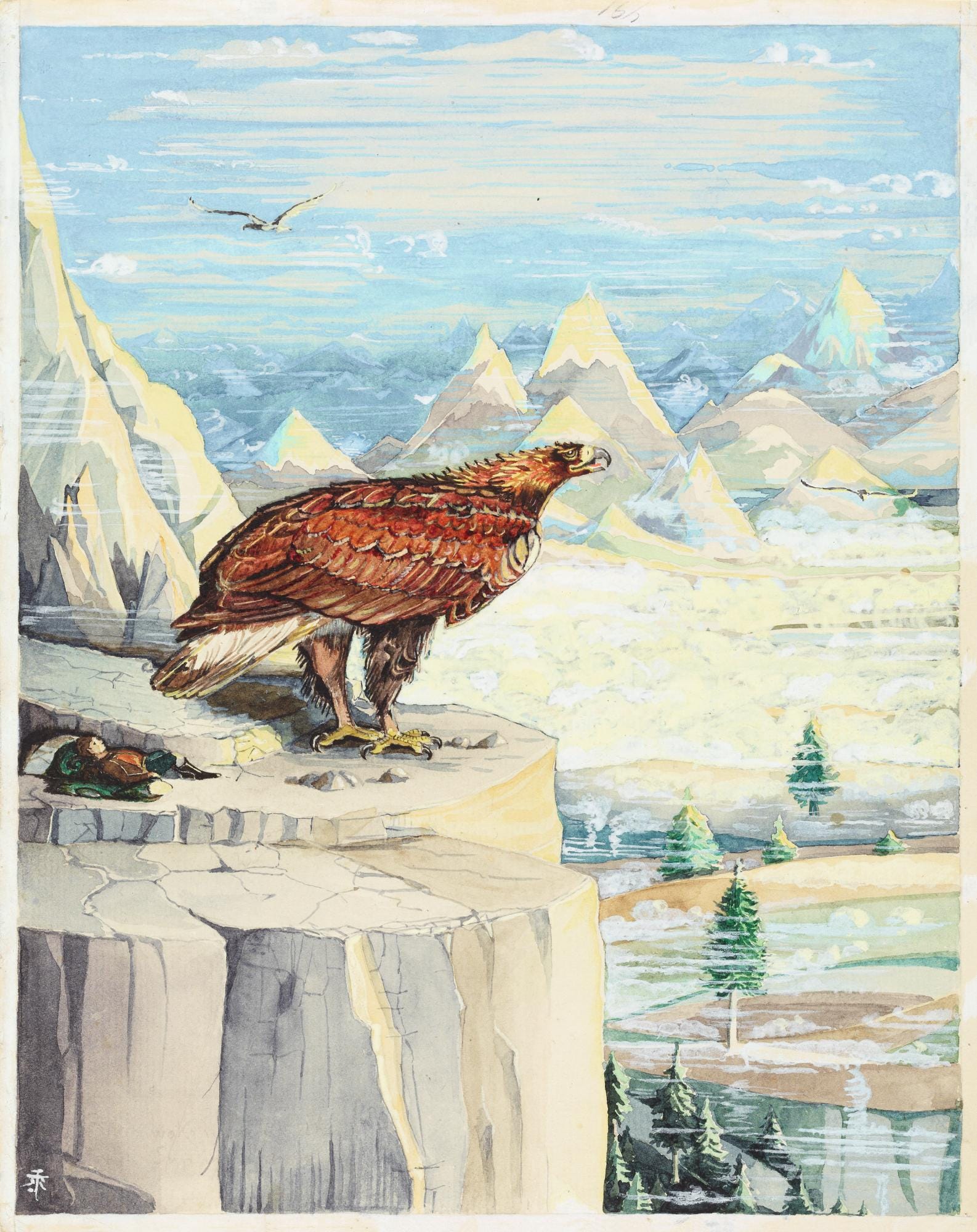
The sunrise is a warm yellow, set off by a chilly sky, and the whole skyline seems to wake up with Bilbo. He was nineteen when the Silberhorn caught his eye and forty-five when he painted this. Some mountains we see only once, and climb for the rest of our lives...
3. His Favorite Painting
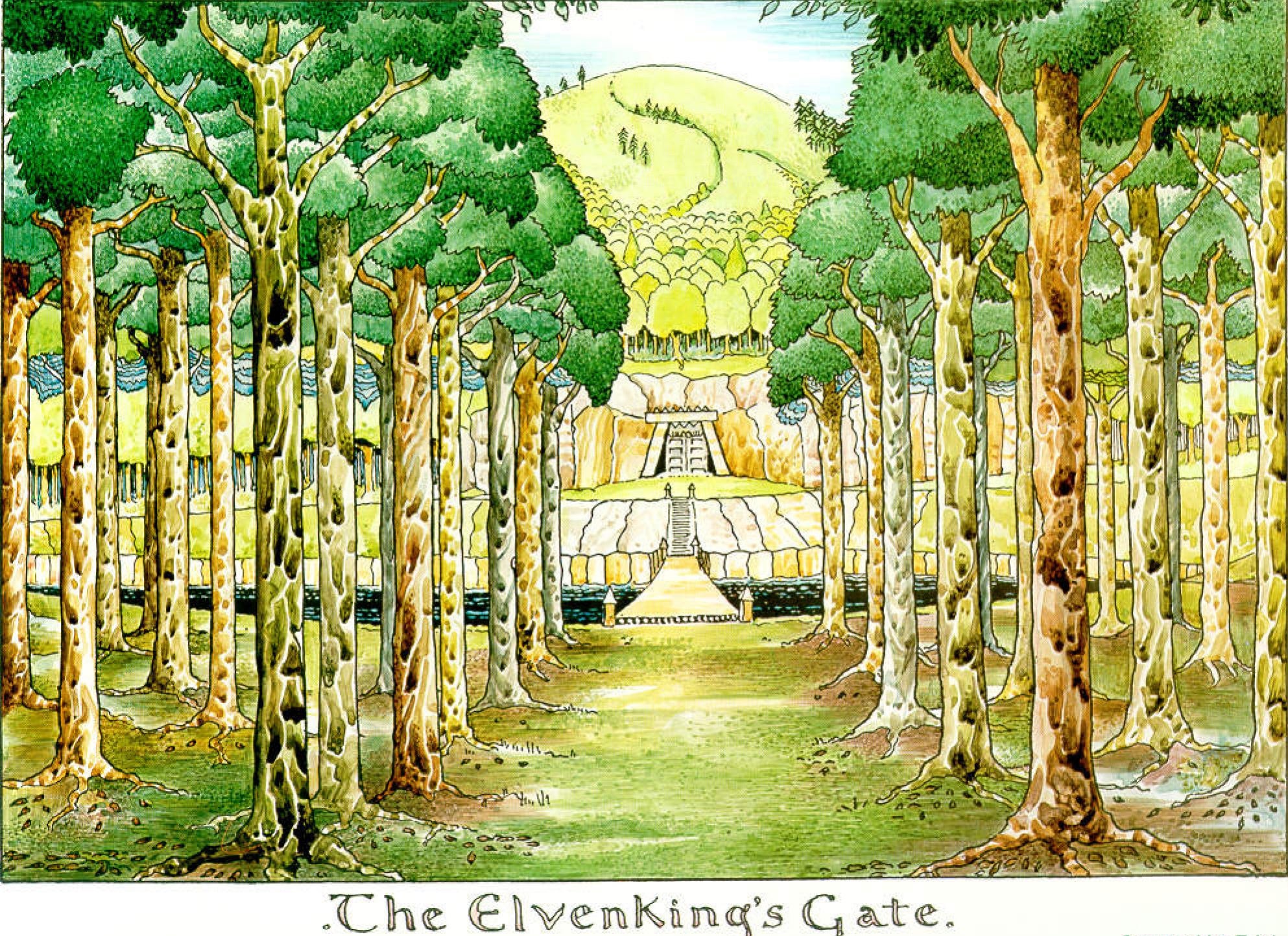
Deep in Mirkwood, the dwarves are seized by the Wood-elves and thrown into the dungeons of the Elvenking. Tolkien tested eight designs for the entrance to his halls, playing with the form of the gate and the angle he drew it from, and this one, the most striking of them all, was chosen for publication:
Here the respectable hobbit finally becomes a burglar: invisible thanks to his ring, Bilbo packs his friends into barrels and rides on top of one as they drift off. “At last Mr Baggins came to a place where the trees on either hand grew thinner,” Tolkien writes. “He could see the paler sky between them. The dark river opened suddenly wide.”
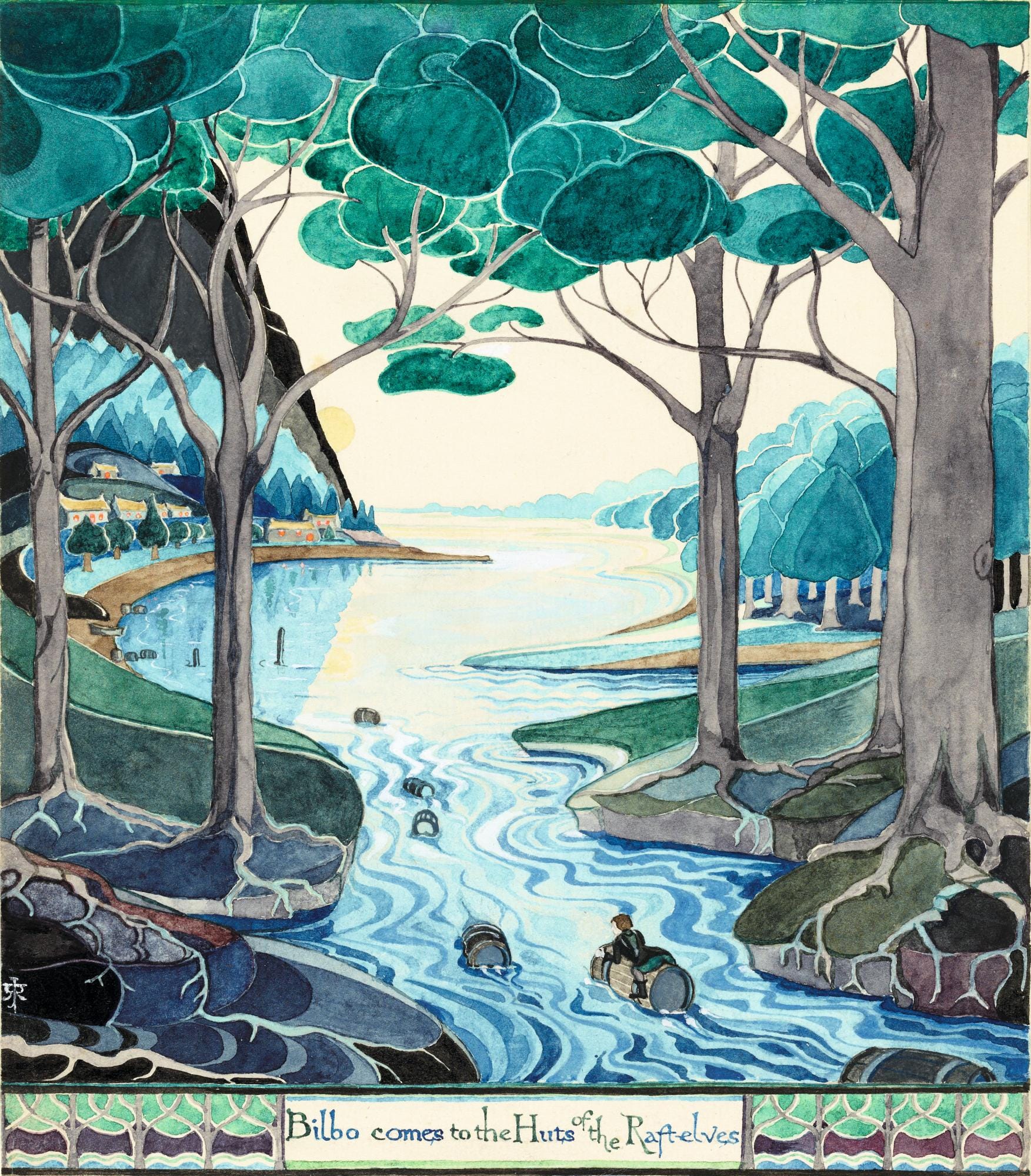
The current leads the eye out from under the forest’s eaves into pale light, framed by branches above and enormous roots below. In the text, Bilbo arrives in the middle of the night, and an earlier attempt showed moonlight, but Tolkien wanted daylight. This was his favorite, the one “where he felt he had captured the scene most successfully,” and he was disappointed when the first United States edition left it out.
The Art Nouveau border at the bottom follows a rule from his lecture “On Fairy-Stories,” in which he argued, “An enchanted forest requires a margin, even an elaborate border.” Printing one edge to edge, “as if it were indeed a ‘snap’ of fairyland,” was to him “a folly and an abuse.”
4. A Curse in Plain Sight
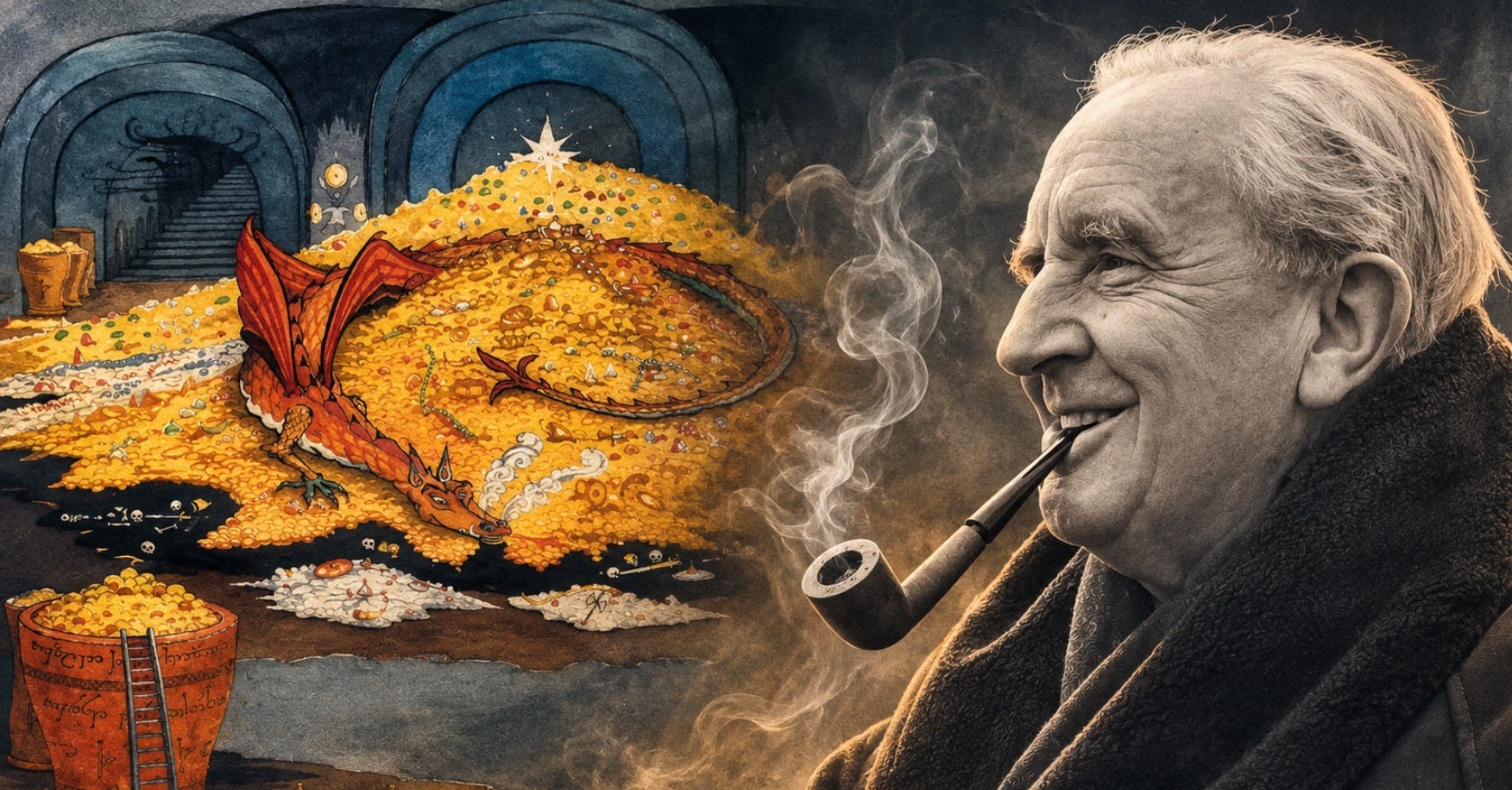
Dragons had fascinated Tolkien from childhood, and in that letter to Auden he wrote, “I first tried to write a story when I was about seven. It was about a dragon.” In The Hobbit, Bilbo creeps down a tunnel into the dragon’s lair and comes face to face with Smaug, whose name Tolkien called “a low philological jest,” since it is the past tense of an ancient Germanic verb meaning to squeeze through a narrow gap…
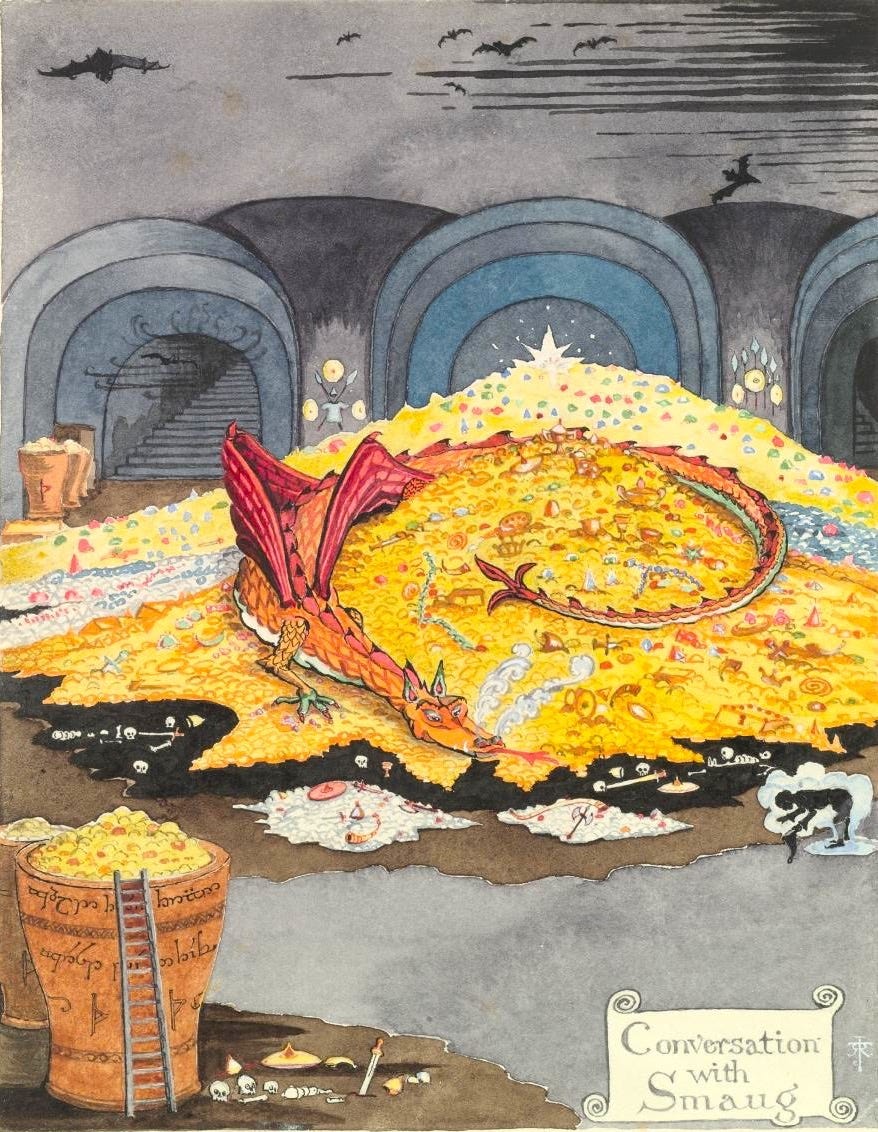
Smaug’s tail is curled possessively around his hoard, while Bilbo, wrapped in a cloud that hides him, “is taking no chances and makes a deep bow to appease the dragon.” The nearest jar is so tall that a hobbit would need a ladder to reach into it, and the signs cut into it introduced Tolkien’s Elvish alphabet to the public. No one could decipher them before the appendices of The Lord of the Rings supplied the key in 1955, and they turned out to be a curse on thieves.
Allen & Unwin were so impressed by what he had sent that they asked him for the jacket too, and he spent the Easter vacation of 1937 on it:
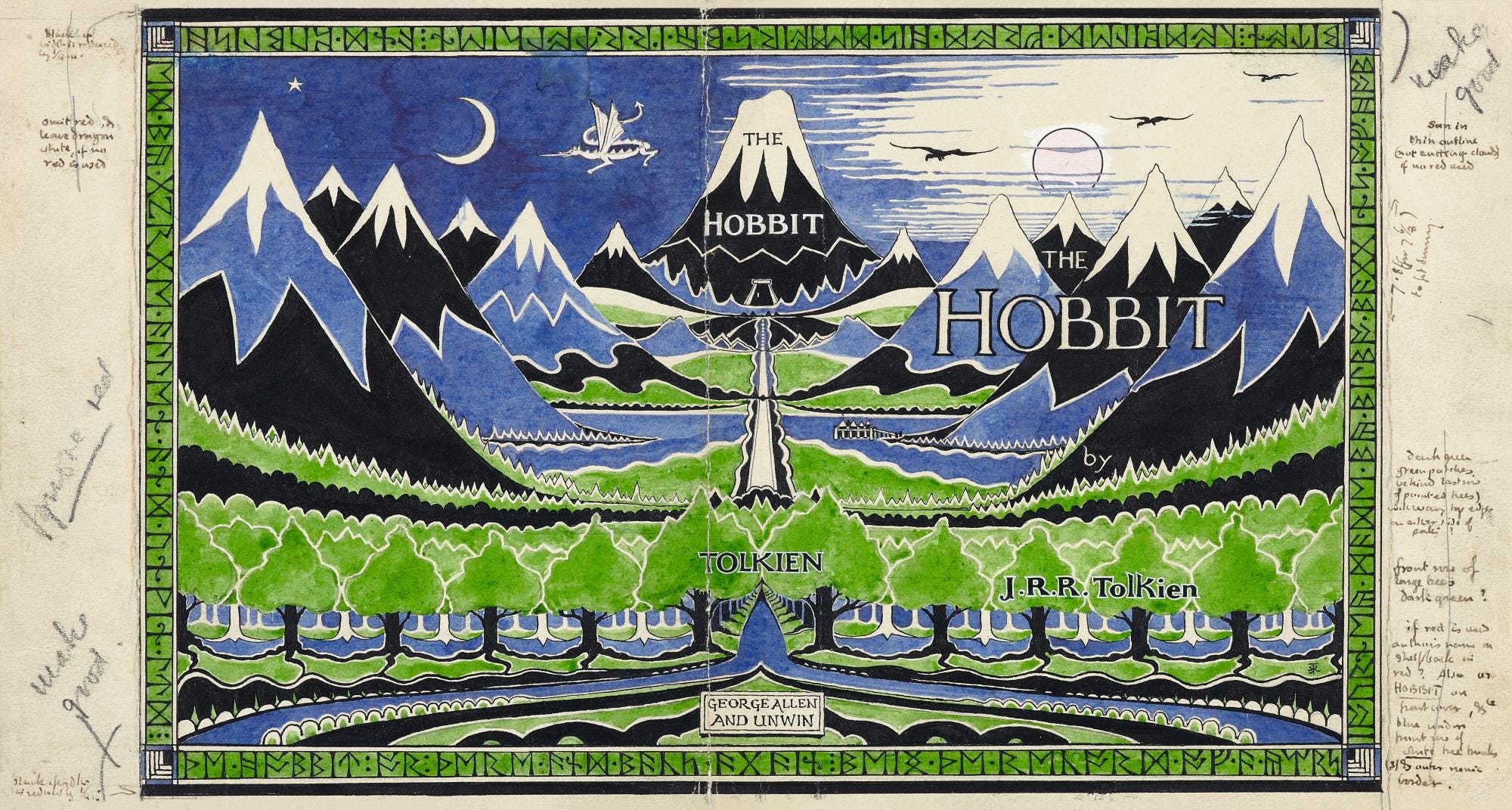
On the back, Smaug flies in the night sky, and the Anglo-Saxon runes along the outside simply spell out the book’s credits. Tolkien hoped for more red, but another color was too costly to print. His editor still replied, “Nobody but the creator of the Hobbit could have produced something so suitable,” and the scholars Wayne Hammond and Christina Scull call it “one of the most distinguished British dust jackets of the twentieth century.”
5. They Are Coming
In The Lord of the Rings, the Fellowship descends into the Mines of Moria and reaches the Chamber of Records, where the chronicle of Balin’s lost colony lies “slashed and stabbed and partly burned.” Tolkien insisted on authenticity, so he forged three of its sheets, charring the edges with his own smoldering pipe and piercing holes where the binding would go. Then he washed them with paint “to resemble dried bloodstains.”
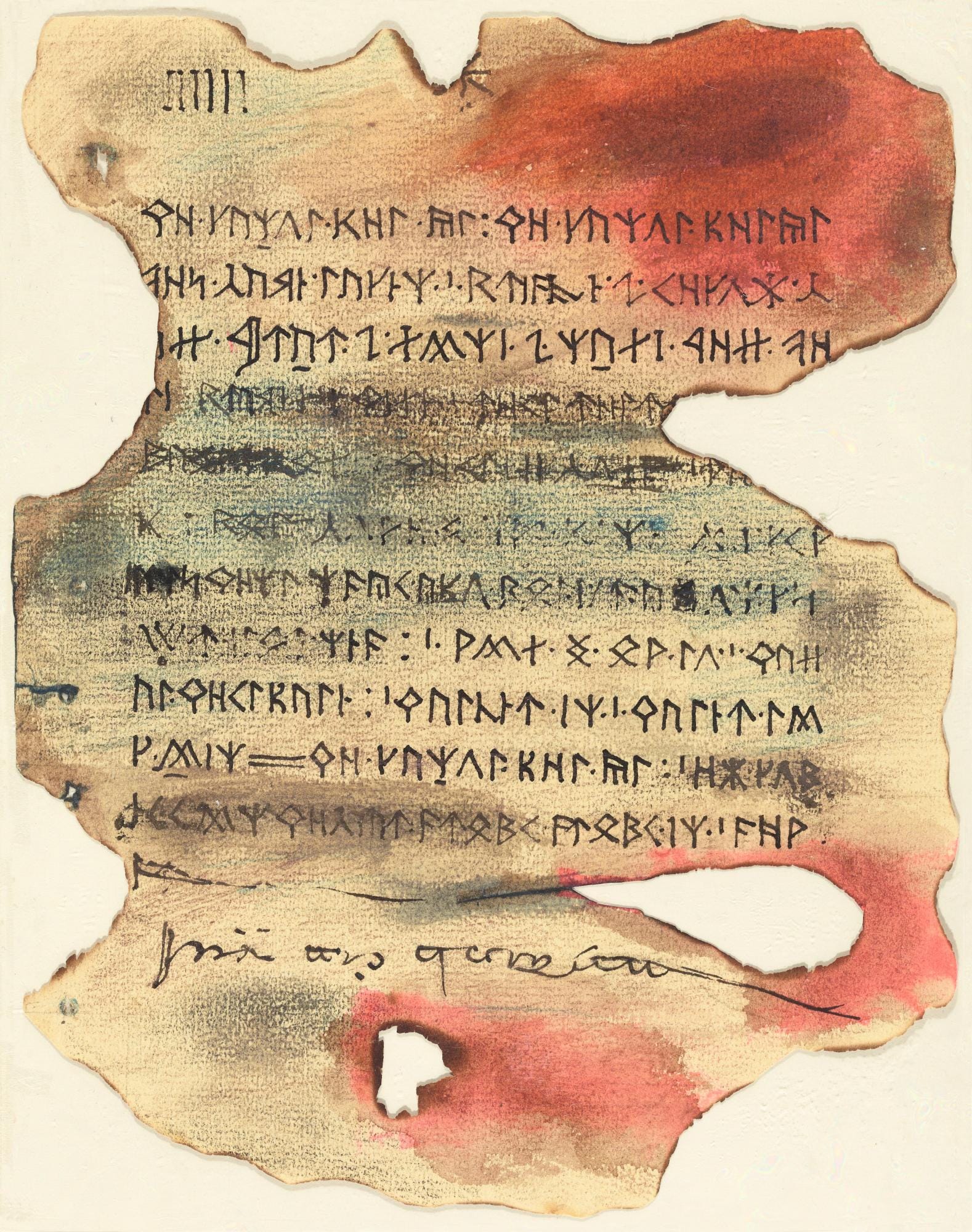
Gandalf can only make out fragments of the last page, the final entry of dwarves trapped deep underground:
We cannot get out. The end comes... drums, drums in the deep... they are coming.
Tolkien wanted the pages printed in the book as exact copies, but the expense proved a step too far, and they had to wait until 2004 to be published.
After the horror underground and the loss of their wizard, the Fellowship finds refuge in Lothlórien, “the heart of elvendom on earth.” Tolkien depicted its mallorns purely for pleasure, with no plan to share them:
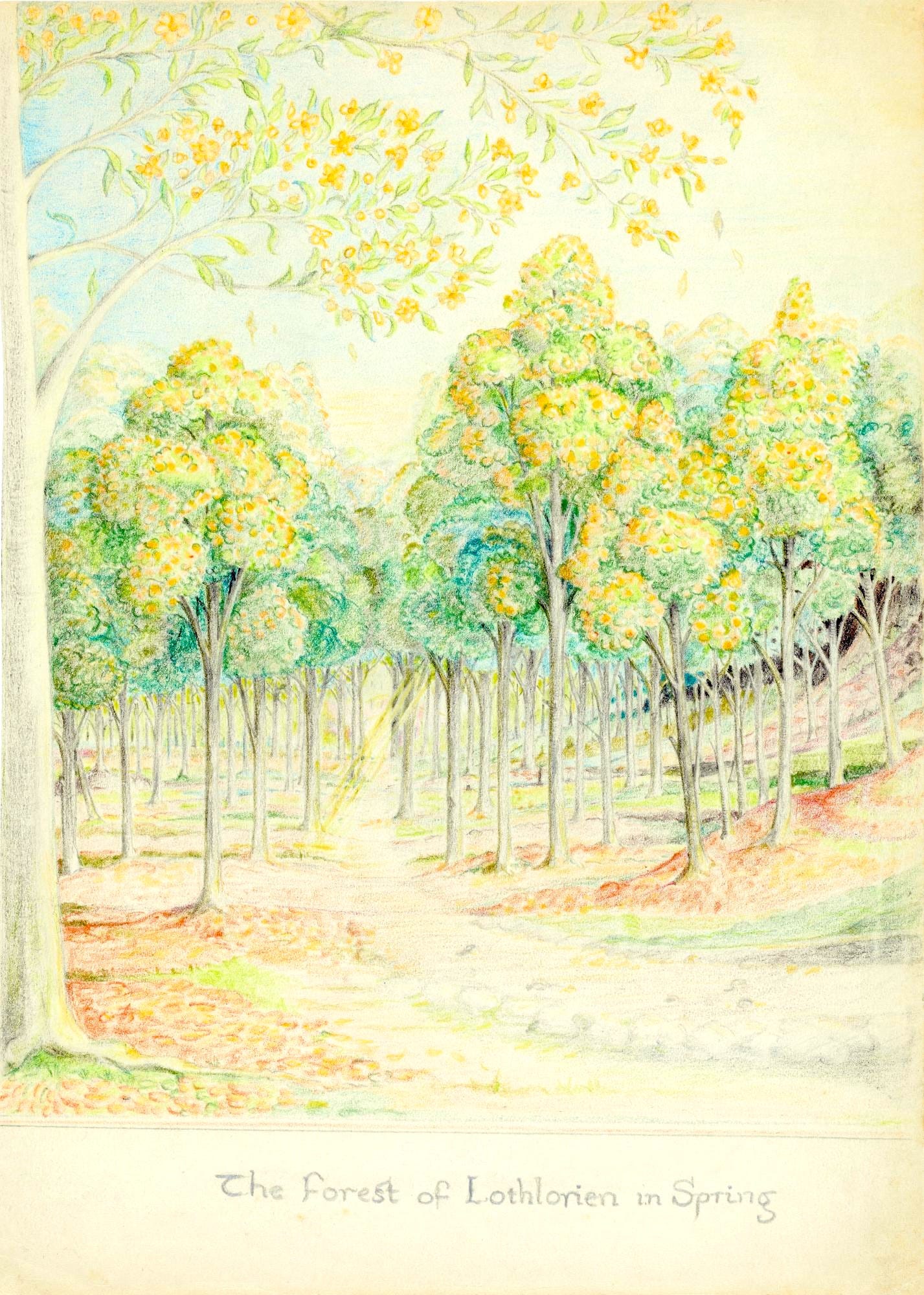
They hold on to their leaves all winter, and only when the new green opens in spring do the old ones fall “in a golden carpet.” “I am (obviously) much in love with plants and above all trees, and always have been,” he confided, and with this drawing he seemed to promise that beyond each Moria waits a Lothlórien...
6. An Almost Forgotten Sunlight
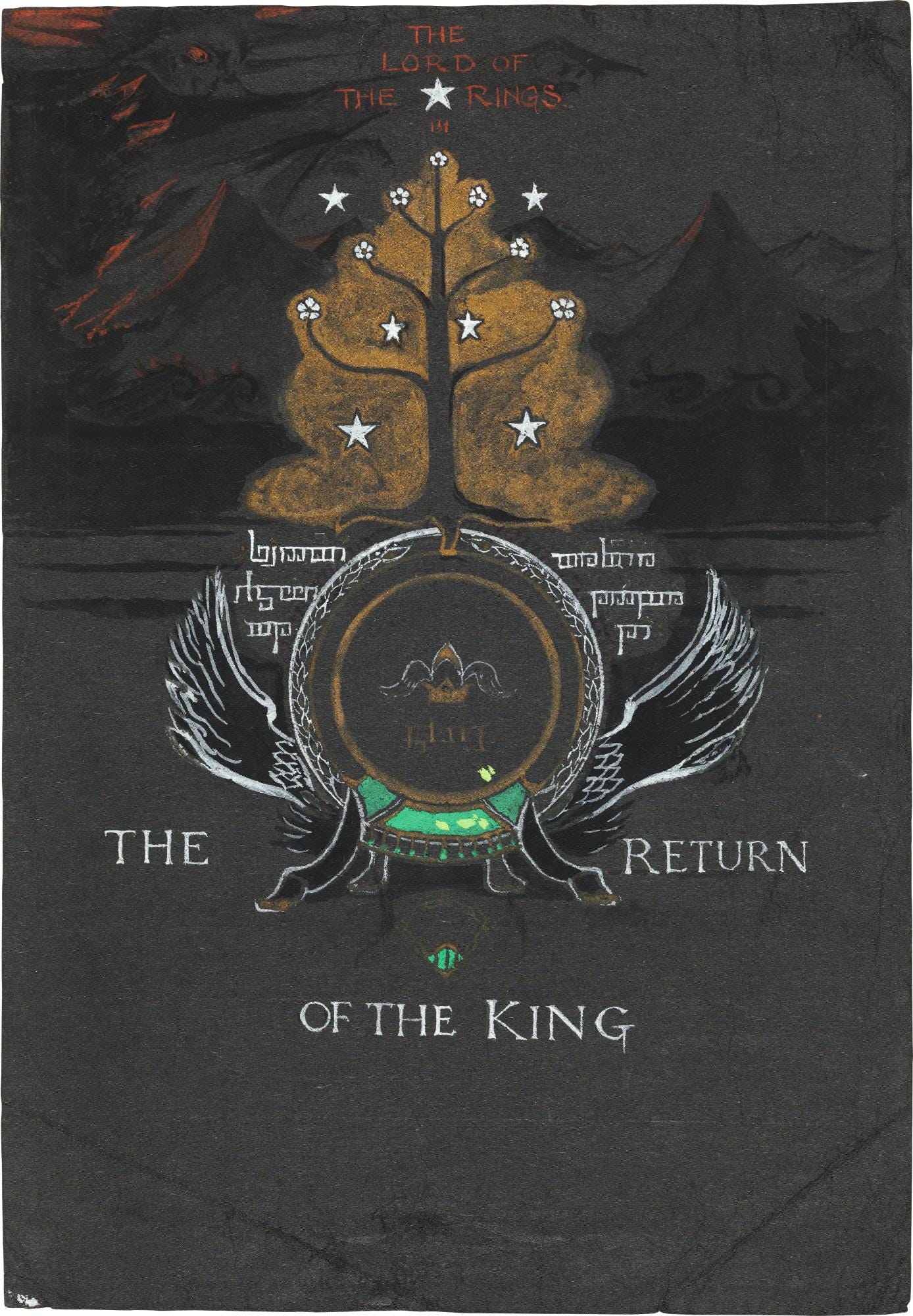
Sauron goes undescribed in The Lord of the Rings, “a deliberate omission allowing the reader’s imagination free rein.” The Dark Lord is only an Eye and a shadow in the east, and the one exception is this study for the jacket of The Return of the King, from March 1954:
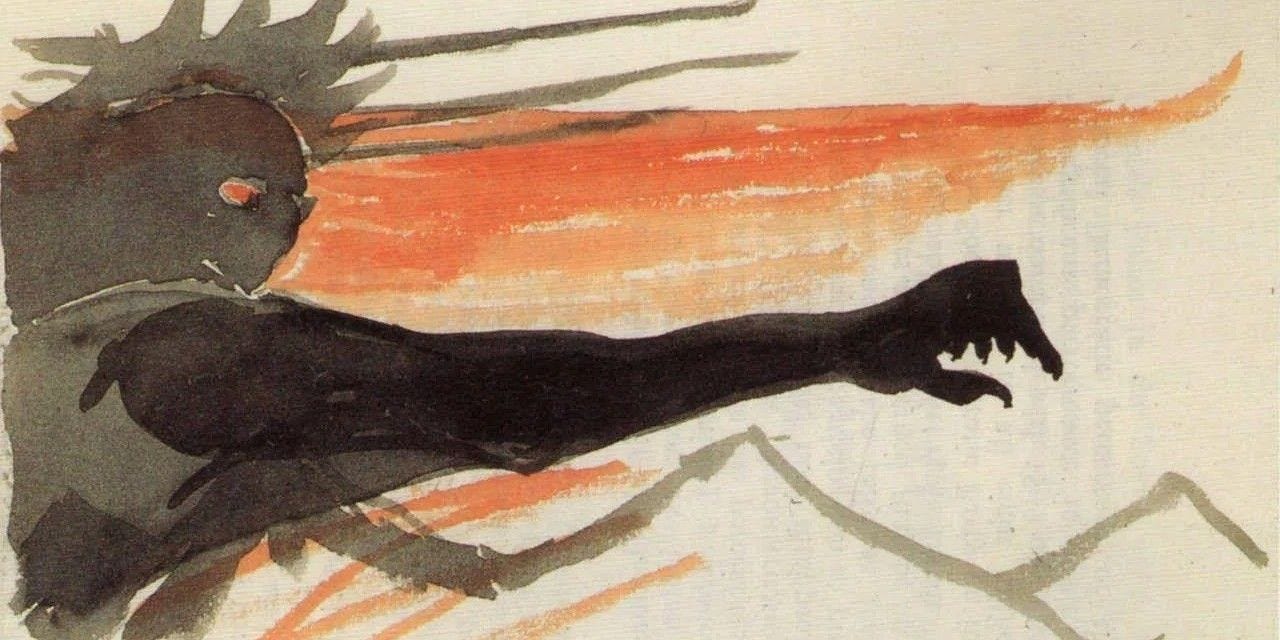
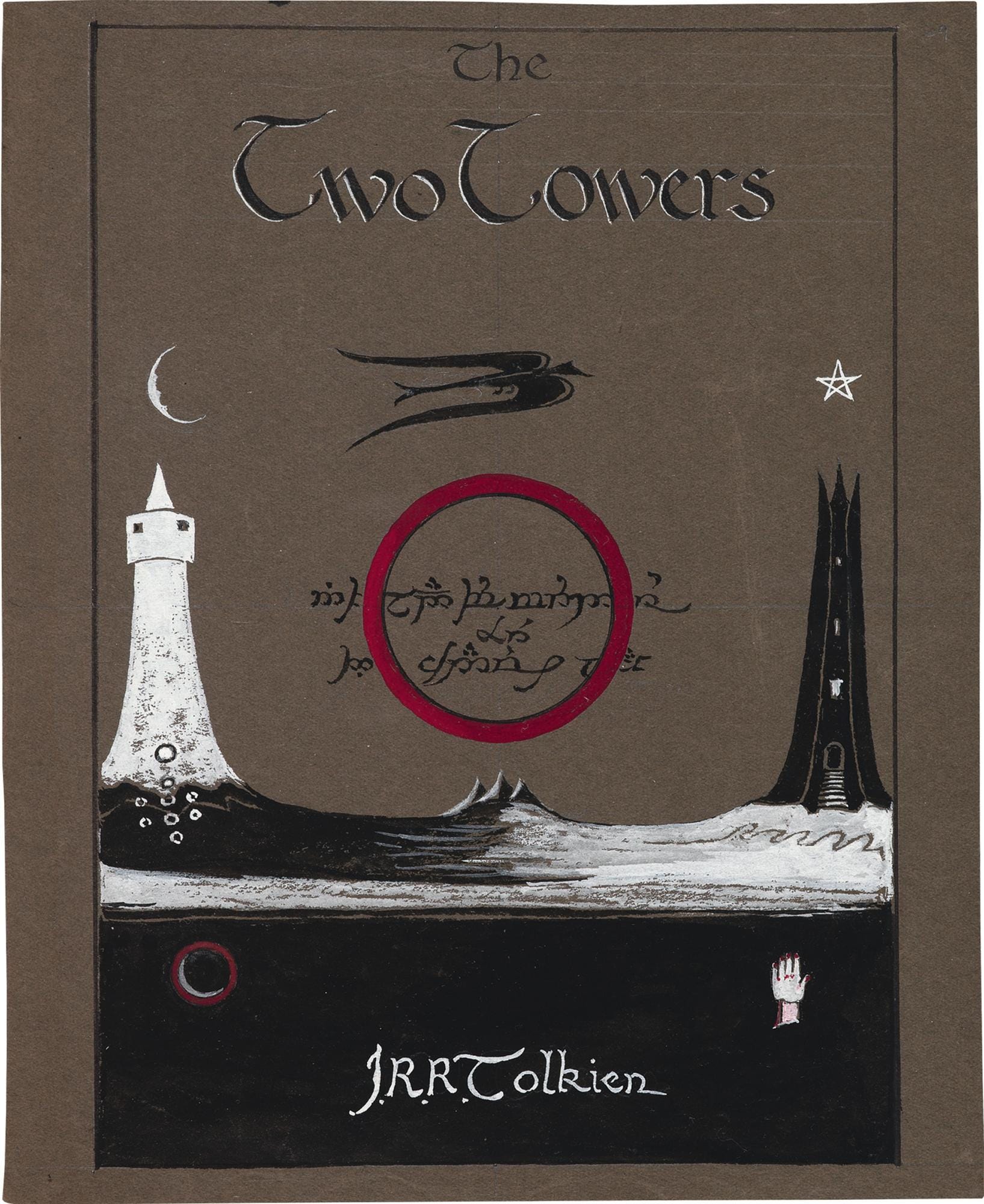
It was all of him he would show us, and it was part of a bigger project. That March, Tolkien worked on jackets for all three books, and for The Two Towers, he was forced to decide which towers the title referred to, since “up to this point it had been left deliberately ambiguous.” He chose Minas Morgul, the white tower held by the Lord of the Nazgûl, and Orthanc, Saruman’s black tower, and placed the One Ring at the center, its script reading, “In the land of Mordor, where the shadows lie.”
For The Return of the King, he planned “The empty throne awaiting return of the King,” with an inscription of Elendil’s words, “In this place will I abide and my heirs until the World’s end.” Behind the throne are “seven stars and one white tree,” and from the top left corner, Sauron’s arm reaches in.
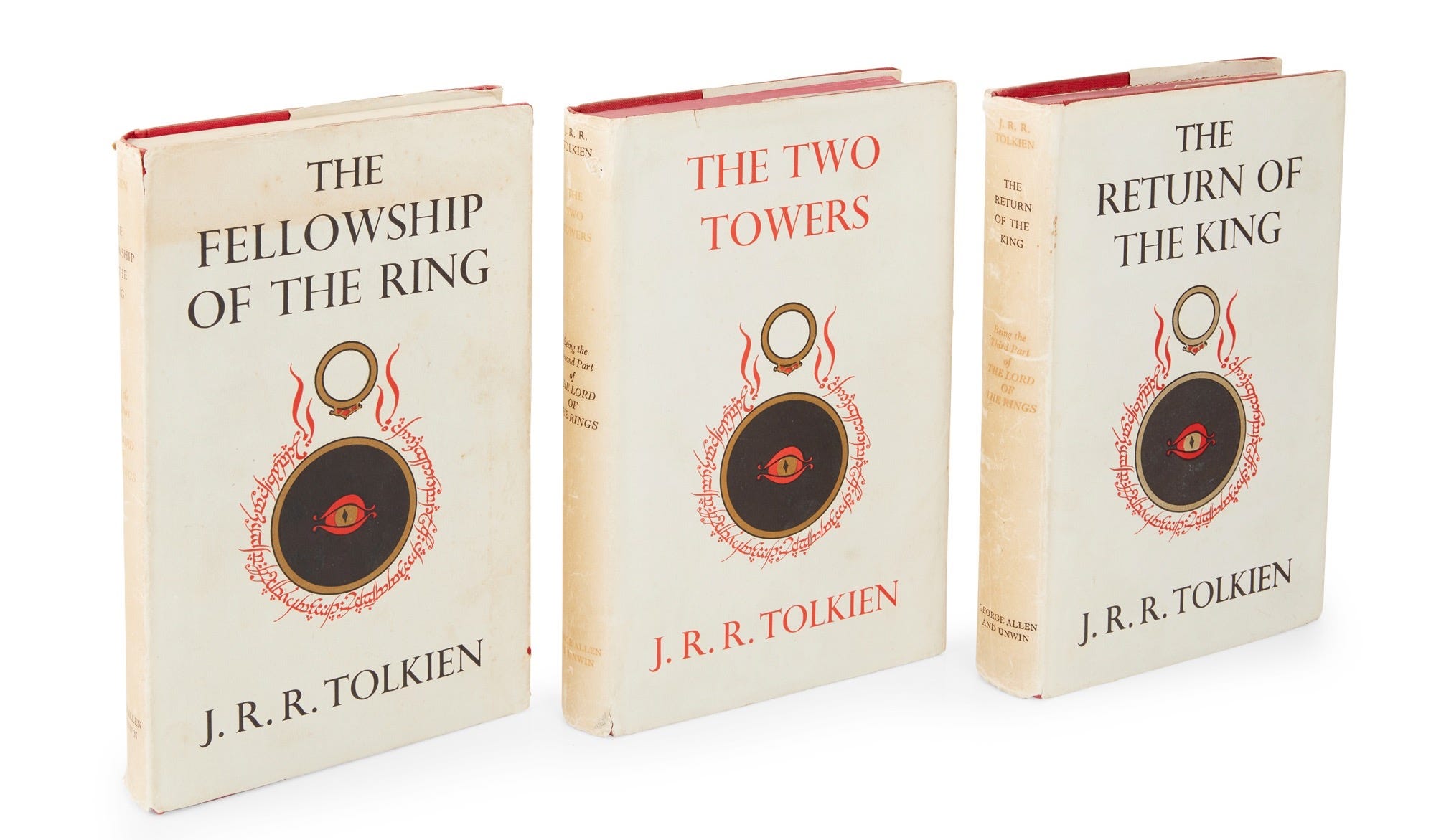
As the release date neared, it was agreed, with Tolkien’s blessing, that a single design “would create a stronger identity,” so all three volumes were issued in a jacket he had drawn for The Fellowship of the Ring.
This is how they first appeared in 1954 and 1955:
In the autumn of 1971, at seventy-nine and less than two years before his death, Tolkien wrote to a reader named Carole Batten-Phelps about everything that had followed the book’s publication. He felt “as if an ever darkening sky over our present world had been suddenly pierced, the clouds rolled back, and an almost forgotten sunlight had poured down again.” Then he asked, “But How? and Why? I think I can now guess what Gandalf would reply.”
His answer took the form of a story, and fittingly for this article, it was about pictures. A few years earlier, a well-known visitor whose name he had since forgotten came to see him in Oxford with a curious idea: “many old pictures seemed to him to have been designed to illustrate The Lord of the Rings long before its time.” He wanted to know whether Tolkien had drawn on them, but Tolkien “had never seen the pictures before and was not well acquainted with pictorial Art.”
The visitor fell silent and looked at him fixedly, then asked, “Of course you don’t suppose, do you, that you wrote all that book yourself?” To Tolkien, it was “Pure Gandalf!” and he said only, ‘No, I don’t suppose so any longer.” It was, he wrote, “an alarming conclusion for an old philologist to draw concerning his private amusement.”
He quickly added that this was no reason for pride, since anyone chosen for such work is imperfect and can seem woefully unfit for it. The visitor’s question echoes Gandalf’s on the last page of The Hobbit, back at Bag End, when he tells Bilbo, “you had a hand in bringing them about yourself,” and asks whether all those adventures and escapes were “managed by mere luck.”
“You are a very fine person, Mr. Baggins, and I am very fond of you,” Gandalf says, and yet he is still “a little fellow in a wide world after all!” “Thank goodness!” laughs Bilbo, passing his old friend the tobacco jar. Every time we open Tolkien’s books or look at his paintings, we stand where Bilbo stood, small and grateful inside a story far wider than ourselves...
Thanks for reading. Everything here, the research, the writing, all of it, is made by one person, with no team behind it, and no ads or sponsors influencing a single word. That independence is only possible because of my readers. If these pieces mean something to you, please consider becoming a paid subscriber for a few dollars a month, and unlock the full archive:
Every subscription genuinely makes a difference.
Thank you for helping keep this work alive.
Thanks James. This article is excellent and really stirred 'something' in me. As if I had somehow seen the illustrations here before. And yet I had only ever read The Hobbit a part of the English school curriculum back in the 70's when I was 12-13. I have never read any more of Tolkien's work and in my ignorance, knew nothing about him at all and so haven't really had an interest in the books etc, such as The Lord of the Rings, which I know is so revered. And yet as an artist his illustrations feel so familiar to me. Now I feel compelled to find an illustrated book of his to buy.
Tolkien’s illustrations convey so much to us readers about middle-earth. They complement the prose perfectly. Tolkien was a multitalented genius.