


The documentary photographer Dorothea Lange once said that “photography takes an instant out of time, altering life by holding it still.”
I have always struggled to make sense of time, and the older I get, the more it seems to me that a photograph is the closest thing we have to a time machine…
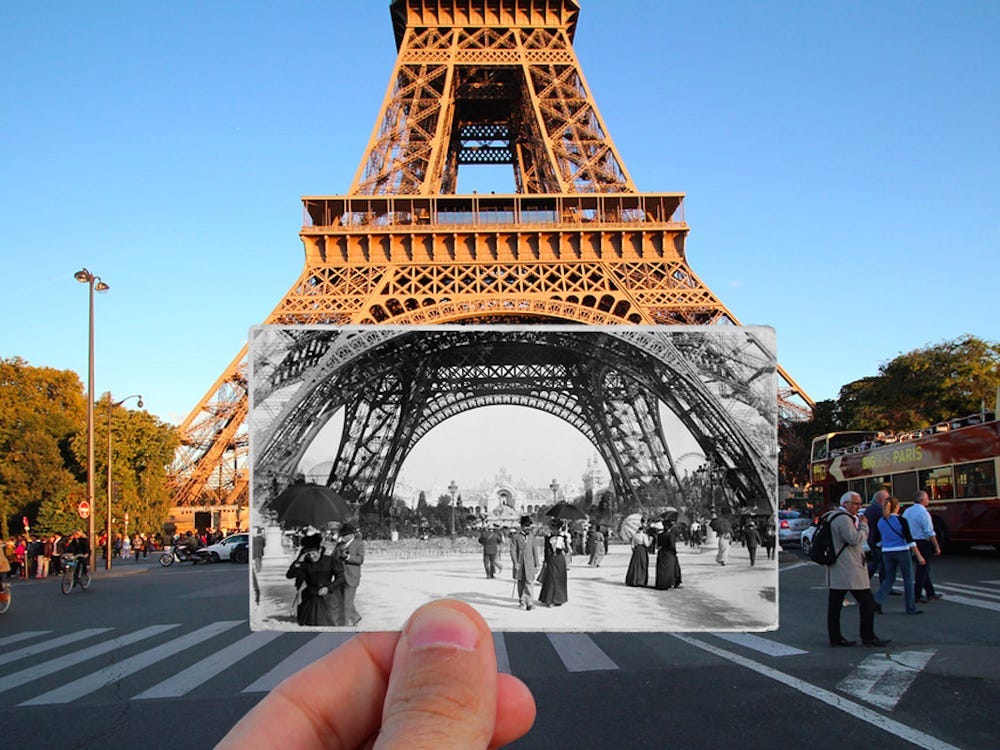
A photo does not simply record what something looked like, but instead catches a single instant that will never come again and lets us hold it in our hands decades, sometimes centuries later. As Karl Lagerfeld put it:
What I like about photographs is that they capture a moment that’s gone forever, impossible to reproduce.
And something strange happens when you set two of those frozen instants beside each other: the same place, the same face, separated by years. The distance between them is where you suddenly feel time itself. It stops being an idea and becomes something you can almost reach out and touch.
Because time is the strangest thing we live inside. We never actually see it move. We only ever see what it leaves behind: the ruin of a great wonder, or a line on your own face that you notice one morning for the first time, though it had been forming for years while you were busy looking at everything else.
What follows are 8 comparisons, and some of them genuinely changed the way I see the world. They’re not much to look at on their own. It is only when you see the two of them together that you realize how much can change, how fast it can happen, and how little of it we notice while we are living through it…
REMINDER: Beauty is Truth is entirely reader-funded. There are no ads here, only independent writing devoted to celebrating beauty — and it can only continue with your help.
If you’ve been thinking about supporting my work, becoming a paid subscriber is the most meaningful way to do it:
With the new annual subscription discount, it costs less than a coffee a month, and it is what keeps all of this going.
Gift subscriptions to Beauty is Truth are now available too:
1. Wounds of the Earth
Across the fields of northern France and Belgium, the Western Front stretched for more than 700 kilometers of mud, wire, and men. Over four years, roughly 1.5 billion artillery shells were fired along it. When the guns finally stopped in November 1918, the landscape had been so completely destroyed that farmers returned to find their villages and fields had vanished.
A century later, the grass has grown back…
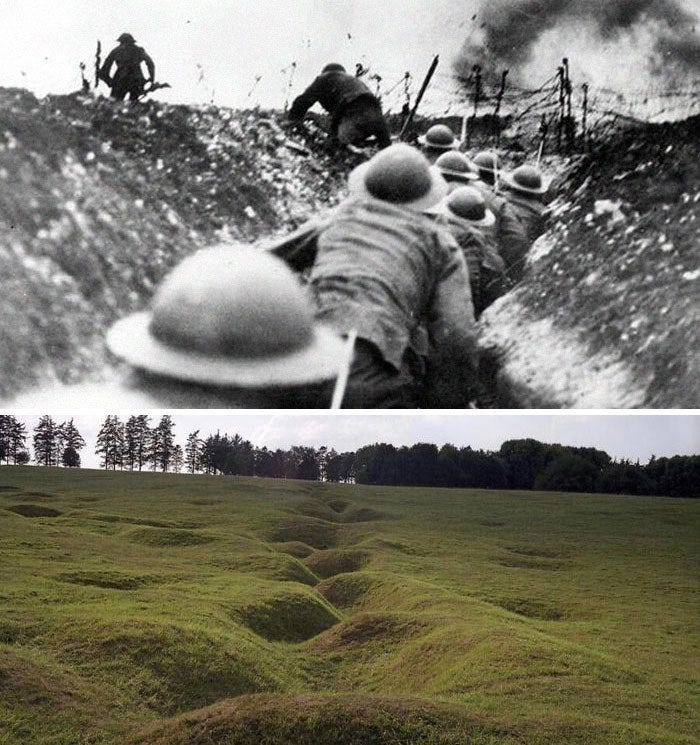
The trenches are still there — you can even trace their lines from the air — but nature has drawn a soft green veil over all of it. The craters where shells exploded are now gentle dips in a meadow. The places where men lived and died underground are covered in wildflowers.
There is something in this comparison that is almost impossible to sit with. All that suffering, all that terror, all those lives, and the earth simply absorbed it and moved on. What is left is an ordinary field. And if you did not know what had happened there, you might walk through without a second thought…
2. Hidden in Plain Sight
When this photograph of El Castillo was taken in 1863, the most famous pyramid in the Maya world was barely visible. It was a mass of stone almost entirely swallowed by jungle, indistinguishable from the surrounding vegetation.
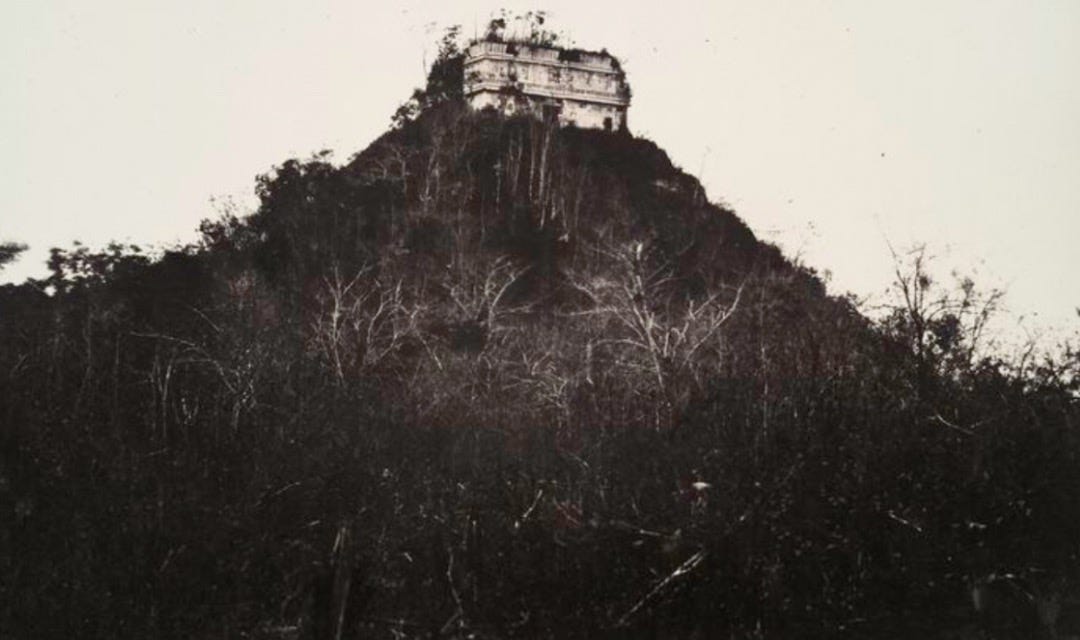
The Maya had abandoned Chichen Itza around the 13th century, and for hundreds of years the rainforest had been doing what rainforests do: reclaiming every surface it could reach.
Serious excavation did not begin until 1924, when archaeologist Sylvanus Morley arrived with a Carnegie Institution team and spent years pulling the jungle back, stone by stone.
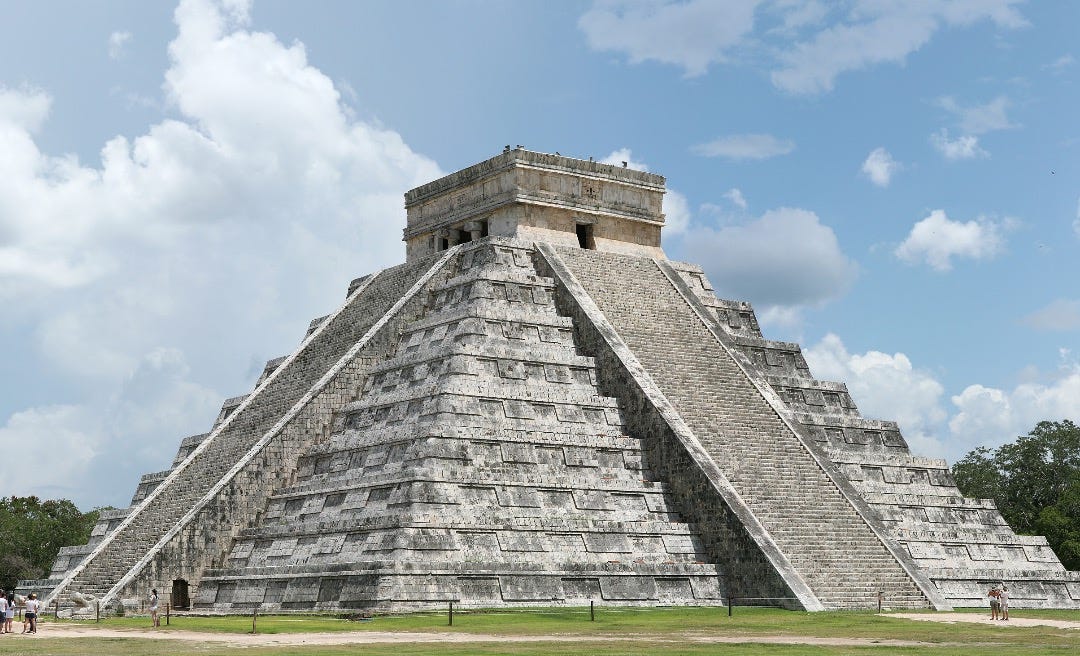
Today, El Castillo dominates the vast plaza with commanding majesty, drawing more than two million visitors a year. There is something reassuring in knowing that what is buried is not always lost, and that some things can be brought back into the light if someone is willing to do the work.
3. The Lion Beneath the Sand
For most of the thousands of years it has been on this earth, the Great Sphinx of Giza was not the monument we know today. Sometime around 2100 BC, the desert began to swallow it. The wind drove sand up against the stone, year after year, century after century, until the entire body of the lion was buried up to the shoulders and only the great head remained visible above the dunes.
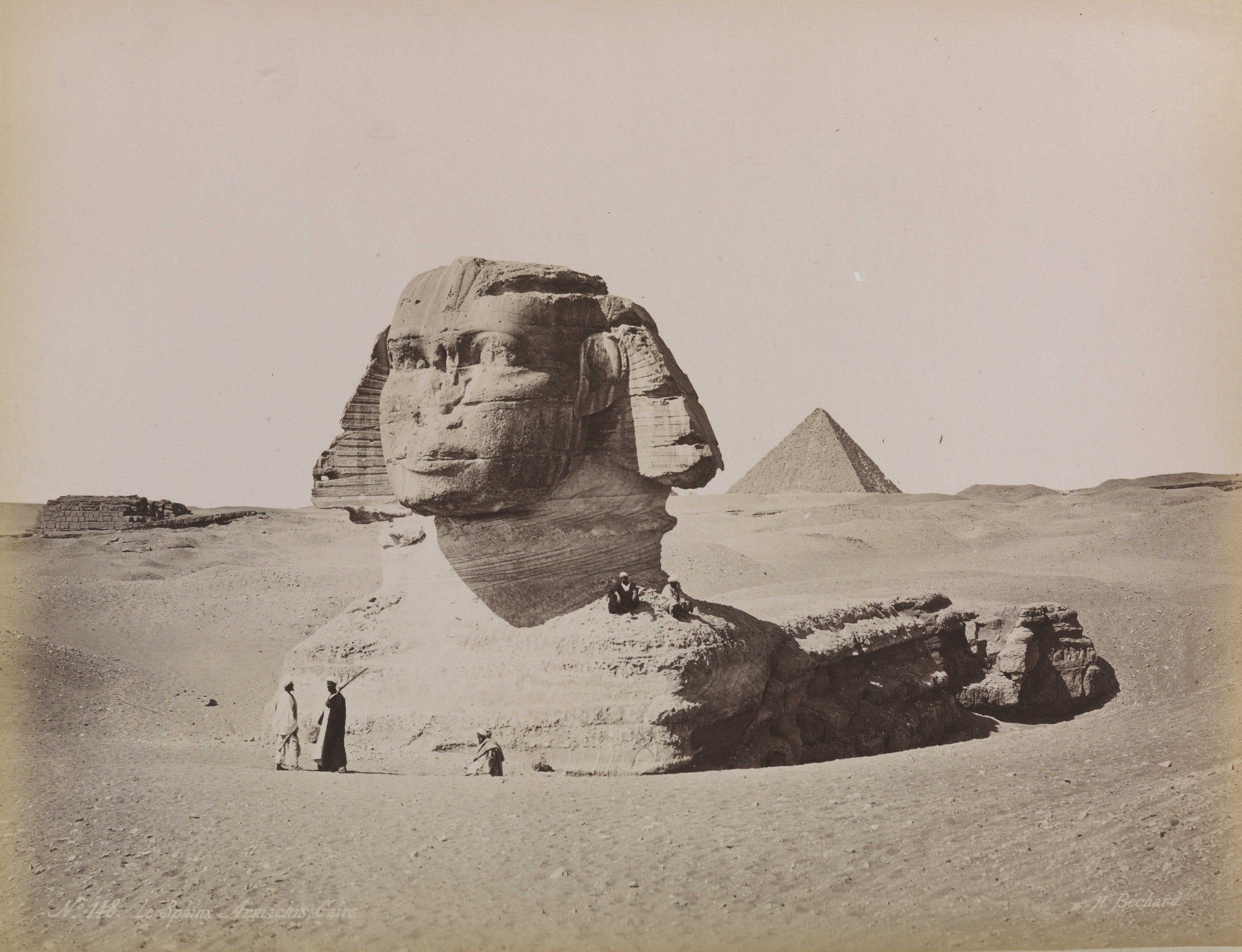
That is how travelers, pilgrims, and photographers saw it for thousands of years: a sad, weatherworn face staring out of an ocean of sand, with no body, no paws, no monument beneath it.
The first serious modern clearing did not happen until 1817, and the full excavation was only completed between 1925 and 1936, under the French engineer Émile Baraize, who spent eleven years pulling the desert back from a creature that had been waiting underneath it the whole time.
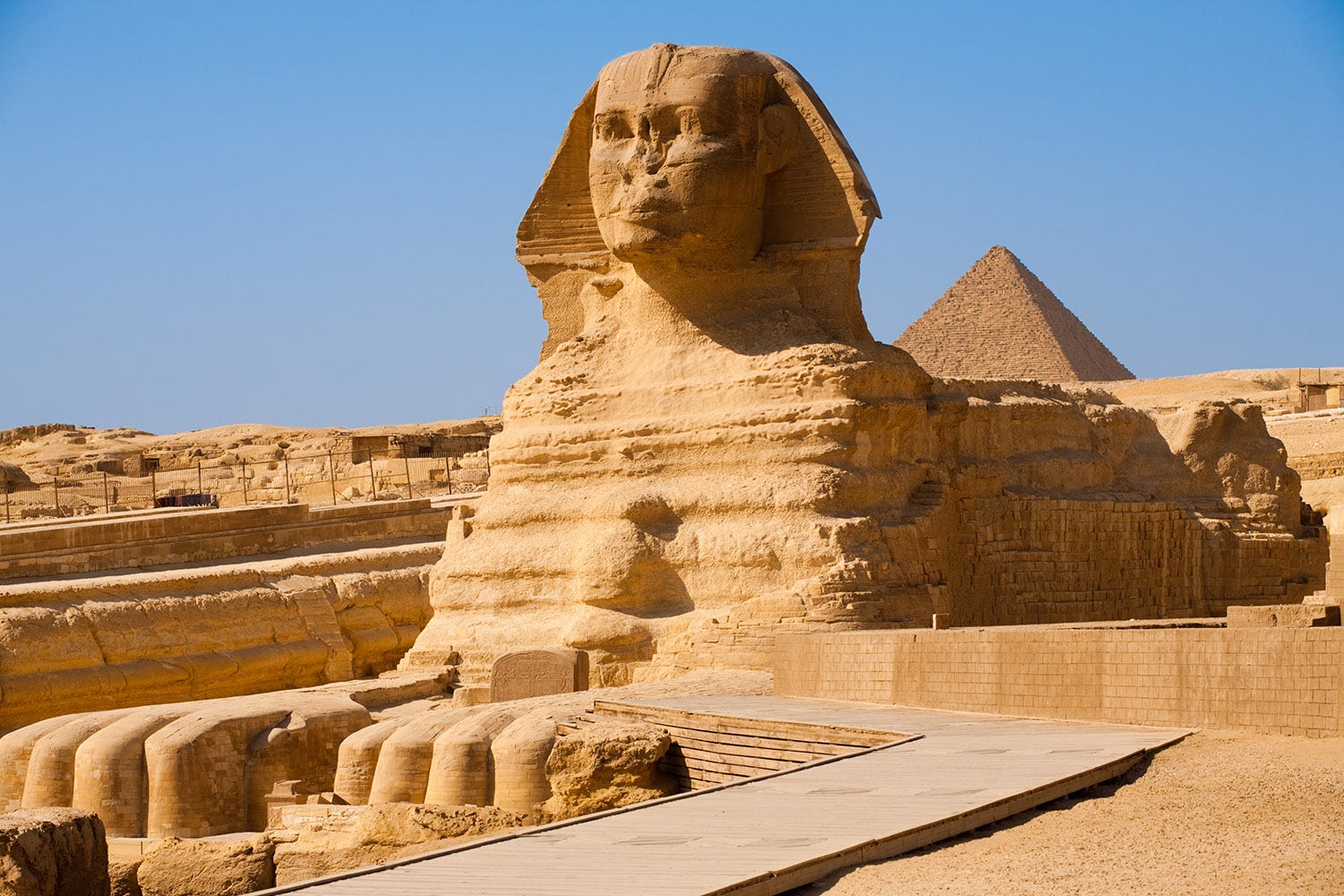
To look at the two photographs side by side is to realize that the Sphinx we think we have always known is, in a sense, less than a hundred years old.
4. The Face of War
In June 1941, a young man named Evgeny Stepanovich Kobytev sat for a photograph. He was thirty years old and he had just graduated from art school in Kyiv. A few days later, Nazi Germany invaded the Soviet Union, and Kobytev set down his brushes and enlisted in the Red Army. He fought. He was wounded. He was captured and held in a German prison camp where prisoners died of starvation. In 1943, he escaped, and rejoined the war. In 1945, he came home.
The day he returned, he sat for another photograph…
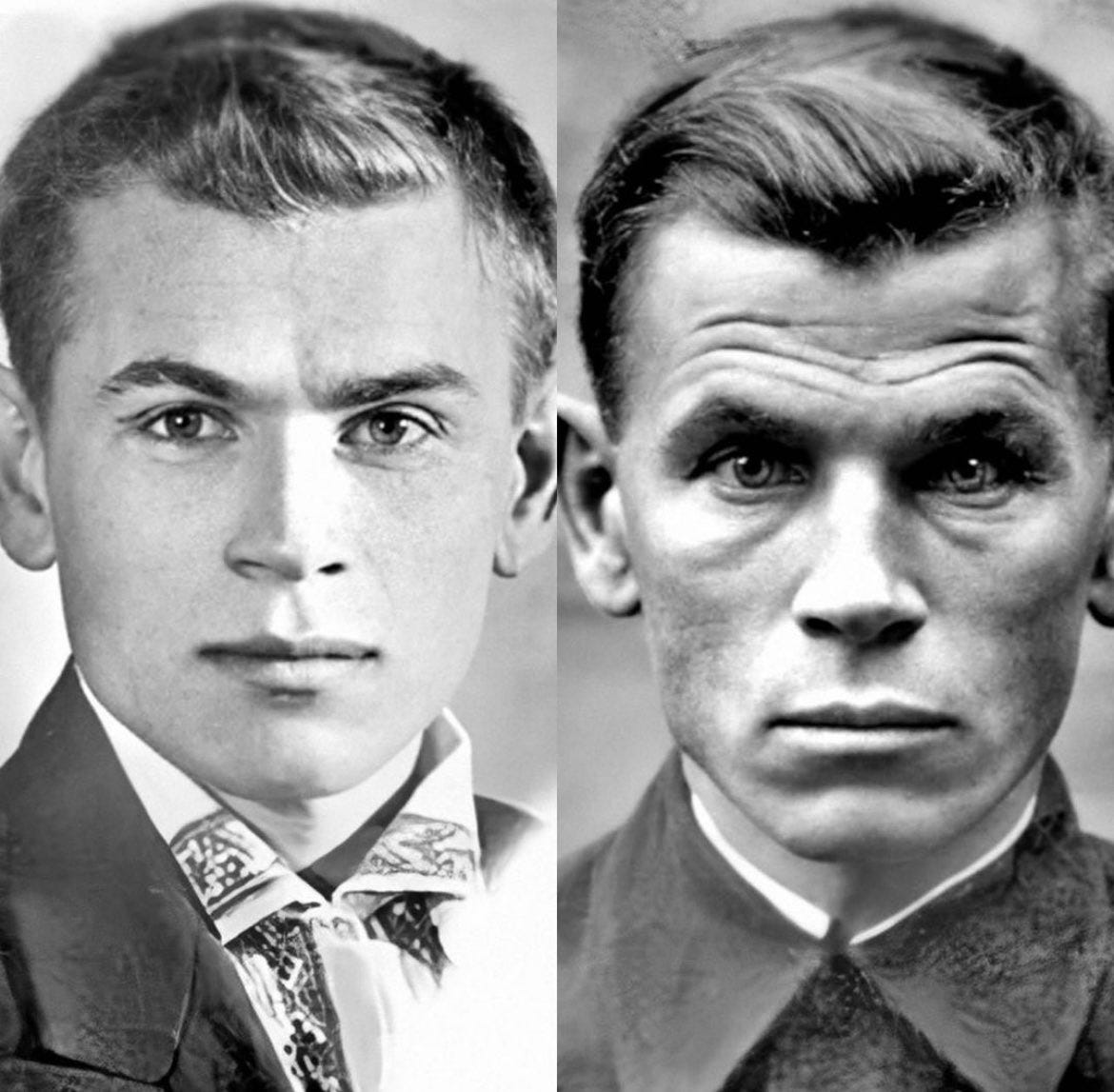
The same man, exactly four years older, and the difference isn’t so much something you see as something you feel. The first picture looks at you. The second one looks through you.
The two photographs hang side by side today in the Andrei Pozdeev Museum in Krasnoyarsk, and they say something about what war does to a person that no-one has ever quite managed to put into words…
5. Natural or Man-Made?
In photographs taken in the late nineteenth century, the Pyramid of the Sun at Teotihuacán looks like an oddly symmetrical hill. Trees and shrubs cover its slopes. A path winds toward something that might be a summit. There is nothing in the landscape that announces the building underneath, only the suspicion that the slope is just a little too even and the lines a little too straight.
To give you an idea, this is a lithograph from 1870:
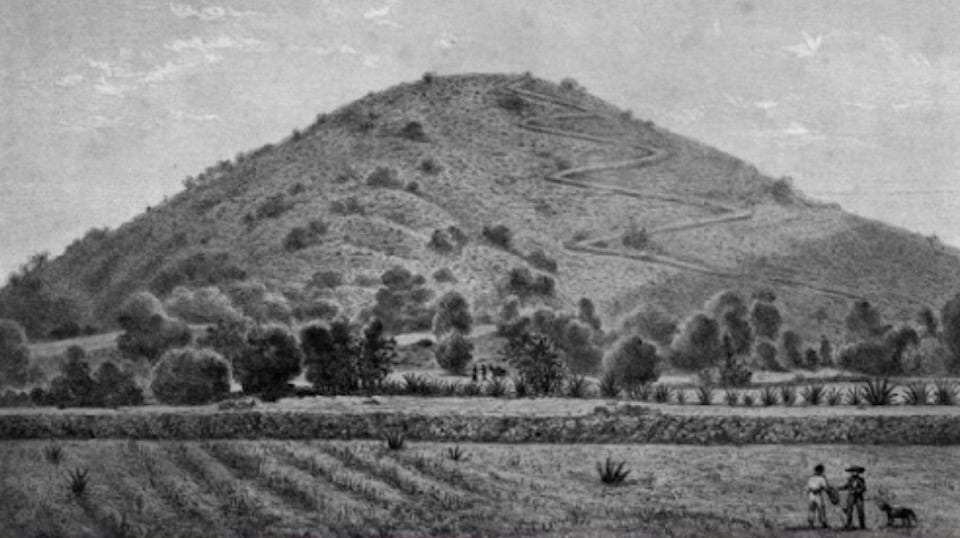
The pyramid had been hidden beneath earth and vegetation for nearly a thousand years. In 1905, Mexican archaeologist Leopoldo Batres began the first major excavation of the site under the orders of President Porfirio Díaz, and over the next five years, he pulled an entire civilization back out of the ground.
Today the pyramid rises 66 meters above the Avenue of the Dead. It’s the third-largest pyramid in the world.
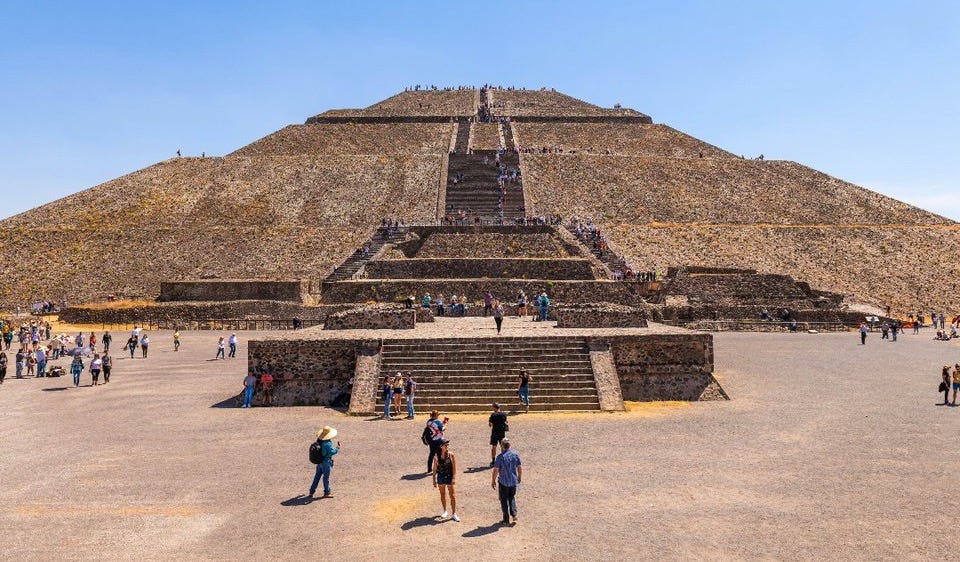
And it is impossible not to ask: how does something this enormous become invisible? The answer, it turns out, is slowly, and then completely, the way most things we stop paying attention to eventually disappear.
6. Mount St. Helens
On the morning of 18 May 1980, at 8:32 AM, a magnitude 5.1 earthquake shook the north face of Mount St. Helens, and in the next few seconds the largest landslide ever recorded in history slid 1,300 feet of mountain off itself and into the valley below.
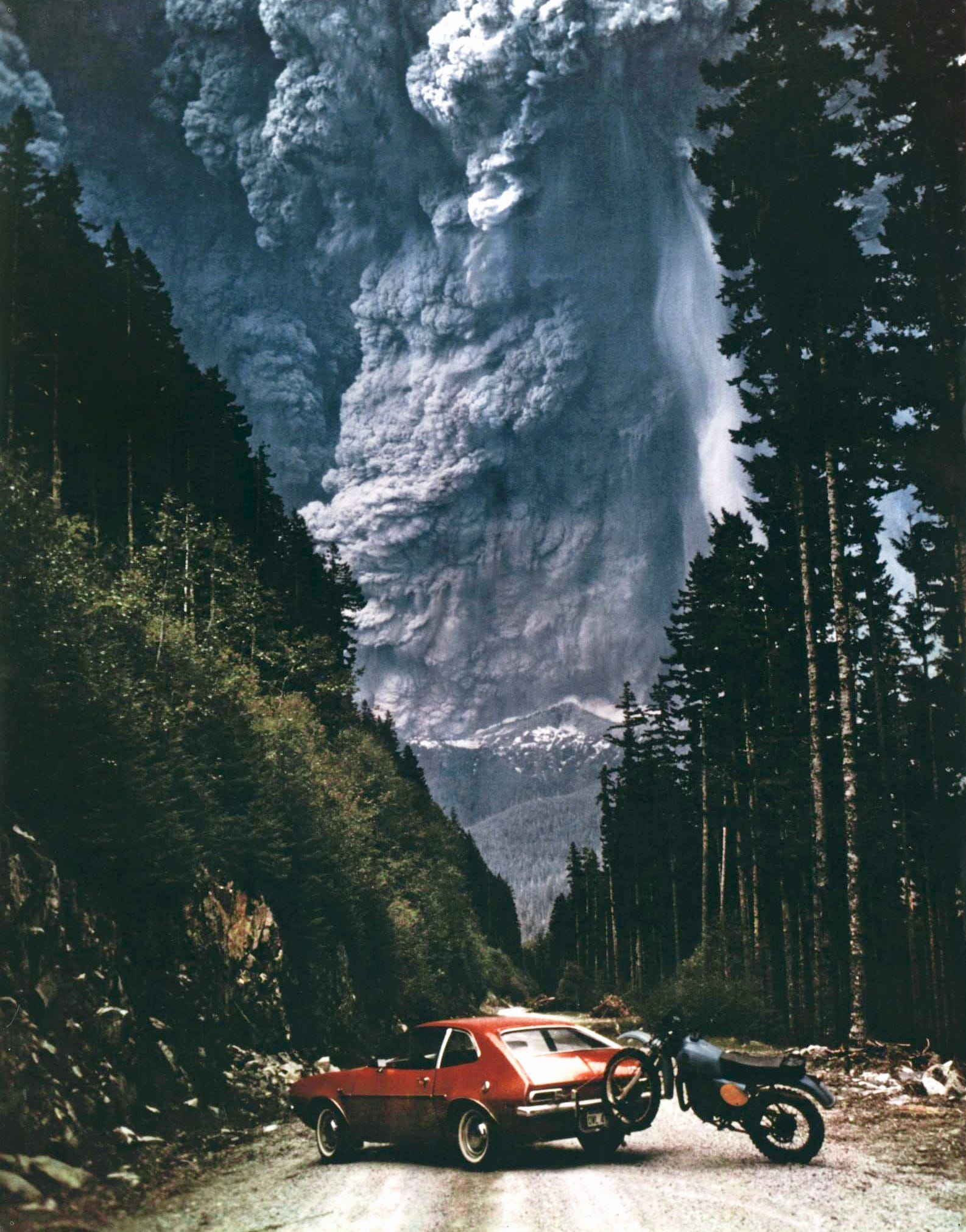
The volcano went from 9,677 feet tall to 8,365 feet in a single morning. Fifty-seven people were killed. The lateral blast that followed traveled at over a thousand kilometers an hour, flattened four billion board feet of timber, and turned 600 square kilometers of forest into ash and bare earth.
Photographs from before the eruption show a perfectly symmetrical, snow-capped peak so beautiful that locals called it the Fujisan of America. Photographs from after show a hollowed-out crater, as though something had taken a bite out of the sky:
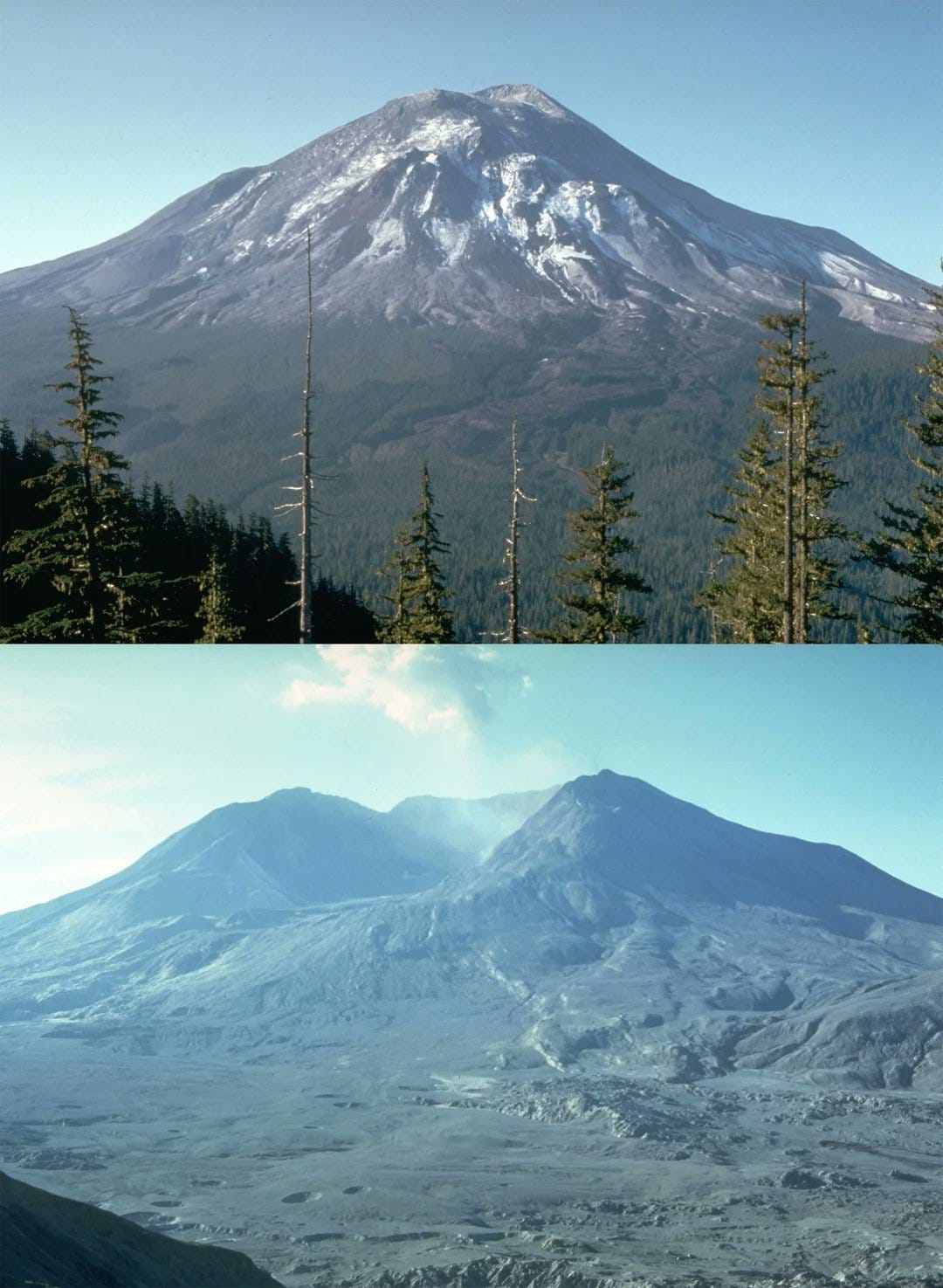
The most unsettling thing about looking at the two images is not the destruction, but the speed: a mountain that had been standing there, untouched, for thousands of years, lost an entire summit in less time than it takes to drink a cup of coffee.
7. The Price of Saving a Country
In 1860, the year he was elected president, Abraham Lincoln sat for a photograph. He looks lean, alert, sharply lit, with the precise gaze of a country lawyer who has just won the largest argument of his life. Five years later, in February 1865, the photographer Alexander Gardner asked him to sit again.
By then the Civil War had killed more than 600,000 Americans, his eleven-year-old son Willie had died in the White House, and Lincoln himself had been carrying the weight of the war and the survival of a divided nation for four straight years.
The man in Gardner’s photograph has aged almost beyond belief:
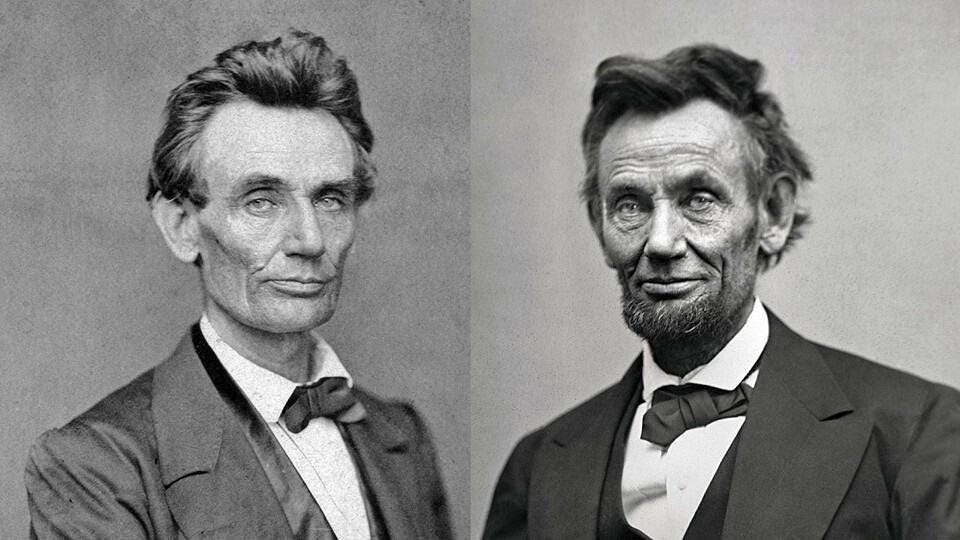
His face is hollow, his eyes deeply set, the lines beneath them carved in. There is even a faint, sad half-smile, as though he was beginning to allow himself to imagine the end of it. The image is from Lincoln’s last posed photo session. Nine weeks later, he was dead.
His secretary John Hay, who saw him every day, wrote that by the end, “in mind, body, and nerves he was a very different man.”
The two photographs make you understand exactly what Hay meant…
8. Fifty Summers Later
On August 15, 1969, a young woman named Judy was driving to a music festival in upstate New York when her car broke down on the Tappan Zee Bridge. A Volkswagen pulled over, full of young men heading to the same place, and offered her and her friends a ride. One of them was named Jerry. By the time they reached the festival grounds and set up camp, something had already happened between them. As Judy later put it, “we basically were together from that point on.”
They had known each other less than 48 hours when, soaking wet, they were photographed huddled under a blanket in the rain — though they would not discover that picture for another fifty years, when they spotted their own 22-year-old faces in a PBS documentary.
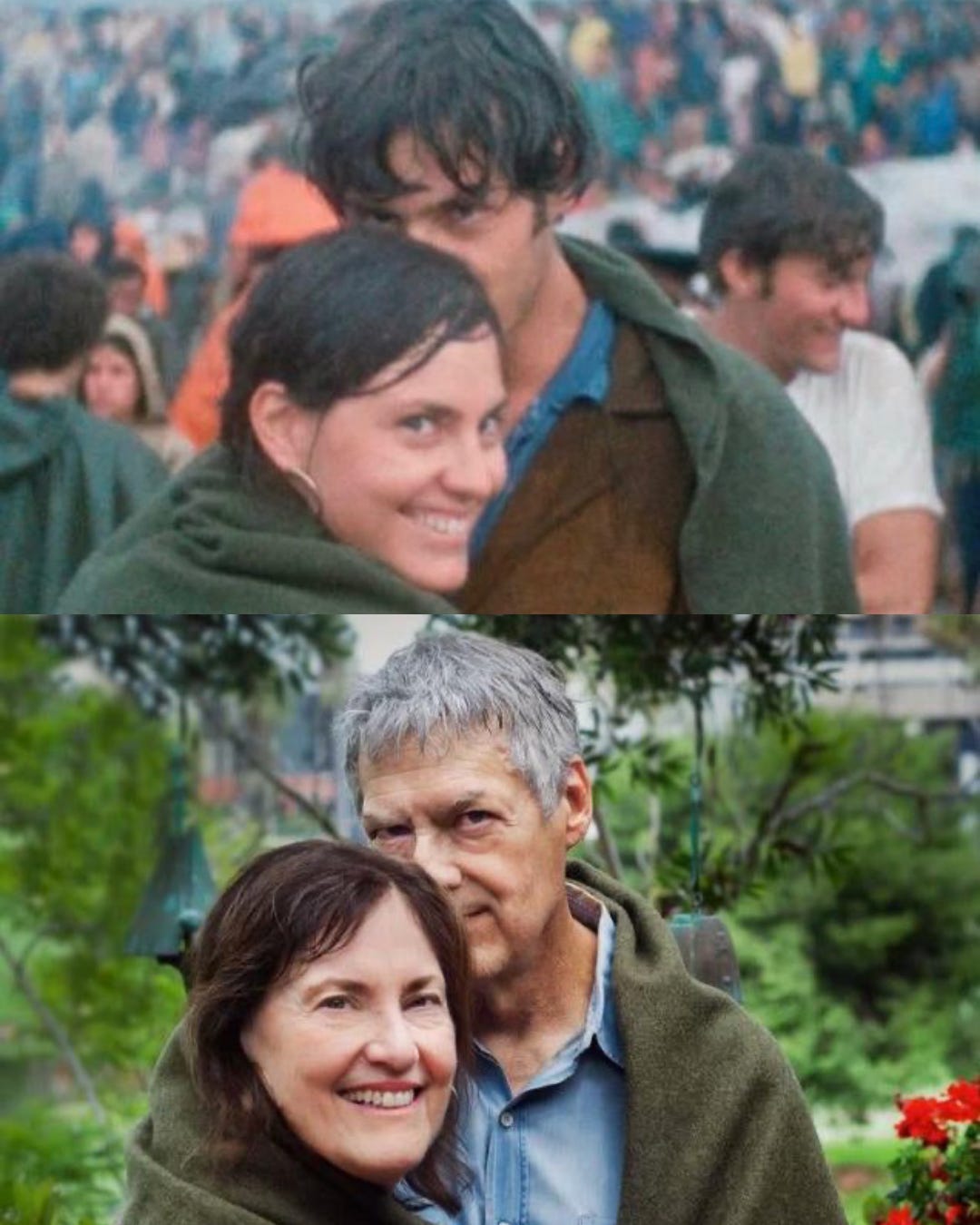
By then they had two sons, five grandchildren, and half a century of marriage behind them, and to mark the anniversary, they recreated that rain-soaked photograph, fifty years older, wrapped in a blanket once more. Set the two side by side and you are looking at the entire arc of a life: two strangers in the rain who had no idea what they were starting, and the same two people, fifty years on, who turned a broken-down car on a bridge into everything that followed…
It is a beautiful thing to see. And it is also a reminder that the clock never stops turning. Youth passes in what feels like a single breath, and with every day that goes by, the past grows heavier and the road ahead grows shorter. We spend so much of our lives caught between the ache of what we remember and the fear of what we cannot yet see, that we forget the only place we have ever actually lived is the present. And though they may be among the coldest words Marcus Aurelius ever wrote in his Meditations, after nearly two thousand years they have only grown truer:
Soon you will have forgotten the world, and soon the world will have forgotten you.
So what do we do with that? My advice this morning will not be motivational or productive — that word we have somehow turned into a religion. It is simply what I feel to be true as I sit here writing these words. We are all living on borrowed time, and none of us knows how much remains. So put off until tomorrow the things you never wanted to do anyway, and do today, now, the thing you have always wanted to do but were too afraid to begin — the thing that frightens you precisely because some part of you knows it matters.
I will leave you with the words of the late Robin Williams, from a monologue in the film Jack that I have carried with me ever since I first heard it:
As we come to the end of this phase of our life, we find ourselves trying to remember the good times, and trying to forget the bad times. And we find ourselves thinking about the future. We start to worry, thinking, what am I going to do? Where am I going to be in ten years? But I say to you, ‘Hey, look at me, please, don’t worry so much.’ Because in the end, none of us have very long on this earth. Life is fleeting. And if you’re ever distressed, cast your eyes to the summer sky, when the stars are strung across the velvety night. And when a shooting star streaks through the blackness, turning night into day, make a wish. Think of me. Make your life spectacular.
Thanks for reading! This newsletter is completely independent and ad-free — and it can only keep going with your help. Please consider contributing a few dollars today, and get access to exclusive articles and the full archive:
Every subscription genuinely makes a difference. Thank you for making this work possible.
Incredibly profound and thought provoking. Thank you 😊
Thank you, forwarding it to my son who loves photography and is also excellent at capturing moments and memories.
Ad always, you provide special things to view and think about.
And now I will revisit special old photographs and compare them to today.
Thank you!