
The Most Beautiful Art Galleries on Earth
And a limited-time Christmas surprise…
When confronted with the overwhelming beauty of the world, I often find myself reaching for the word “ineffable.” Some experiences simply defy description. Recently, however, I discovered a concept from traditional Japanese aesthetics called Yūgen (幽玄) — an awareness of the universe that evokes emotions so profound they transcend language.
Often characterized as “subtle profundity” or “mysterious grace,” Yūgen points to a beauty that is sensed rather than fully seen, felt deeply yet only partially understood. It is not an escape into another world — it is about this one, here and now. This is how Zeami Motokiyo, the famous Japanese aesthetician, described the moments that open the door to Yūgen:
To watch the sun sink behind a flower-clad hill. To wander on in a huge forest without thought of return. To stand upon the shore and gaze after a boat that disappears behind distant islands. To contemplate the flight of wild geese seen and lost among the clouds.
To these natural wonders, I would humbly add another source of such stirring emotion: the transformative encounter with great art. The first time you step into one of the world’s most extraordinary galleries, the experience can be as profound, transcendent, and even cathartic as any scene Zeami described — an encounter capable of lifting the soul to heights where words fall short.
In the spirit of Yūgen, I invite you to explore ten of the most breathtaking museums and art galleries on Earth — rooms where the weight of beauty is simple, immediate, and unmistakable, leaving nothing to do but stand still and feel…
CHRISTMAS SPECIAL 🎁
Beauty is Truth is a reader-funded publication, supported entirely by you. There are no ads here, simply a labor of love devoted to celebrating beauty.
With Christmas around the corner, I want to say thank you by offering 20% off all annual subscriptions — for yourself or as a gift for someone dear to you.
If you’ve been thinking about supporting my work, becoming a paid subscriber is the most meaningful way to do it. The offer is limited to the first 100 people:
And if you’re looking for a gift that truly feels heartfelt, you can now give a year of beauty — short, uplifting 5-minute reads that add a bit of light to everyday life. It’s personal, memorable, and costs less than a coffee a month:
1. Galleria dell’Accademia
Seeing the David for the first time is one of those experiences that leaves words behind. You feel an uncanny certainty that this marble figure could step down from its pedestal at any moment…
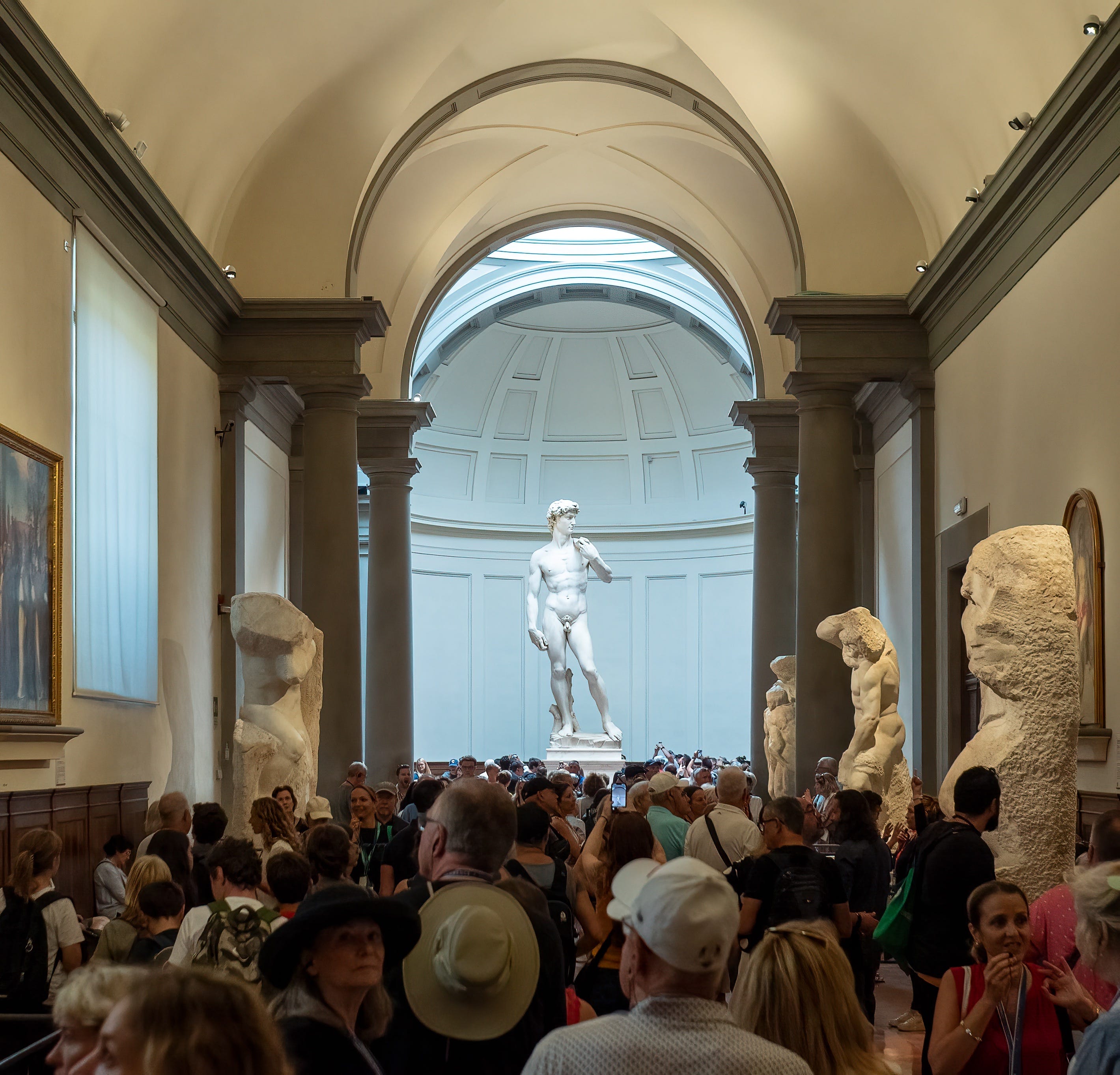
Best known as the home of Michelangelo’s magnum opus, this gallery in Florence also guards other sculptures shaped by his hands, along with an exceptional collection of Florentine paintings, mostly from the Trecento to the Late Renaissance.
2. Galleria Borghese
The Galleria Borghese in Rome is a space as magnificent as the treasures it holds. In this stunning photograph by Pierluigi Napoli, you can see Bernini’s masterpiece, Apollo and Daphne — the very work from which this room takes its name.
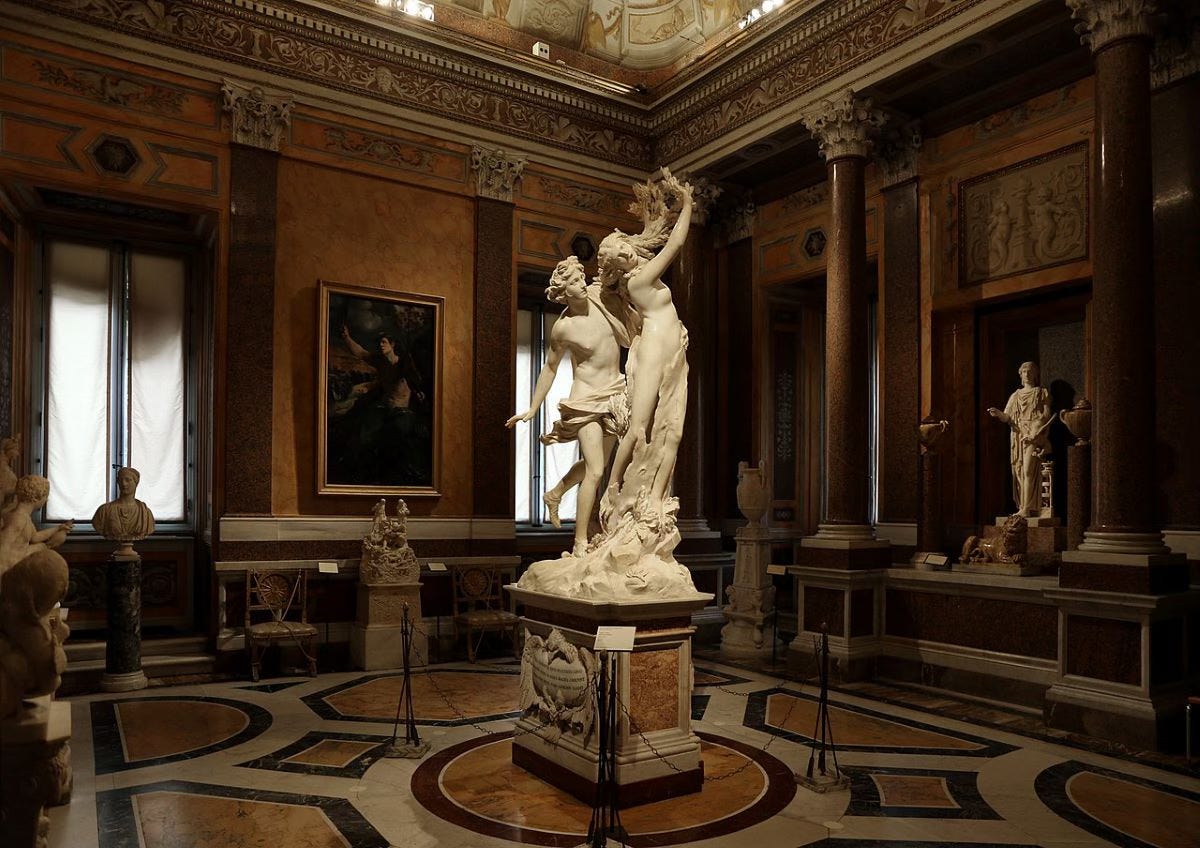
The room itself was decorated between 1780 and 1785 following a design by Antonio Asprucci (1723–1808), and the ceiling painting at its center revisits the same dramatic scene immortalized in Bernini’s sculpture.
The Galleria Borghese preserves a substantial portion of the Borghese Collection, begun by Cardinal Scipione Borghese. Today, the gallery is one of the world’s most prestigious repositories of art, home to masterpieces by Caravaggio, Bernini, Canova, Raphael, and Titian.
The main hall on the ground floor, the Salone, is crowned by a trompe-l’œil fresco by Sicilian artist Mariano Rossi, whose masterful foreshortening makes the ceiling seem to leap into three-dimensional space:
3. Hermitage Museum
Founded in Saint Petersburg in 1764 by Empress Catherine the Great, this architectural masterpiece is home to the largest collection of paintings in the world.
Among its many wonders, the Hermitage is also famous for an unusual tradition: its “Hermitage cats”…
These felines have roamed the museum for centuries, tasked with guarding the priceless artworks from rodents. The tradition began in the 18th century, when cats were brought to the Winter Palace to protect the walls and paintings from rats and mice. In 1745, Elizabeth of Russia even ordered that cats be installed in the palace, granting them a special title: “guardians of the galleries.”
Today, the cats remain an integral part of the museum. They have a press secretary, three dedicated caretakers, and a head of the “cat department,” Irina Popovets, who famously declared that the cats are “as well-known as our collections.”
4. National Gallery
Founded in London in 1824, this art museum houses more than 2,300 paintings dating from the mid-13th century to the 1900s.
Notable works include Vincent van Gogh’s Sunflowers and Jan van Eyck’s The Arnolfini Portrait.
5. Louvre
One of the world’s most famous museums, it is home to some of the most canonical works of Western art, including the Mona Lisa, the Venus de Milo, and the Winged Victory.
The museum is located within the Louvre Palace, which was originally constructed in the late 12th to 13th century during the reign of Philip II.
6. Vatican Museums
The Vatican Museums contain within their walls an extraordinary collection accumulated by the Catholic Church and the papacy over centuries — an immense treasury that includes some of the most renowned Roman sculptures and many of the defining masterpieces of Renaissance art.
The Sistine Chapel, with its ceiling and altar wall painted by Michelangelo, and the Stanze di Raffaello, decorated by Raphael, are two of the highest achievements in the history of Western art.
After visiting the chapel in the 1700s, German polymath Johann Wolfgang von Goethe said:
Without having seen the Sistine Chapel one can form no appreciable idea of what one man is capable of achieving.
Across the museums’ nearly 70,000 works, one of the most astonishing — yet often overlooked — spaces is the Gallery of Maps, a long corridor lined with brilliantly painted topographical maps of Italy, created from the drawings of the friar and geographer Ignazio Danti:
7. Uffizi Gallery
This is one of the first modern museums in the world.
After the ruling House of Medici died out, their incredible art collections were entrusted to the city of Florence under the famous Patto di Famiglia (“family pact”), negotiated by Anna Maria Luisa, the last Medici heiress.
Open to visitors since the sixteenth century, it houses iconic masterpieces such as Sandro Botticelli’s The Birth of Venus and Leonardo da Vinci’s The Annunciation.
8. Metropolitan Museum of Art
The Met’s majestic Beaux‑Arts façade and soaring Great Hall immediately set a tone of awe, as if stepping into a modern-day palace of culture.
Inside, you’ll find an encyclopedic collection covering 5,000 years of history and cultures from around the world — an experience everyone should add to their bucket list.
9. Rijksmuseum
Founded in The Hague on 19 November 1798 and moved to Amsterdam in 1808, it is the most visited museum in the Netherlands.
The Rijksmuseum houses paintings by Rembrandt and Vermeer, and features one of the most breathtaking libraries in the world.
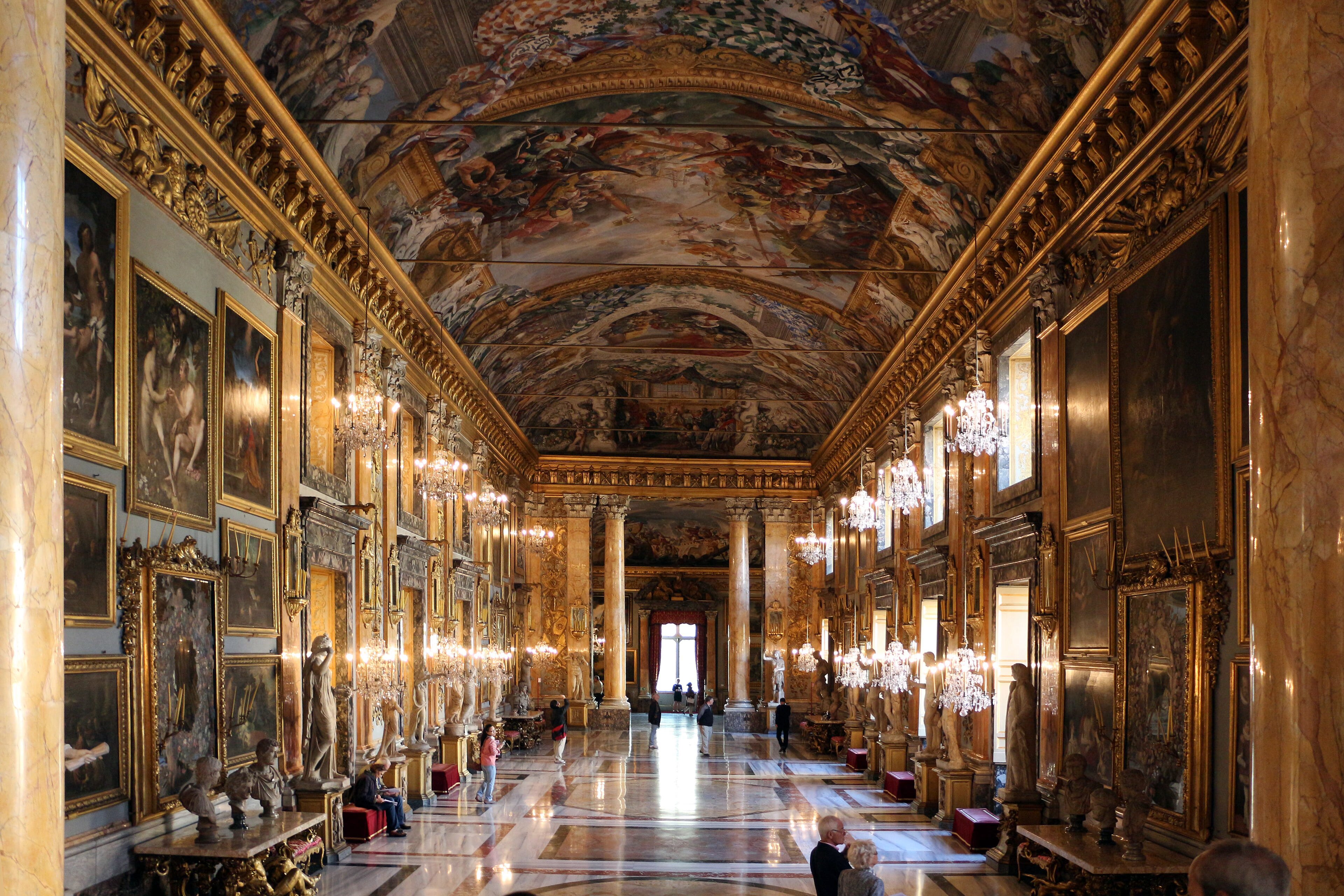
10. Galleria Colonna
Housed within its eponymous palace, this Gallery is a jewel of Roman Baroque…
Established in 1654 by Cardinal Girolamo I Colonna, its creation was entrusted to the architect Antonio Del Grande and later carried forward by Gian Lorenzo Bernini, Johan Paul Schor, and Carlo Fontana. Inaugurated in 1700 by Filippo II Colonna, it has remained in the family for more than twenty generations.
Fun fact: embedded in the staircase to the Great Hall lies a cannonball, fired in 1849 from Janiculum Hill by the French army under General Oudinot — it has stayed there ever since.
From the start, Galleria Colonna was designed as a magnificent ceremonial space, celebrating the Christian victory over the Turks at the Battle of Lepanto in 1571. Marcantonio II Colonna, commander of the papal fleet, is depicted across the ceiling of the Great Hall:
Alongside the collections of the Doria-Pamphilij and Pallavicini-Rospigliosi families, this is one of the largest private art collections in Rome.
If we set aside the pomp, the ostentation, and the immense fortunes that built these iconic collections, what remains is something far more profound: sheer wonder.
Walking through these galleries, surrounded by an astonishing abundance of art — its quality as breathtaking as its quantity — one cannot help but feel humbled, witnessing how even the legacy of wealth and power here seems to take a backseat, eclipsed by the undeniable force of beauty itself.
As many of you know, this newsletter takes its name from a famous line in Keats’ Ode on a Grecian Urn, and if beauty is indeed truth, then perhaps one thing is certain: of all illusions, art is the most sincere. In these halls, amidst masterpieces that span centuries and continents, that truth is impossible to ignore…
Thanks for reading! A quick reminder: this newsletter runs entirely on reader support. If you enjoy the content, consider contributing a few dollars a month. Your help makes a huge difference — and as a bonus, you’ll get access to exclusive articles, the subscriber-only chat and the full archive.
You can now take advantage of 20% off when you subscribe as part of the new Christmas special offer:
And you can share the gift of beauty with someone you love — also at 20% off:
Thank you!


Thank you so much James. My breath has been taken away as I see in awe all this beauty. 💖
Thank you Mr. Lucas! Your posts are always at the top of my reading list.