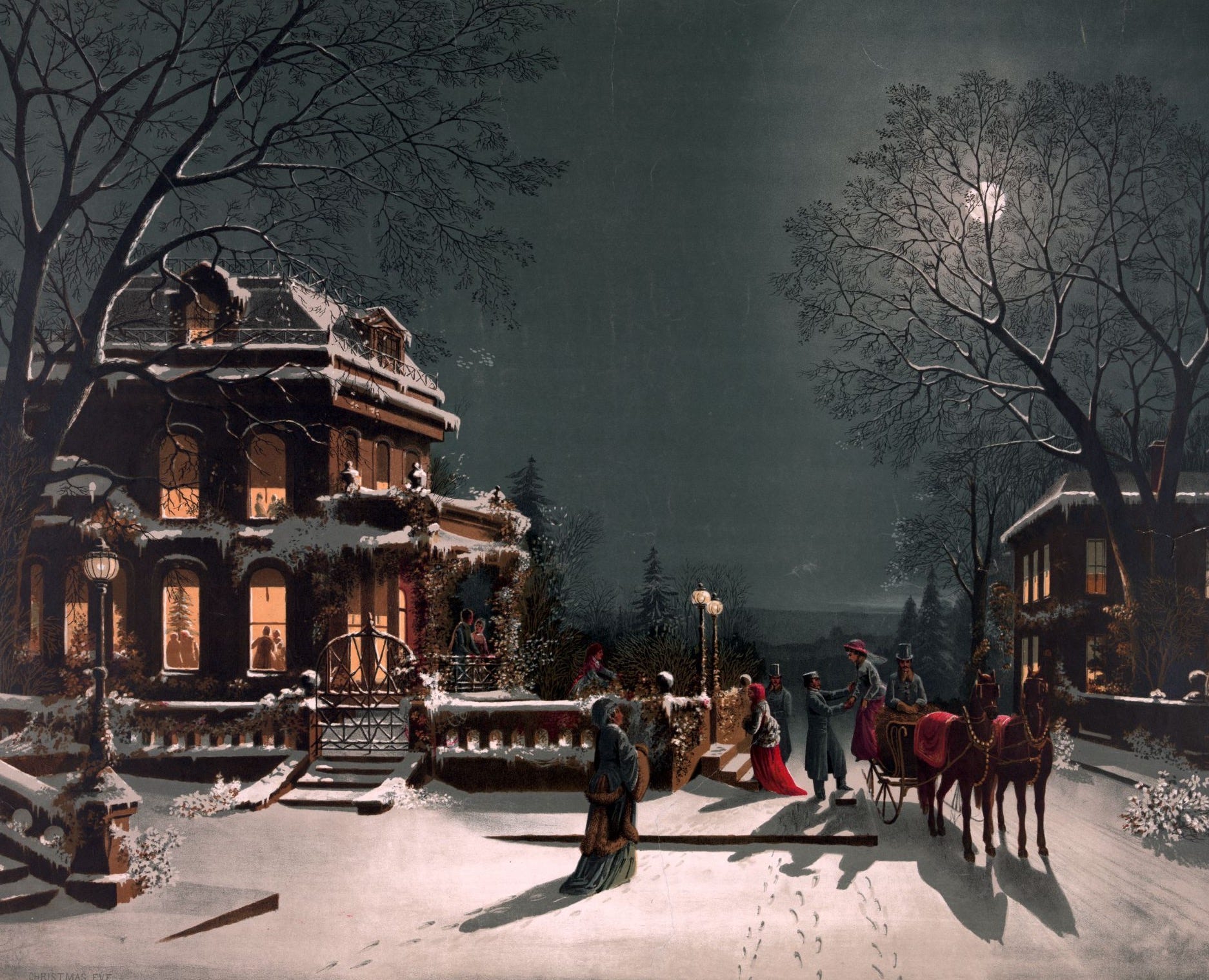
I was reading Seneca’s De Vita Beata (On the Happy Life) last Sunday when I came across a line that stopped me in my tracks:
Wherever there is a human being, there is the opportunity for a kindness.
It made me think about this season and how, when someone crosses our minds, we are always presented with a choice: to postpone the thought, to tell ourselves it isn’t important, or to act with a small gesture of care. A Christmas card may seem like a simple thing, but for centuries it has carried a meaningful message: “I was thinking of you.” It reminds people they’re seen, remembered, and part of our lives.
And it is precisely in this spirit that I want to explore the history of Christmas cards…
Reminder: this is a teaser for my subscriber-only articles.
Beauty is Truth is a reader-funded publication, supported entirely by you. There are no ads here, only independent writing devoted to celebrating beauty.
If you’ve been thinking about supporting my work, becoming a paid subscriber is the most meaningful way to do it. It costs less than a coffee a month:
The first known card was sent in 1611 by Michael Maier to King James I of England and his son Henry Frederick, Prince of Wales. Hand-made and adorned with Rosicrucian imagery, the greeting itself was arranged in the shape of a rose and read:
A greeting on the birthday of the Sacred King, to the most worshipful and energetic lord and most eminent James, King of Great Britain and Ireland, and Defender of the true faith, with a gesture of joyful celebration of the Birthday of the Lord, in most joy and fortune, we enter into the new auspicious year 1612.
What began as an intimate, symbolic letter would grow into a beloved tradition that mirrors the changing tastes, values, and artistry of each era. Below are 10 examples of how this cherished custom has taken shape over time — from the quirks of the Victorian age to the elegance of Art Nouveau, and the nostalgic warmth of Norman Rockwell…
1. The First Christmas Card
The first commercially produced Christmas card was commissioned by Sir Henry Cole and designed by John Callcott Horsley in London in 1843.
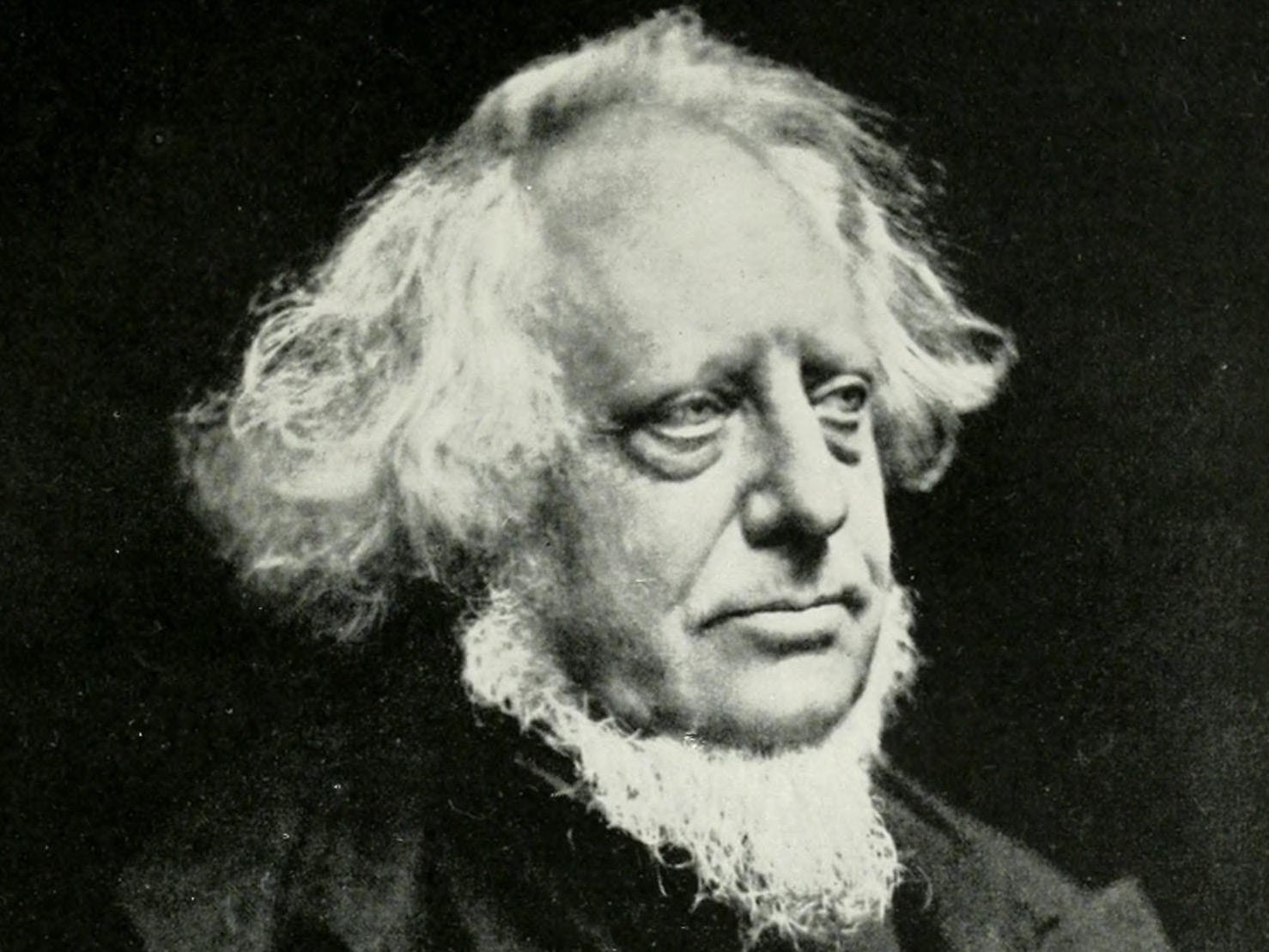
Cole, a prominent educator and patron of the arts, moved in the elite circles of early Victorian England — but he faced a modern dilemma: too many friends and too little time. By Christmas that year, he was feeling overwhelmed by the flood of holiday letters, made easier — and more popular — by the recent introduction of the Penny Post.
Wanting to respond to everyone without writing dozens of letters, Cole turned to artist J.C. Horsley to bring his idea to life. The design featured a central image of three generations of a family raising a toast to the card’s recipient, flanked on either side by scenes of charity, with food and clothing being given to the poor.
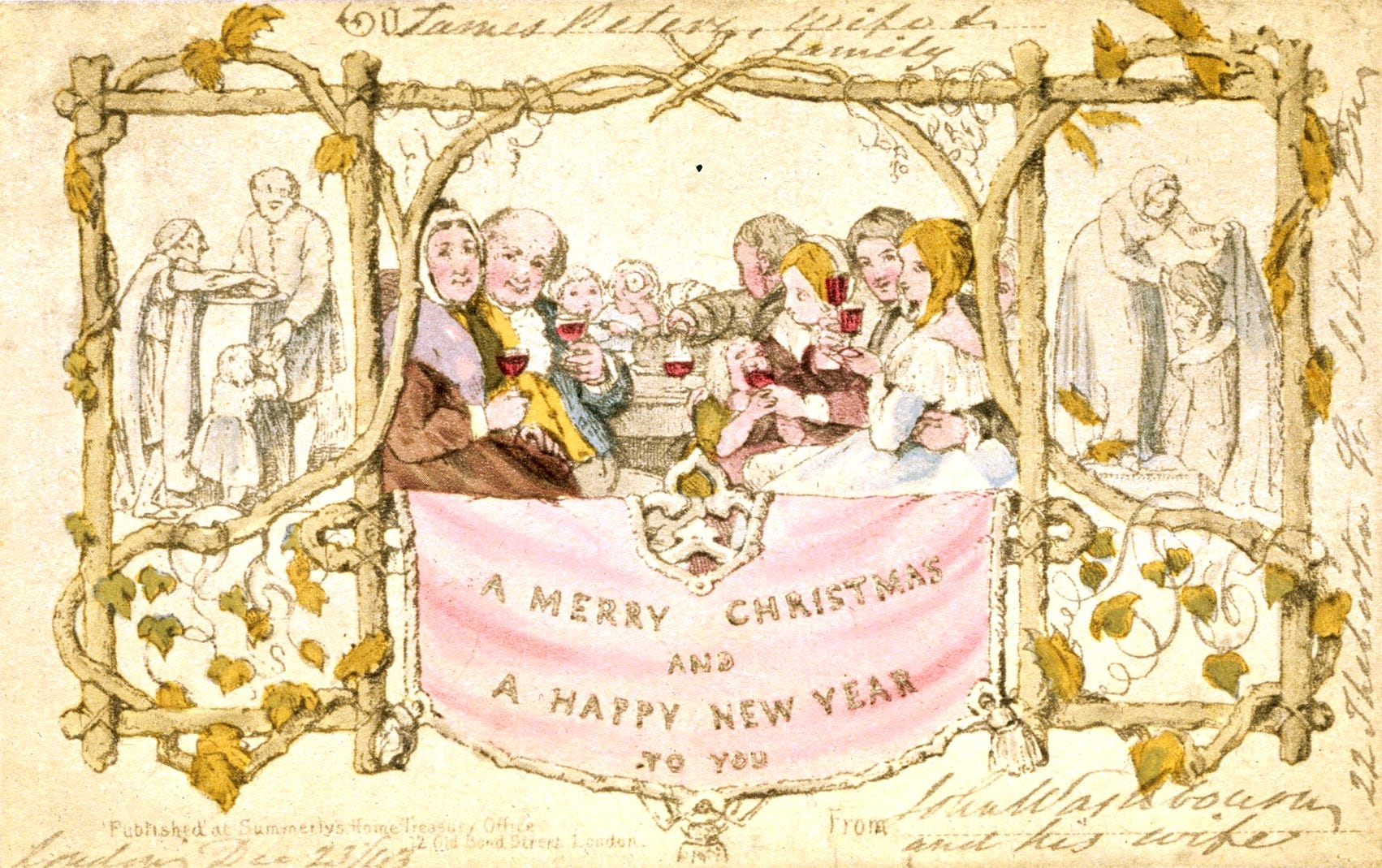
Two batches, totaling 2,050 cards, were printed and sold that year for a shilling each. Every card included a space for a personalized message alongside the standard greeting, “A Merry Christmas and A Happy New Year To You.” This small innovation would launch the era of the commercial Christmas card, a tradition that has endured for nearly two centuries…
2. Louis Prang
Although Cole and Horsley introduced the first Christmas card, the custom didn’t become widespread immediately. It took several decades for it to gain real popularity in both Great Britain and the United States.
In 1875, Louis Prang, a Prussian immigrant who ran a printing business near Boston, produced what is widely recognized as the first American Christmas card. Prang took a very different approach from his Victorian predecessor: rather than depicting a festive scene, his card featured a simple painting of a flower with the greeting “Merry Christmas.”
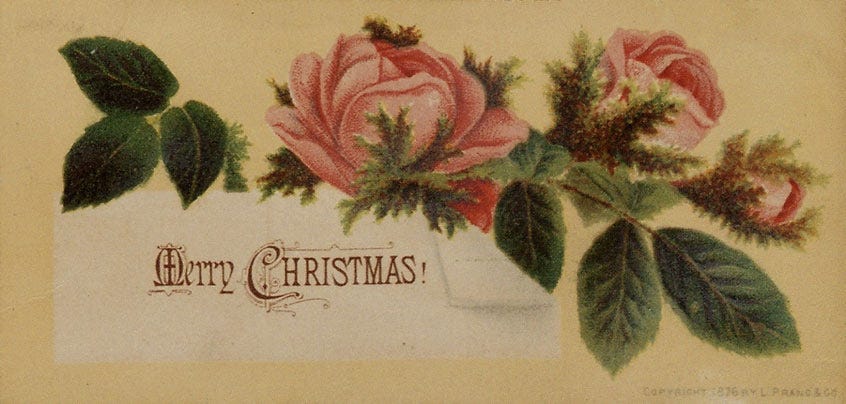
By the 1880s, Prang — later known as the “father of the American Christmas card” — was producing over five million cards a year…
3. Victorian Christmas Humor
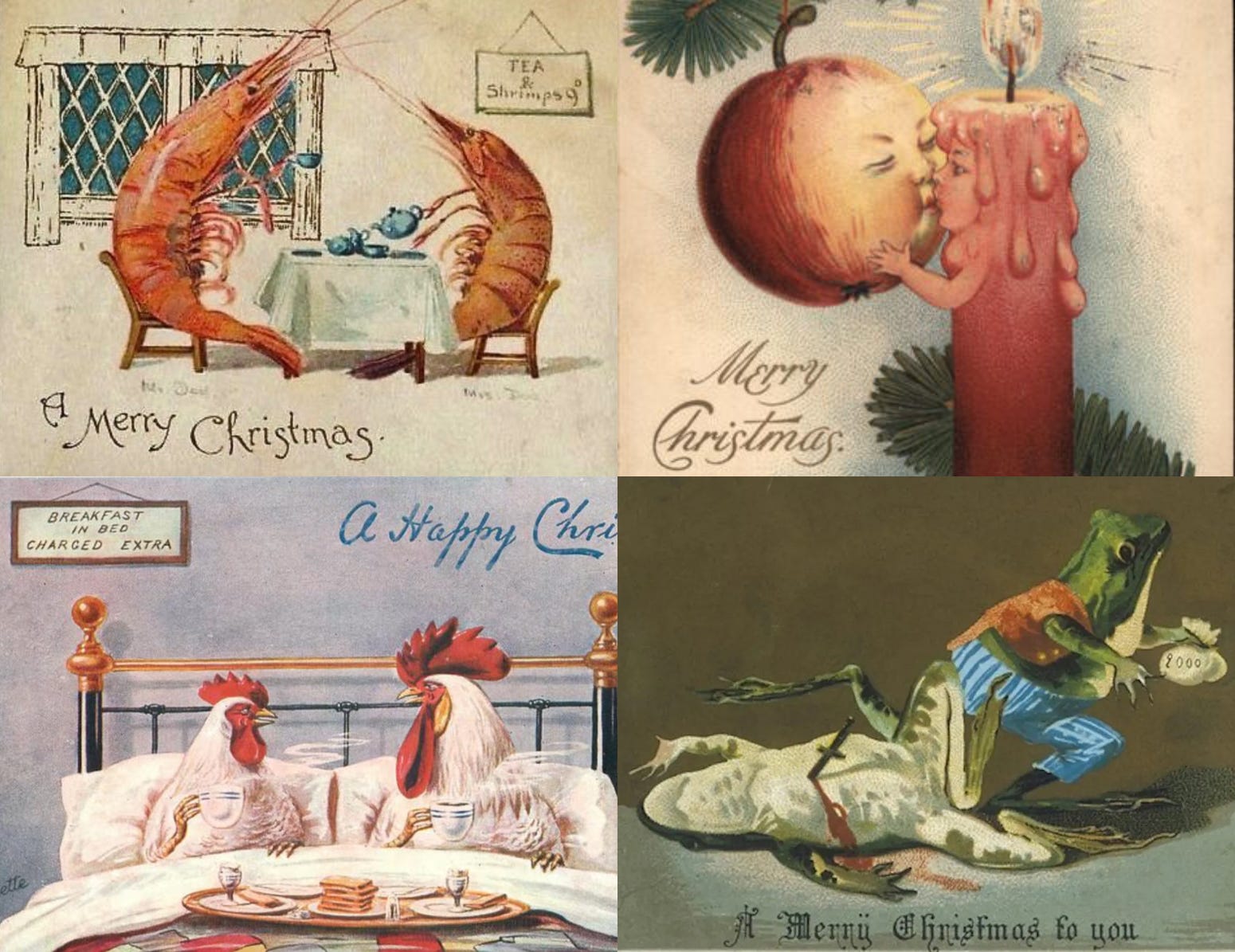
And now we arrive at one of my favorite chapters in the history of Christmas cards: the utterly bizarre — and sometimes downright creepy — Victorian examples. Amid the countless cards filled with snowy landscapes, Father Christmas, and cozy family gatherings, there were always a few so strange they defy description. Take, for instance, this gem of a mouse riding a lobster…
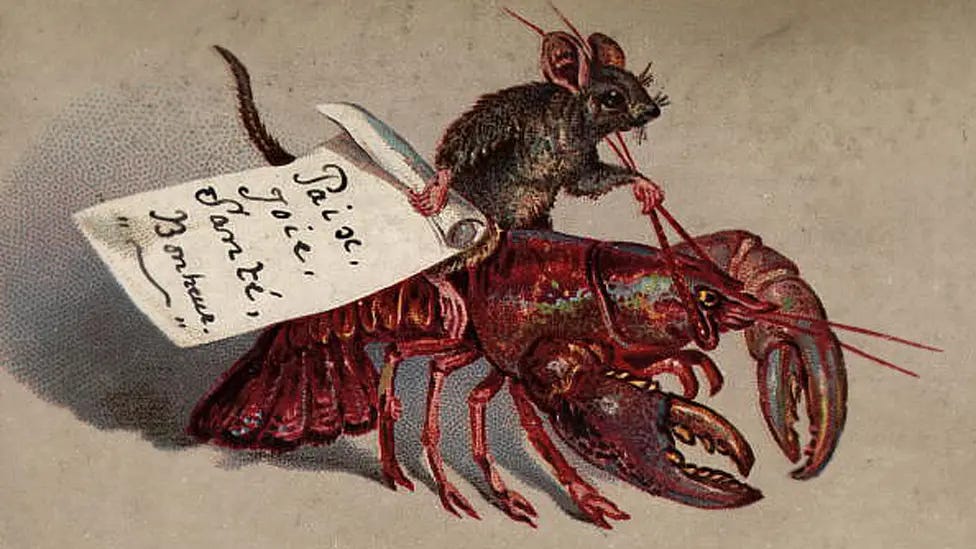
By 1885, Prang and other artists of the era began experimenting with unusual subjects, giving some seasonal greetings a humorous — or occasionally unsettling — twist. Because, as everyone knows, nothing says Merry Christmas quite like shrimps sipping tea, a candle kissing an apple, vacationing chickens, or… frog-on-frog murder: