


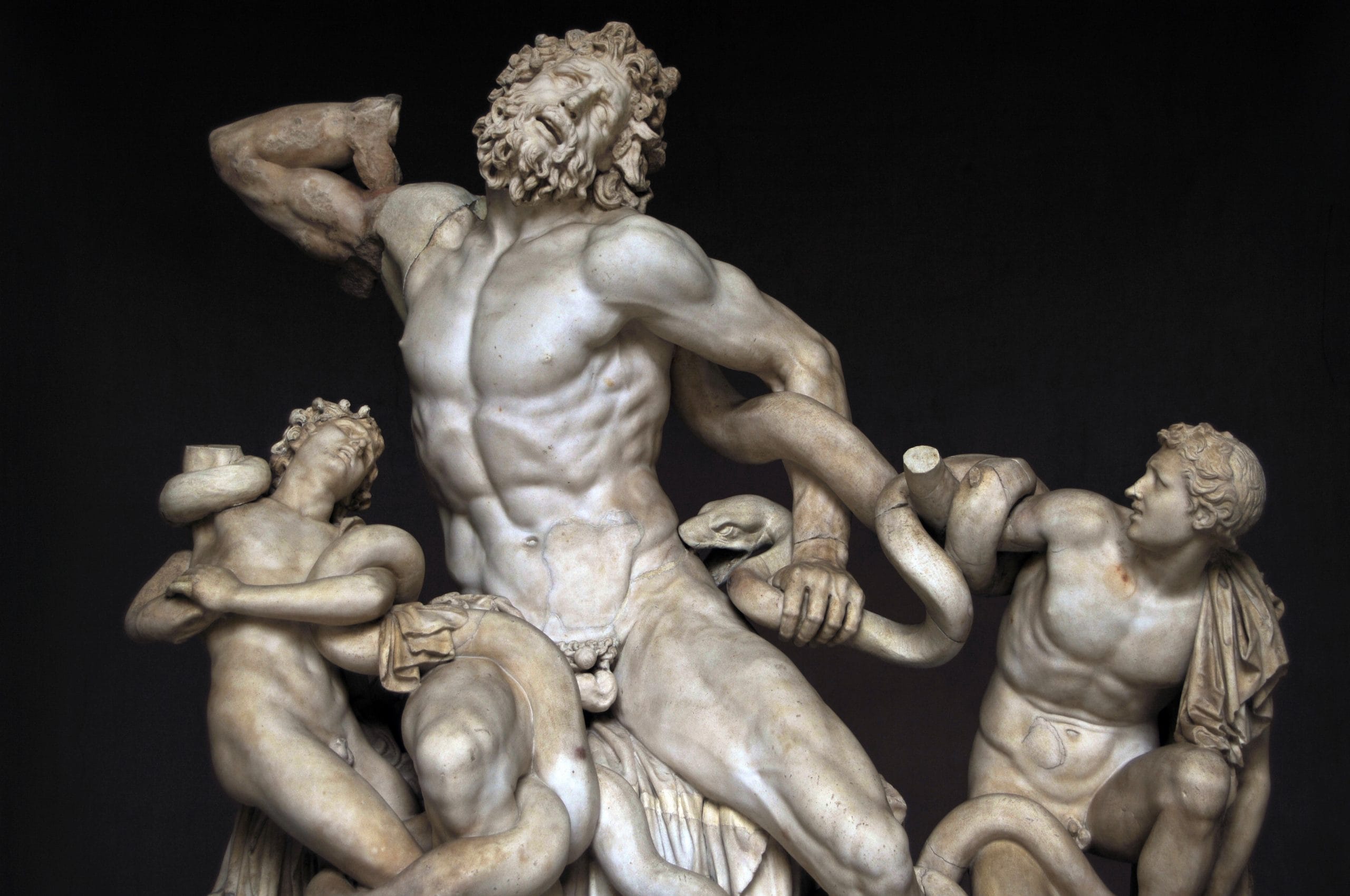
A work to be preferred to all that the arts of painting and sculpture have produced.
That’s how the Roman writer Pliny the Elder described a group of marble figures he saw in the palace of the emperor Titus, almost two thousand years ago. For more than fourteen centuries afterward, that sculpture existed only in his words. Then, in 1506, it came out of the ground in a vineyard in Rome, and further down you’ll see what makes it so extraordinary...
The ancient world was crowded with statues, and almost all of them are gone, which makes it close to a miracle that any survived at all. Bronze was too valuable to leave standing, so nearly every ancient bronze statue was eventually melted down and turned into something else, and today fewer than thirty large Greek bronzes survive more or less intact.
Maybe that’s why ancient sculpture feels so different from anything else in a museum: when you stand in front of one of these works, you’re looking at something that outlived the civilization that made it and, often, even the name of its maker.
Even the word statue seems to know this, since it comes from the Latin statua, “that which is set up,” and, further back, from stare, “to stand.” A statue, at its root, is something made to stand. Some of the 5 below were found in pieces, buried in the earth or lying at the bottom of the sea, and today, centuries later, they stand again.
In 1908, the poet Rainer Maria Rilke stood in front of an ancient statue in the Louvre that time had worn down to a torso, without its head or limbs. It had no eyes left to look with, and yet Rilke felt that the broken stone was looking straight at him, from every part of its body at once, and he wrote a poem about it. The poem ends with a single line, as if it were the statue speaking:
You must change your life.
REMINDER: Beauty is Truth is entirely reader-funded. There are no ads here, only independent writing devoted to celebrating beauty. And it can only continue with your help.
If my posts have meant something to you, becoming a paid subscriber is the most meaningful way to support this work. With the new annual subscription discount, it costs less than a coffee a month. Join here:
Gift subscriptions to Beauty is Truth are now available too. Beauty is best when it’s shared, so if a friend or family member comes to mind, consider passing a little of it into their inbox:
1. The Riace Bronzes
On August 16, 1972, a young amateur diver from Rome named Stefano Mariottini was on holiday in Calabria, at the southern tip of Italy, snorkeling about two hundred meters off the beach at Riace. A few meters below him, something was sticking out of the sand: a human arm. His first thought was that he had found a drowned body. Then he touched it, and it was bronze.
He brushed the sand away and found a bearded man, taller than most living men, and right beside him a second one. Before swimming back, he covered them up again with sand to keep them safe, and he reported the find to the museum in Reggio Calabria. Within a week, police divers had lifted both warriors out of the sea.
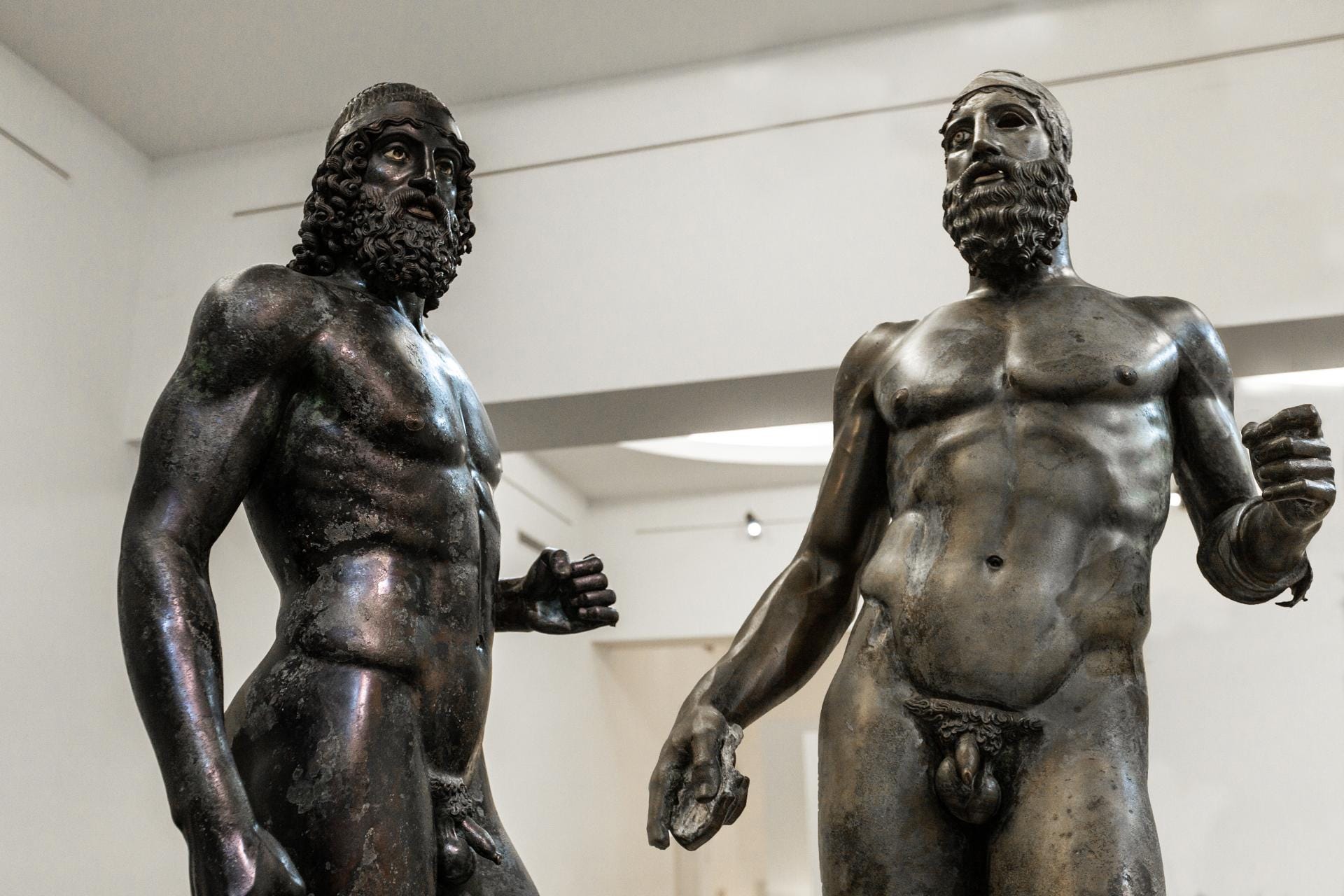
They were Greek, cast in the fifth century BC, and today they are known simply as Statue A, “the Younger,” and Statue B, “the Elder,” probably made about thirty years apart.
Up close, what’s most astonishing is how much of each warrior isn’t bronze at all: the lips and nipples, and even the eyelashes, were made of copper, giving the bodies a reddish, living warmth. The younger warrior’s teeth, just visible between his parted lips, are silver. Their eyes were made of white calcite, and someone took the trouble to shape the small inner corner of each eye, the tear duct, from a piece of pink stone…
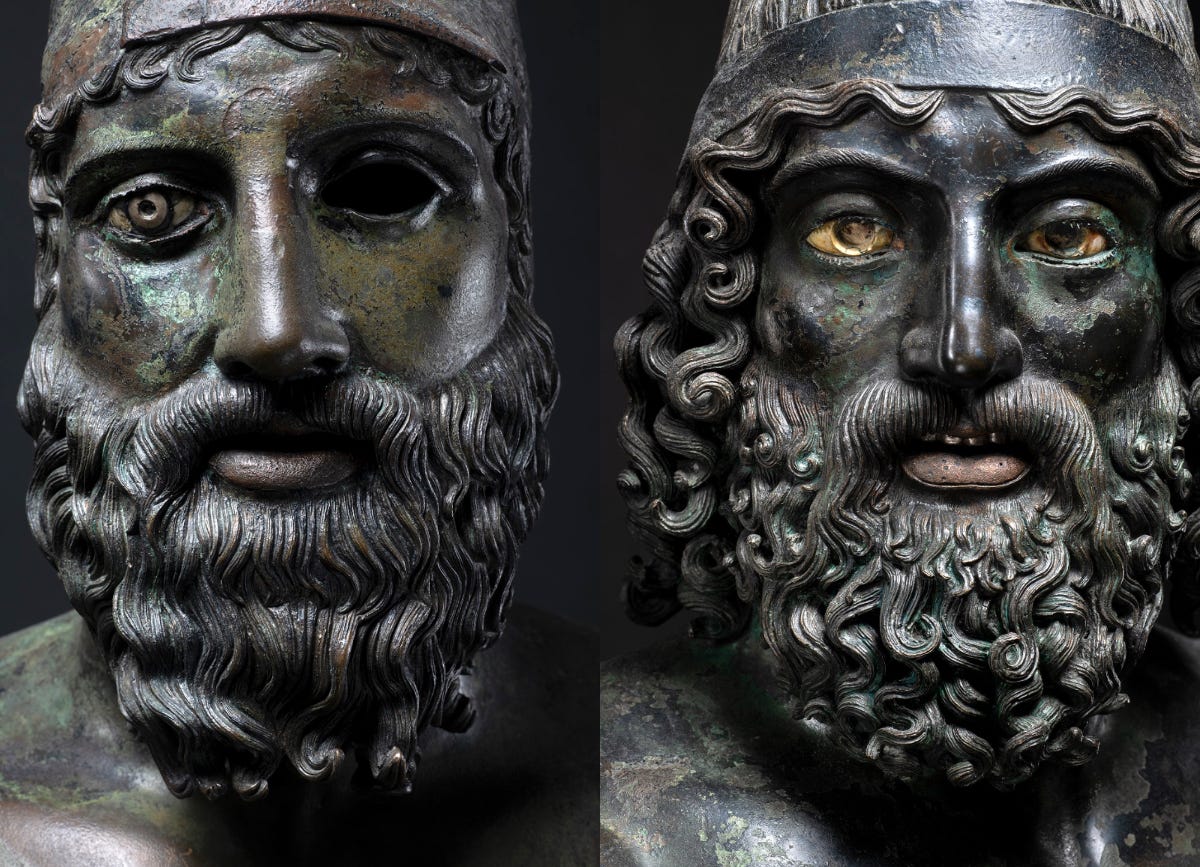
Two and a half thousand years ago, a sculptor decided that even that detail mattered.
We still don’t know who that sculptor was, or how the two warriors ended up in the water. No shipwreck has ever been found, only a scattering of lead rings that may once have belonged to the vessel that carried them. All we know is that two warriors, made to stand, spent more than two thousand years lying side by side on the seabed, like comrades who had fallen in the same battle. Today they are on their feet again in the National Archaeological Museum in Reggio Calabria, and people come from all over the world to look them in the eye…
2. Laocoön and His Sons
In the story of the fall of Troy, Laocoön was the priest who tried to stop the Trojans from dragging the great wooden horse inside their walls. In Virgil’s telling, he warned them:
I fear the Greeks, even when they bring gifts.
The gods, who wanted Troy to fall, sent two enormous serpents out of the sea, and they killed him along with his two sons. This is that moment: a father twisting in agony, trying to tear a serpent off his body while it bites into his side, and his sons trapped in the same coils on either side of him.
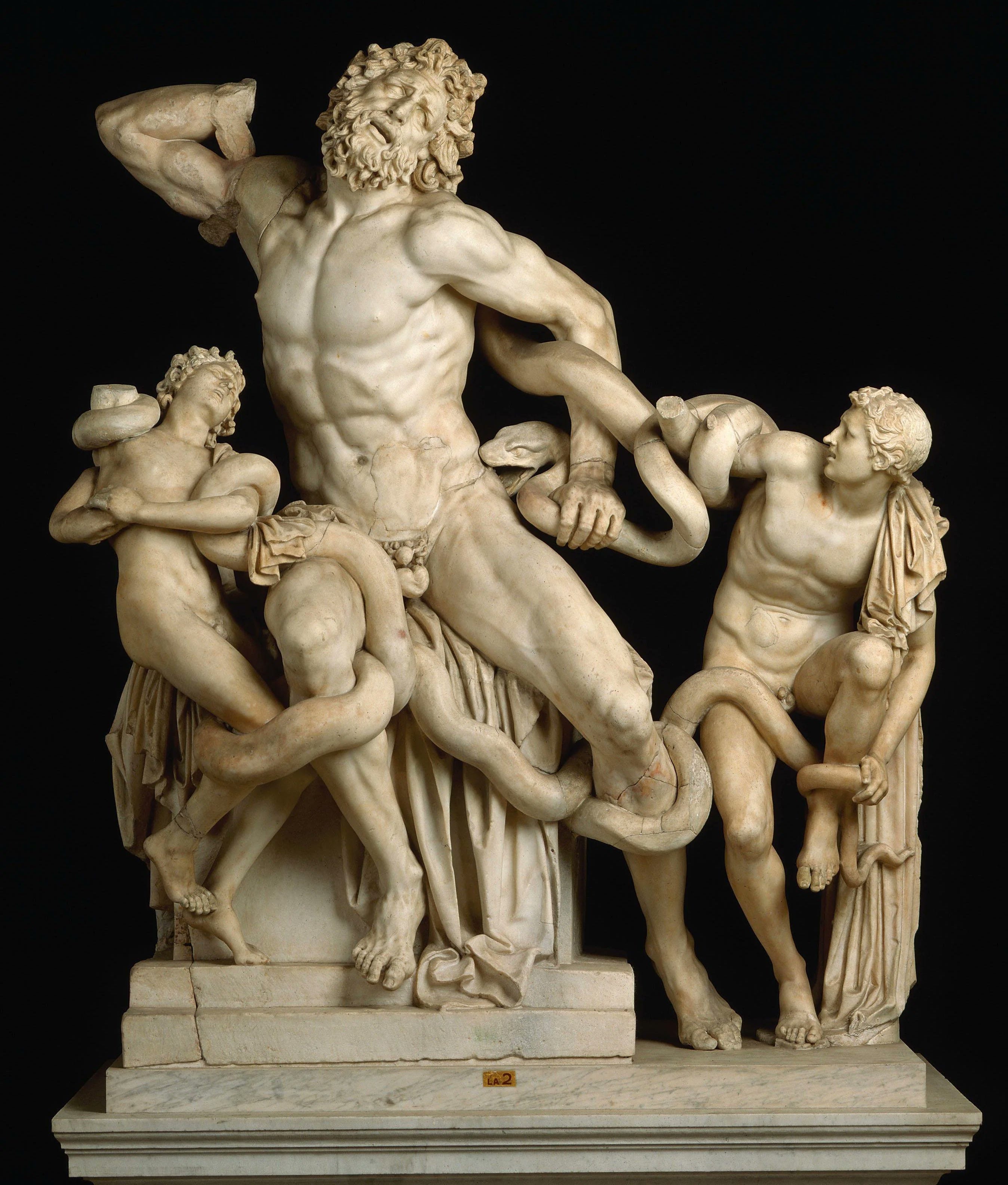
This is the sculpture from the very beginning of this piece, the one Pliny praised so highly. When it came out of the ground in Rome in 1506, Pope Julius II sent his architect, Giuliano da Sangallo, to see it, and Sangallo brought along a sculptor who happened to be at his house that day: Michelangelo. Sangallo’s young son went with them, and decades later he remembered that his father recognized it on the spot:
That is the Laocoön, which Pliny mentions.
The pope bought it and put it on display at the Vatican, and the Vatican Museums trace their origins to this single sculpture.
But one important piece was missing: Laocoön’s right arm. Artists argued about how it should be restored. Michelangelo believed it had been bent back over his shoulder, still straining against the serpent, but in 1532 the sculptor Giovanni Montorsoli gave Laocoön a new arm stretched heroically upward, and for more than four hundred years that is how the world knew him. Copies made in that time, in the Louvre and the Uffizi, still show the arm raised toward the sky.
Then, in 1905, an archaeologist and antiquities dealer named Ludwig Pollak noticed a broken marble arm, bent sharply at the elbow, in a stonemason’s yard in Rome, not far from where the sculpture had been found. He was convinced it belonged to Laocoön, and the following year he gave it to the Vatican. It sat in storage for decades, until a major restoration in the 1950s confirmed what Pollak had suspected: a drill hole in the arm lined up perfectly with one in the shoulder, and the arm was finally put back where it belonged. Michelangelo had been right all along…
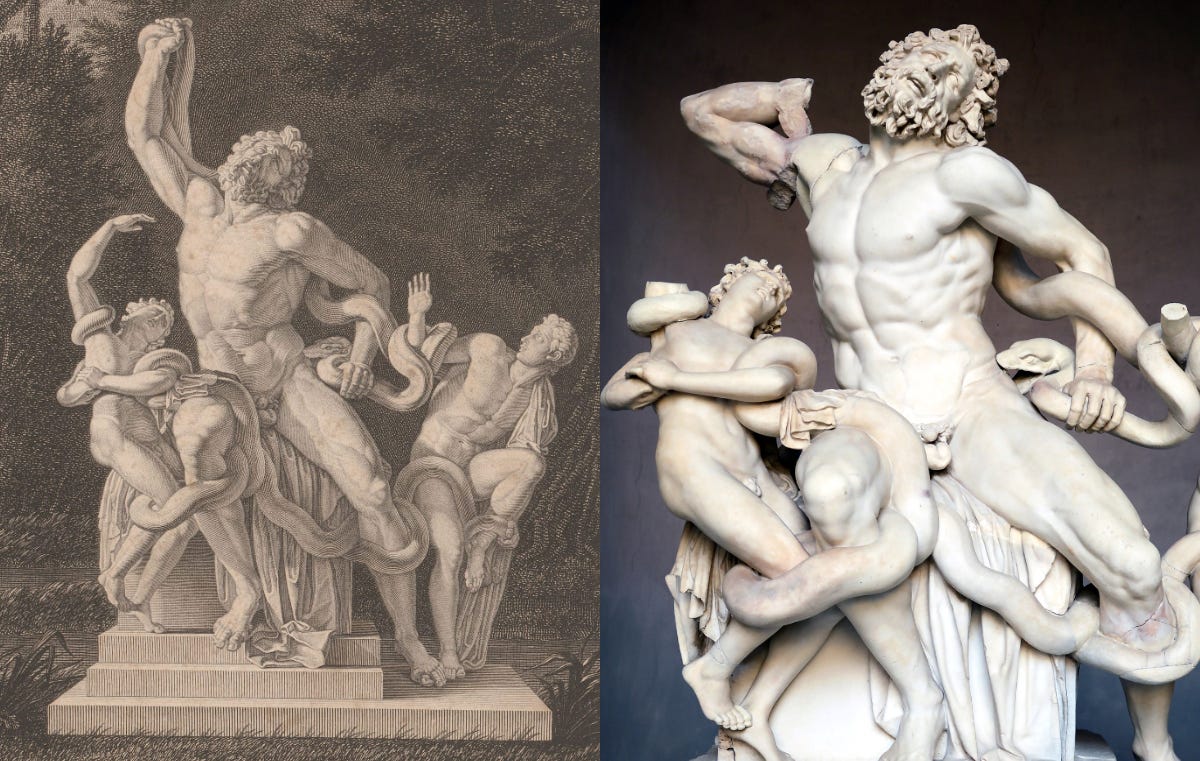
Artists copied it for centuries, and in 1766 the German writer Gotthold Ephraim Lessing named one of the most famous essays ever written about art after it. Still, I think what has kept it alive for so long is the man at its center, the only person in Troy who saw the truth, dared to say it out loud, and was destroyed for being right while his own people watched. Then came the bitterest irony of all: the Trojans decided his death proved him wrong, and dragged the horse inside their walls.
It is one of the oldest stories there is, and it has never stopped repeating itself.
There is nothing new under the sun…
3. The Dying Gaul
A man sits on the ground, too weak to stand, propping himself up on one arm. He is naked, and there is a wound in his side, with blood running from it. His head is bowed, as if he is looking at something only he can see. He is not screaming or begging. He is simply dying, alone, and trying to hold himself upright for as long as he can.
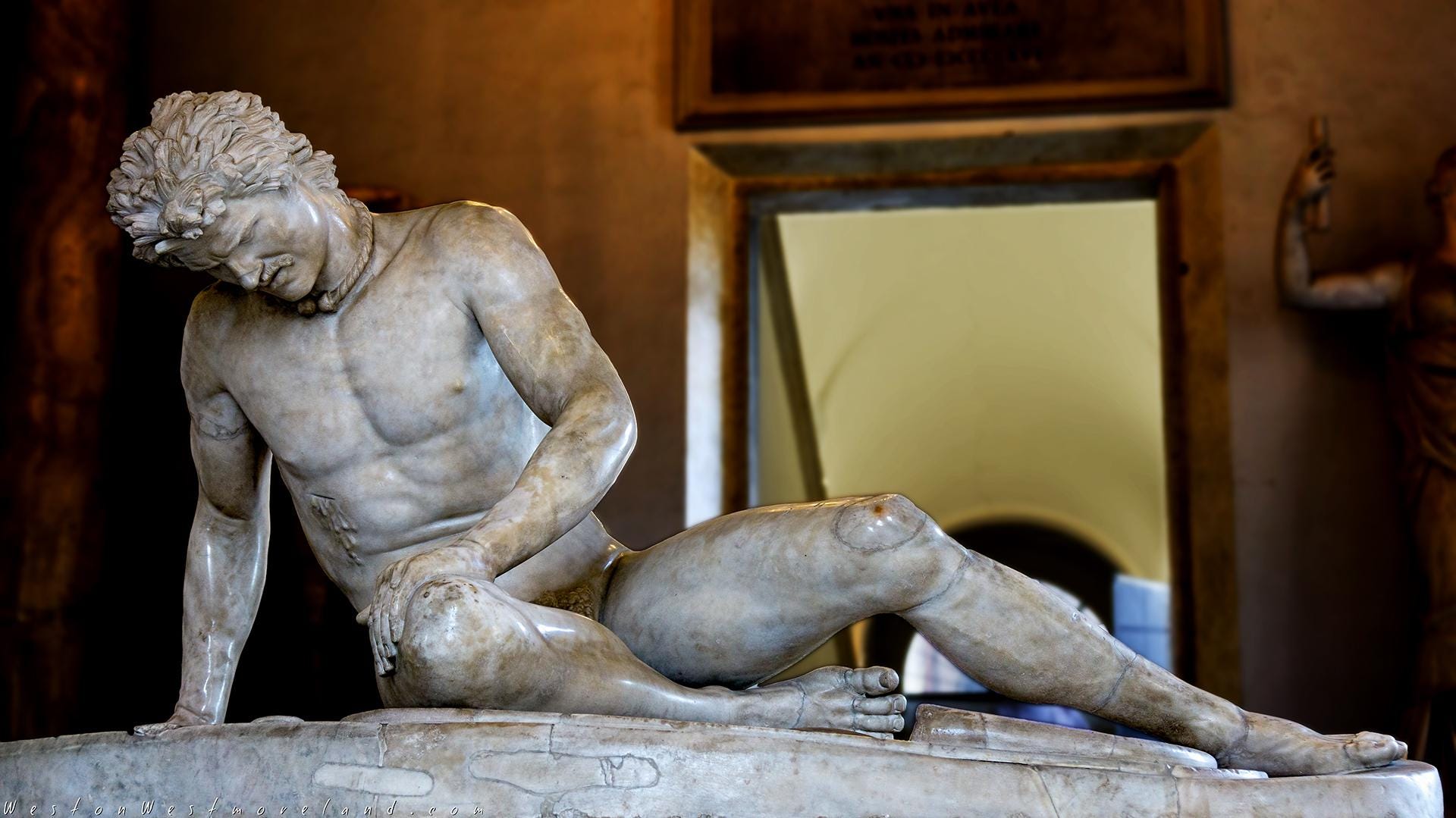
He is a Gaul, one of the Celtic warriors who had settled in Anatolia, in what is now Turkey, and who were known for fighting naked. Around 230–220 BC, Attalus I, king of the Greek city of Pergamon, defeated them in battle and commissioned a monument to celebrate his victory, which probably included a bronze original of this figure. That bronze is lost. What survives is a marble copy, made by the Romans, who admired the work enough to reproduce it.
The people who made this sculpture were the very people who had beaten him, and they made it to celebrate his defeat. And yet the sculptor didn’t make him a monster or a coward. He gave his enemy dignity, courage, and a death that still breaks your heart more than two thousand years later. Perhaps that was meant to make the victory look even greater: the braver the enemy, the more glorious the win. But what’s left, now that the battle and the kingdom have become distant history, is something much more human: a man dying with grace, carved with compassion by the very people who wanted him dead.
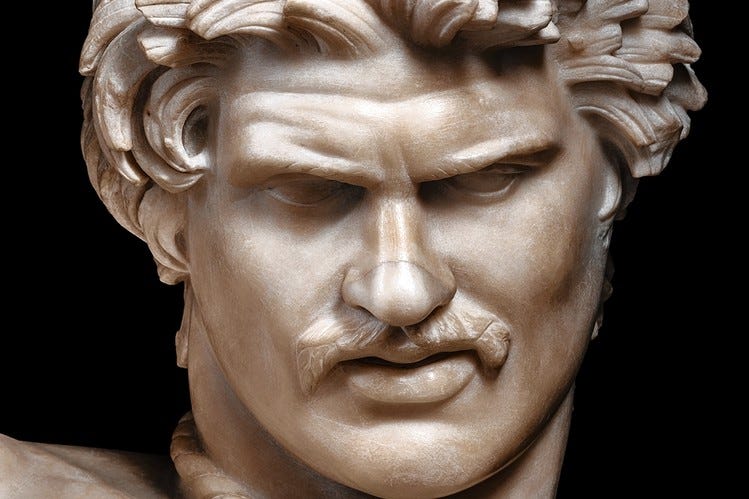
The marble copy turned up in Rome in the early 1600s, while workers were digging the foundations of a villa, and for centuries visitors mistook him for a gladiator dying in the arena. Lord Byron saw him in Rome and wrote some of his most famous lines about him:
He leans upon his hand, his manly brow
Consents to death, but conquers agony.
In 1797, Napoleon’s armies took him to Paris, where he was displayed in the Louvre until he was returned to Rome in 1816. He is still there in the Capitoline Museums, head bowed, refusing to let go…
4. Venus de Milo
On April 8, 1820, on the Greek island of Milos, a farmer was digging among some ancient ruins near his field, looking for stones he could use for building. What he found instead was the upper half of a marble woman. A young French naval officer named Olivier Voutier happened to be exploring the island that day, saw what was coming out of the ground, and urged the farmer to keep digging.
Together they uncovered the rest of her:
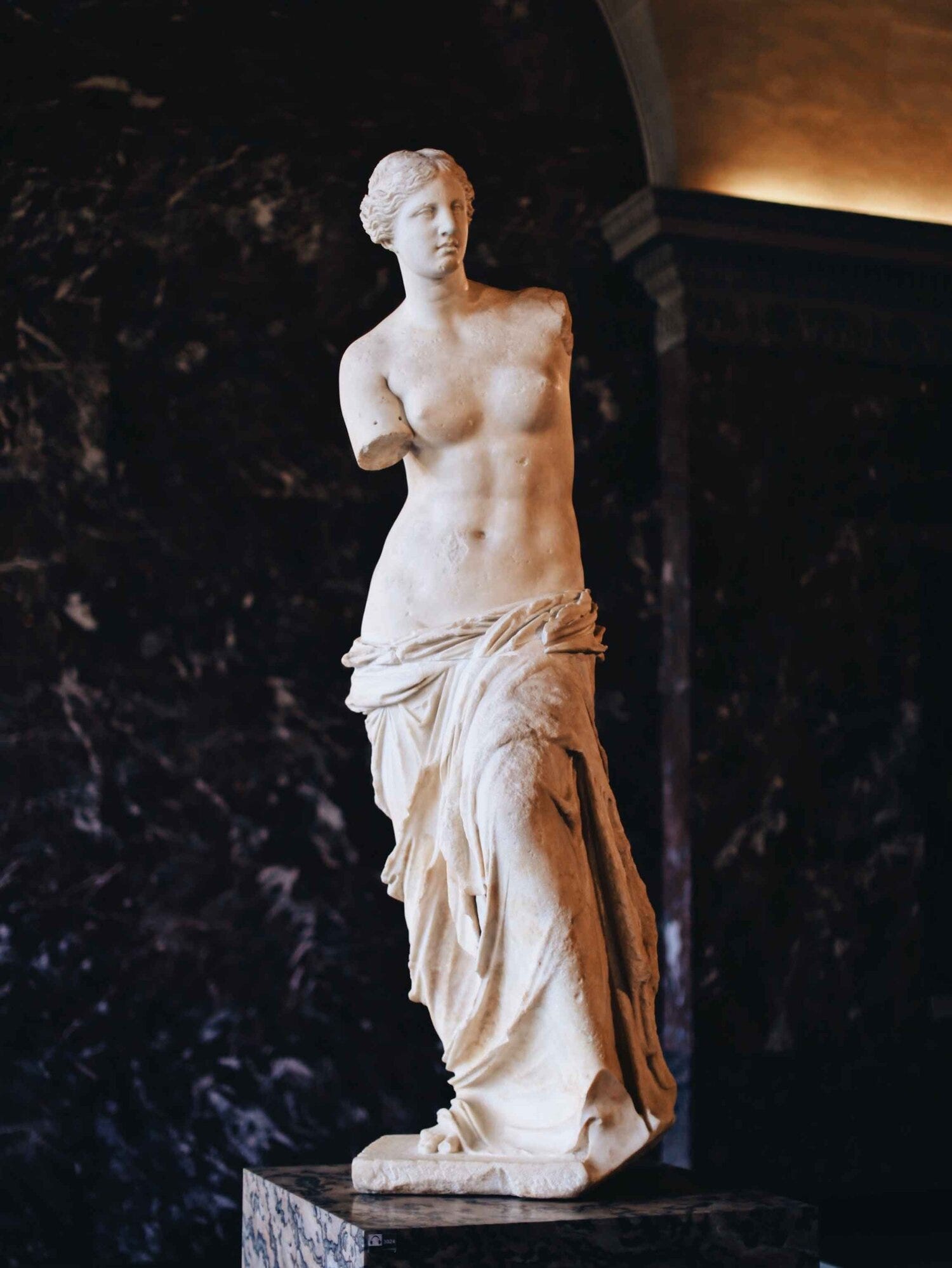
She is the goddess Aphrodite, whom the Romans called Venus: taller than a person, her upper body bare, her drapery slipping from her hips as if it might fall at any moment, her body turning gently in a spiral from her feet to her face. Within a year she was on her way to France, where King Louis XVIII gave her to the Louvre in 1821, and she has been there ever since, one of the most famous works of art in the world.
She was found without her arms, and despite a popular legend that they were broken off in a scuffle on the beach as the French carried her away, the sketches Voutier made at the time show that they were already gone when she came out of the earth. And here is the strange thing: we have stopped wishing she had them. The empty space where her arms should be has become part of who she is. Everyone who stands in front of her finishes her in their own imagination, each in a different way. She is the rare work of art that became more beautiful by losing something, and maybe that is why people have loved her so fiercely for two hundred years.
She is proof that what we lose doesn’t have to make us less…
5. Winged Victory of Samothrace
In April 1863, a French diplomat named Charles Champoiseau was digging among the ruins of an ancient sanctuary on the Greek island of Samothrace when his workers uncovered part of a marble woman. Then another piece. Then another. By the time they were done, there were around 110 fragments: feathers, folds of drapery, a torso, the beginnings of two great wings. There was no head and there were no arms.
Champoiseau sent her to Paris anyway. Years later, he returned to the island to search for what was missing, but he never found her face…
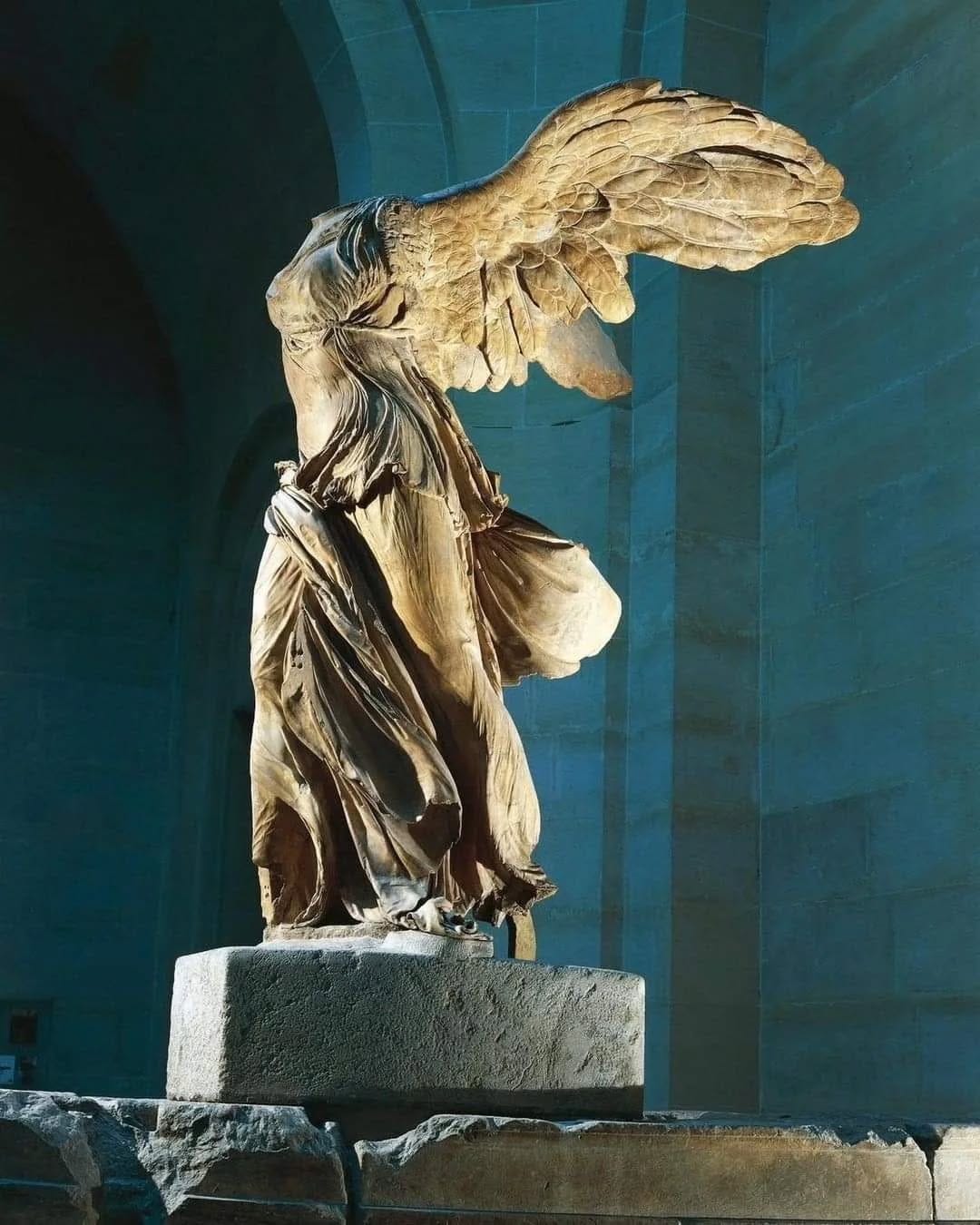
She is Nike, the goddess of victory, and she has just landed on the prow of a warship, her wings still spread behind her, the sea wind pressing her dress so tightly against her body that the marble looks wet. She was probably made to celebrate a naval victory won by the island of Rhodes, more than two thousand years ago.
She is also one of the very few Greek statues whose exact original location is known: she once stood high above the sanctuary, facing the sea, so that anyone arriving could see her.
On the night of September 3, 1939, as war broke out across Europe, workers at the Louvre built a wooden ramp over the great staircase where she stands and slowly lowered her down it. She spent the next six years hidden in a château in the French countryside, sheltered alongside the Venus de Milo, and when the war was over, she came back and climbed her staircase again.
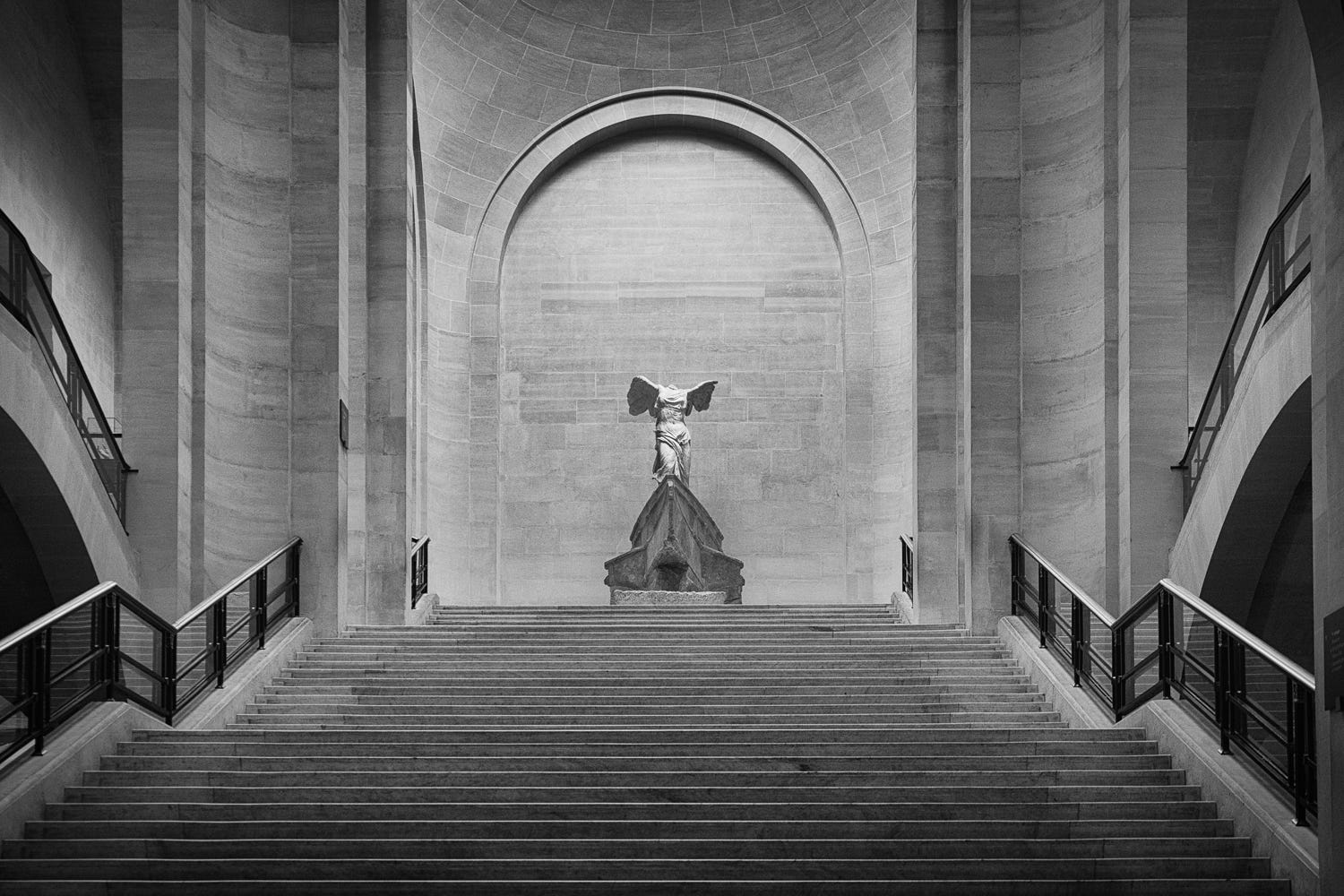
She wasn’t the only one leaving. As Paris braced for bombs, the people of the Louvre spent those days packing statues and paintings into crates and sending them out of the city, as carefully as if they were evacuating people. In a way, they were. When disaster is coming, we find out what we truly can’t live without…
Each of these five sculptures is here today because, at some point in its long life, someone decided it was worth saving. We usually think of art as something we protect, but I’ve come to believe it protects us just as often, because when everything else falls apart, it shows us what is still worth living for. The people who made these works lived through wars and losses we can barely imagine, and still chose to spend their days carving marble and casting bronze.
Two thousand years have changed almost everything about the way we live, and almost nothing about what it means to be human. Whatever hard times we’re given, someone like us has been through them before and left something beautiful behind, as if to say it can be done.
In 1819, the poet John Keats wrote a poem about an ancient Greek urn and imagined it outlasting his own generation, still there long after he was gone, a comfort to people facing sorrows he would never know. It ends with the lines my publication is named after:
When old age shall this generation waste,
Thou shalt remain, in midst of other woe
Than ours, a friend to man, to whom thou say’st,
“Beauty is truth, truth beauty,”—that is all
Ye know on earth, and all ye need to know.
Thanks for reading. Everything here, the research, the writing, all of it, is made by one person, with no team behind it, and no ads or sponsors influencing a single word. That independence is only possible because of my readers. If these pieces mean something to you, please consider becoming a paid subscriber for a few dollars a month, and unlock the full archive:
Every subscription genuinely makes a difference.
Thank you for helping keep this work alive.
Let me get this out of the way first. OMG! Ancient statues, I now see them so differently. I might even take up snorkeling and head off to the Mediterranean islands. Of perhaps,write a little fiction piece about how those two bearded men statues found their way to a sandy seabed.
Following this Substack is way better than either of the art classes I was required to take in College. I look forward to it. It’s a daily gift.
Well written! The referenced poetry was wonderful too. I found some new pets to read. Thank you.