


In 1612, a painter in Rome sat down to write to the Grand Duchess of Tuscany about his teenage daughter. She had been training in his workshop for only a few years, he explained, and she had already become:
So skilled that I dare say she has no equal today.
Proud fathers tend to exaggerate...
His daughter was Artemisia Gentileschi, and she had been producing professional work since the age of fifteen, painting with the stark chiaroscuro and unidealized naturalism of Caravaggio, the most revolutionary artist of the age. In a time when the few women who made a living with a brush were mostly kept to portraits and still lifes, she took on the grandest subjects there were, the great scenes of scripture and history.
That same year, she was sitting in a courtroom. At seventeen she had been raped by a painter who had been teaching her, and in the trial that followed, she was the one made to suffer to prove she was telling the truth. When it was over, she went back to her easel, and what she painted soon after is one of the most ferocious images I have ever seen. It is one of the paintings waiting for you below…
In the decades after the trial, she became the first woman admitted to Florence’s Academy of the Arts of Drawing and built a career across Europe under her own name, courted by some of the most powerful patrons of her time. But after she died, the story of art moved on without her. Historians barely mentioned her, and some of her paintings ended up credited to her father and to other men, Caravaggio among them. For the better part of three centuries, one of the finest painters of the Baroque was almost completely forgotten.
I believe she is the greatest female painter who ever lived, and her story is best told through her own work. So here are 5 of her paintings, in the order she made them. By the last one, I think you will agree that her father was not exaggerating at all…
REMINDER: Beauty is Truth is entirely reader-funded. There are no ads here, just independent writing devoted to celebrating beauty. And it can only continue with your help.
If my posts have meant something to you, becoming a paid subscriber is the most meaningful way to support this work. With the new annual subscription discount, it costs less than a coffee a month. Join here:
Gift subscriptions to Beauty is Truth are now available too. Beauty is best when it’s shared, so if a friend or family member comes to mind, consider passing a little of it into their inbox:
1. Susanna and the Elders (1610)
When the National Gallery in London finally gave Artemisia her first major exhibition in Britain, in 2020, this was the painting that greeted visitors at the door. It is the earliest work she ever signed and dated, and she finished it when she was seventeen:
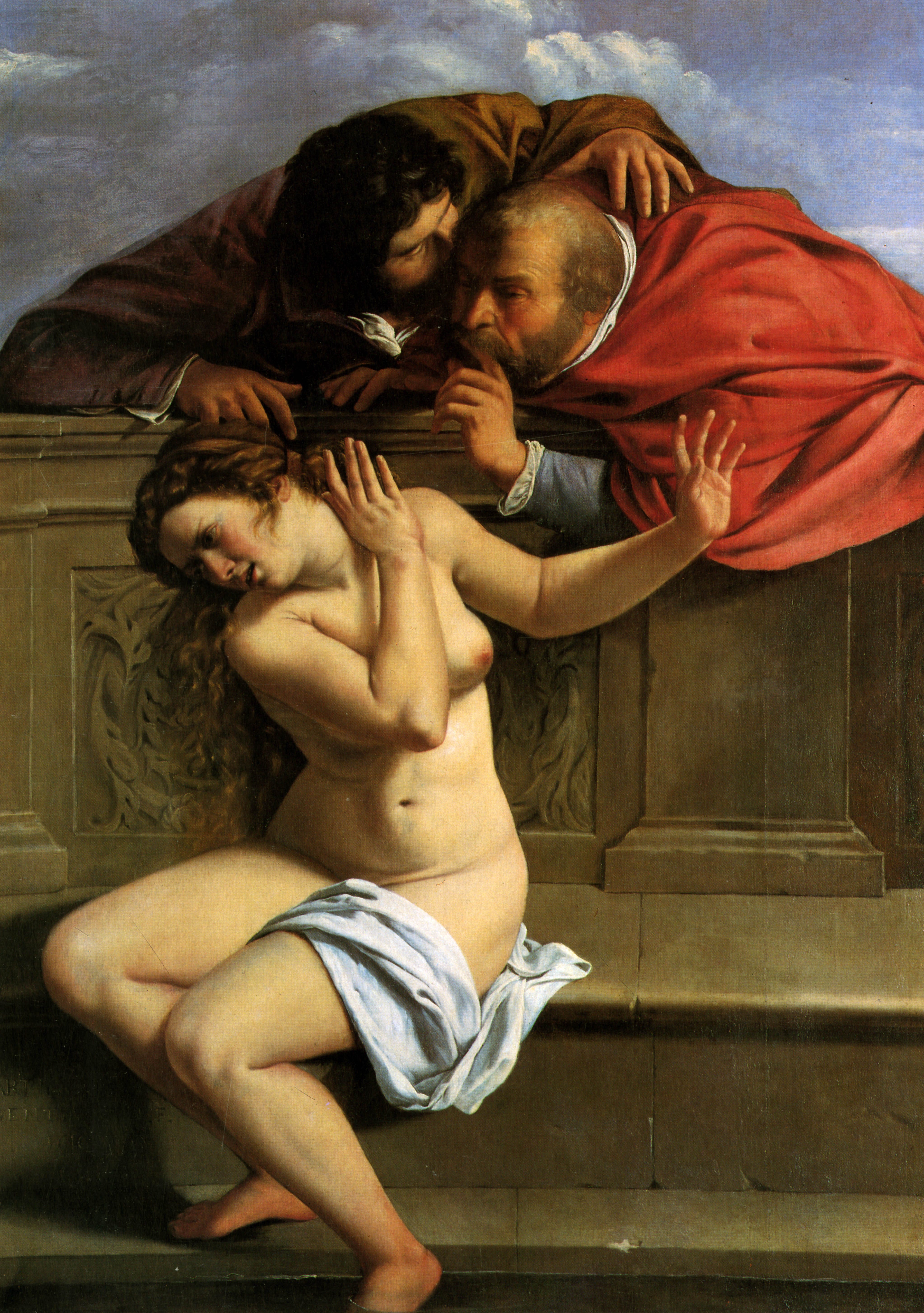
The story comes from the Book of Daniel. Susanna, a young married woman, is bathing in her garden when two respected elders of her community, who have been secretly watching her, step out and corner her. Their offer is blackmail: give yourself to us, or we will swear we caught you with a lover, a crime punishable by death. She refuses them…
For generations, painters had loved this story for reasons that had little to do with Susanna. It was a respectable excuse to paint a naked woman being looked at, and many showed her calm and untroubled, as if the attention did not bother her at all. Artemisia painted the moment as it would feel from inside.
The two men loom over the wall, close enough to touch her. One whispers into the other’s ear, and the fingers of the man on the left seem to brush her hair. Susanna wrenches her body away from them, her face tight with revulsion. There is no landscape to admire, and the three figures are pushed so close to the front of the canvas that there is nowhere for her to go. It is among the earliest paintings of this story to show Susanna in real distress.
She made it in her father’s house in Rome, and she signed it with her full name and the year: ARTEMISIA GENTILESCHI F. 1610. The F stands for fecit, Latin for “made it.” It was a teenager’s claim of authorship, and for a very long time nobody honored it: this was one of those paintings the world credited to her father.
In the story, the elders carry out their threat, and Susanna has to defend her word before a crowd that believes the two powerful men and condemns her. Within two years, Artemisia would be standing in a courtroom of her own. Look again at those raised hands, and at the refusal in them. The girl who painted them could not have known how soon she would have to find that same courage in herself…
2. Judith Slaying Holofernes (1612–13)
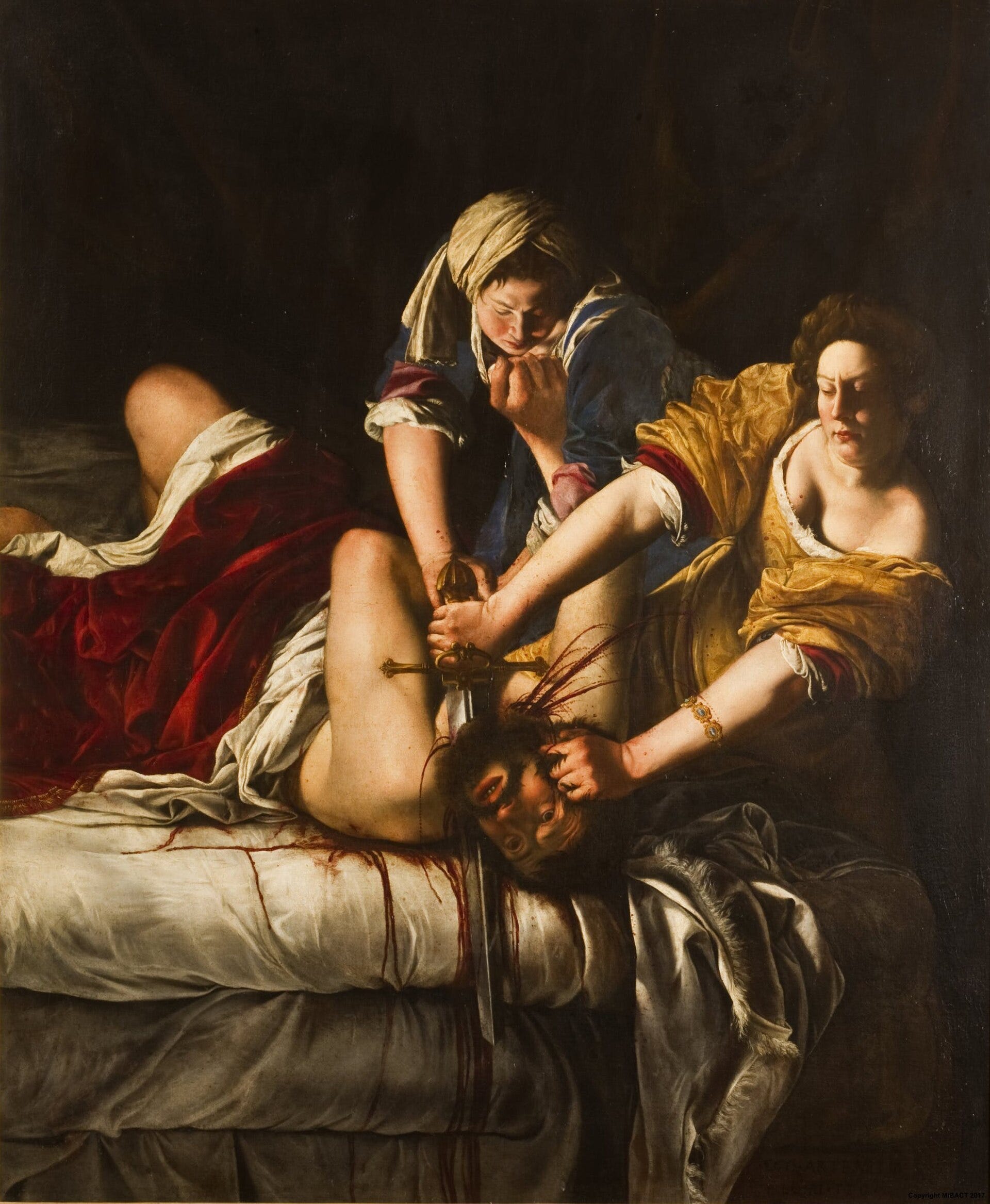
Here it is. Two women are holding a man down on a bed. The younger one, the servant, throws her weight across him to pin his flailing arms while his fist pushes back against her. The other, Judith, presses his head into the sheets with one hand, and with the other drags a sword through his neck. The blood runs into the white linen at the very front of the canvas, as close to you as the painting can bring it.
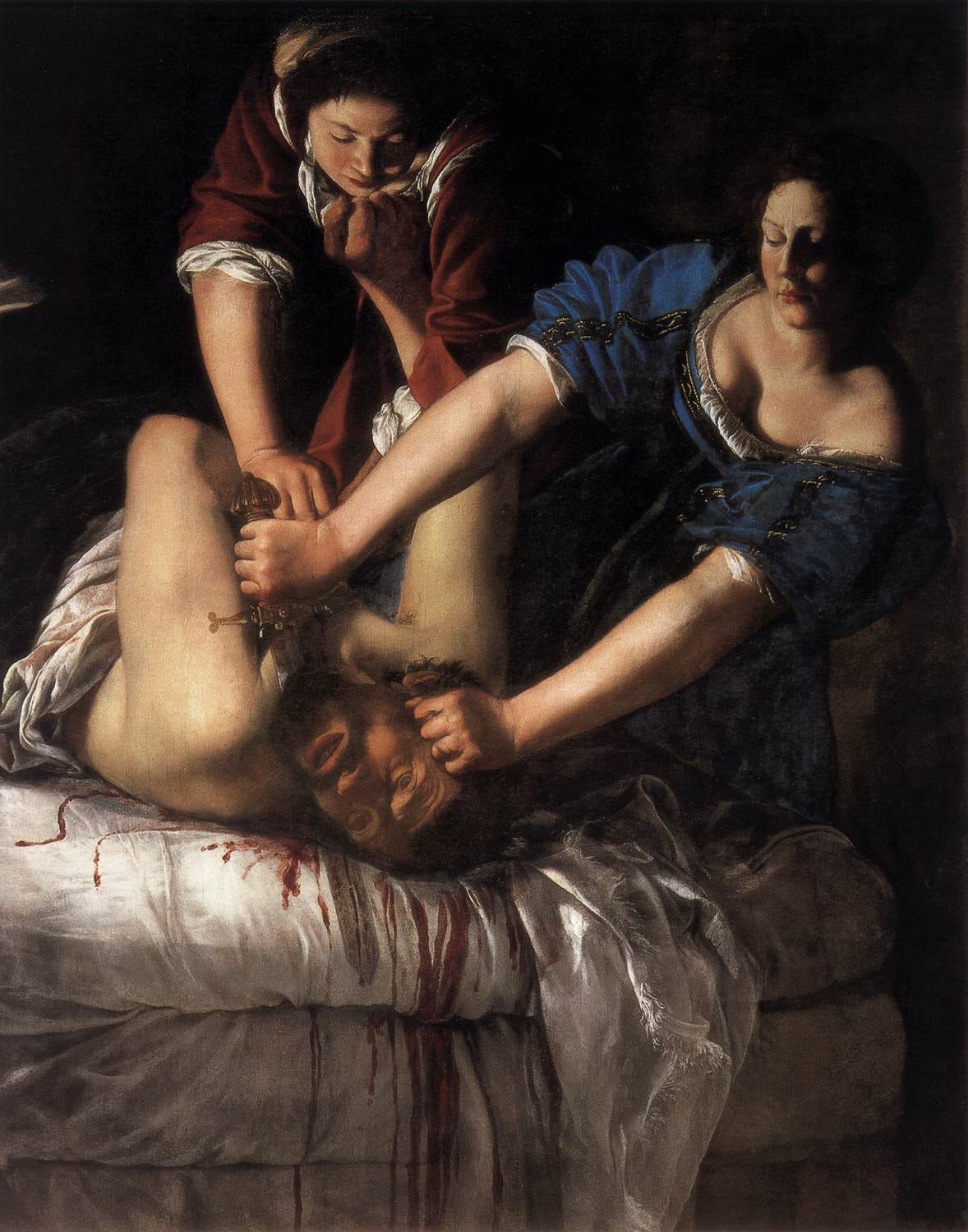
The story comes from the Book of Judith. Holofernes is an Assyrian general besieging her city. Judith, a young widow, walks into his camp, wins his confidence, and when he falls into a drunken sleep, she and her maid cut off his head and save her people. Caravaggio had painted the scene in Rome more than a decade earlier, and his Judith recoils from the task, holding the sword almost at arm’s length, while an old, wrinkled servant stands by and watches. Artemisia’s women do the work together. Her Judith does not flinch, and you can see the strain in her wrists.
At a lecture I once attended, an art historian described the result as “more Caravaggio than Caravaggio himself,” and I think about it every time I see this masterpiece…
She painted it around the time of the trial, before she turned twenty. The man who had raped her, Agostino Tassi, was her father’s friend and colleague, and afterward he had promised to marry her. When he never did, her father took him to court. The case dragged on for seven months, and to test whether she was lying, the court had cords wound around her fingers and pulled tight, the same fingers she painted with. Tassi was never put through anything of the kind. As the cords tightened, she kept screaming the same words: “È vero! È vero! È vero!” It is true. Then she turned to the man who had promised to marry her and said:
This is the ring that you give me and these are your promises.
For a long time, critics read this painting as revenge, and it is almost impossible to look at it without thinking of that courtroom. Many historians now caution against reducing it to that alone, and they are right to: it is also a young painter taking on the most violent subject in scripture and handling it as boldly as any man of her time.
She could not let the image go, and about eight years later she painted it again, larger and even bloodier, with the blood now leaping from his neck in long arcs that, one study found, closely follow the curved path her friend Galileo had worked out for projectiles, years before he published it. On Judith’s arm she added a bracelet whose tiny cameos, one scholar has suggested, may show Artemis, the goddess whose name she carried.
Tassi was found guilty and given a choice between five years of hard labor and exile from Rome. He chose exile, and the sentence was never enforced.
Her name was not so lucky: Tassi had bribed witnesses to swear she had slept with other men and produced fake love letters she had supposedly written. Before long, she had become the subject of lewd sonnets passed around the city. To salvage what was left of her honor, she was married off the day after the trial ended to a Florentine painter, Pierantonio Stiattesi, and sent away from the only city she had ever known. The man who had raped her walked free, and she was the one who had to leave.
But nothing that happened in that courtroom could take away what she could do with a brush…
3. Self-Portrait as Saint Catherine of Alexandria (1615–17)
By the spring of 1613, Artemisia was in Florence: nineteen years old, far from Rome, married to a man she had not chosen. Between 1613 and 1618 she gave birth to five children, and she lost most of them. Her first, a son, lived little more than a week. Only one, her daughter Prudentia, would live to grow up. Through all of it she kept working, and she began to win the favor of the Medici, the family that ruled the city.
This is how she chose to paint herself in those years:
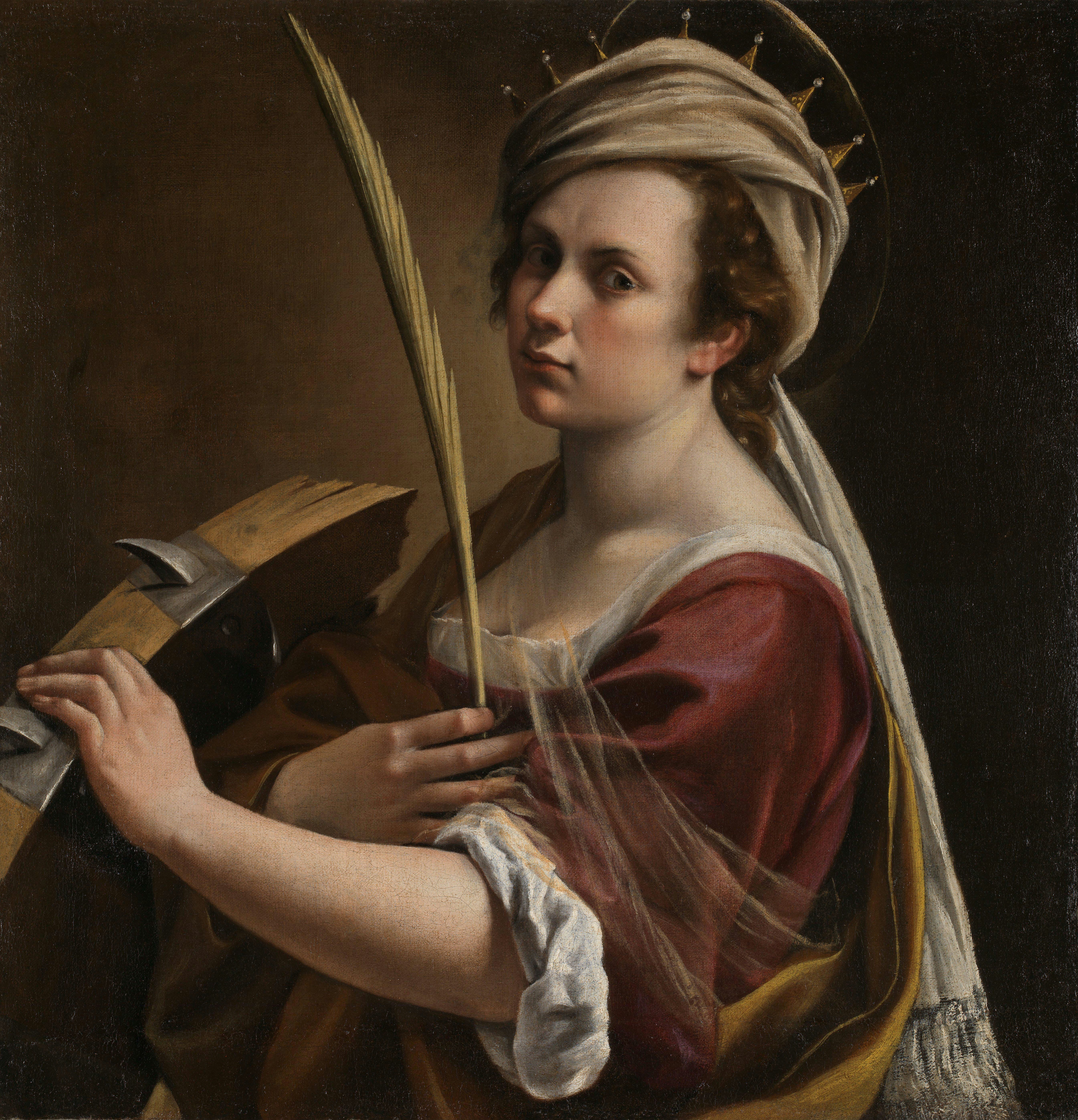
She turns toward us with strong hazel eyes, an off-white scarf wound around her head like a turban, a crown of pearls and a faint halo above it. One hand rests on a broken wheel studded with iron spikes, the other holds a martyr’s palm against her chest.
Catherine of Alexandria, according to legend, was a brilliant young woman of royal blood in the fourth century. When she refused the Roman emperor who wanted her for his wife, he had her bound to wheels studded with spikes. The wheel broke apart before it could harm her, and she was beheaded instead.
What makes this painting truly incredible is what the National Gallery found when it examined it. It did not begin as a saint. It began as Artemisia, simply herself, with a cloth wrapped around her head. Everything that makes her Saint Catherine, the wheel included, was added afterward, and the crown still sits a little awkwardly on top of the scarf because it was never part of the original composition. Nobody knows whether a patron asked for the change or whether it was her own idea. But there is a word for what she turned herself into...
Martyr comes from the Greek martys, which originally meant “witness.” Catherine was a witness for her faith. Artemisia had been a witness too, in a Roman court that tortured her to test her word, and here she is, holding the broken wheel and looking straight at you.
The painting resurfaced only recently: in 2018 the National Gallery in London bought it for £3.6 million (about $4.5 million), the first work by a woman it had acquired in nearly thirty years, and the first painting by Artemisia ever to enter a public collection in Britain. Its director said it “now belongs to everyone,” and the gallery meant it. The following spring it was sent on tour to places that rarely see great art, a doctor’s office in Yorkshire among them, and then somewhere no painting from a British national collection had ever gone before: a women’s prison in Surrey. For three days it hung there, and women in the prison sat in front of it.
Four centuries after a court wound cords around her fingers, Artemisia was carried into a prison, and there she was, holding the broken wheel, looking them in the eye…
4. Judith and Her Maidservant (1623–25)
By 1620, Artemisia was back in Rome, and the city that had once watched her humiliated now wanted her work. She had become one of the most sought-after painters there, with a house, in a phrase from the period, “full of cardinals and princes wanting pictures from her.” And by 1623 she and her husband were no longer living together. She was around thirty, and her life was her own.
Then she went back to Judith, but this time she chose a different moment: the one right after.
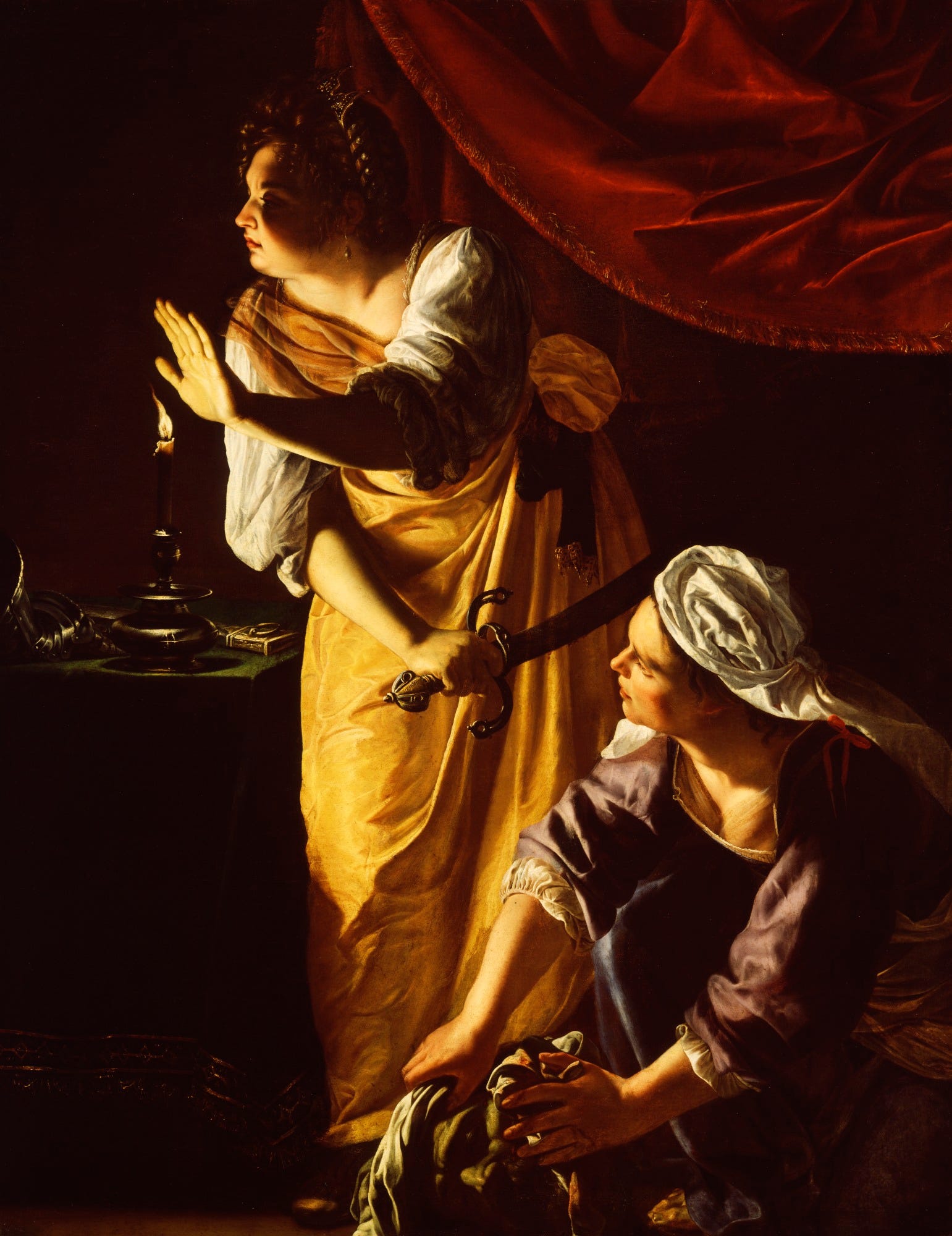
It is night inside Holofernes’s tent, and the only light comes from a single candle. Judith stands with the sword still in her hand and raises the other against the flame. The shadow it throws across half her face looks astonishingly real, and it is one of my favorite details in all her work. At her feet, her maid kneels, wrapping the severed head in a cloth. Both women have turned toward something we cannot see, beyond the edge of the canvas…
A decade earlier, she had painted the killing itself. Here the violence is already over, and what fills the canvas is the most dangerous moment of all: two women in an enemy camp in the dead of night, holding a general’s head, trying to get out alive. The Detroit Institute of Arts, where it hangs today, says that in its naturalism and its clear sympathy for the fear and apprehension of its two heroines, the painting is entirely unique to Artemisia herself.
It is also the work of a painter in complete command. Judith is wrapped in the rich golden yellow Artemisia favored in those years, glowing against the dark, and every surface in the tent catches the candle differently. Letizia Treves, the curator who brought Artemisia to the National Gallery, wrote that with this painting:
Artemisia rightly takes her place among the leading artists of the Italian Baroque.
And yet this masterpiece, too, slipped out of sight. No one knows where it was for most of its life. It surfaced in 1952, in the collection of a Roman prince, and that same year it was bought and given to the Detroit Institute of Arts.
Twelve years before she painted it, Artemisia had shown the world a woman striking the blow. Here she paints what comes after: the worst already behind you and the danger still near, with nothing to lead you out of the dark but your own steady hand.
5. Self-Portrait as the Allegory of Painting (1638–39)
In 1638, when Artemisia was in her mid-forties, a king sent for her. Charles I of England invited her to London, where her father, now in his seventies, had been working at court for more than a decade. Orazio was painting the ceiling of the Queen’s House at Greenwich, and so father and daughter ended up working side by side once more, the way they had when she was a girl in his workshop in Rome.
It did not last...
In February 1639, the man who had once written that his daughter had no equal died in London. She probably painted this during those months:
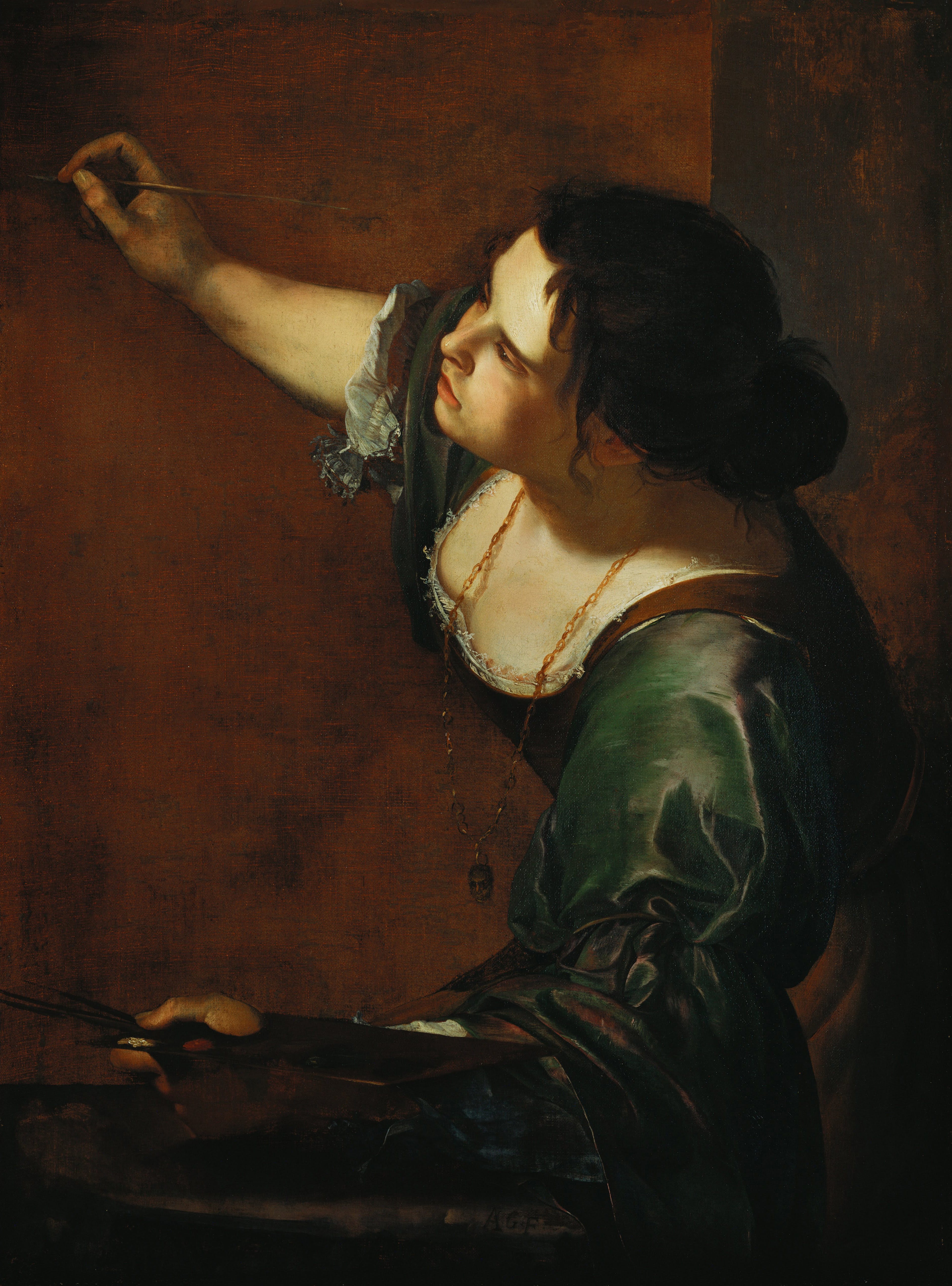
It is a self-portrait, but she did not paint herself as a woman, or as a saint. She painted herself as Painting itself. The artists of her day worked from a handbook by Cesare Ripa that described exactly how to depict Painting: a beautiful woman with loose, disheveled dark hair and a gold chain at her throat, hung with a small mask as the emblem of imitation. Artemisia gave that figure her own face. Her dress is shot silk that shifts between green and mauve, her sleeve is pushed up past the elbow, and she leans toward a canvas we cannot see caught in the middle of a thought.
One detail from Ripa is missing, and i love that it is. His Painting was supposed to have her mouth covered by a cloth tied behind her ears, a sign that painting is mute. Artemisia left the gag out. And on the stone slab she leans on, the one used for grinding colors, she painted her initials in large letters: A.G.F., Artemisia Gentileschi fecit. The same word she had written beside her name at seventeen…
Her father did not live to see it, but her first biographer wrote that in England she quickly surpassed his fame.
A few years later, she moved to Naples, and she stayed there for the rest of her life, running her own workshop with no permanent post at any court and no powerful husband to shield her. Even then, after everything she had done, she was still fighting to be believed. Writing to the Sicilian collector Don Antonio Ruffo in 1649, she admitted that a woman’s name raises doubts until her work is seen.
In 1652, approaching sixty, she painted Susanna and the Elders one more time, the same story she had painted at seventeen in her father’s house. It is her last known dated work. After it, her trail fades, and nobody knows for certain when she died. For years, this final Susanna, too, was credited to someone else, and even its signature is incomplete. On the first one, the girl in Rome had written her full name. On this one, only the end of it remains: ...schi f. 1652.
But one small thing survived. Her first name is gone, yet the little f is still there: fecit. And in those same letters to Ruffo, she had promised him something:
I will show Your Illustrious Lordship what a woman can do.
She did. The world did everything it could to stop her, and it failed.
Artemisia fecit. Artemisia made it.
Thanks for reading. Everything here, the research, the writing, all of it, is made by one person, with no team behind it, and no ads or sponsors influencing a single word. That independence is only possible because of my readers. If these pieces mean something to you, please consider becoming a paid subscriber for a few dollars a month, and unlock the full archive:
Every subscription genuinely makes a difference.
Thank you for helping keep this work alive.
How much beauty is missing from the world because of men's oppression of women?
How will the world ever know how many female artists work was attributed to men? Changing history isn’t a contemporary problem; it has gone unnoticed for centuries.