


René Magritte, the painter of faces hidden behind apples and veils, once explained in a 1965 radio interview why he kept doing it:
Everything we see hides another thing, we always want to see what is hidden by what we see.
Most of us have rewritten a message a dozen times before sending it, and the person who receives it never sees the versions we deleted. Painters worked the same way, except that a canvas never fully forgets. As oil paint ages, the top layer can slowly turn transparent, and shapes an artist covered centuries ago begin to show through.
Art historians call these ghosts pentimenti, from the Italian pentirsi, “to repent” or “to change one’s mind.” It may be my favorite word in all of art history, because it means that even the greatest painters had doubts, and their canvases still carry them.
Until 1895, the only ones we could see were those that time had brought to the surface, but that year Wilhelm Röntgen discovered X-rays. By the following year, a professor in Frankfurt was already pointing the new rays at a painting, as if we couldn’t wait to find out what artists had kept to themselves, and what later hands had tried to erase.
The secrets I love most, though, never needed a machine, because they have been in plain view all along, and in April 1819 Goethe summed up why so many of us miss them:
One perceives only what one already knows and understands.
Our eyes can only find what our minds are ready for, which is why the right fact can change a painting we thought we knew. So before you read each of the 6 stories below, give the painting a moment and see whether you can find its secret on your own. Once you’ve seen it, I promise you’ll never be able to unsee it…
REMINDER: this is a teaser for my subscriber-only articles.
Beauty is Truth is entirely reader-funded. There are no ads here, just independent writing devoted to celebrating beauty. And it can only continue with your help.
If my posts have meant something to you, becoming a paid subscriber is the most meaningful way to support this work. With the new annual subscription discount, it costs less than a coffee a month. Join here:
Gift subscriptions to Beauty is Truth are now available too. Beauty is best when it’s shared, so if a friend or family member comes to mind, consider passing a little of it into their inbox:
1. What His Mother Saw
The sun is going down over the hills, and in a small carpenter’s workshop a young man who has been sawing all afternoon lifts his arms above his head to stretch. Shavings cover the floor around him, and behind him a woman kneels beside an open chest, her back turned to us. It looks like the most ordinary moment at the end of a long day…
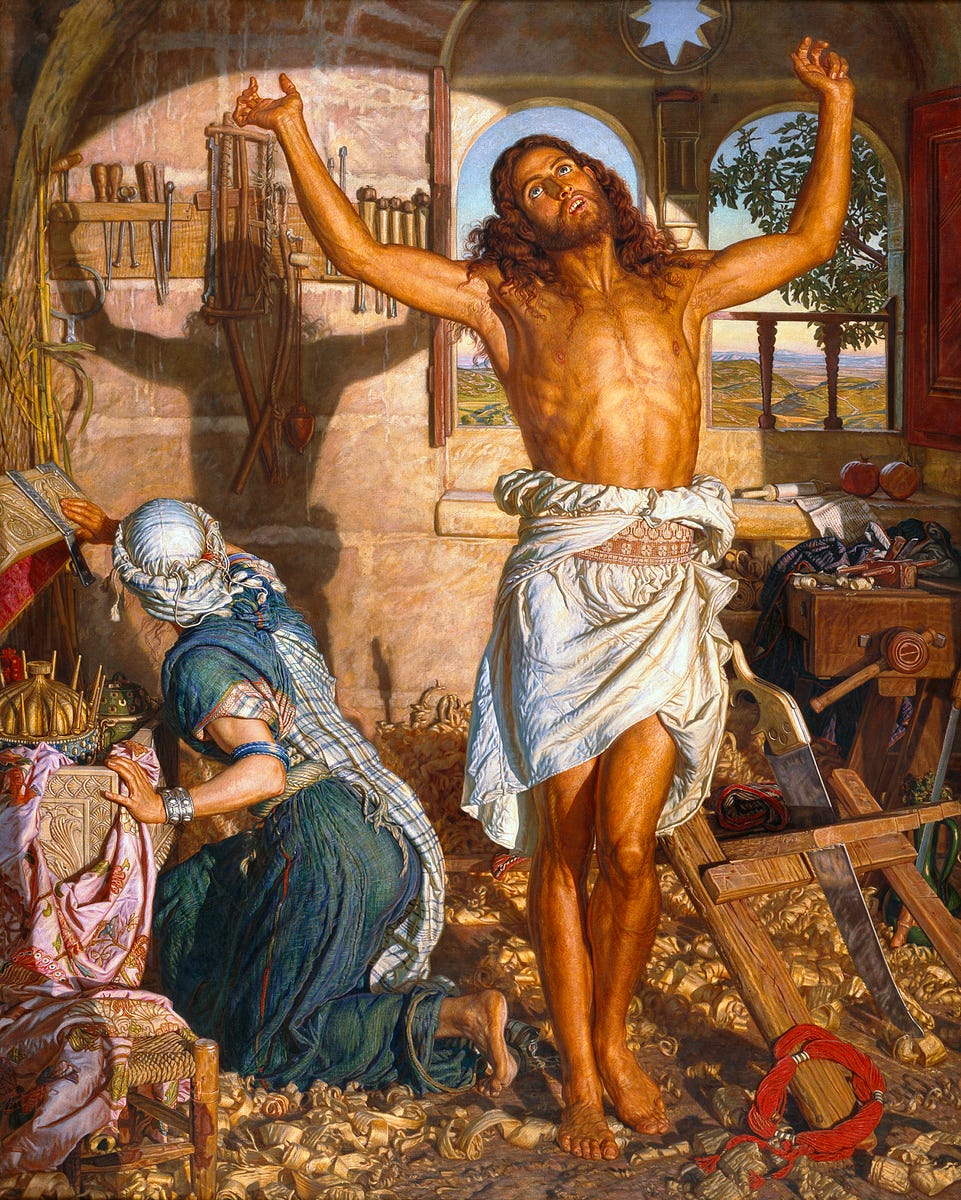
The young man is Jesus, the woman is his mother, Mary, and the painter is William Holman Hunt, one of the founders of the Pre-Raphaelite Brotherhood. Hunt wanted to show what he called “the Man Christ,” a working man earning his bread with his own hands, and he went to great lengths to get it right. He made his first studies in a carpenter’s shop in Bethlehem, then spent the best part of three years on the canvas in Jerusalem, where he built a hut on the roof of his rented house so he could control the light. The finished picture stands more than two meters tall, and at one point Hunt even thought about destroying it, afraid he couldn’t stay true to nature on such a large scale.
Look at the wall behind Jesus, though, and the whole scene changes: the low sun throws the shadow of his raised arms across a rack of tools, and his silhouette becomes a man nailed to a cross. His gesture couldn’t be more innocent, yet the light has already sketched what is waiting for him…
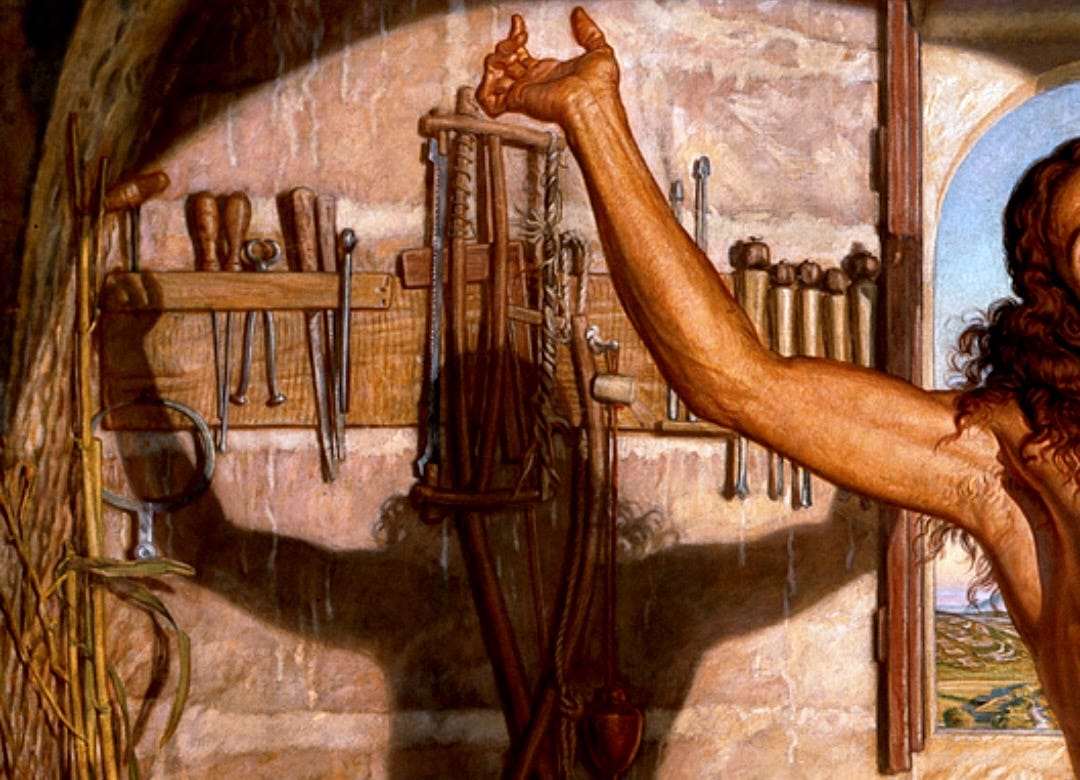
The cross is so striking that few people look any further, but the rest of the room is telling the same story: on the floor near his feet lies a red headband, a reminder of the crown of thorns, and the reeds leaning in the corner foreshadow the one the soldiers will press into his hand as a mock scepter. Even the arch of the window behind his head becomes a halo, and above it, a star-shaped opening recalls the star that once led the Magi to his cradle.
His mother has kept their gifts in that chest ever since, the way some parents save a child’s first shoes, and she was looking at them once more when something on the wall made her lift her head. In a single glance, she has traveled from the beginning of his life to its end. Hunt wrote to his friend Edward Lear that she needed no vision from heaven to understand, since many women whose sons set out to change the world had foreseen their fate without one.
Hunt had learned for himself how close a birth and a death can be when his wife, Fanny, died in Florence weeks after their son was born, and he gave the boy the middle name Benoni, Hebrew for “son of my sorrow.” He let us share what Mary saw, but he never let us see her face, as if some sorrows are too private to paint…
2. What the Crowd Came to See
Study the photo below before reading on, and try to work out what this crowd has come to see:
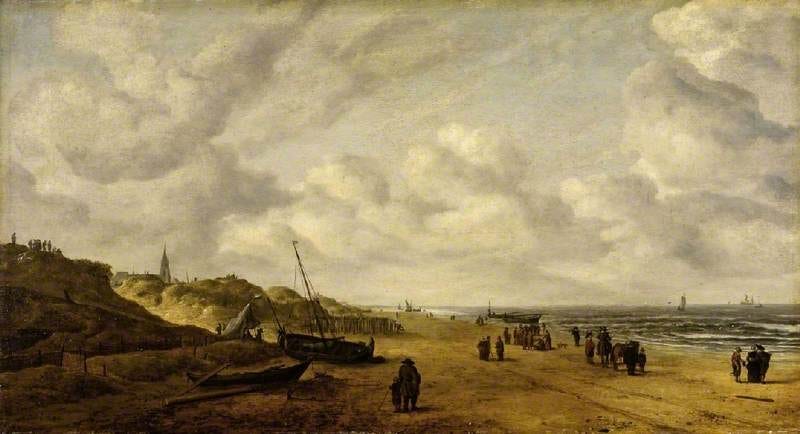
It’s a gray winter day on a Dutch beach almost four centuries ago, and groups of people have walked out across the sand while others watch from the dunes, yet the stretch of shore they’re all facing is empty. For generations, nobody suspected there was anything to explain. Then, in 2014, a conservation student began cleaning the painting, and a man appeared on the horizon, standing on thin air. Someone, long ago, had hidden what he was standing on, and it was far bigger than anyone could have imagined…