


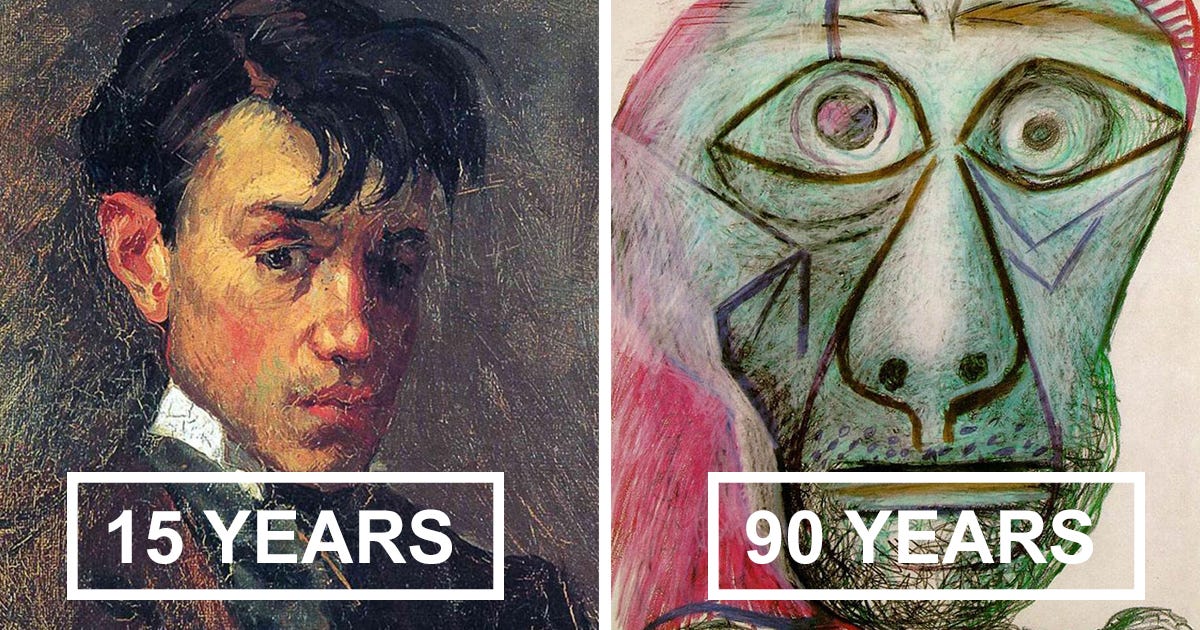
Most of us have heard it said, or thought it ourselves, in front of one of Picasso’s later portraits, with one eye bigger than the other and a face made of triangles: “A child could have painted that.” Picasso might have taken it as a compliment, since he’s often quoted as saying, “It took me four years to paint like Raphael, but a lifetime to paint like a child.”
The first half of that line sounds like a boast, but in September 1895, a few weeks before his fourteenth birthday, he took the entrance exam for the advanced drawing classes at Barcelona’s School of Fine Arts. According to the Musée national Picasso-Paris, he was given a month to complete it, and he finished in a single day…
It helped that his first teacher was his father, José Ruiz Blasco, a painter himself, though the name he would make famous was his mother’s. In A Coruña, where the family lived before settling in Barcelona, Pablo joined his class at eleven. Within a year, a charcoal study of the Torso of the Belvedere had placed him among the eight best of 141 students, “by far the youngest,” as two scholars who have studied his time there point out. In February 1895, at thirteen, he showed his work in a furniture shop window on Calle Real and earned two excellent reviews in the local press, while his father’s own exhibitions had drawn lukewarm ones. That was when José Ruiz decided to “hang up” his brushes and give his painting materials to his son.
Those brushes were in good hands, and the paintings below, all from the years before Cubism, are the proof that when Picasso broke the human figure into pieces, he knew exactly how to put it back together...
Along the way, he grows from a prodigy into a man, which, by his own account, is where the trouble starts:
In every child there is an artist. The problem is to know how to remain an artist when growing up.
REMINDER: this is a teaser for my subscriber-only articles.
Beauty is Truth is entirely reader-funded. There are no ads here, just independent writing devoted to celebrating beauty. And it can only continue with your help.
If my posts have meant something to you, becoming a paid subscriber is the most meaningful way to support this work. With the new annual subscription discount, it costs less than a coffee a month. Join here:
Gift subscriptions to Beauty is Truth are now available too. Beauty is best when it’s shared, so if a friend or family member comes to mind, consider passing a little of it into their inbox:
1. A Child Painted This
His father used to take him to the bullfights in their hometown, and when he had just turned eight, Pablo made his first painting in oil: a picador in a bright yellow costume on horseback, with a handful of figures looking on…
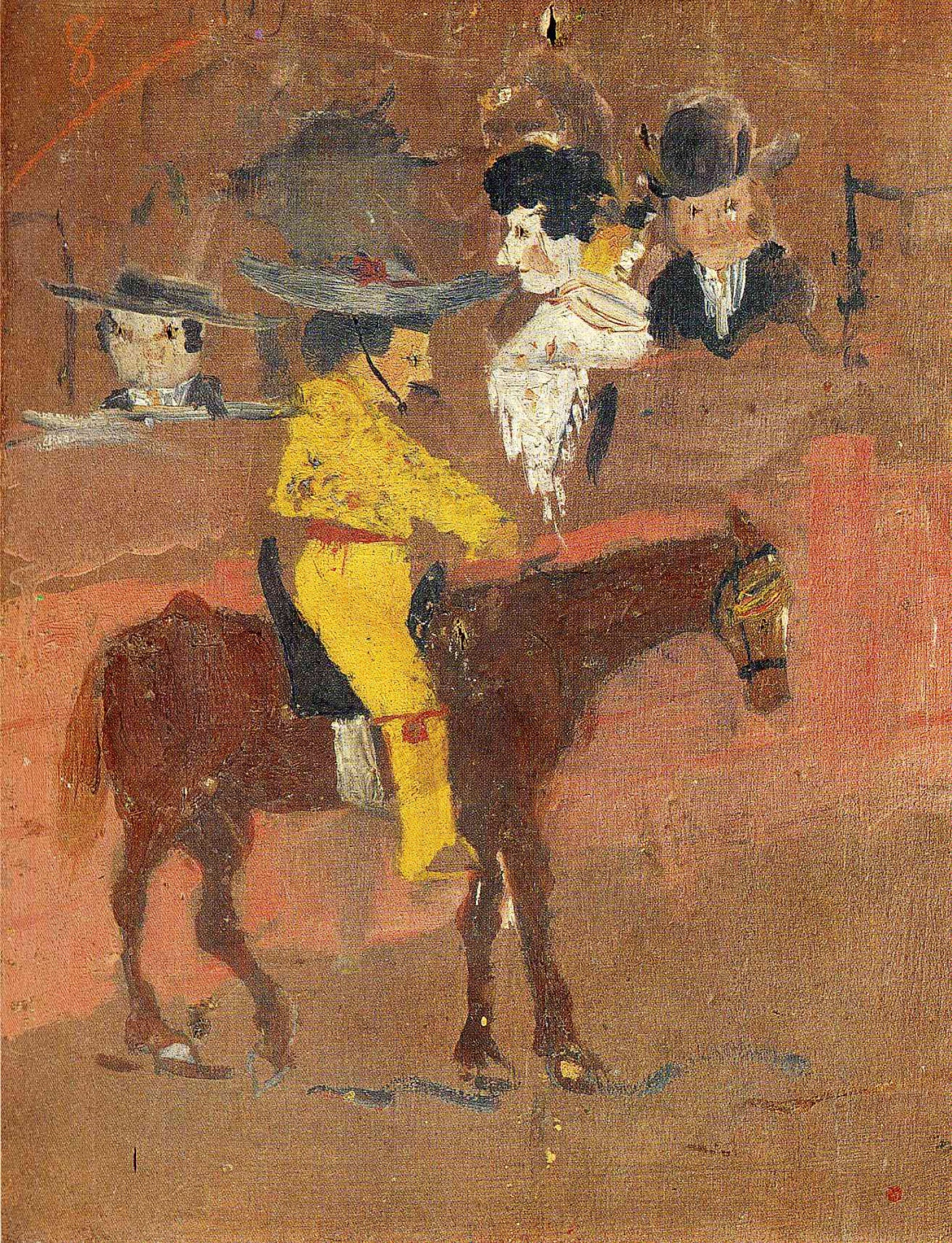
Painted on a wooden panel not much bigger than a book, it’s the earliest painting of his we know of, and according to his friend and biographer John Richardson, “it was something he always hung on to.”
Six years later, in the first months of 1896, he finished this canvas, nearly five and a half feet tall. His sister Lola, in a white dress, kneels at a prie-dieu, and around her the colors glow against the deep red of the walls, from the patterned carpet to the flowers on the altar…
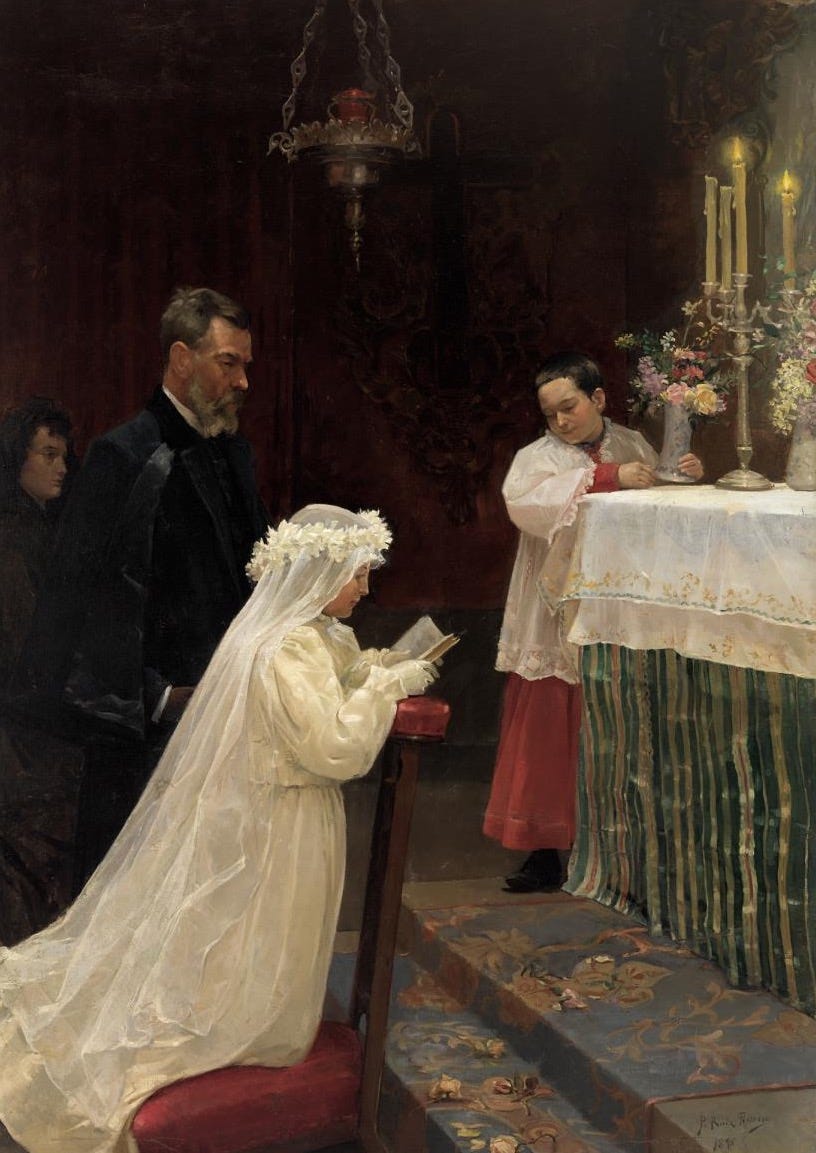
None of it took place in a church, though, because Picasso staged the scene in the studio of José Garnelo, a friend of his father’s who specialized in religious painting and lent him the liturgical objects. The Museu Picasso sees a technical command “surprising for his age” in the translucence of her veil, the altar boy’s surplice and the altar cloth. He built the picture around its whites, which carry the eye from Lola’s dress to the altar, so the scene reads as a passage from one life into another.
He was only fourteen, and he understood that…
That spring, just seven months after he arrived in Barcelona, the painting was accepted for the Third Exhibition of Fine Arts and Artistic Industries, in what the museum calls his “debut in society.” It hung alongside works by some of the most important artists of the day, among them Santiago Rusiñol, a painter more than twice his age, and Picasso later made his own version of one of Rusiñol’s paintings from that same exhibition. He was already good enough to stand beside the best painters around him, and curious enough to learn from them…
2. Not Even a Painting
That same year, he drew a portrait of someone dear to him, and it may be the most beautiful thing he ever made…