


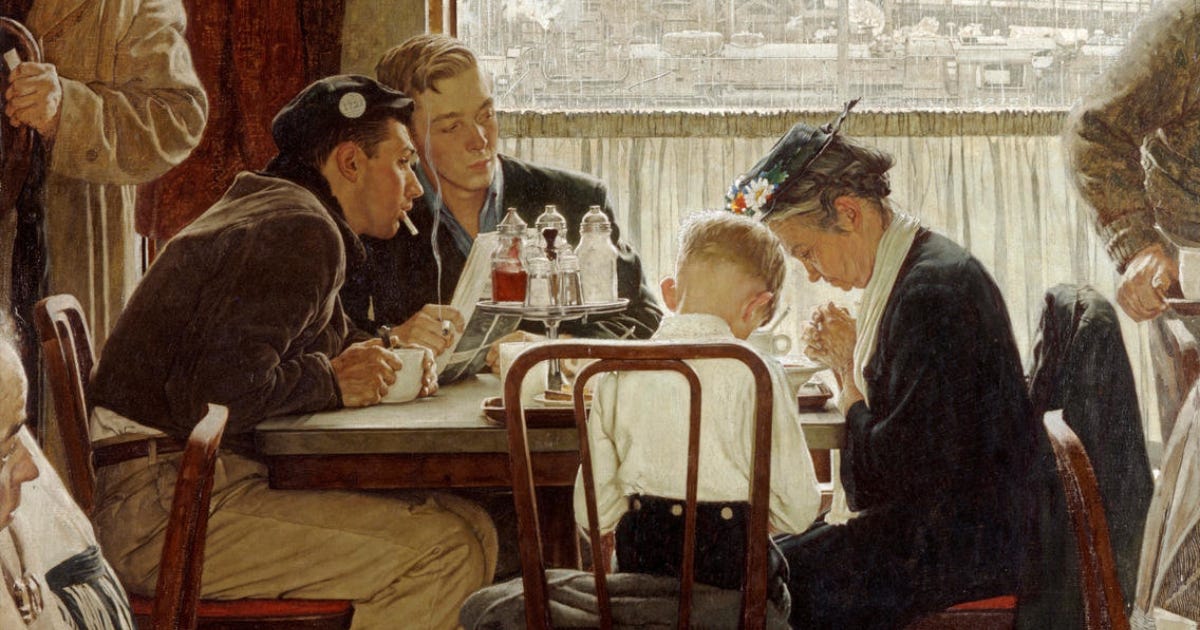
Norman Rockwell spent his whole life being told he was not a real artist, and he never fought it. He put it like this:
Some people have been kind enough to call me a fine artist. I’ve always called myself an illustrator. I’m not sure what the difference is.
For most of the twentieth century, the art world was very sure of the difference...
Rockwell was the man on the cover of the Saturday Evening Post, the painter of Thanksgiving dinners and small-town life, beloved by millions and dismissed by the critics as sentimental, commercial, and simple. To them, “illustrator” was not a job description but a verdict: a way of saying he was not, and could never be, a real artist. The dean of American art critics, Clement Greenberg, put him “below the rank of minor artist” and said that he had “chosen not to be serious.” To be called a Rockwell became a kind of insult, a byword for pretty, harmless, and shallow.
But let’s take a look at the etymology of the very word they used to brush him off: “illustrator” comes from the Latin illustrare, meaning to light up, to illuminate, to cast light on a thing so that it can finally be seen. And that, it turns out, is exactly what Rockwell did for fifty years. He took the ordinary American moments everyone lived through and no one looked at twice, and he lit them from within until you could not look away.
Many critics have since come around. The paintings they called kitsch now hang in major museums and sell for tens of millions… one of them, as you’ll see later, was even chosen to hang in the White House. The sentimental illustrator, it seems, was one of the sharpest observers of the human heart America ever produced, and beneath the warmth there was often something far more serious than anyone bothered to notice.
Rockwell knew precisely what he was doing, and he said so, plainly, without apology:
My life’s work, and my pleasure, is to tell stories to other people through pictures.
What follows are 7 of those stories. Look a little longer than you meant to, and you will see what the critics missed for so long…
REMINDER: this is a teaser for my subscriber-only articles.
Beauty is Truth is a reader-funded publication. There are no ads here, only independent writing devoted to celebrating beauty.
If you’ve been thinking about supporting my work, becoming a paid subscriber is the most meaningful way to do it:
With the new annual subscription discount, it costs less than a coffee a month — and it’s what keeps all of this going. Gift subscriptions to Beauty is Truth are now available too:
1. The Runaway
We start with a small boy who has decided to leave home for good.
You can read the whole story without a word of explanation, which was Rockwell’s particular genius. The boy has run away. His belongings are tied up in a red handkerchief on a stick, tucked under the stool, the entire worldly estate of a child who has had enough. He has made it as far as a roadside diner, where he sits beside a state trooper. You brace, for a second, for him to be in trouble. Then you look again, and see there is nothing to fear…
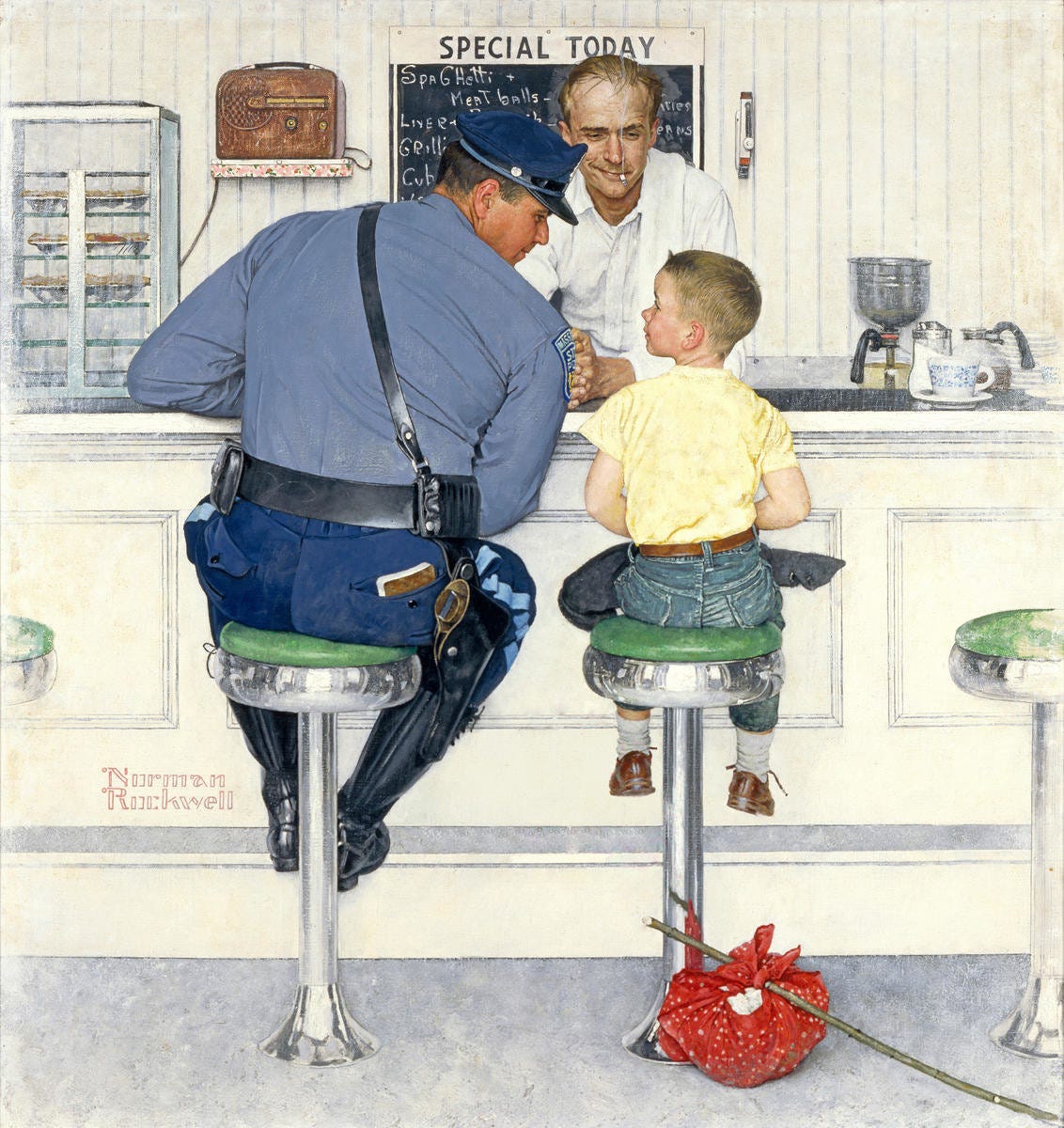
The trooper is not scolding him or marching him out. He has leaned down, his big frame folded to meet the boy at eye level, and he is talking to him gently while the counterman looks on with a knowing smile. Nobody here makes him feel small for wanting to leave. There is no punishment coming. Instead the boy gets a warm room, a grown-up who takes him seriously, and, you sense, a ride home when the talking is done. A big man with a badge has chosen to be tender with a child who was sure no one in the world was on his side.
Rockwell built this out of real people and real places, which is how he worked. The officer was his actual neighbor in Stockbridge, a state trooper named Richard Clemens, and the boy was eight-year-old Eddie Locke from the local school. Rockwell posed them at a Howard Johnson’s, and then he did what he always did: he improved reality. He erased every trace of the restaurant, turning its famous list of twenty-eight ice cream flavors into a plain blackboard of daily specials, because, he explained, he “wanted a more rural look, to suggest the kid had gotten a little further out of town.”
He wanted the boy just slightly more lost, so that being found would mean a little more.
Every one of us was once that boy, certain the whole world had turned against us, running as far as our legs would carry us, sure that leaving was the only answer. And what we needed was not to be caught and punished, but exactly this: one patient adult who came down to our level and made us feel we were worth going after. Because sometimes the kindest thing you can do for someone who is running away is to sit beside them for a while, and point them back toward home…
2. Homecoming G.I.
In the spring of 1945, with the war in Europe finally over, Rockwell painted a young soldier stepping back into the poor brick courtyard he grew up in, and the whole building erupting with joy to see him alive.
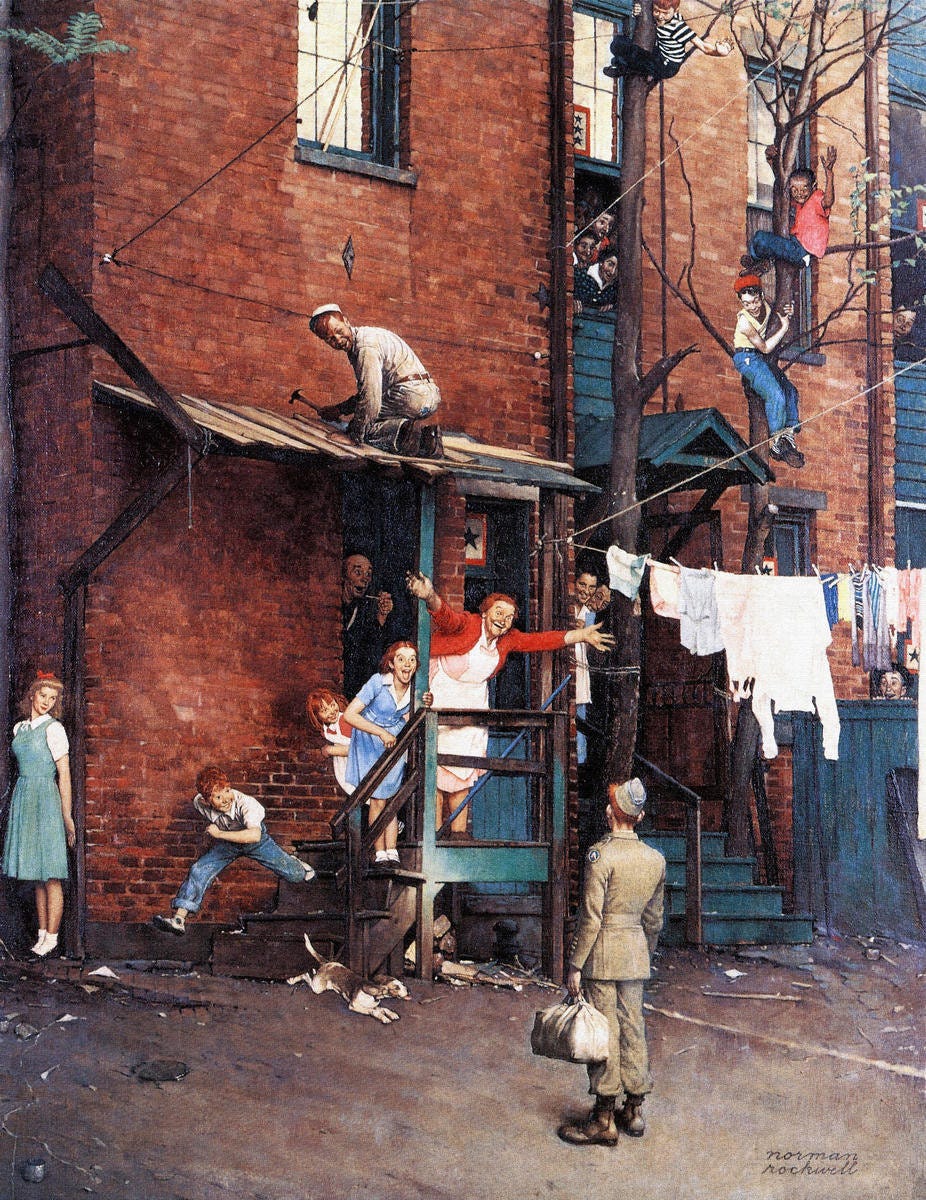
But this painting has a secret. It is small, and easy to miss, and it changes everything once you see it…