


In a letter dated September 1537, the poet Pietro Aretino wrote:
The world has many kings, but only one Michelangelo.
Many today still consider him the greatest artist of all time. The archetypal Renaissance man — a sculptor, a painter, an architect, a poet — who seemed to operate at a level his contemporaries could not even properly describe.
Already in his lifetime, they called him Il Divino, the divine one. Art historians ever since have used another word, terribilità, to describe what he produced: the particular quality of an artwork so overwhelming that it provokes not admiration but awe, the sense of standing before something that should not be possible.
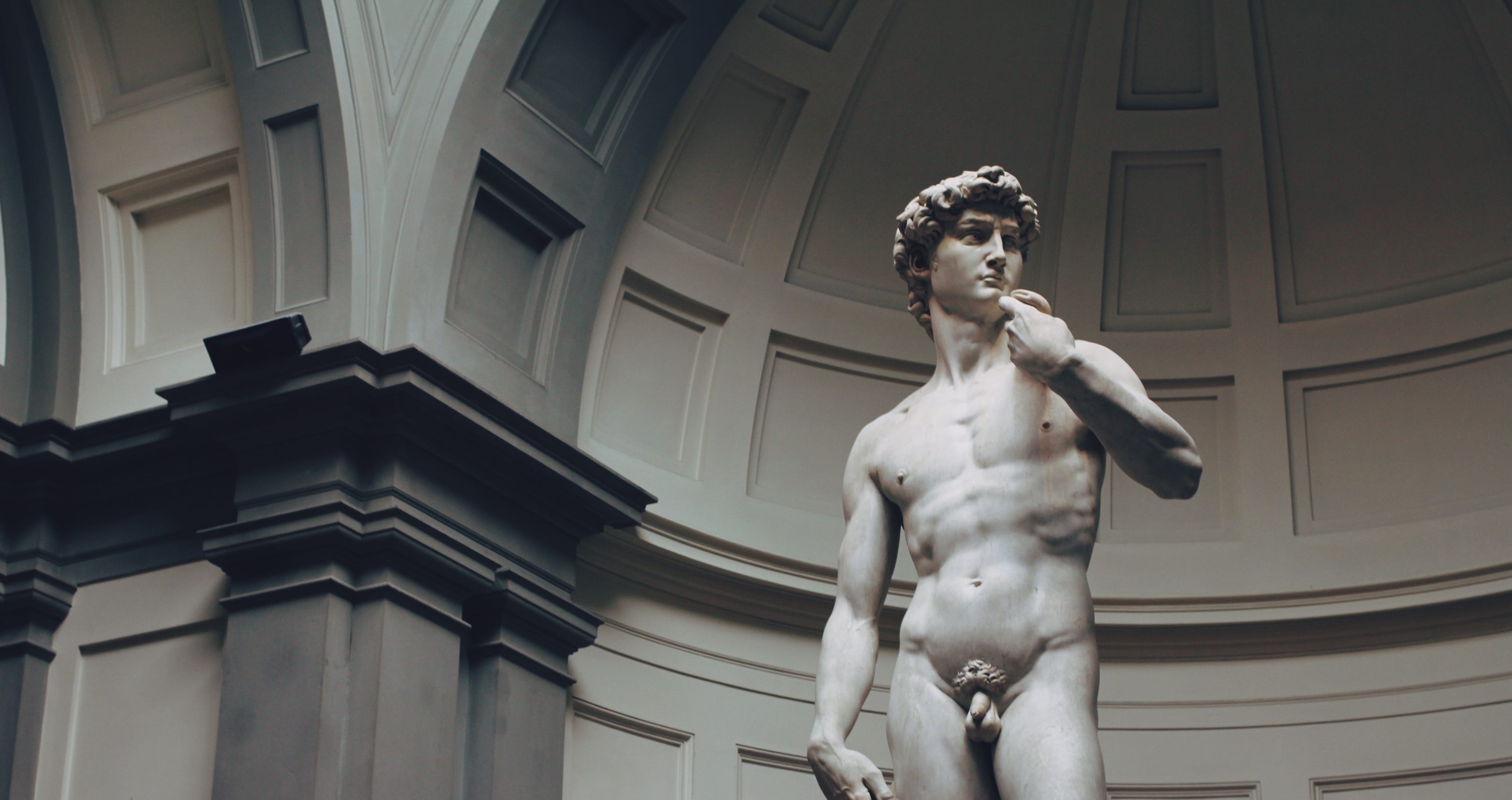
There is no work in which this quality is more directly experienced than the David.
Anyone who has ever stood in front of it in the Galleria dell’Accademia in Florence knows exactly what terribilità means. There is no photograph that prepares you for it...
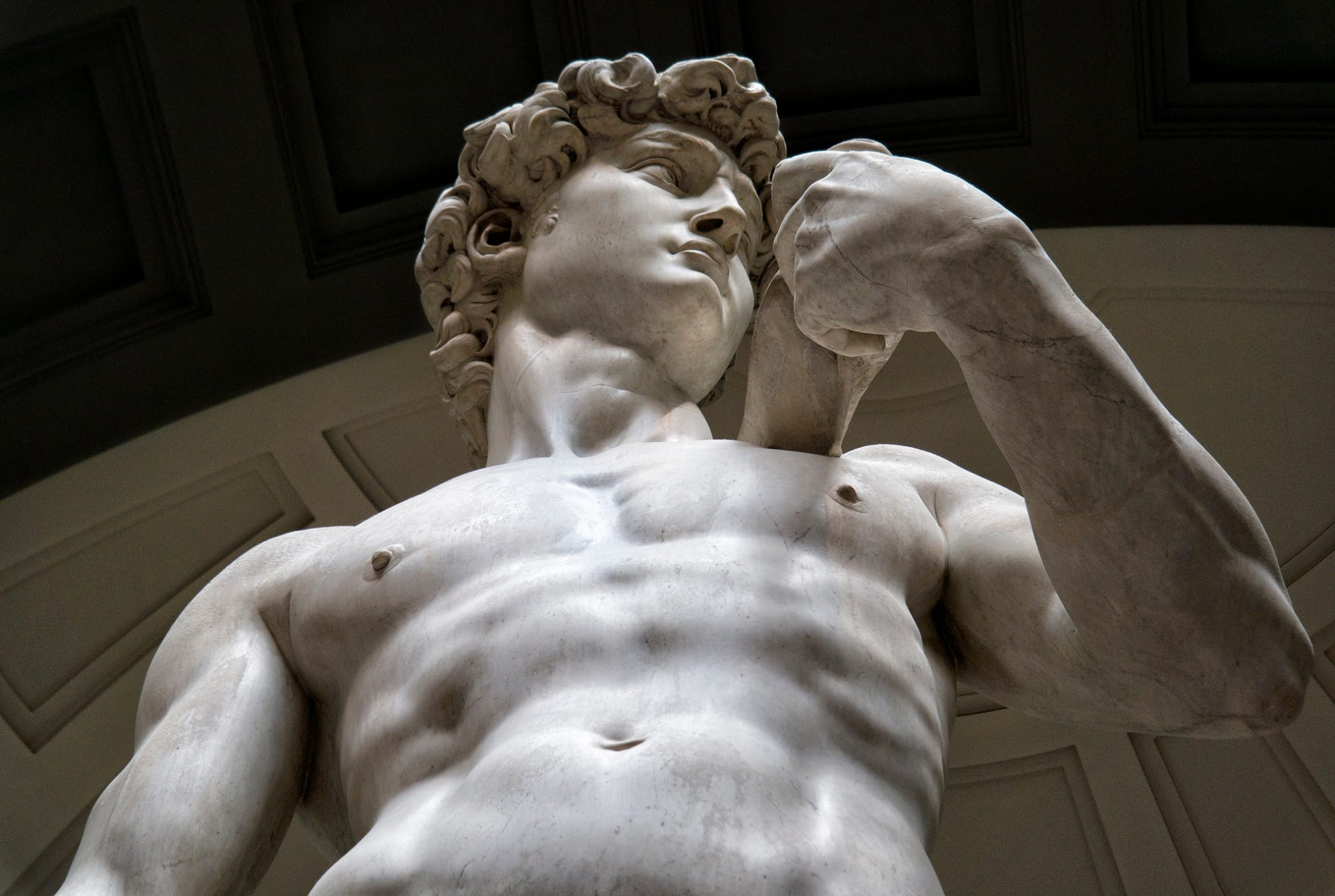
Michelangelo received the commission in August 1501, when he was twenty-six years old. He finished it in three years, working in such secrecy that wooden planks were built around the block to keep anyone from seeing the work in progress.
When the statue was finally unveiled in September 1504, his contemporary Giorgio Vasari, the father of art history, wrote that Michelangelo had “surpassed all ancient and modern statues, whether Greek or Latin, that have ever existed.”
Five centuries later, the Italian art critic Vittorio Sgarbi has spoken about his art in language that few modern critics would dare to use:
If an artist like Michelangelo exists, it means that God exists. In his work, he seems to enter into a direct dialogue with the divine.
That may sound like hyperbole — but the 5 details you are about to see will show you why it isn’t. That a single human being is responsible for all of them is something almost impossible to comprehend. Perhaps the closest thing to an answer was given by Michelangelo himself, when he said this about his own work:
In every block of marble I see a statue as plain as though it stood before me. I have only to hew away the rough walls that imprison the apparition to reveal it to the other eyes as mine see it.
REMINDER: Beauty is Truth is entirely reader-funded. There are no ads here, only independent writing devoted to celebrating beauty — and it can only continue with your help.
If you’ve been thinking about supporting my work, becoming a paid subscriber is the most meaningful way to do it:
Upgrading gives you full access to every paid article and to the entire archive. With the new annual subscription discount, it costs less than a coffee a month. And it is what keeps all of this going.
Gift subscriptions to Beauty is Truth are now available too:
1. The Vein That Anticipated Science by a Century
In December 2019, Dr. Daniel Gelfman, a cardiologist and clinical professor at the Marian University College of Osteopathic Medicine, published a short paper in JAMA Cardiology, one of the most respected medical journals in the world. He titled it “The David Sign.” It described a detail he had noticed while visiting the Galleria dell’Accademia — a detail that, in his words, had been “hiding in plain sight for more than 500 years.”
What Gelfman had seen, with the trained eye of a heart specialist, was that the external jugular vein on the right side of David’s neck is clearly distended — visibly raised above the collarbone, exactly as it would appear on a real human being in a state of intense physical excitement.
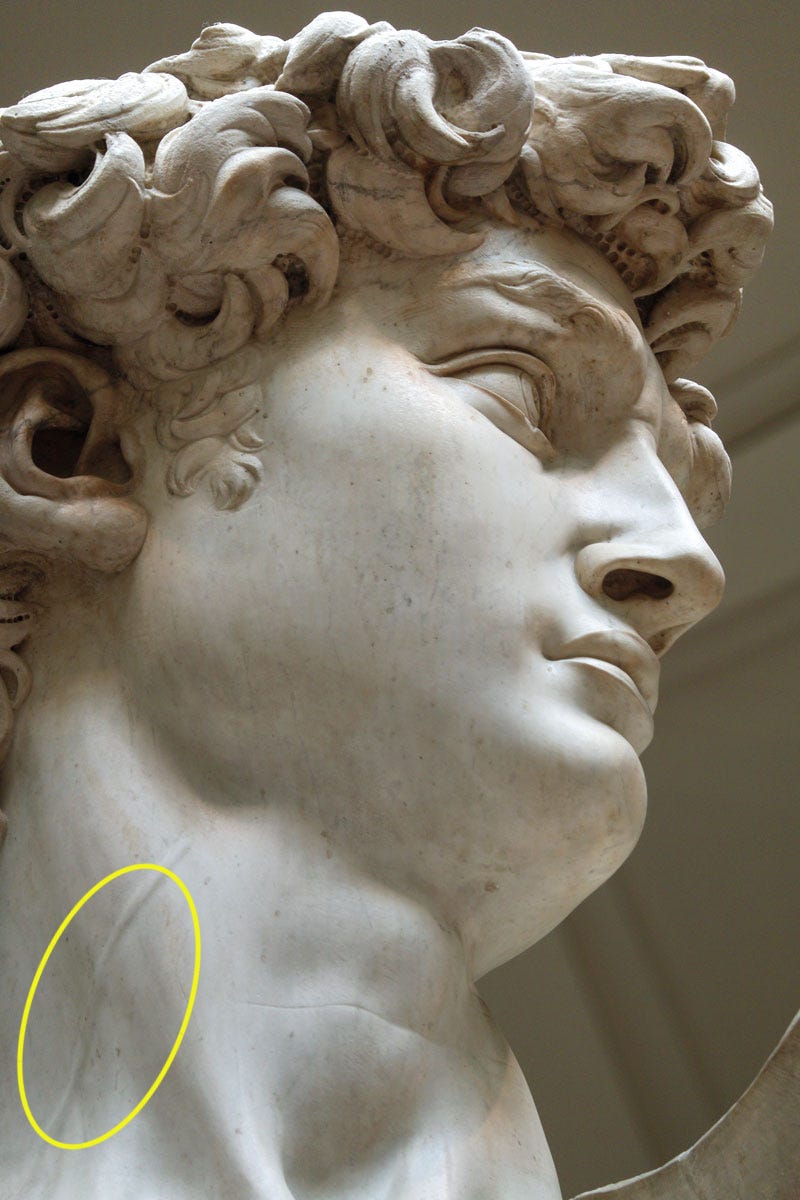
In ordinary anatomy, this vein is not normally visible. It only stands out under specific physiological conditions: extreme stress, intense exertion, or heightened cardiovascular activity. In other words, exactly the state a young man would be in moments before facing a giant.
This is where the discovery becomes extraordinary. The mechanics of the human circulatory system — how blood actually flows back to the heart through the venous system — were not formally described in medical science until 1628, when the English physician William Harvey published his treatise De Motu Cordis. Michelangelo finished David in 1504. He was depicting, with anatomical precision, a circulatory phenomenon that science would not understand for another 124 years.
“Michelangelo, like some of his artistic contemporaries, had anatomical training,” Gelfman wrote in his paper. “I realized that he must have noticed temporary jugular venous distension in healthy individuals who are excited.”
He had. The marble had been telling us for five centuries before a doctor finally noticed…
2. Manu Fortis
Look at David’s right hand. It is, anatomically speaking, too big for his body. The proportion is wrong. Every casual observer who has stood in front of the statue and looked carefully has noticed it.
There are two reasons for this — and both reveal something about Michelangelo’s mind.
The first is practical. David was originally commissioned in 1501 as one of twelve statues of prophets to be installed along the roofline of the Florence Cathedral, roughly 80 meters above the ground.
Michelangelo sculpted the statue knowing it would be viewed from far below, and he deliberately enlarged the head, the hands, and certain other features to compensate for the foreshortening that distance would create.
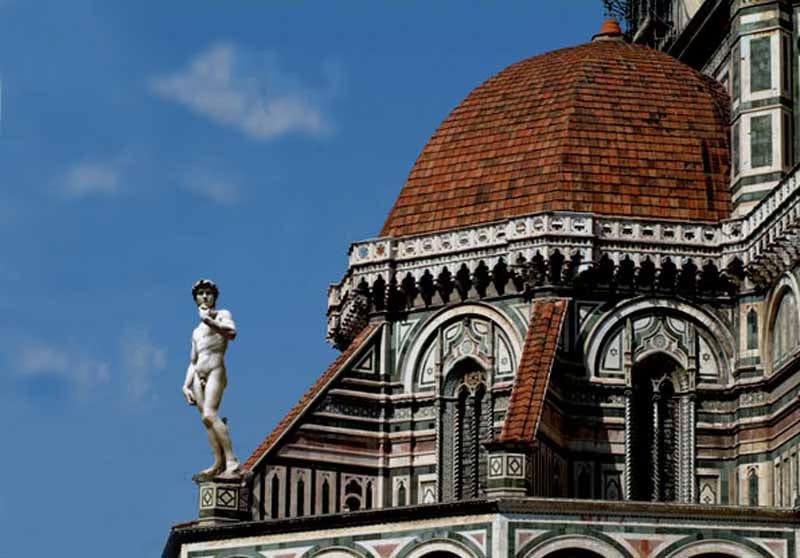
When the statue was finally completed, however, a commission of the most prominent artists of the age decided it was simply too beautiful to be hidden 80 meters in the air. They placed it instead in the public square in front of the Palazzo della Signoria, where it was unveiled on 8 September 1504. It stood there for 369 years, until it was finally moved indoors in 1873.
The second reason is symbolic. In the Middle Ages, the biblical David was known by the Latin epithet manu fortis — strong of hand. It was a reference to the divine power that flowed through him when he faced Goliath: the strength of God, made visible in the body of a young shepherd boy. Michelangelo carved that nickname directly into the marble. The hand is large because David’s hand, in the story, was the instrument of the impossible.
But none of this prepares you for what that hand actually looks like up close…
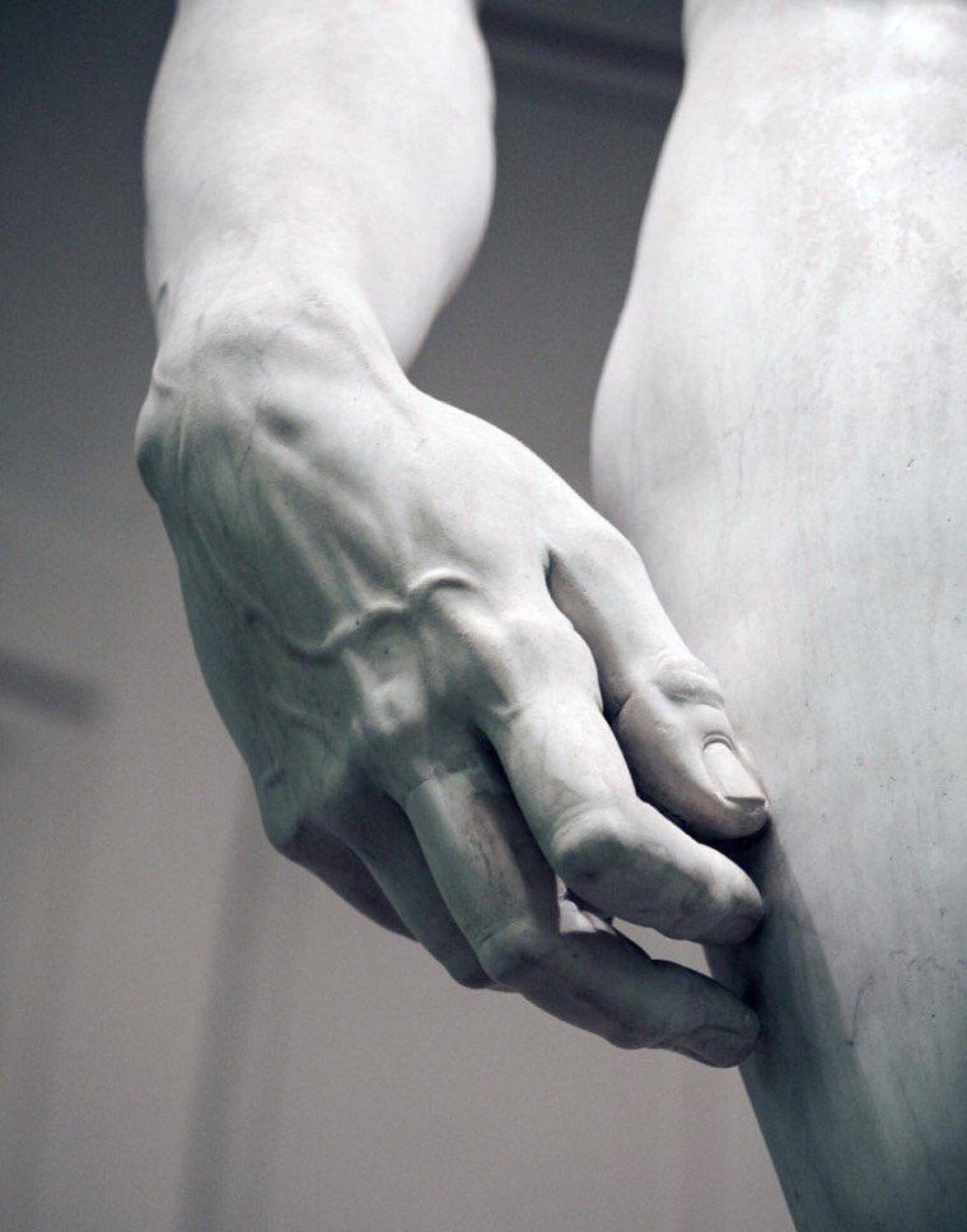
Stand below it and you will see veins that rise beneath the surface of the stone the way veins rise beneath skin under tension. It is the hand of a real man, in a real moment, captured with such precision that you find yourself looking — almost involuntarily — for a pulse.
And then you remember that what made all this possible was a damaged block of marble that two other sculptors had given up on. Agostino di Duccio in 1464, Antonio Rossellino in 1475 — both abandoned it because it was too flawed to be worked with. The block sat outside in the cathedral yard for over thirty years before Michelangelo arrived. The slim figure of the David, the slightly sideways gaze, the narrow stance — all of these were dictated by the limitations of a stone no one else thought could be saved.
And then Michelangelo freed David from a piece of rock the rest of the world had given up on…
3. Two Hearts, Hidden in Plain Sight
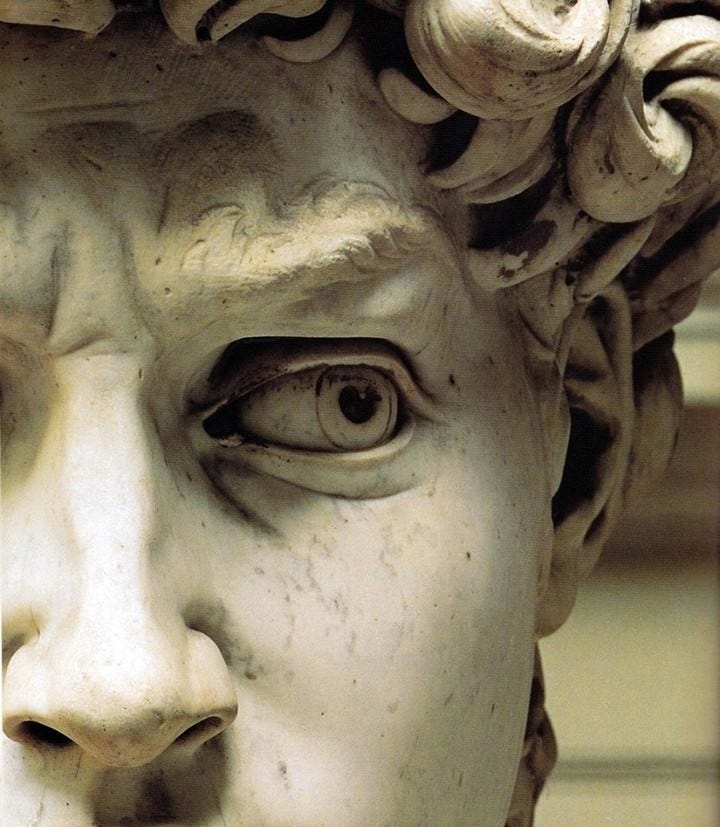
Look closely at David’s eyes — closely enough to forget for a moment the image you already know. Look only at the pupils.
They are not circles. They are hearts.
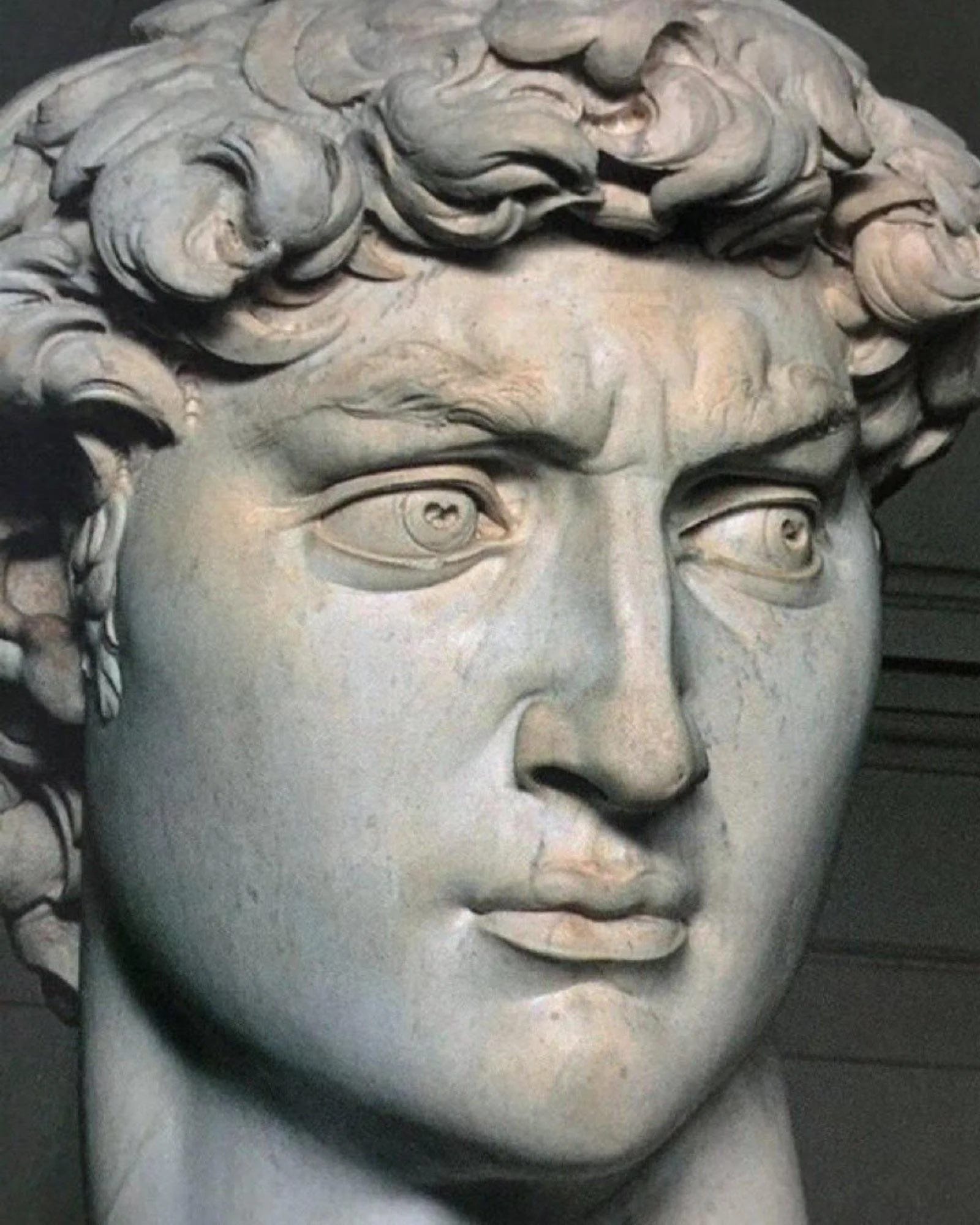
Most statues use a simple vertical slit in the pupil to give the eye depth and catch the light. David’s pupils are unmistakably heart-shaped.
Some have suggested it was a play on the letter D, often written as a heart shape in Renaissance Italy. A more technical reading holds that it was a sculptural device designed to catch light from below and create the illusion of a moist, living eye — since the statue was originally meant to be viewed from far beneath.
There is something else hidden in those eyes that no one noticed for a very long time. In 2005, an article published in the Journal of the Royal Society of Medicine, based on data from Stanford University’s Digital Michelangelo Project, revealed that David is slightly cross-eyed. His right eye gazes straight ahead. His left eye is focused on a different, more distant point.
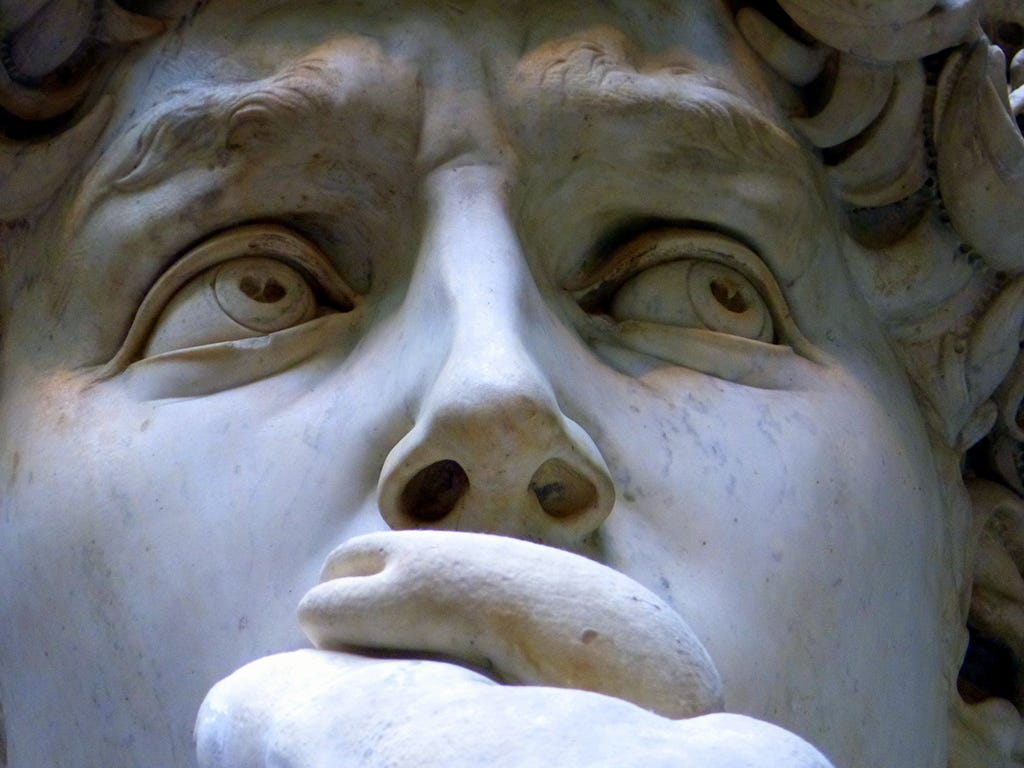
The reason this had escaped notice for half a millennium is simple: most viewers are physically unable to examine the David at eye level, since he stands more than five meters above the floor. From below, the asymmetry is invisible. Only the high-resolution 3D scans of Stanford’s project finally exposed it.
Why Michelangelo did this is something scholars are still debating.
What is no longer in doubt is that the eyes are not just open... They are watching.
4. The One Imperfection He Could Not Hide
Walk around to the back of the David and look at the right side of his back, between the shoulder blade and the spine. There, where the right infraspinatus muscle should be — one of the four muscles that make up the rotator cuff — there is nothing. The muscle is missing.
The American Academy of Orthopaedic Surgeons has noted this anomaly, and modern shoulder specialists who study the statue all see it immediately.
But Michelangelo knew...
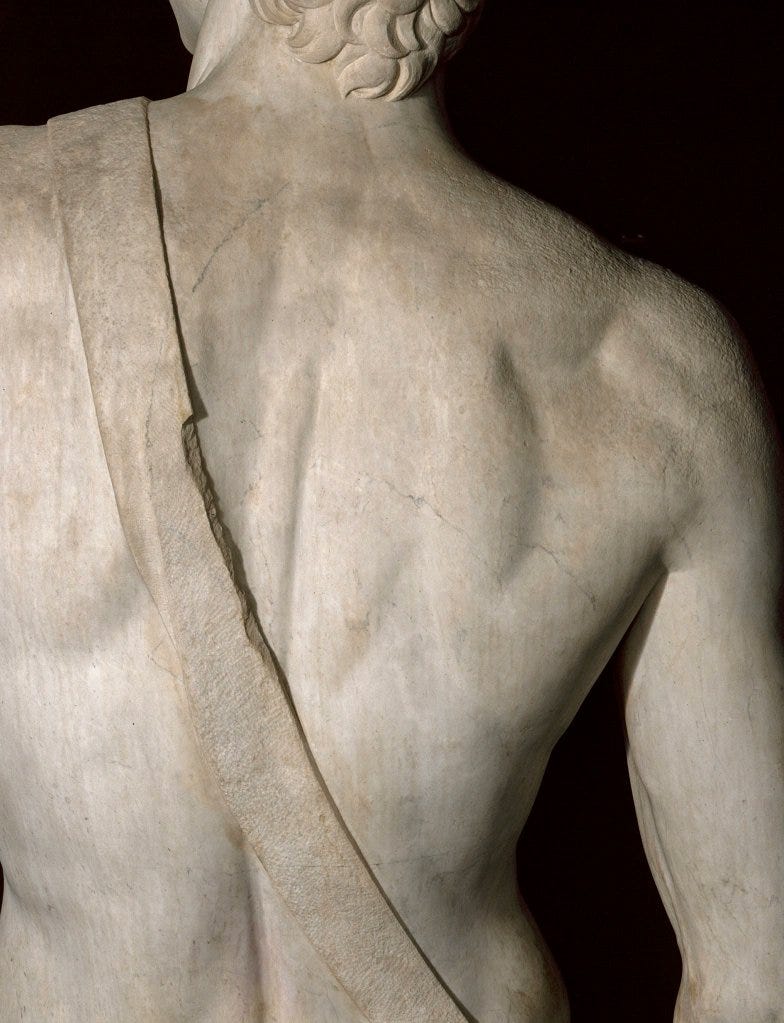
In one of his own letters, he wrote that there was a defect in the block of marble that prevented him from reproducing the muscle. He could not have hidden it. He could only acknowledge it.
The reason this matters is that Michelangelo, alongside Leonardo da Vinci, was one of the most rigorous students of human anatomy of his age. He began dissecting corpses at the age of seventeen, when the prior of Santo Spirito in Florence granted him access to bodies awaiting burial. The practice would continue, intensively, for over a decade.
He knew the body better than almost anyone alive. The only thing missing from his David is what the stone would not let him reach.
5. A Soul Trapped in Marble
Forget for a moment the body, the hand, the proportions. Look only at the brow, the eyes, the deep furrow between them.
This does not look like something a man carved out of stone. It looks like something alive. As if Michelangelo had not sculpted David at all, but caught the soul of someone real and let it settle inside the marble, where it has been looking back at us, century after century, ever since.
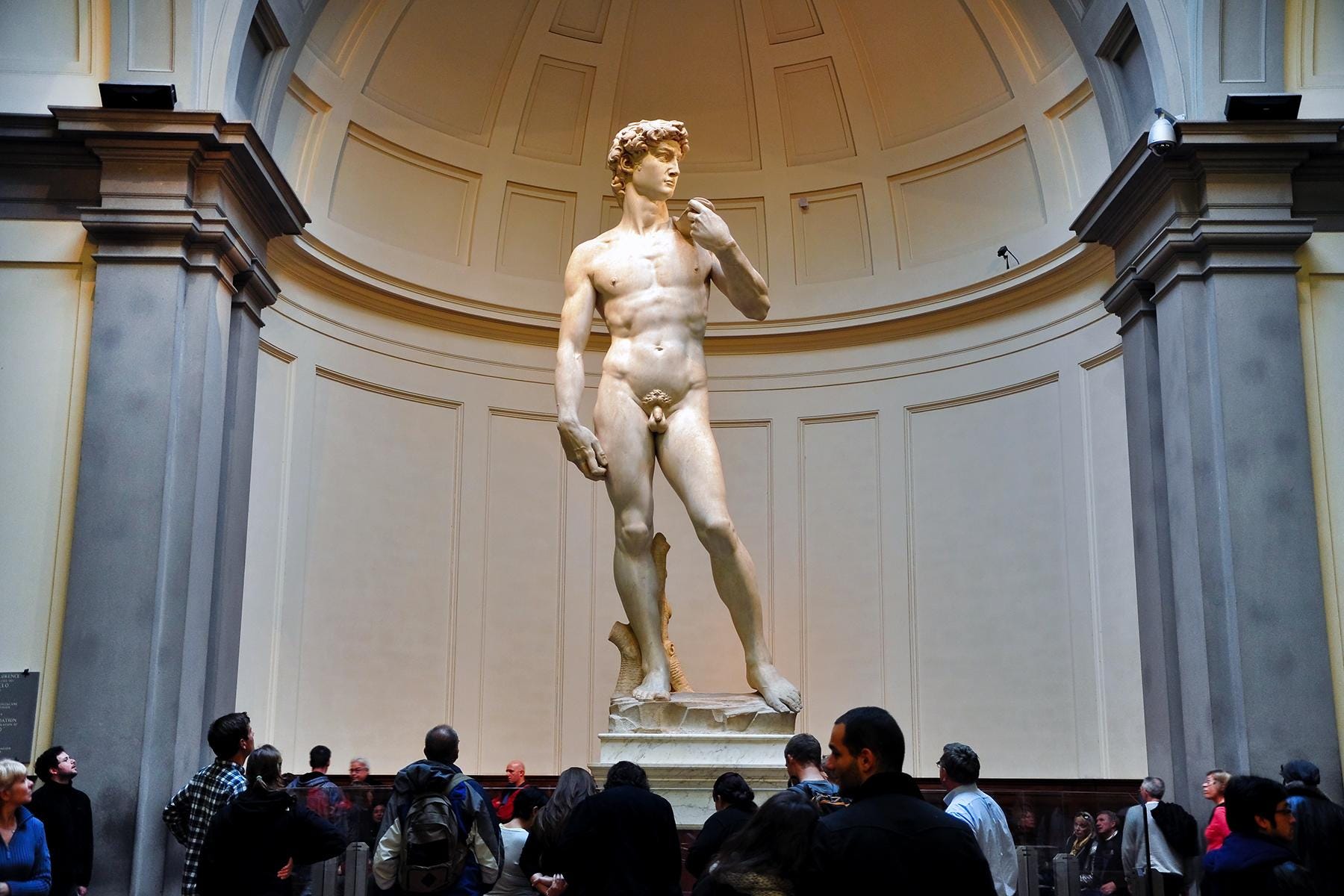
At 5.17 meters tall — roughly the height of a two-story building — David was not only the first colossal marble statue of the High Renaissance, but the largest since classical antiquity.
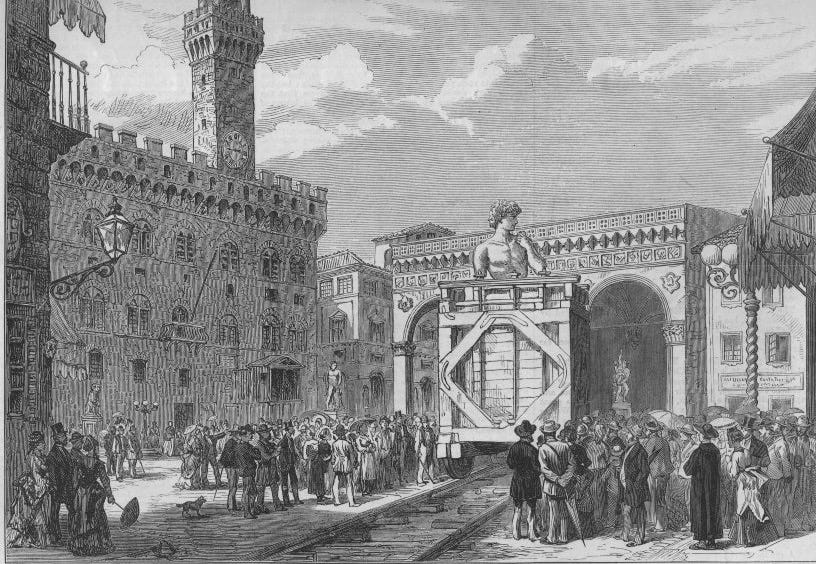
When the work was finally finished they had to tear down the archway of Michelangelo’s workshop to get the statue out, as recorded by the Florentine chronicler Luca Landucci. It then took 40 men, 4 days, and 14 greased logs to move it half a mile to the Piazza della Signoria.
The engraving below shows the David being moved again from the Piazza in 1873:
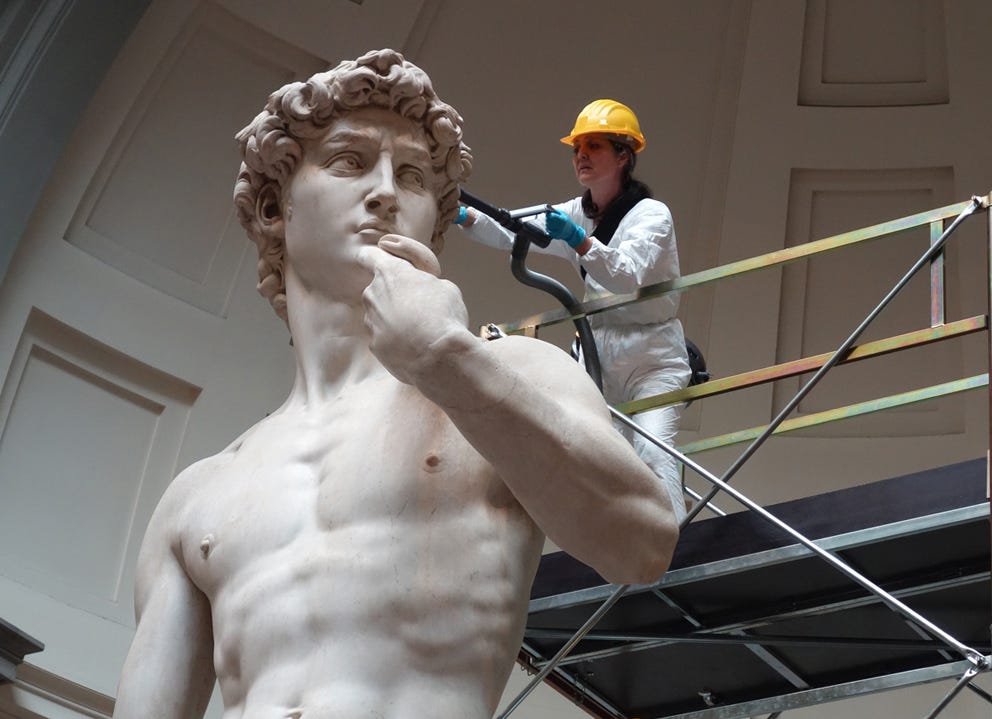
Today, in the Galleria dell’Accademia, the statue is dusted regularly by hand.
The photographs of restorers standing on small platforms next to him, leaning in to clean his hair, are the only images that give you any honest sense of his scale. And it is in those photographs that the impossibility of what Michelangelo did finally lands: the fact that a single human being, alone, produced a sculpture this enormous and this perfect.
Just as Sandro Botticelli’s Venus is regarded as the epitome of female beauty in art, Michelangelo’s David is seen as the ideal representation of the male form — and many scholars today still consider it the most beautiful work of art ever created by man.
There is, perhaps, no better way to close this piece than with the words of Vasari, who stood in the Piazza della Signoria the day the David was unveiled. After everything we have just seen, what he wrote no longer sounds like exaggeration:
It was a miracle that Michelangelo was able to raise up one who had died.
Thanks for reading! This newsletter is completely independent and ad-free — and it can only keep going with your help. Please consider contributing a few dollars a month today, and get access to exclusive articles and the full archive:
Every subscription genuinely makes a difference. Thank you for making this work possible.
Beautiful enlightenment here! Thank you! Divine indeed!
I wish I had known all this when I saw it in person 25 years ago.