



How often do we dismiss the seemingly impossible as an unattainable dream?
Yet, history consistently demonstrates that, through innovation, determination, and the indomitable will of the human spirit, the unimaginable can be achieved.
It always seems impossible until it's done.
This profound observation, often attributed to Nelson Mandela, makes us reflect on the extraordinary achievements that were once thought to be mere figments of imagination.
REMINDER: Beauty is Truth is a reader-funded publication, supported entirely by you. There are no ads here, only independent writing devoted to celebrating beauty — and it can only continue with your help.
If you’ve been thinking about supporting my work, becoming a paid subscriber is the most meaningful way to do it:
With the annual subscription discount, it’s less than the cost of a coffee per month — and it’s what makes all of this possible.
For most of human history, we relied on primal instincts for survival and procreation, navigating life without any form of technology. However, our intrinsic fascination with technological advancement is hardwired into our brains, and shifting priorities have driven innovations that allow us to explore new frontiers, both literal and metaphorical.
Think about this: we were once skeptic about space travel, and today we find ourselves contemplating the colonization of Mars as a crucial step for the survival of our species — turning what was once science fiction into a tangible priority.
Keynes understood this: “Ideas shape the course of history.”
Few ideas have shaped it quite as boldly as the vision behind the Florence Cathedral’s Dome. For decades it stood unfinished, a breathtaking ambition with no clear solution — until Filippo Brunelleschi decided the problem was worth solving. What he built wasn’t just a dome. It was proof that the impossible has a habit of yielding to the right mind at the right moment, and that one person’s refusal to accept limitation can rewrite what everyone else believes is possible.
Brunelleschi’s Dome: The Impossible Task
After a hundred years of construction, Florence Cathedral still lacked its dome in the beginning of the 15th century.
The space that needed to be covered was immense, presenting an unprecedented challenge: constructing a dome nearly 150 feet in diameter, starting 180 feet above the ground, atop existing walls. It surpassed the scale of the ancient Pantheon's dome or any other dome in Europe.
In 1418 a competition was held to select the builder and, according to legend, Brunelleschi confidently claimed that he alone possessed the solution based on his studies of ancient dome creation methods. His proposal was a unique one — an octagonal double-shell dome, topped by a lantern, built without scaffolding.
The Overseers of Santa Maria del Fiore, skeptical of his claims, demanded to see his model, but Brunelleschi adamantly refused, fearing that other competitors would steal his idea. He then issued a challenge: the commission should go to the one who could make an egg stand on its end — a test to see who had the necessary skills.
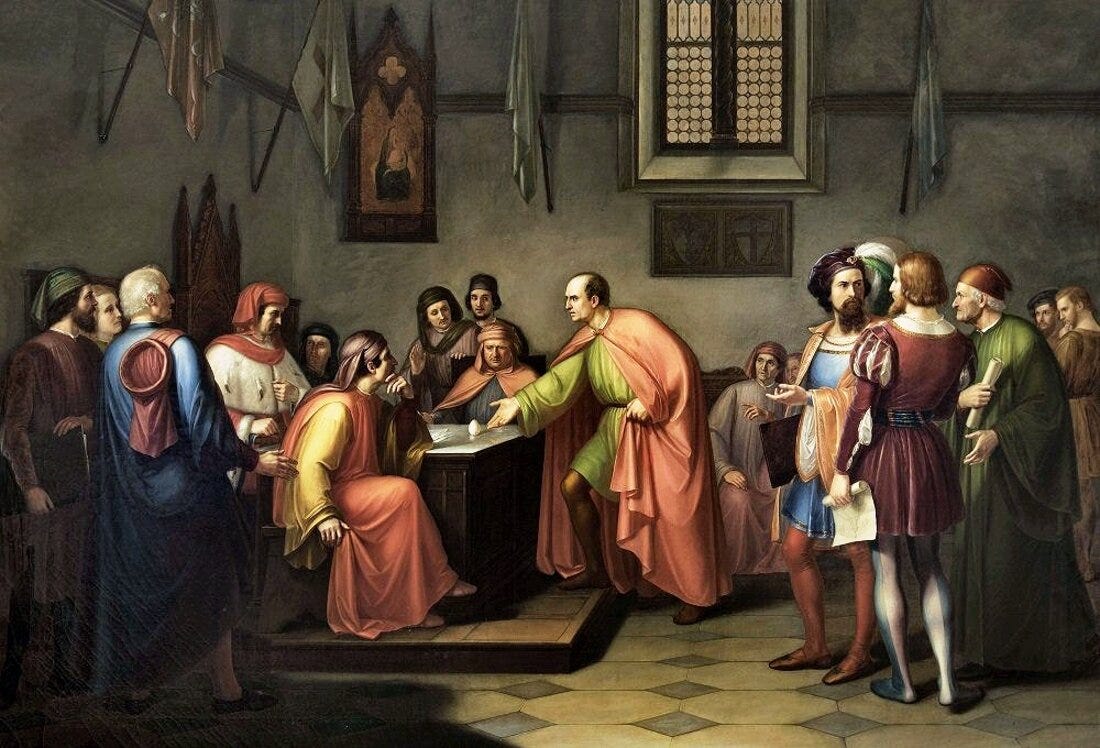
After futile attempts by other architects, Brunelleschi took an egg and pressed its tip onto the tabletop, making it stand upright. When his competitors protested, claiming they could have done the same, he replied that, likewise, if they had seen his model, they could have built the Cathedral’s dome. Impressed by his ingenuity and confidence, the Overseers awarded him the commission.
Legend aside, Brunelleschi ultimately triumphed, and the rest is history. Through a series of groundbreaking technical advancements, he forever revolutionized the art of dome construction.
His innovative double-shell design resulted in a structure that possessed greater lightness and height compared to a solid dome of similar proportions. Additionally, he employed the rarely used technique of herringbone brickwork, which reinforced the dome’s stability and ensured its enduring strength — an innovation far ahead of its time.
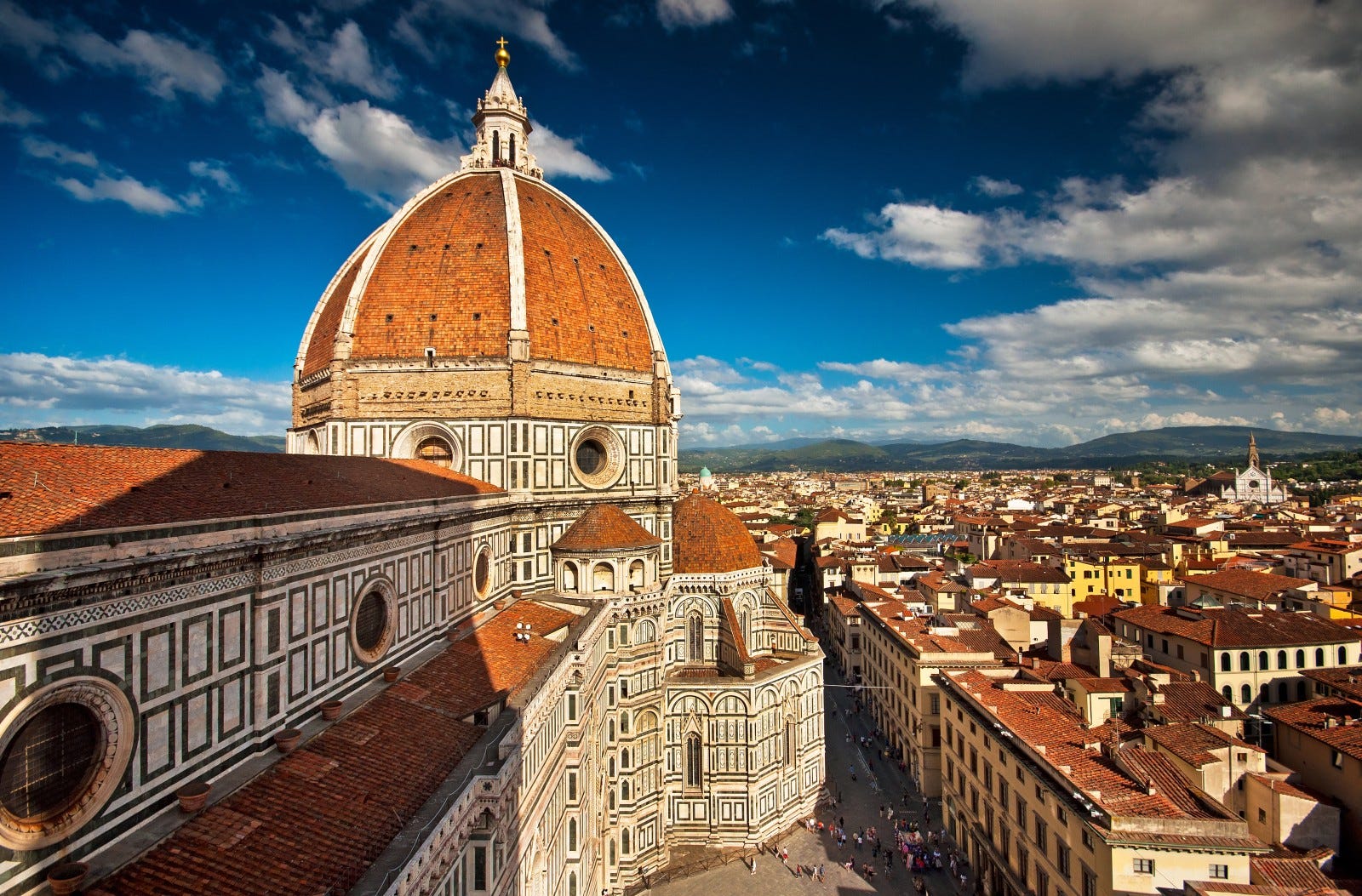
Over 16 years, he raced against gravity, overcoming perplexities, criticisms and unparalleled challenges in architectural history. The completion of the dome marked a major milestone in Renaissance engineering, reflecting the era’s innovative prowess.
As Italian director Franco Zeffirelli once said:
When I feel depressed I return to Florence and look at Brunelleschi's dome: if the genius of man has reached such heights, I too must try to create, act, and live.
Overcoming the Impossible is a Catalyst for Collective Inspiration
Achievements of such extraordinary magnitude naturally inspire others to pursue greatness.
After the dome’s completion, doubts arose about Filippo’s ability to crown it with a lantern, leading to yet another competition. Construction of the lantern began shortly before his death in 1446 and was completed in 1461 by Brunelleschi’s close friend, Michelozzo. The copper ball, which was intended to be placed atop the lantern, was brought to life by sculptor Andrea del Verrocchio.
Adding a touch of wonder to this tale is the involvement of a young apprentice in Verrocchio’s workshop — none other than the legendary Leonardo da Vinci.
Fascinated by the ingenious machines Brunelleschi had designed, which Verrocchio used to hoist the ball, Leonardo meticulously sketched them in his notebooks. Though often mistakenly credited with inventing these devices, the experience profoundly shaped his later explorations of mechanics.
What we do know for certain is that Leonardo played a role in the seemingly impossible task of raising the massive hollow sphere to the top of the lantern cone.
Yet, the sheer magnificence of Brunelleschi’s dome ignited a profound sense of ambition, compelling those who followed to pursue the replication of his brilliance, no matter the obstacles.
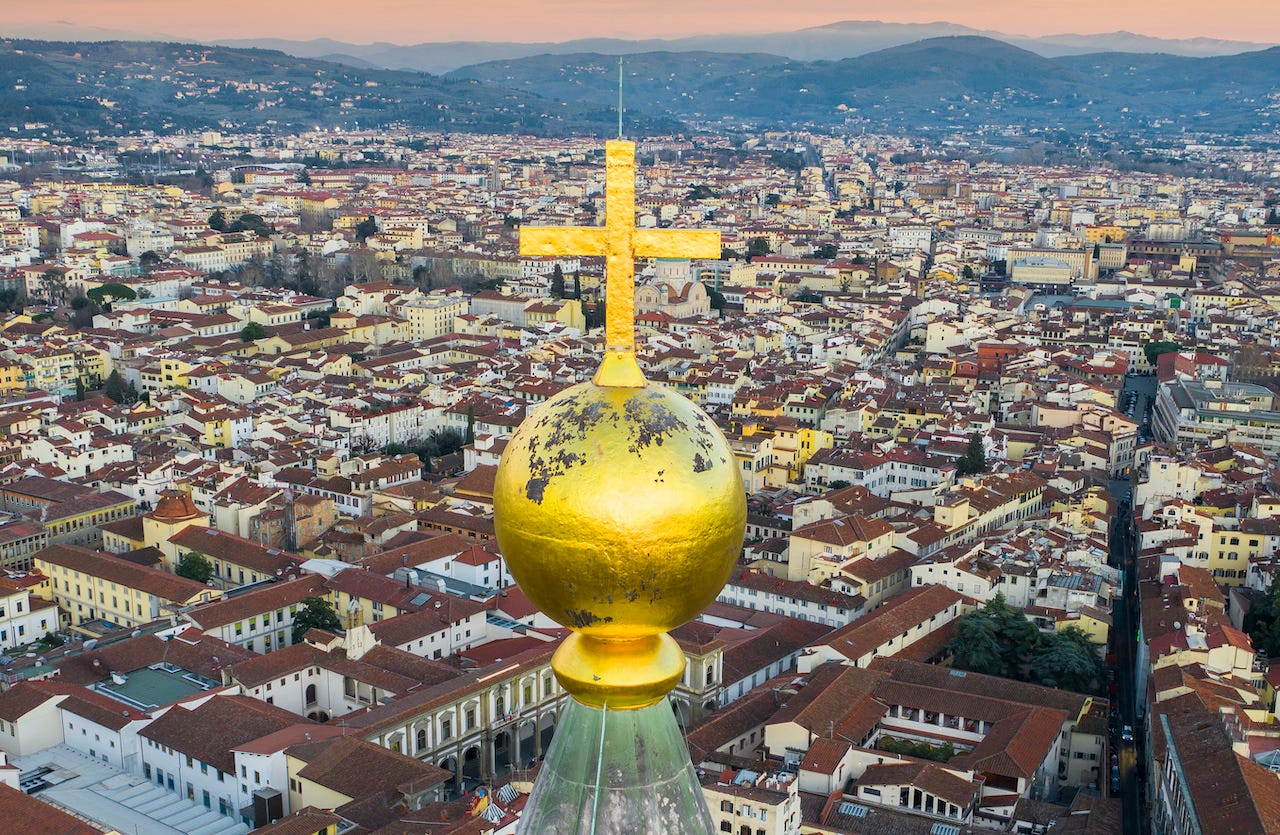
In 1471, as Vasari tells it, the gilded ball caught the light above Florence “with great celebration and pleasure of the people.” A city looked up. And for a moment, the impossible was just... done.
That image has never really left us. Because every time someone bends the limits of what we thought was fixed, something stirs in the rest of us. It’s less a lesson and more a reminder: that the most extraordinary things ever built, discovered, or dared began with someone unwilling to accept the world exactly as it was handed to them.
The status quo has always been temporary. It just needed the right person to prove it.
Thanks for reading! This newsletter is completely independent and ad-free — and it can only keep going with your support. Consider contributing a few dollars a month today, and get access to exclusive articles, the subscriber-only chat, and the full archive:
Thanks for being here — readers like you make it all possible.
Hi James, thank you so such for this. I live 3 hours away and haven't visited and also never knew this. I'm setting my intention to visit this year.
https://www.awesomebooks.com/book/9780712664806/brunelleschis-dome-the-story-of-the-great-cathedral/used?gad_source=1&gclid=CjwKCAiAnKi8BhB0EiwA58DA4bOpBK_IuMD7yYNhLQn4hyLdpqBZ5vvow0xqL8HfGJrZIXBmyk7t2RoCq6oQAvD_BwE
Thank you for this most excellent post. One of my favourite books describes this incredible achievement- I also love the open dome and watching the rain fall in the Pantheon in Rome as another jaw dropping act of designer daring from the past.