Umberto Eco once said:
By the age of 70, he who doesn’t read will have lived only one life. He who reads will have lived 5000 years. Reading is immortality backwards.
The legendary Italian medievalist, philosopher, and novelist owned a private library of over 50,000 books. When asked why he kept so many, he replied that criticizing someone for acquiring more books than they can read is like insisting one must use every piece of cutlery, every pair of sunglasses, or every screwdriver before buying another.
Eco believed that certain things — books among them — should exist in abundance, even if we only ever use a fraction. He likened them to medicine: it’s best to have many at home so that, when the moment calls, the right one is always at hand.
He also noted that those who buy only a single book often read it once and discard it, approaching literature with a purely consumerist mindset. True book lovers, however, know that books are far more than mere commodities…
REMINDER: this is a teaser for my subscriber-only articles.
Beauty is Truth is a reader-funded publication, supported entirely by you. There are no ads here, only independent writing devoted to celebrating beauty.
If you’ve been thinking about supporting my work, becoming a paid subscriber is the most meaningful way to do it:
With the annual subscription discount, it’s less than the cost of a coffee per month — and it’s what makes all of this possible.
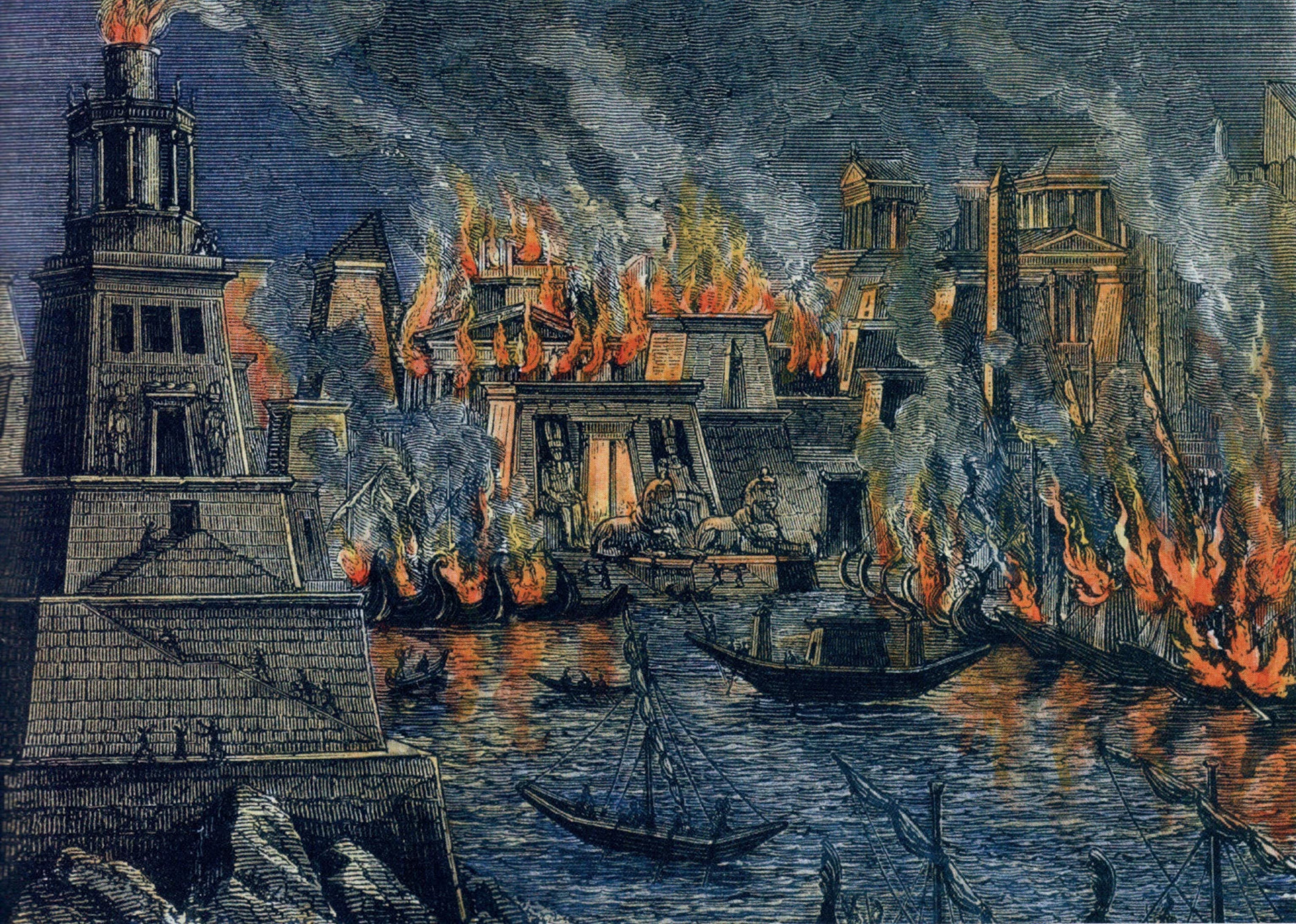
Whenever I read Umberto Eco’s words about books, I think of the great libraries of history that no longer exist — wonders like the Library of Alexandria, Baghdad’s House of Wisdom, and the Library of Pergamum. These were immense repositories, often holding hundreds of thousands of scrolls, preserving the achievements of philosophy, science, literature, and mathematics from across the ancient world.
Yet, despite their once vast collections, the fragility of materials, fires, wars, and neglect have left only a sliver of the original works: researchers believe that a mere 1–2% of all ancient Greek and Latin texts survive today.
Their loss is a reminder of how easily human knowledge can vanish, no matter how monumental its preservation seemed.
The following are 6 legendary ancient libraries that have been lost to the sands of time…
1. Library of Alexandria
The Library of Alexandria was one of the greatest intellectual institutions of the ancient world, emblematic of a city that served as a cultural crossroads linking Africa, Europe, and Asia.
In his book The Library at Night, a meditation on the meaning of libraries, Alberto Manguel wrote:
We can roam the bloated stacks of the Library of Alexandria, where all imagination and knowledge are assembled; we can recognize in its destruction the warning that all we gather will be lost, but also that much of it can be collected again.
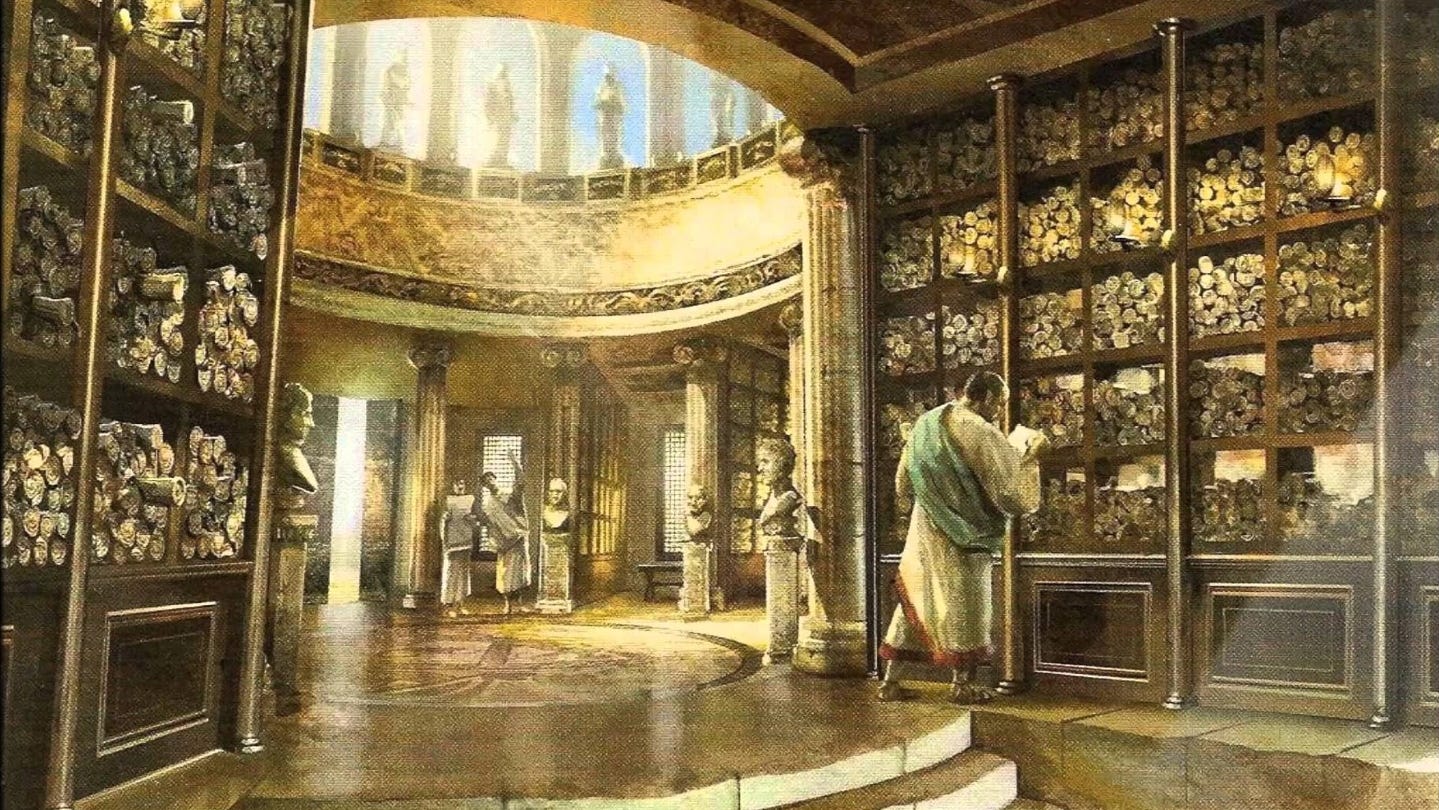
Founded around 331 BC by Alexander the Great, Alexandria later came under the rule of Ptolemy I Soter, who developed it into a major center of Greek culture and learning.
Scholars from across Egypt, Greece, and Persia were drawn to the city, generously supported so they could devote themselves entirely to study and research. The library grew through aggressive acquisition of manuscripts, ultimately becoming the largest collection of written works in the ancient world, with estimates ranging from 40,000 to as many as 400,000 scrolls at its height. These included priceless works by authors such as Aristotle, Homer, Plato, and Herodotus.
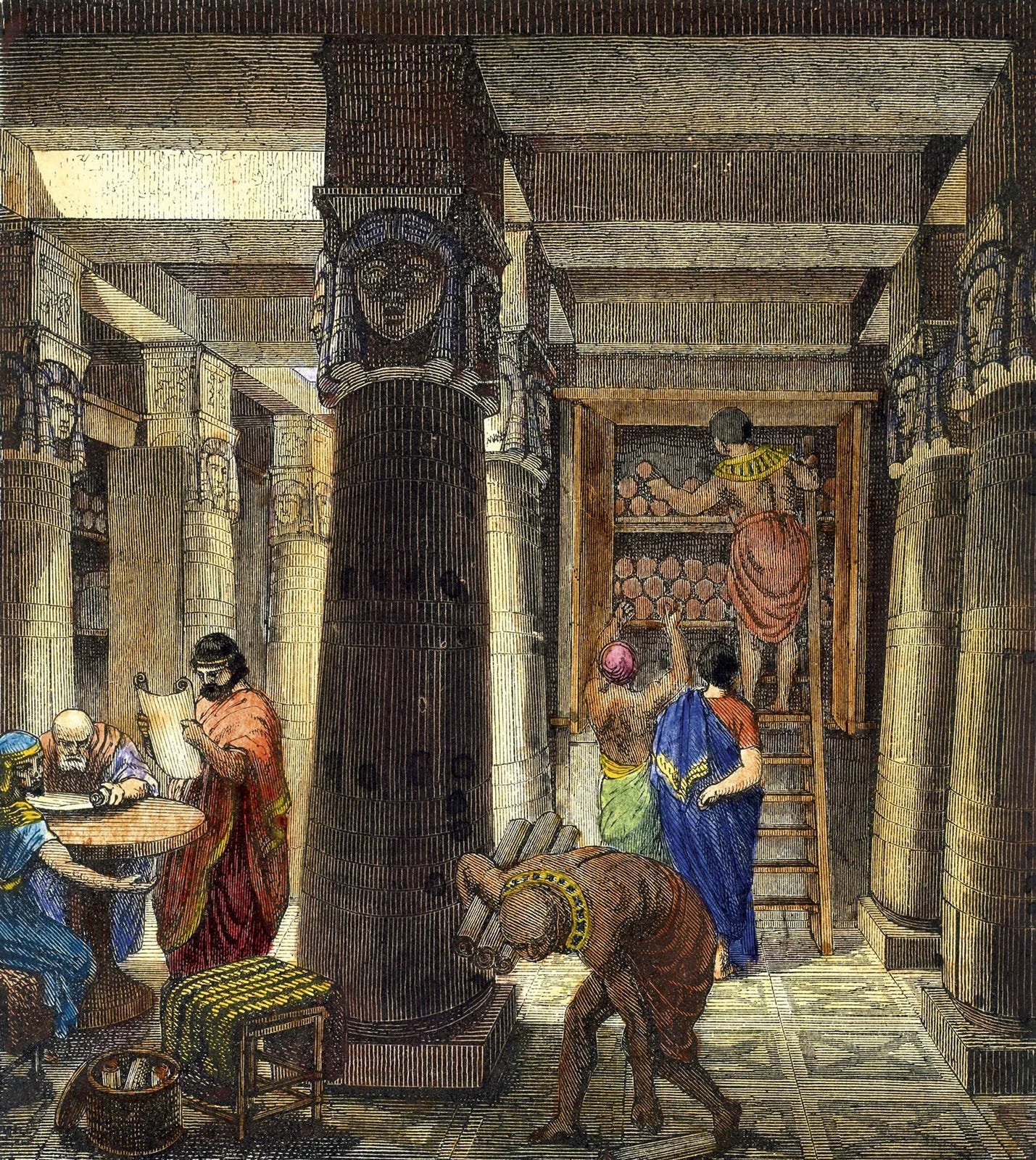
Aristotle alone is believed to have written around 200 treatises across philosophy, science, and economics, yet only about 30 survive today.
The library was also a hub of original scholarship. Figures such as Eratosthenes measured the Earth’s circumference with astonishing precision, while scholars like Zenodotus of Ephesus and Aristarchus of Samothrace worked to produce authoritative editions of Homer’s texts. Callimachus compiled the Pinakes, widely regarded as the world’s first library catalog, and according to legend, Archimedes, while studying there, invented the Archimedes screw, a device for raising water.
Despite its immense influence, the library declined gradually over several centuries. Portions of its collection were damaged during Julius Caesar’s campaign in Alexandria in 48 BC, though the extent of the destruction remains uncertain and some form of the library appears to have survived or been rebuilt.
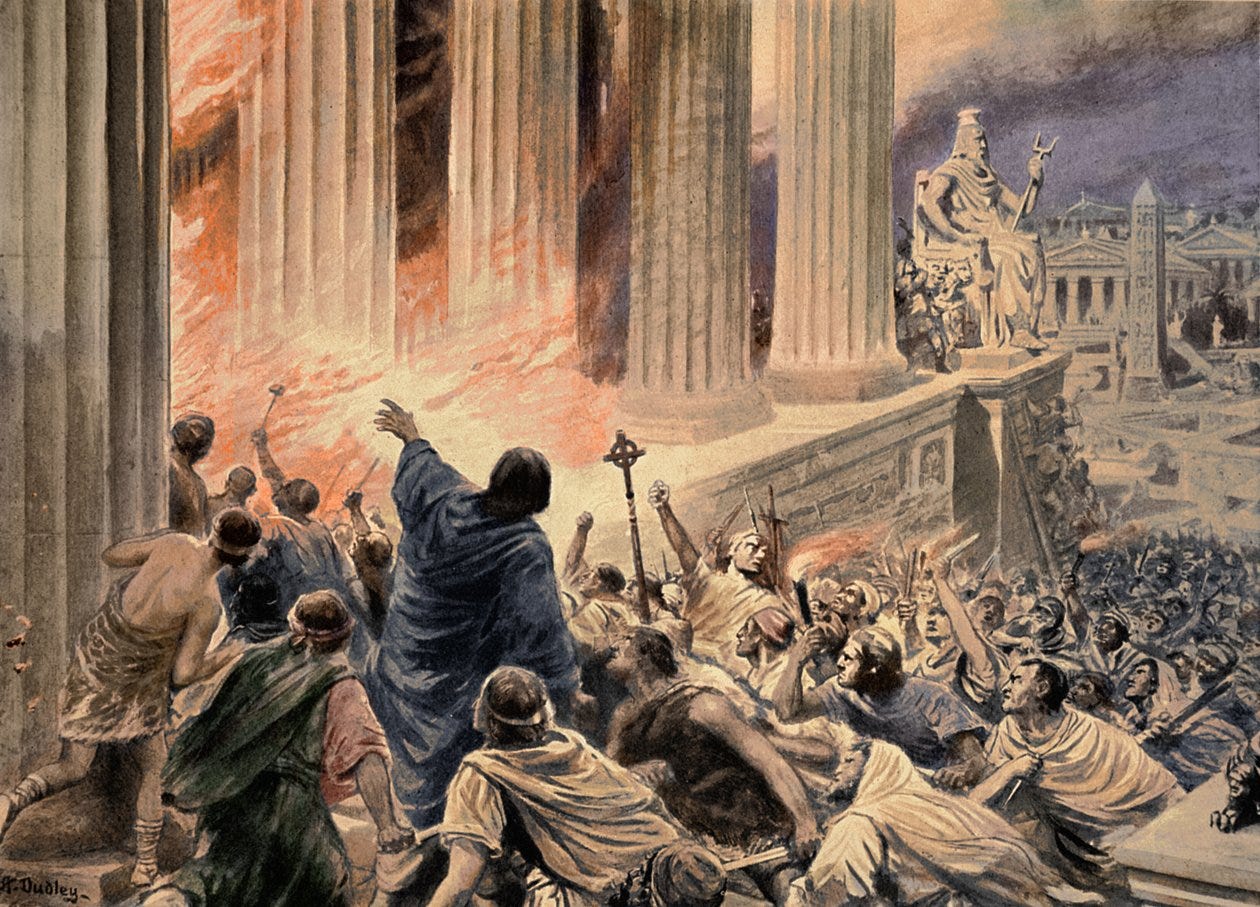
During the Roman period, however, sustained funding and institutional support waned, and by the third century AD the scholarly community associated with the library had largely disappeared. Between 270 and 275 AD, invasions and imperial counterattacks likely destroyed whatever remnants still existed, marking the end of an institution whose lost works represent one of the greatest cultural losses in human history.
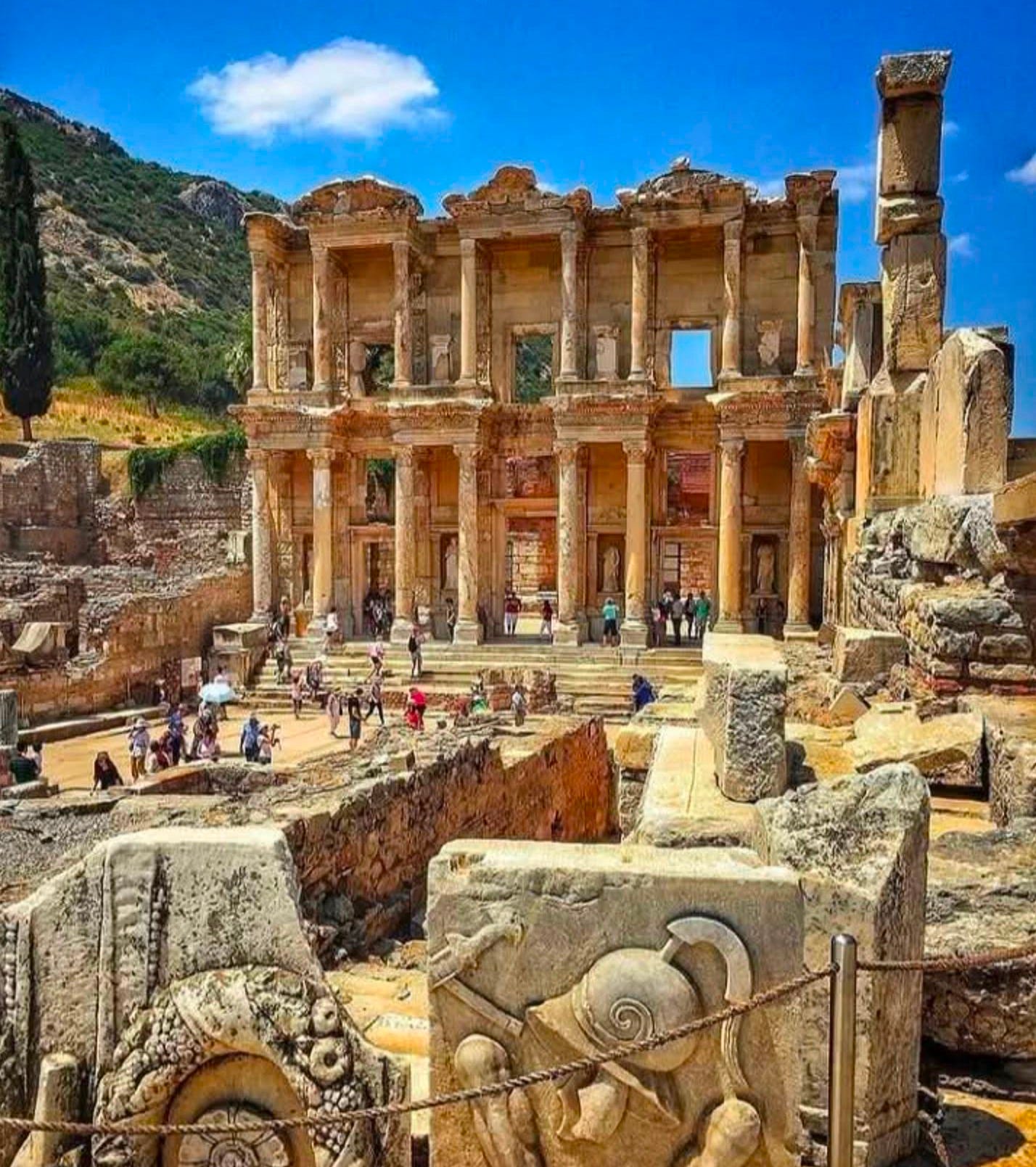
2. Library of Celsus
This isn’t just another Roman ruin — it’s one of the few surviving examples of the ancient world’s great libraries, and its secrets are still being uncovered…