


Nearly two thousand years ago, in his Meditations, Marcus Aurelius wrote:
Nothing happens to anyone that he is not fitted by nature to bear.
It is an easy idea to resist, especially when the pain is your own. Said carelessly, it can even sound cruel. But Marcus was not claiming that people never break, that every loss is fair, or that suffering is somehow deserved. He meant that life will bring you things you never chose and cannot control, and that there is more strength in you than the pain allows you to see. We almost always underestimate what we are able to survive.
I have been writing this newsletter long enough to know how many of you are carrying something heavy: the loss of someone you loved, an illness, a private grief you have never put into words. It is the most delicate subject there is, and I have never felt it was my place to preach about it, or to offer anyone advice. But pain is the one thing none of us escapes. And perhaps that is exactly why it binds us together more closely than almost anything else can…
The one thing that has ever truly helped me is the last thing you want to do when you are hurting: to turn outward, instead of inward. To be of service. To set down your own ego and give something to someone else. Sorrow, left alone, becomes an echo chamber, a room where your pain keeps circling back to itself. The surest way I have ever found out of that room is to lose myself in helping another person. As Meister Eckhart put it:
Everything would be given to the person who completely renounced himself, even for a single moment.
But wiser people than me have spoken about pain far more beautifully than I ever could. So below I have gathered 5 of the most profound things ever written about it, paired with 5 of the most moving paintings ever made in response to it. I hope that somewhere among them, you find something that helps you carry whatever it is you are carrying…
REMINDER: Beauty is Truth is entirely reader-funded. There are no ads here, only independent writing devoted to celebrating beauty — and it can only continue with your help.
If you’ve been thinking about supporting my work, becoming a paid subscriber is the most meaningful way to do it:
With the new annual subscription discount, it costs less than a coffee a month, and it is what keeps all of this going.
Gift subscriptions to Beauty is Truth are now available too:
1. The Fear No One Warns You About
We begin where grief itself begins: in the body, before the mind has caught up.
In 1960, C.S. Lewis lost his wife, Joy Davidman, to cancer. They had married late, but loved each other fiercely. In the weeks after her death, Lewis kept a journal, scribbling into old notebooks simply to survive the days. He never intended to publish it. When he finally did, he released it under the pseudonym N.W. Clerk. The little book is called A Grief Observed, and it opens with a sentence that has startled the bereaved for sixty years:
No one ever told me that grief felt so like fear. I am not afraid, but the sensation is like being afraid. The same fluttering in the stomach, the same restlessness, the yawning. I keep on swallowing.
It is the truest thing anyone has written about the first days of loss. We expect grief to feel like sadness. No one warns us that it arrives as something closer to terror, lodged in the stomach, in the breath, in the hands. Lewis goes on:
At other times it feels like being mildly drunk, or concussed. There is a sort of invisible blanket between the world and me. I find it hard to take in what anyone says.
Anyone who has grieved knows that invisible blanket. The strange muffling of the world, the way other people’s voices seem to reach you through water, the sense of being present and absent at once. And then comes the loneliest line of all:
Yet I want the others to be about me. I dread the moments when the house is empty. If only they would talk to one another and not to me.
There is no resolution here, no comfort offered, and that is exactly why it helps. Lewis is not trying to fix anything. He is simply telling the truth, and in telling it, he reaches across sixty years and lays a hand on the shoulder of everyone who has ever felt this and believed they were the only one.
To read it in the middle of your own grief is to understand, perhaps for the first time, that the pain is not something gone wrong in you, but simply the shape love takes when it has nowhere left to go.
That same ache lives in Frederic William Burton’s The Meeting on the Turret Stairs, painted in 1864. It illustrates a medieval Danish ballad. Hellelil, a king’s daughter, has fallen in love with Hildebrand, the prince assigned to guard her; when her father discovers it, he orders her seven brothers to kill him. Burton chose to paint not the bloodshed that follows, but the moment just before it: the lovers passing on a narrow turret stair, in their last instant together before Hildebrand goes out to die…
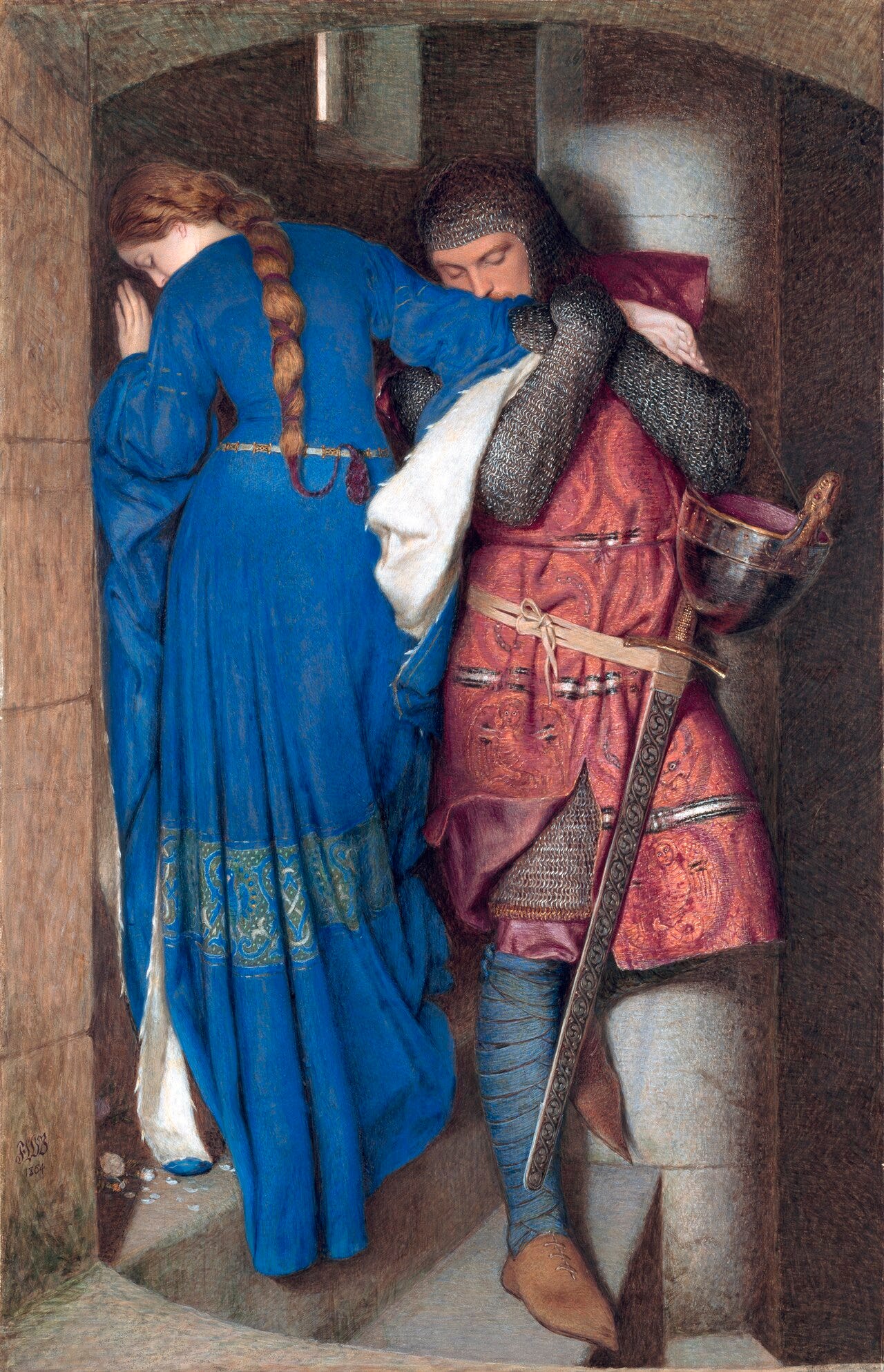
The knight lowers his head to press his lips to the girl’s bare arm. She turns away, unable to look at him. They do not embrace. They barely touch. George Eliot, who stood before this painting and never forgot it, wrote that “the face of the knight is the face of a man to whom the kiss is a sacrament.” The subject, she marveled, “might have been made the most vulgar thing in the world,” and yet Burton “has raised it to the highest pitch of refined emotion.”
Everything unbearable about the image lives in that fraction of space between them: the love that is fully present, and the loss that is already certain.
Burton understood what Lewis understood. That the deepest grief is only ever the price of the deepest love, and that no one who has truly loved is ever spared it.
2. The Slow Inventory of Loss
There is no greater pain than the loss of a child… it reverses the order the world is supposed to follow.
In 1896, while Mark Twain was traveling abroad, his daughter Susy — twenty-four years old, luminous, the one he believed had inherited the most of him — died of meningitis in the family home in Hartford. Twain was an ocean away. He learned of it by cablegram. Years later, writing his autobiography, he described the moment the news reached him, and in doing so left us a precise account of what a great loss does to the mind:
It is one of the mysteries of our nature that a man, all unprepared, can receive a thunder-stroke like that and live. There is but one reasonable explanation of it. The intellect is stunned by the shock, and but gropingly gathers the meaning of the words. The power to realize their full import is mercifully wanting. The mind has a dumb sense of vast loss — that is all.
A dumb sense of vast loss. Anyone who has received that kind of news knows what he is describing: in the first hours, you do not feel the whole of it, because you cannot. The mind, to keep you alive, refuses to let the full weight land all at once. But then Twain goes further, and gives the truest description of grief’s long aftermath that I have ever read:
A man’s house burns down. The smoking wreckage represents only a ruined home that was dear through years of use and pleasant associations. By and by, as the days and weeks go on, first he misses this, then that, then the other thing. And, when he casts about for it, he finds that it was in that house. It is irrevocably lost. It will be years before the tale of lost essentials is complete, and not till then can he truly know the magnitude of his disaster.
This is the thing no one warns you about. Grief is not a single event but a slow inventory. You do not lose the person all at once. You lose them again and again, in a thousand small discoveries, for years — every time you reach for something that was in that house, and find that it is gone.
The death happens in a single moment. The loss takes the rest of your life…
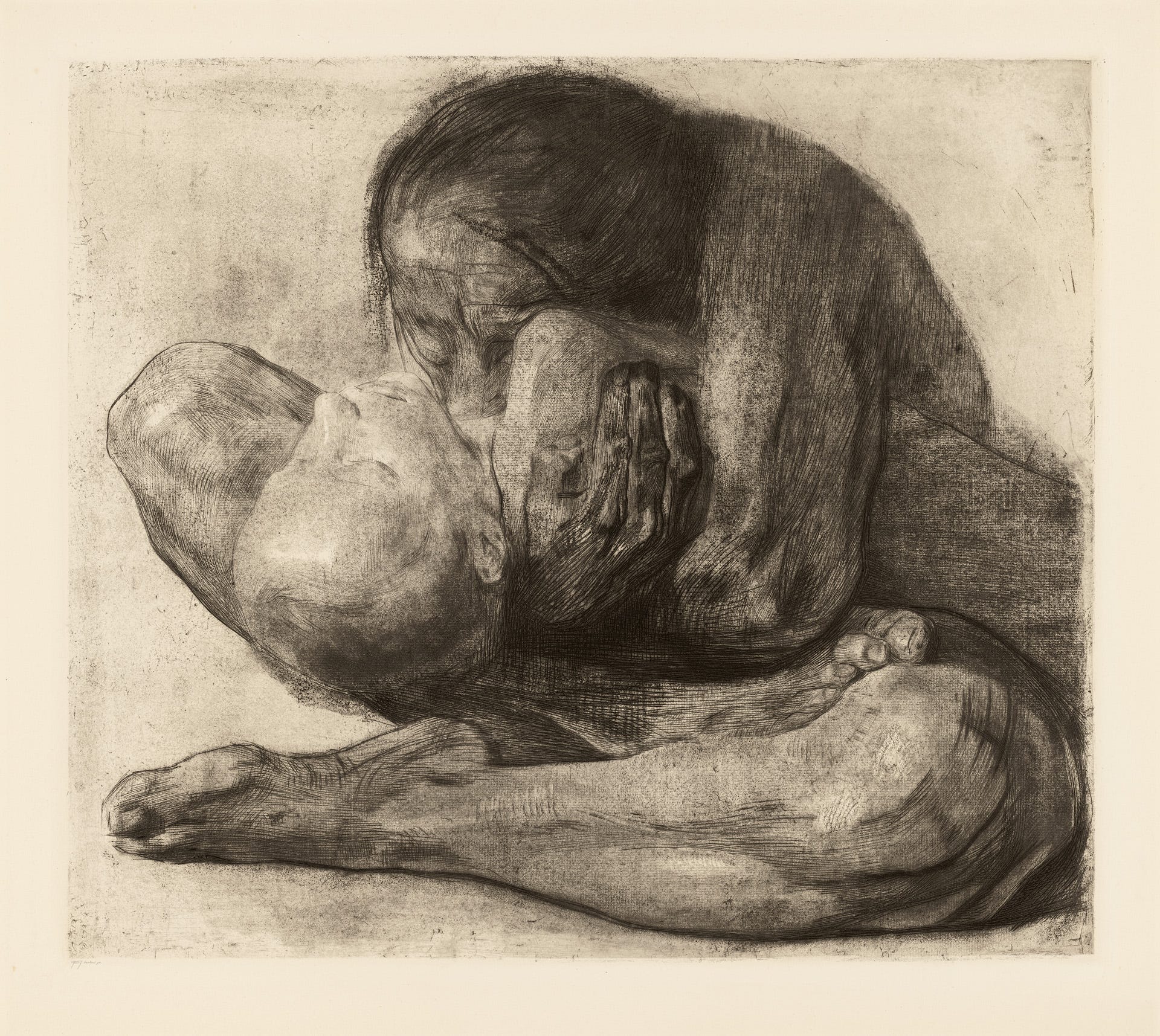
No artist understood this better than Käthe Kollwitz. In 1914, her younger son Peter was killed in the first weeks of the First World War, at the age of eighteen. She spent her remaining years returning to that wound in her art. Her 1903 piece titled Woman with Dead Child — made even before her own son’s death, as if she had foreseen it — shows a mother curled around the body of her child, not weeping prettily but gripping him with her whole body, her face buried in him, the two figures fused into a single dark mass of grief.
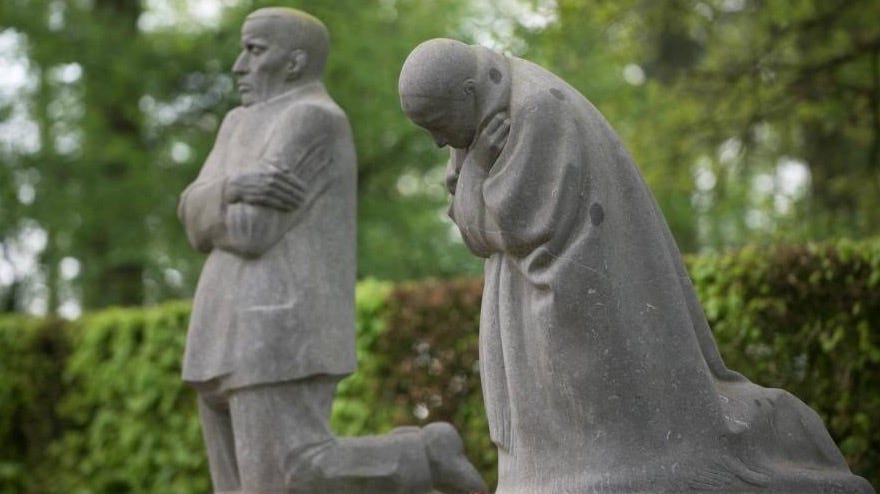
And for eighteen years she carved a memorial for Peter, The Grieving Parents, two figures kneeling in sorrow that still stands today in the war cemetery in Belgium where he is buried.
She spent decades counting what the fire had taken. And out of that long inventory of loss, she built the one thing pain had not destroyed: the proof that he had been loved...
3. Better to Have Loved
When Alfred Tennyson was a young man at Cambridge, he had a friend named Arthur Henry Hallam — brilliant, beloved, engaged to Tennyson’s sister, and, by every account, the person Tennyson loved most in the world. In 1833, with no warning, Hallam died of a sudden brain hemorrhage. He was twenty-two.
The loss broke something in Tennyson so completely that he spent the next seventeen years writing his way through it, in fragments, returning again and again to the same grief, until those fragments became one of the greatest poems of all time: In Memoriam A.H.H.
It is out of those long years that the most famous lines on loss ever written in English emerged:
I hold it true, whate’er befall;
I feel it, when I sorrow most;
‘Tis better to have loved and lost
Than never to have loved at all.
We have heard the last two lines so often that they have nearly worn smooth, like a coin passed through too many hands. But look at the line above them, the one almost no one quotes: I feel it, when I sorrow most. Tennyson is saying that it is precisely in his deepest grief — not in spite of it, but inside it — that he knows the loving was worth the losing.
The pain does not cancel the love. The pain is the proof of it. To grieve this much is simply the receipt for having loved that much, and he would not give the love back to escape the loss.
In 1875, George Frederic Watts painted that same truth in his allegory Love and Death. He had watched a gifted young nobleman waste away despite all the devoted care of his wife, and the image came to him: a great shrouded figure, Death, advancing slowly toward the doorway of a house, and a smaller winged figure, Love, throwing itself against that inevitable approach in a doomed attempt to bar the way.
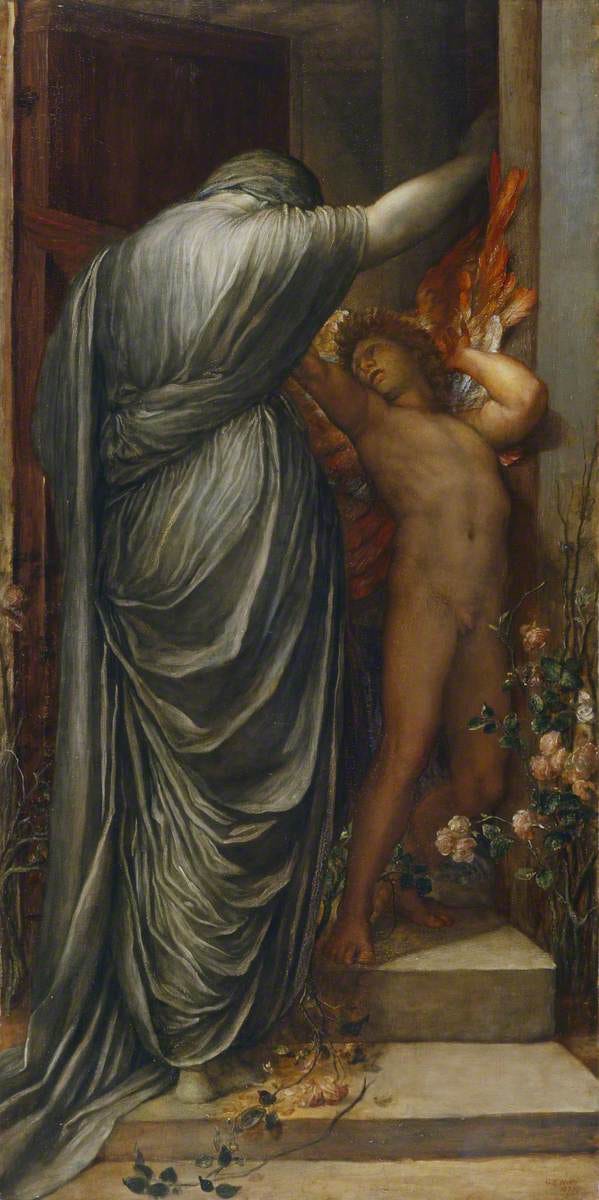
Watts was careful to explain that Love is not holding Death back, for nothing can. “I wish to suggest,” he said, “the passionate though unavailing struggle to meet the inevitable.”
It is all of us, in the end, standing in that doorway. We love anyway, knowing exactly how the story has to end.
And perhaps that is the bravest thing a human being ever does. Because as Dostoevsky wrote in The Brothers Karamazov:
What is hell? I maintain that it is the suffering of being unable to love.
The grief is terrible. But the alternative — a life that never risked loving at all, and so never had anything to lose — is the only thing worse…
4. The Breaking of the Shell
So far we have stayed close to the rawness of loss. But there is another way of looking at pain and it is the one that begins, slowly, to turn grief toward meaning.
There is an old Chinese parable that opens the door to it. A farmer’s only horse runs away, and his neighbors come to say how terrible it is. “Maybe,” the old man replies. The next day the horse returns, bringing several wild horses with it, and the neighbors come to celebrate his good fortune. “Maybe,” he says again. His son tries to tame one of the wild horses, is thrown, and breaks his leg. Terrible luck, the neighbors say. “Maybe.” Then the army comes through the village to conscript every able-bodied young man for a war, and passes the son by, because of his broken leg. The parable could run forever, because that is what life does. We almost never know, in the moment, whether what has happened to us is the end of the story, or the beginning of another one we cannot yet see.
This is not to say that suffering is good, or that loss is secretly a gift in disguise. Only that pain, however unwanted, changes us, and not every change it leaves behind is damage. No one expressed this more beautifully than the Lebanese poet Kahlil Gibran, in the chapter “On Pain” from his 1923 masterpiece The Prophet:
Your pain is the breaking of the shell that encloses your understanding. Even as the stone of the fruit must break, that its heart may stand in the sun, so must you know pain.
The seed cannot grow while it is still sealed inside its hard shell. The shell has to break, and the breaking surely feels to the seed like destruction, like the end of everything. But it is the opposite of an end. It is the only way the green shoot ever reaches the light. Leonard Cohen said the same thing in his song Anthem: “There is a crack in everything. That’s how the light gets in.” Gibran does not pretend the breaking is painless; he only refuses to call it meaningless. He goes on:
And you would watch with serenity through the winters of your grief.
Not the absence of winter. The serenity to live through it, trusting that the season will turn, as seasons do. That is what the parable and the poet are both pointing toward: not a denial of pain, but a longer view of it, wide enough to hold the possibility that what feels like ruin today may be, in some way you cannot yet see, the breaking open of something that needed to grow.
No painter captured this better than Ivan Aivazovsky, the great master of the sea. In his storm paintings, a small ship is tossed on enormous black waves beneath a sky torn apart by tempest — and yet, almost always, on the horizon, the artist places a single break in the clouds where the sun is rising, laying a path of gold across the very water that moments ago looked only deadly.
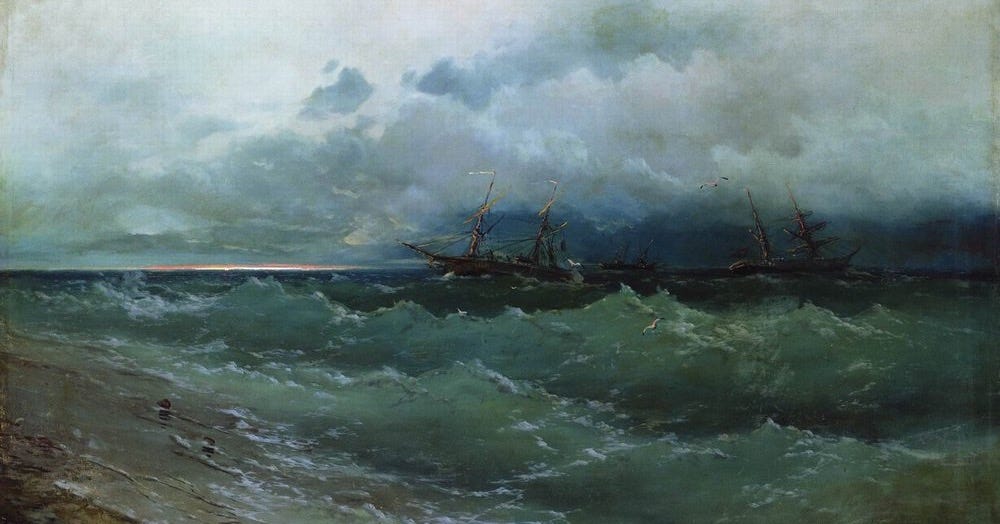
He painted the storm and the dawn in the same frame, because he understood that they are never as separate as they feel from inside the tempest. The light is already coming. You usually just cannot see it yet from the trough of the wave…
5. Life Has Not Forgotten You
The last word belongs to Rainer Maria Rilke, who in Letters to a Young Poet wrote about suffering with more wisdom and compassion than anyone before or since.
In 1904, Rilke was writing to a young cadet who had confided his sadnesses and self-doubt, and he replied with what would become one of the most consoling passages ever written about the hard and frightening things in life:
Perhaps all the dragons of our lives are princesses who are only waiting to see us once beautiful and brave. Perhaps everything terrible is in its deepest being something helpless that wants help from us.
It is a staggering reversal. The thing that frightens us most, the grief that looms over us like a monster, may not be a monster at all, but something waiting to transform, if only we can find the courage to stop running from it and turn to face it. What comes next is, to me, one of the greatest lines he ever wrote:
You must think that something is happening with you, that life has not forgotten you, that it holds you in its hand; it will not let you fall.
Life has not forgotten you. Whatever you are carrying right now, however invisible you feel inside it, you have not been abandoned by the world. You are still being held.
There is a painting by Caspar David Friedrich, Woman before the Rising Sun, that gives me this exact feeling. A lone woman stands in an open field at dawn, her back to us, her arms slightly lifted and opening, as though she is being met by the light rather than merely watching it. The sun has not fully risen. The land around her is still half in shadow. But she faces it, open-armed, the way a person finally turns to face what they have survived.
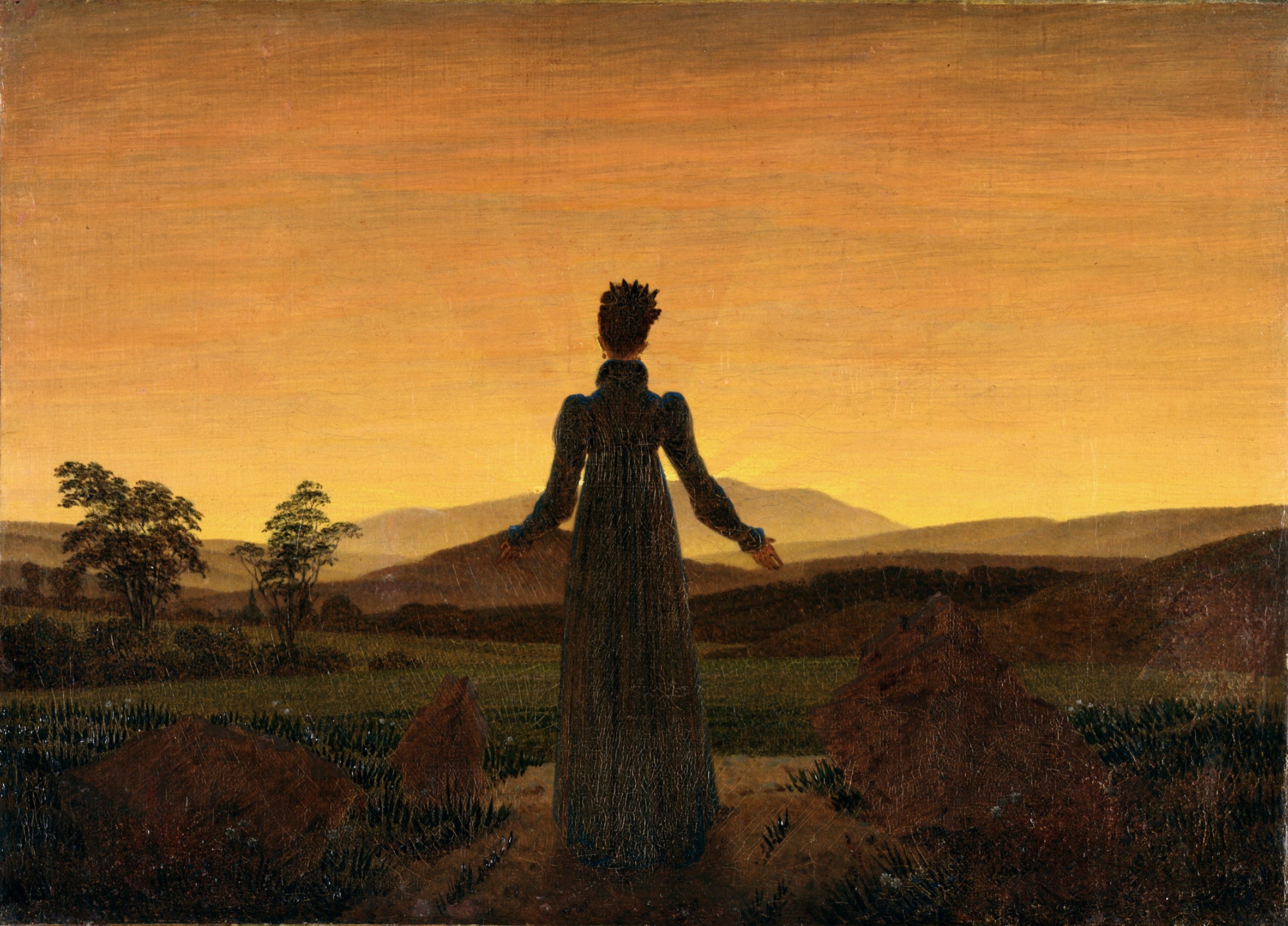
Friedrich never tells us what she has been through. He does not need to. We recognize the posture. It is the moment after the worst of the night, when you are still standing, and the light is beginning, very slowly, to return…
And so we come to the end, though grief, of course, has no neat ending.
If there is one thing all five of these voices seem to agree on, it is this: there is no way around pain, and no way over it. The only way out is through. As Rilke wrote in The Book of Hours:
Let everything happen to you: beauty and terror. Just keep going. No feeling is final.
No feeling is final. Not even this one. The grief that feels permanent today is not the last thing you will ever feel, however much it insists otherwise.
And there is something on the other side of it, something the writers in this piece kept circling back to: that survival alone is not the point. As Dostoevsky wrote in The Brothers Karamazov:
The mystery of human existence lies not in just staying alive, but in finding something to live for.
Pain hollows us out, but what it carves can be filled again, with purpose, with love, with the slow rediscovery of why we are here at all.
And here, at the very end, I will mention again the only thing I have ever truly known to help. When your own pain becomes too heavy to carry alone, turn it outward. Find someone else who is hurting, and help them. It will not erase what happened to you. But it will remind you, in the only way that ever works, that you are still here, still useful, still capable of love, still part of the long human chain of people holding one another up through the dark.
That is how the light gets back in. Not all at once. But person by person, hand by hand.
So wherever you are reading this, and whatever you are carrying, I will leave you with an old blessing, the kindest words I know:
May the wind always be at your back and the sun upon your face. And may the wings of destiny carry you aloft to dance with the stars.
Thanks for reading! This newsletter is completely independent and ad-free — and it can only keep going with your help. Please consider contributing a few dollars today, and get access to exclusive articles and the full archive:
Every subscription genuinely makes a difference.
Thank you for making this work possible.
I love the way you intertwine prose with paintings. It graphically illuminates the artists’ intense feelings of grief.
Cit.
<<The death happens in a single moment. The loss takes the rest of your life…>>
Also you gave us this beautiful sentence, a great gift. I like it a lot, as it is sadly, really the truth.
THNX