



Albert Camus once wrote:
In the middle of winter, I at last discovered that there was in me an invincible summer.
There is a question that feels almost indecent to ask when the world is burning. And yet it may be the most important one we can ask right now: can beauty exist in a world at war?
The instinct is to say no. That beauty is a luxury — something that belongs to times of peace. That it should wait, politely and patiently, until the suffering has stopped. This instinct is understandable. It is also, history suggests, completely wrong…
Fyodor Dostoevsky had earned the right to say so. At twenty-seven, he was arrested for political dissent and spent eight months imprisoned in the Peter and Paul Fortress before being led, on December 22, 1849, to Semyonovsky Place in St. Petersburg, where a sentence of death by firing squad was read aloud. The first group of men was tied to the posts. The drums rolled. At the last possible moment, a courier arrived with a stay of execution from the Tsar — the mock execution had been scripted as punishment all along.
One of the prisoners went permanently insane on the spot. Dostoevsky was sent to four years of hard labour in Siberia.
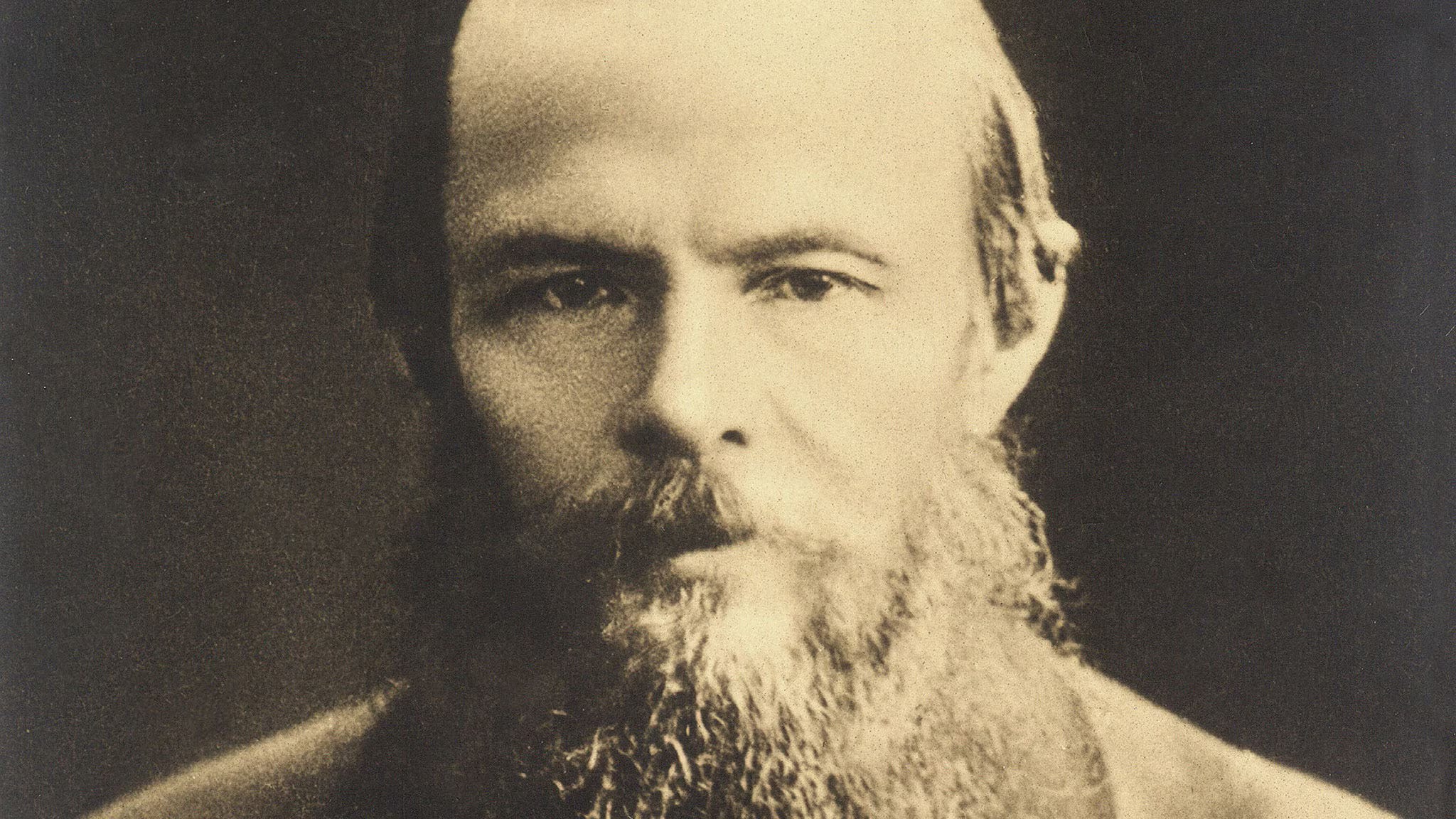
He arrived believing that politics could redeem the world. He left convinced of something far harder to argue with: that no system, however brutal, could fully extinguish the human capacity to be stopped in its tracks by beauty.
He had watched it happen in the camp itself — the way a man might pause, in the middle of degradation and cold, to notice that the sky above the frozen steppe was inexplicably, almost offensively magnificent.
Viktor Frankl, who survived four concentration camps and spent years studying what allowed people to endure the unendurable, put his finger on the same truth in Man’s Search for Meaning:
Everything can be taken from a man but one thing: the last of the human freedoms — to choose one’s attitude in any given set of circumstances.
For Dostoevsky, beauty was precisely this: not an escape from suffering, but a choice within it...
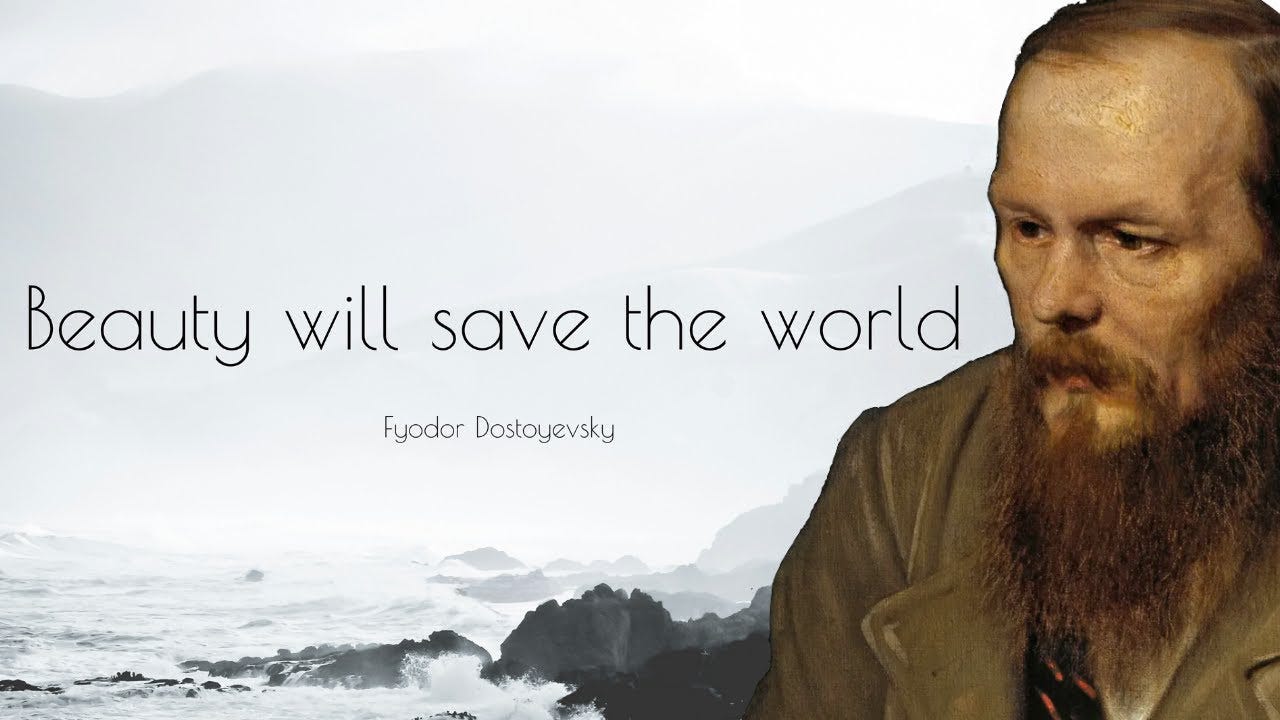
It was this conviction he carried into his fiction. In The Idiot, a young nihilist named Ippolit — dying of tuberculosis, contemptuous of hope — turns to the gentle, innocent Prince Myshkin and asks this question in mockery:
Is it true, prince, that you once declared that ‘beauty would save the world’? Great Heaven! […] What beauty saves the world?
He meant it as a taunt. And it would be easy to read it as the delusion of a fool. But Dostoevsky, who had knelt before a firing squad and spent four years in chains, intended the opposite. Because by beauty, Myshkin did not mean prettiness... he meant that stubborn, irrational force that rises without permission from the worst possible ground — the proof, available even in the darkest of circumstances, that the human soul has not been entirely defeated.
And the most brutal chapters of history keep arriving at the same conclusion: that beauty does not require peace. That it has never required peace, and that some of the most extraordinary things ever made were born precisely in its absence.
A monologue written by Graham Greene and delivered by Orson Welles in The Third Man makes the argument in a way that is very hard to forget:
In Italy for thirty years under the Borgias they had warfare, terror, murder, and bloodshed, but they produced Michelangelo, Leonardo da Vinci, and the Renaissance. In Switzerland they had brotherly love, they had five hundred years of democracy and peace — and what did that produce? The cuckoo clock.
Like a flower pushing through snow, beauty in wartime does not wait for better conditions. It does not wait for the ceasefire, or the peace treaty, or permission. It simply rises — sometimes as defiance, sometimes as grief made visible, sometimes as the only form of resistance left available. What follows are 5 examples of exactly that…
REMINDER: Beauty is Truth is a reader-funded publication. There are no ads here, only independent writing devoted to celebrating beauty — and it can only continue with your help.
If you’ve been thinking about supporting my work, becoming a paid subscriber is the most meaningful way to do it:
With the new annual subscription discount, it costs less than a coffee a month — and it’s what keeps all of this going. Gift subscriptions to Beauty is Truth are now available too:
1. The Last Judgment
The Renaissance — the most concentrated explosion of human genius in Western history — unfolded against plague, assassination, and continuous war. Michelangelo painted the Sistine Chapel ceiling between 1508 and 1512 while Italy was caught in the turmoil of the Italian Wars. Then, twenty years later, he returned…
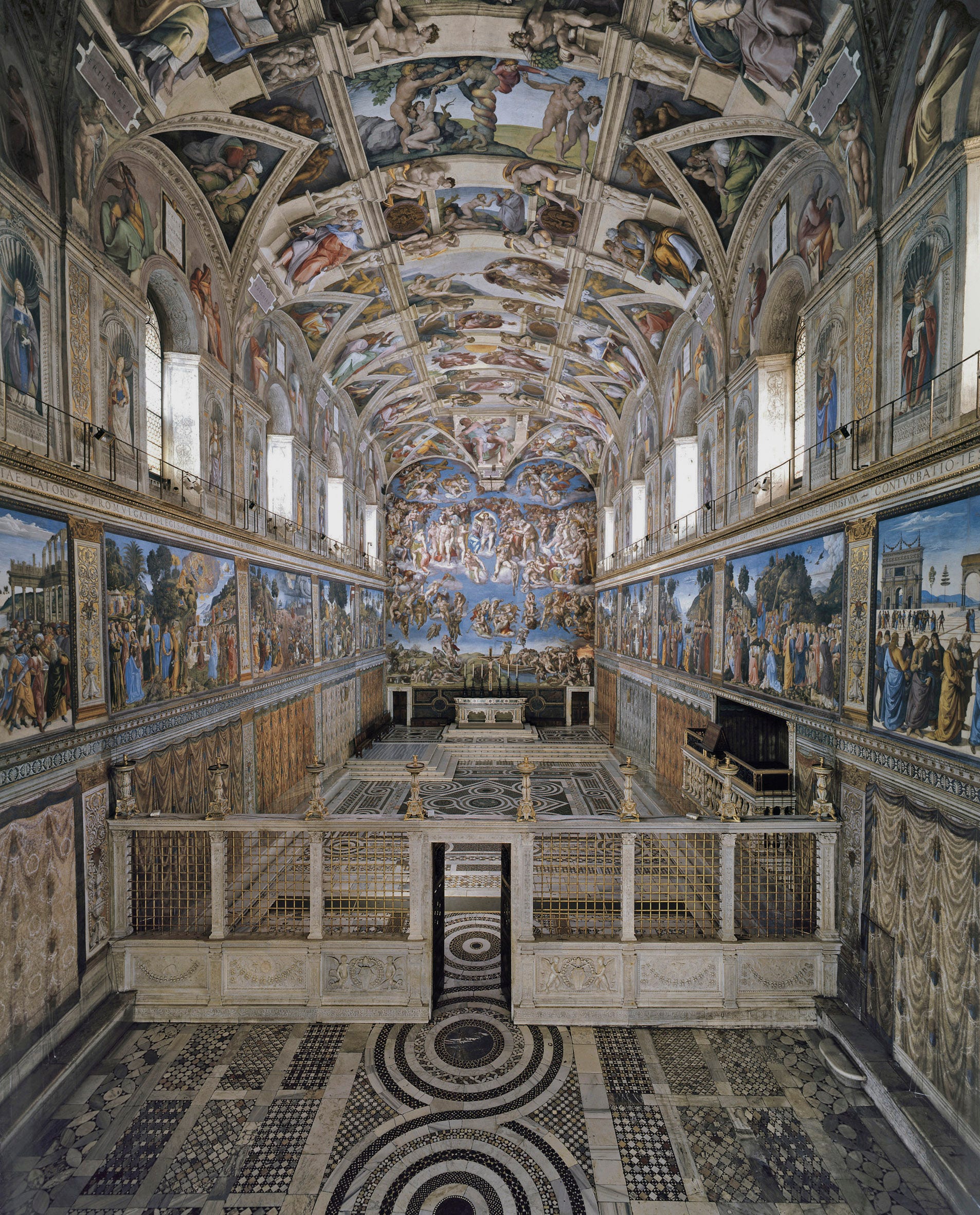
By then, Rome had suffered one of the most traumatic events in its history. In 1527, the soldiers of Emperor Charles V sacked the city, leaving thousands dead and the Tiber clogged with corpses. Amid the devastation, Michelangelo painted his answer: 180 square meters, 400 figures, five years of work.
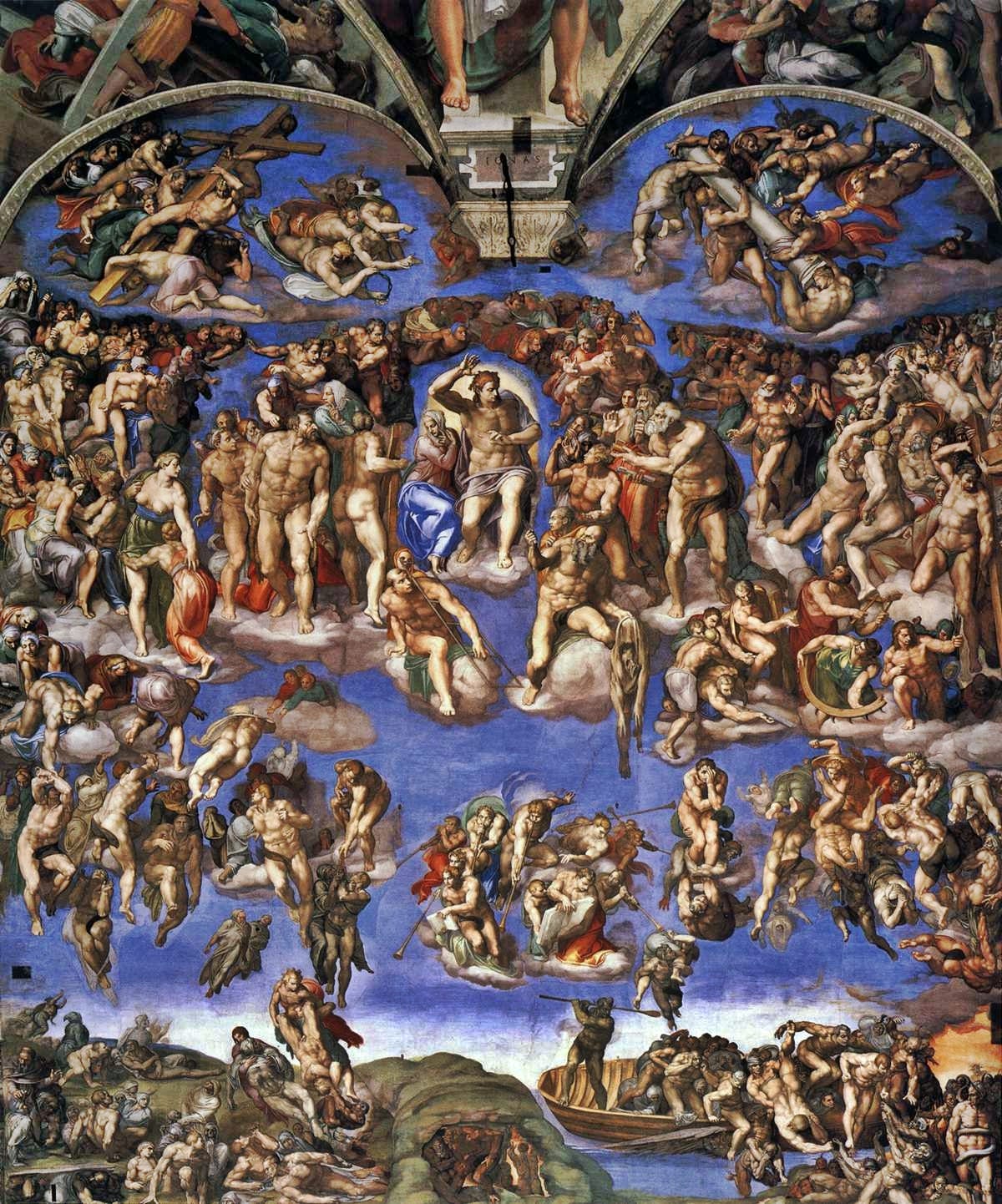
Even Giorgio Vasari, who saw it unveiled on Christmas Day 1541, could barely find the words:
It surpasses every extraordinary beauty, so harmoniously painted and executed that the multitude of figures, the awe-inspiring scale, and the power of the work are beyond description, filled with every conceivable human emotion, each expressed with marvelous skill.
A vision of cosmic judgment — saints and sinners whirling through space, the blessed rising and the damned dragged down — painted with a ferocity that shocked even those who had commissioned it. The papal master of ceremonies denounced it as a disgraceful thing, not fit for the chapel of a Pope but for a tavern. Michelangelo’s response was to paint his face on the figure of Minos in Hell, complete with donkey ears — a symbol, in Renaissance iconography, of irredeemable stupidity.
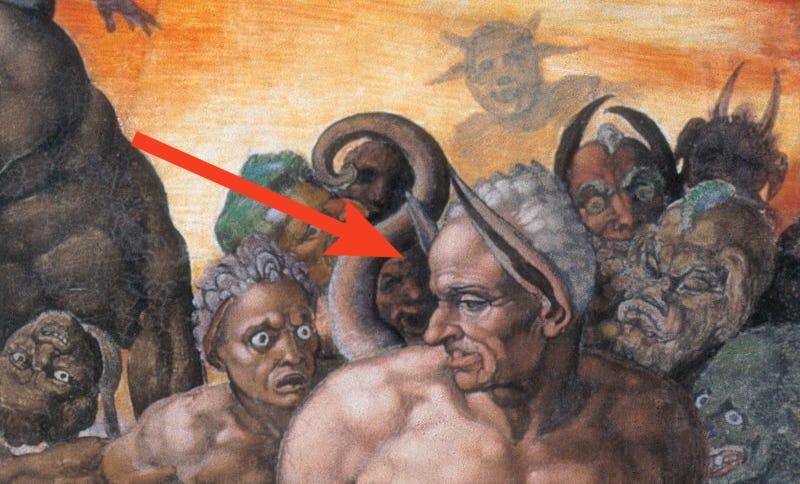
This is what beauty looks like when it is made under pressure.
Notice the pattern. The comfortable eras, the stable ones, leave almost nothing behind. It is the broken ones, the besieged ones, the ones with everything to lose, that make things that last. Stability preserves life. Struggle reveals what life is for.
2. The Third of May 1808
Francisco Goya had spent decades as the most celebrated painter in Spain, rising in 1799 to the prestigious role of First Court Painter. Then Napoleon’s armies invaded in 1808, and something in him shifted.
He began recording what he saw in private — 82 etchings, The Disasters of War, showing atrocities with a directness that would not be published until 35 years after his death. By the time the French left, he was deaf, ill, and traumatized. He was also still painting.
In 1814, he petitioned the Spanish government to commemorate the night of May 3, 1808 — when civilians who had risen in revolt were rounded up and shot before dawn. The government expected a celebration of heroism…
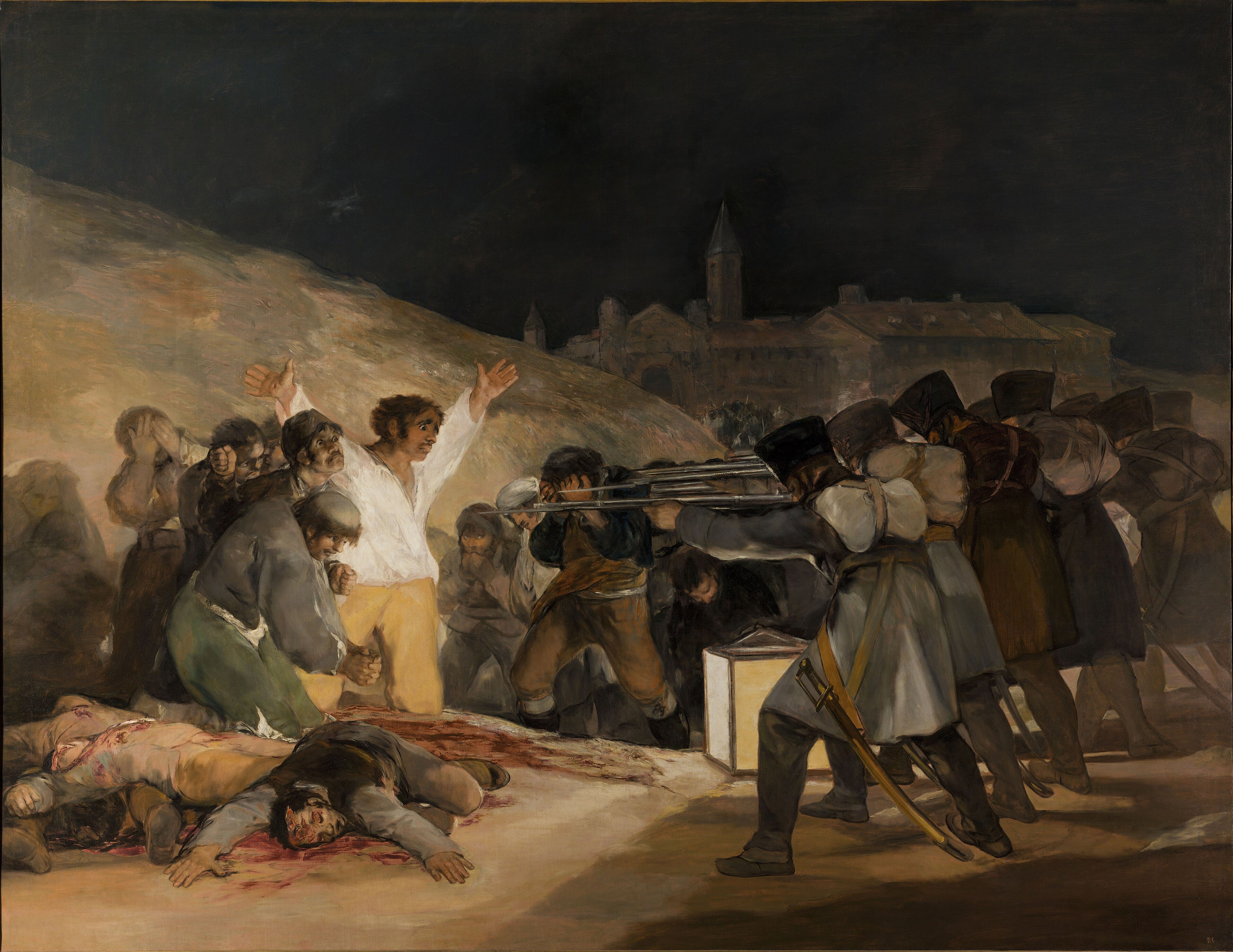
On the right of the canvas: the firing squad, faceless, mechanical, more machine than men. On the left: the victims, terrified, individual, human. At the centre, one figure in a lantern’s white glare, arms flung wide, bearing on his palms what appears to be stigmata — Christ dragged into the modern world. Kenneth Clark called it “the first great picture which can be called revolutionary in every sense of the word.”
An absolute masterpiece.
Considered one of the first paintings of the modern era, it was commissioned as tribute but became an indictment. Not just of one night in Madrid… but of what power does when it decides that some lives are expendable.
3. The Sarajevo Roses
Between 1992 and 1995, Sarajevo endured the longest siege of a capital city in the history of modern warfare.
For 1,425 days, an average of 329 mortar shells rained down on the city every single day. More than 11,500 people were killed and yet inside the city, schools continued to operate in basements, the university kept its doors open, actors founded an underground theatre and performed 2,000 shows during the siege, and a film festival was born — today one of the largest in Europe.
Sarajevo did not stop living. It refused to.
After the war ended, residents did something that no authority had planned or commissioned. They found the mortar craters in the pavement and filled them with blood-red resin.
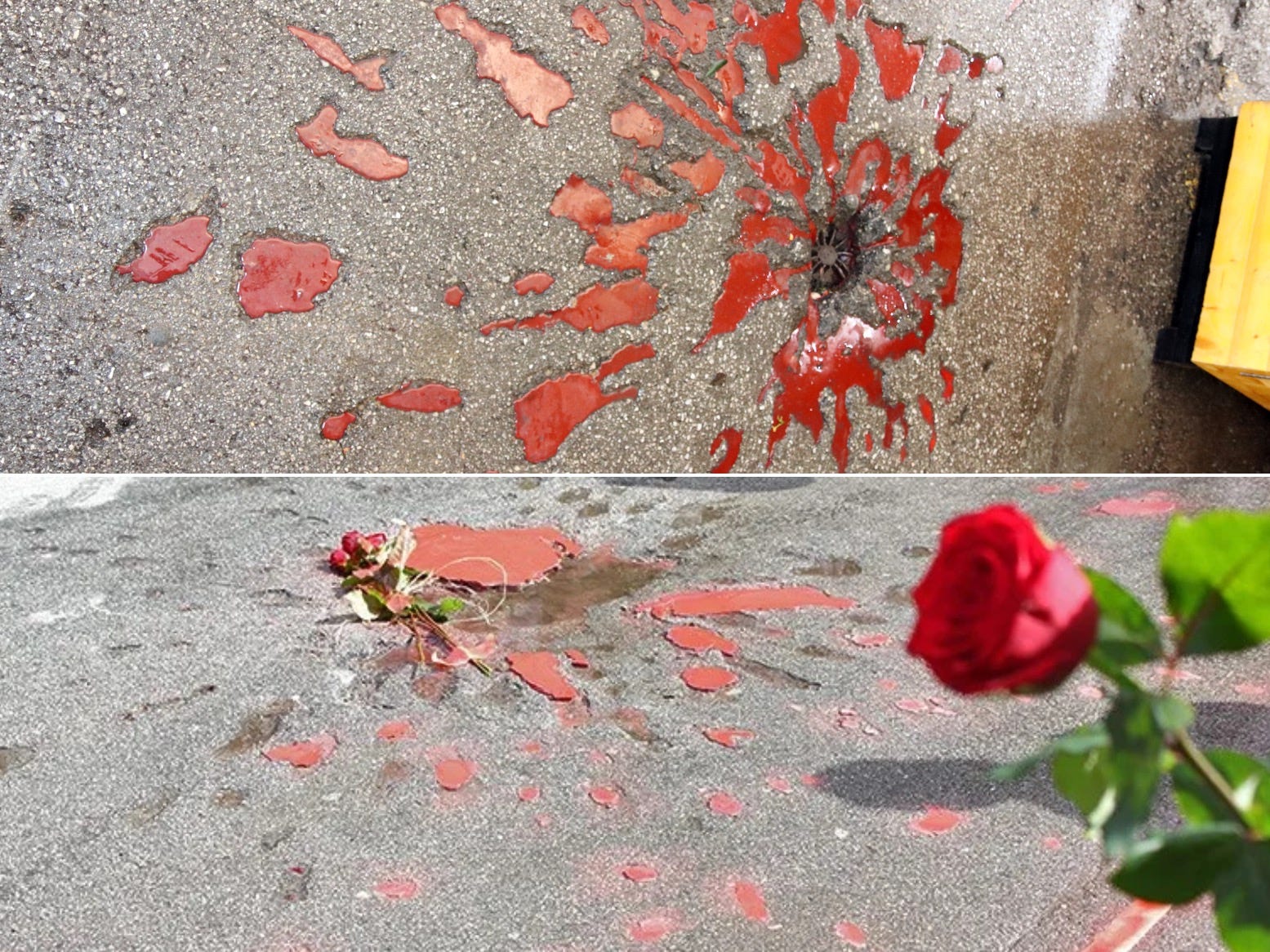
The explosion pattern left by a mortar shell in concrete splays outward in a shape that looks, from above, almost like a flower. They called them Sarajevo Roses. Nearly 200 of them are scattered across the city, walked over every day by the people who survived. There is no more precise definition of beauty as resistance: a city that turned its own wounds into flowers…
4. Guernica
On April 26, 1937, German and Italian warplanes bombed the Basque town of Guernica. Picasso, living in Paris, had been preparing a mural for the Spanish Pavilion at the World’s Fair. He abandoned it, and in roughly six weeks, he painted Guernica instead. He chose black, white, and grey. The colors of a newspaper photograph. The colors of evidence.
The painting does not depict the bombing. It depicts what bombing does — a screaming horse, a mother clutching a dead child, a shattered soldier… No heroism. No enemy. No flag. Just the wreckage that remains when the planes have gone home.
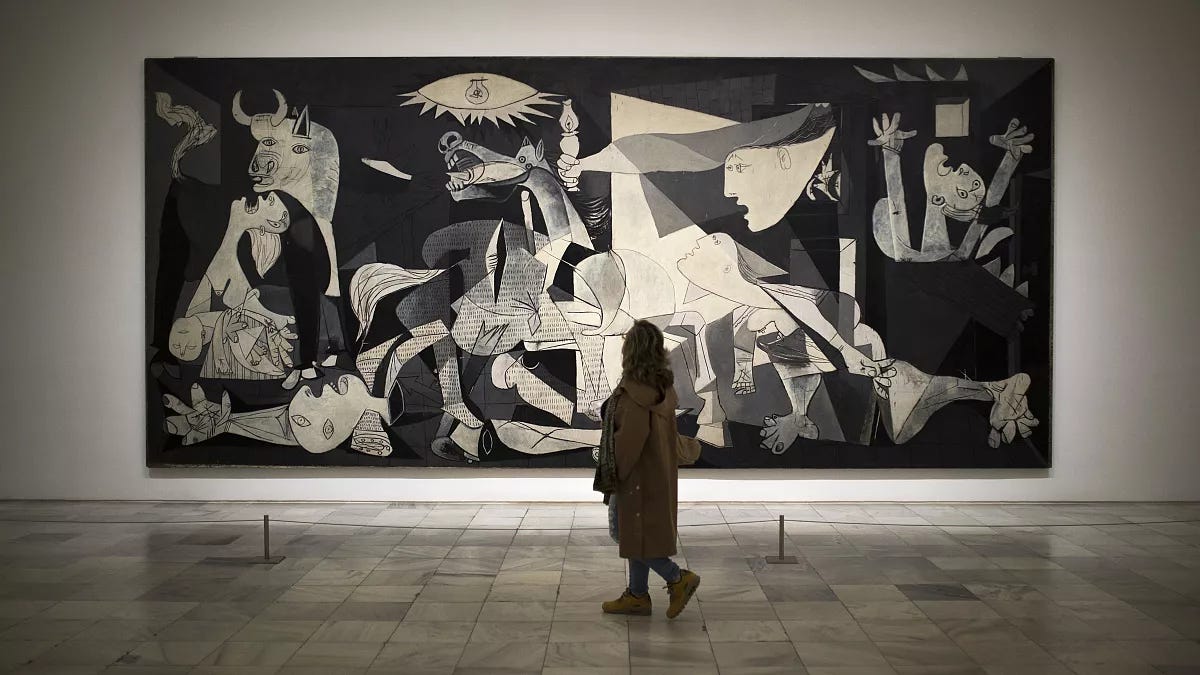
After its debut it traveled — Scandinavia, London, New York — raising funds for Spanish refugees, forcing the war into rooms where people had preferred not to think about it. Picasso stipulated it could not return to Spain until democracy was restored. It waited forty-four years.
Today it is regarded by many art critics as the most moving and powerful anti-war painting in history.
During the Nazi occupation of Paris, a German officer visiting his studio allegedly pointed to a photograph of the painting and asked: “Did you do that?” Picasso looked at him. “No,” he said. “You did.” That is what art can do that weapons cannot: it can hold a mirror up to power, and make power flinch. Without firing a single shot.
5. The Leningrad Symphony
Shostakovich began his Seventh Symphony in Leningrad in the first weeks of the German invasion, in the summer of 1941. He worked on it under bombardment, completing movements between sprints to the nearest bomb shelter.
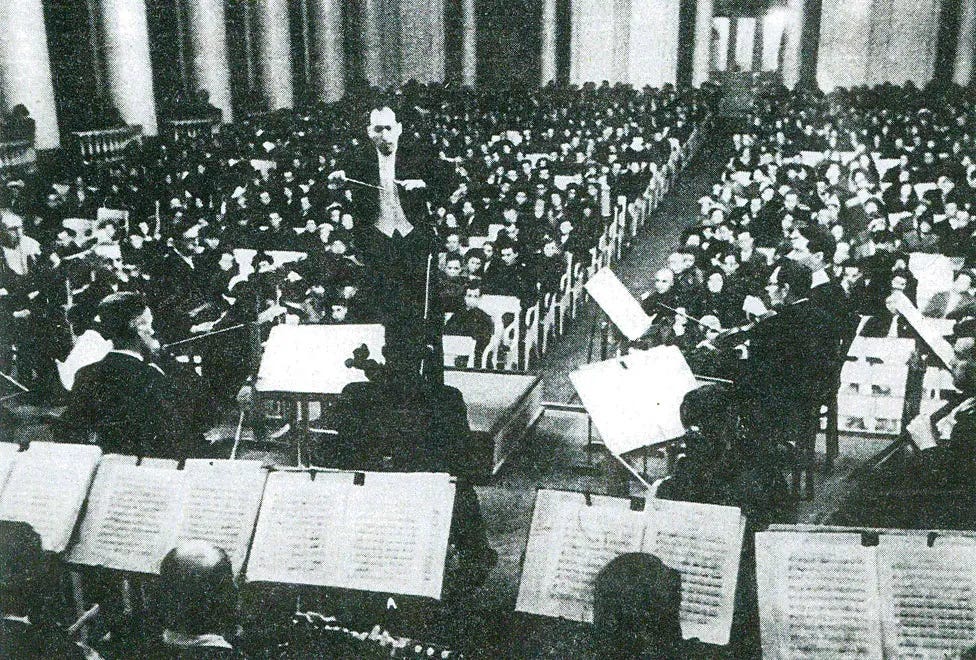
The premiere took place inside Leningrad on August 9, 1942. The German army stood at the city’s gates. The siege had already lasted nearly a year. Of the Leningrad Radio Orchestra, only a small number of musicians remained… the others had starved or gone to fight. General Govorov ordered an artillery operation to suppress German guns during the performance, and loudspeakers broadcast the symphony toward the German lines. The city listened. So did the enemy.
Years later, Shostakovich himself said:
While composing this symphony, I thought about our people’s nobility, heroism, marvelous humanist ideas, human values, our splendid nature, humankind, beauty.
Which brings us back to where we started.
A century after Dostoevsky knelt before a firing squad and emerged somehow more convinced than ever that beauty was not a luxury but a lifeline, Aleksandr Solzhenitsyn — himself a survivor of the Soviet Gulag — stood before the Nobel Committee in 1970 to deliver his acceptance speech.
He wrestled with the iconic line from The Idiot, admitting its apparent absurdity — and then, slowly, turned it inside out:
One day Dostoevsky threw out the enigmatic remark: “Beauty will save the world”. What sort of a statement is that? For a long time I considered it mere words. How could that be possible? When in bloodthirsty history did beauty ever save anyone from anything? Ennobled, uplifted, yes – but whom has it saved?
There is, however, a certain peculiarity in the essence of beauty, a peculiarity in the status of art: namely, the convincingness of a true work of art is completely irrefutable and it forces even an opposing heart to surrender. So perhaps that ancient trinity of Truth, Goodness and Beauty is not simply an empty, faded formula as we thought in the days of our self-confident, materialistic youth…
If the tops of these three trees converge, as the scholars maintained, but the too blatant, too direct stems of Truth and Goodness are crushed, cut down, not allowed through – then perhaps the fantastic, unpredictable, unexpected stems of Beauty will push through and soar to that very same place, and in so doing will fulfil the work of all three. And in that case Dostoevsky’s remark was not a careless phrase but a prophecy.
This is the answer. Beauty does not stop wars but it refuses to concede that the worst of what humans do is the whole of what humans are.
Dostoevsky said beauty would save the world. He did not mean it would happen quickly. He meant it could not, ultimately, be stopped.
Thanks for reading! This newsletter is completely independent and ad-free — and it can only keep going with your help. Consider contributing a few dollars a month today, and get access to exclusive articles and the full archive:
Your support means the world to me — thank you for making it possible to continue this work.
The Sarajevo Roses took me out. This entire essay left me with a hard lump of emotion in my throat. I'm thinking of tiny blooms making their way to the sun at the frontlines in Ukraine, in the shattered cities filled with resilient people refusing to be shattered - these tiny reminders that life somehow finds a way. Thank you for the care you take to help us cope in a world on fire. ❤️
James ... you really do your homework. And .. to be honest, I have always believed peace is a state of mind. Everything that surrounds you may be in total chaos
but yet beauty and peace can be found. Not going to lie and say that I am always successful at this, but
that does not mean it does not exist... I just cant see it in the fire
of the moment. Thank you. 🕊