


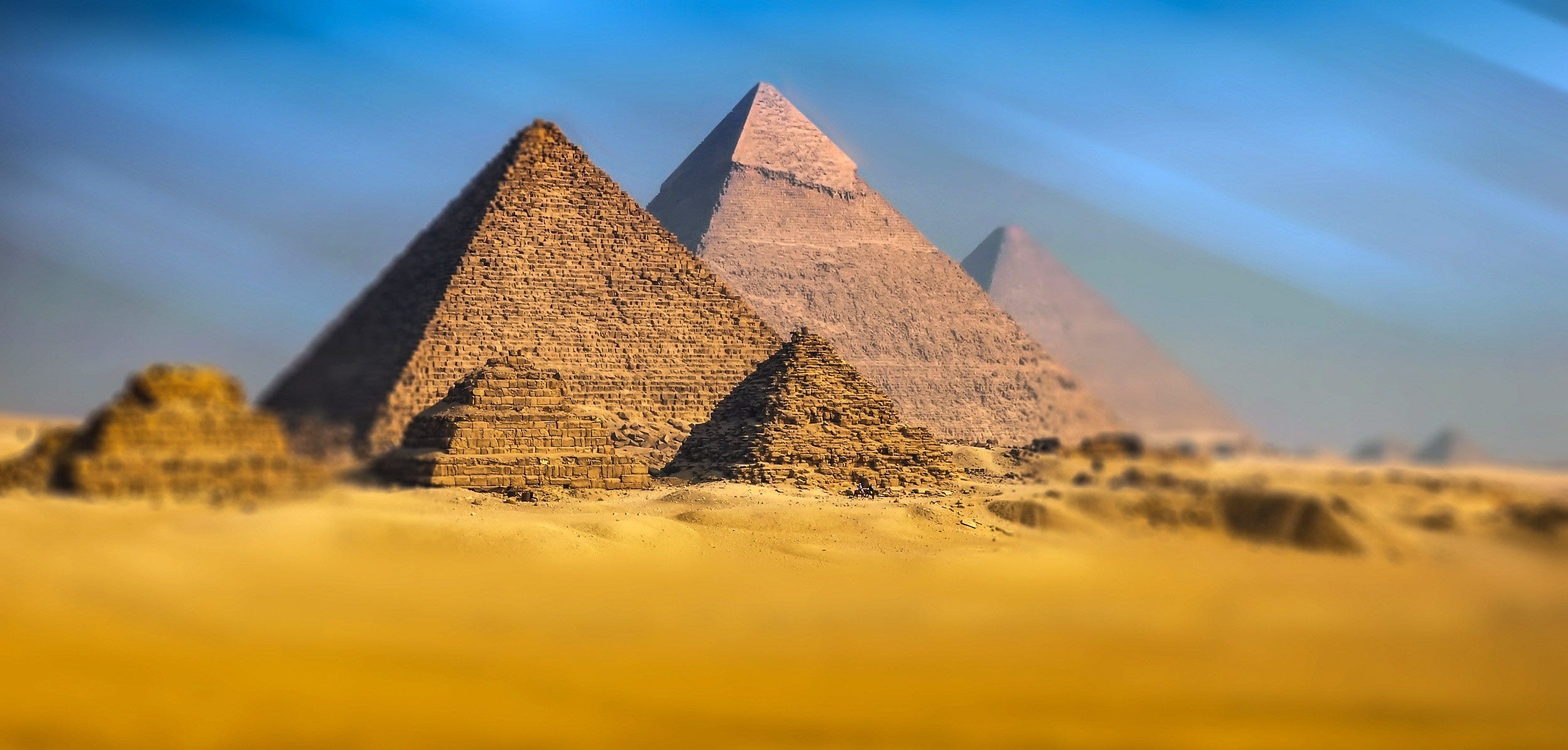
On the morning of 21 July 1798, leading his army into battle near the pyramids of Giza, Napoleon Bonaparte turned to his troops and said:
From the heights of these pyramids, forty centuries look down on us.
Even Napoleon, a man not known for being easily humbled, could not stand in front of the Giza plateau and feel anything but small…
Anyone who has been there knows the feeling. The pyramids overwhelm you. And as you look at them, a question forms in the back of your mind that nobody has ever entirely answered: how did this happen? How did a civilization capable of producing structures so enormous, so geometrically precise, so engineered for permanence, appear in the Nile Valley thousands of years before anything comparable existed anywhere else on earth?
The Great Pyramid alone stood as the tallest man-made structure on earth for millennia, and experts who have studied it across entire careers often admit that what the Egyptians accomplished — without modern machines, without iron, without the wheel as we use it today — remains genuinely difficult to grasp.
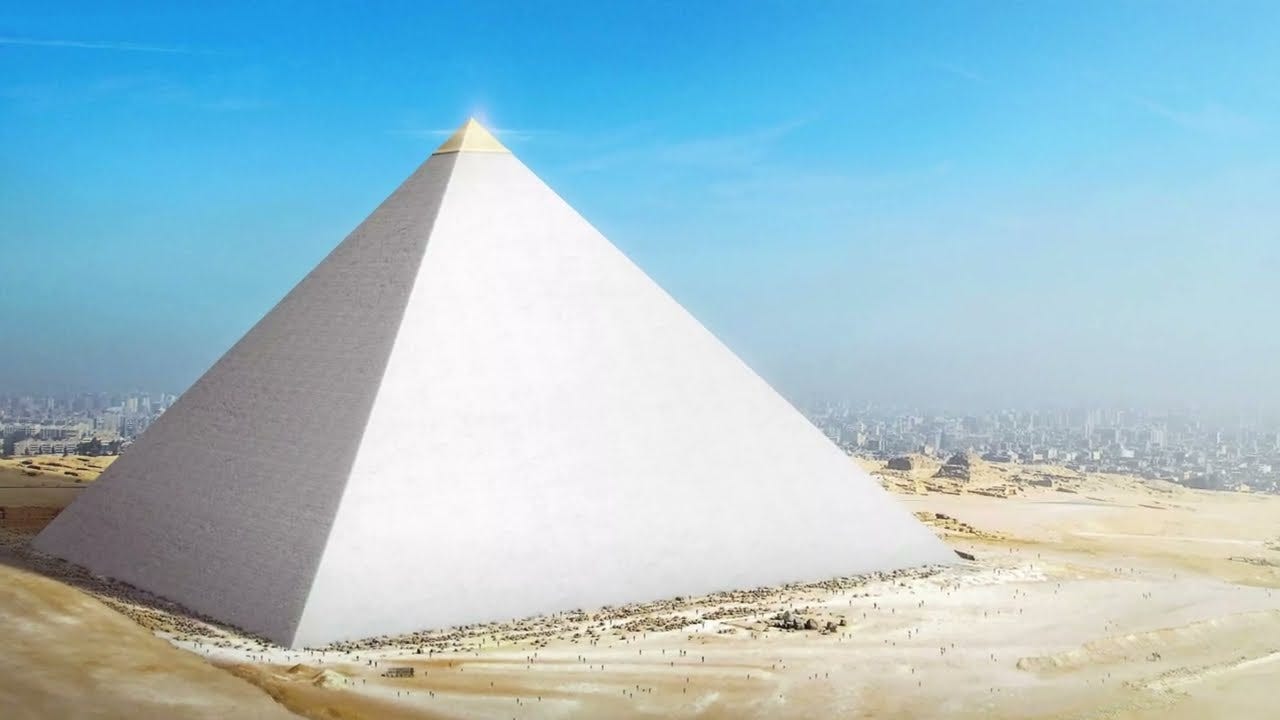
And the strangeness does not stop at the pyramids. Across thousands of years, they produced a long catalogue of objects, monuments, and astonishing feats of engineering. Mainstream Egyptology has plausible explanations for most of them: ramps, sledges, copper chisels, dolerite hammers, organized labor, and enormous spans of time. These explanations work for much of what survives. But against the scale and precision of certain works, they still leave us with more questions than full answers.
A civilization working with copper tools and rope produced things that even modern engineers, with diamond saws and industrial cranes, describe as remarkable. You do not need to reach for anything beyond the evidence to be in awe of what they were able to bring into the world.
As the American Egyptologist Mark Lehner — one of the foremost living authorities on Giza — has written:
We think of the pyramids as mysteries, but the stones, hieroglyphs, landscapes, and even layers of sands and debris around them hold stories.
Here are five of those stories. Five things ancient Egypt built that, even after centuries of study, still do not entirely make sense…
REMINDER: this is a teaser for my subscriber-only articles.
Beauty is Truth is entirely reader-funded. There are no ads here, only independent writing devoted to celebrating beauty.
If you’ve been thinking about supporting my work, becoming a paid subscriber is the most meaningful way to do it:
With the new annual subscription discount, it costs less than a coffee a month — and it’s what keeps all of this going. Gift subscriptions to Beauty is Truth are now available too:
1. The Wonder That Surpassed the Pyramids
While we still wait to see whether the recent claims by Italian researcher Filippo Biondi about massive underground structures beneath the Giza Plateau hold up under scrutiny — most archaeologists remain deeply skeptical, and the work has yet to be peer-reviewed — the debate itself highlights something important.
We know for a fact that the Egyptians built extraordinary underground complexes, and that they impressed the ancients just as much as they impress us today.
In the fifth century BC, the Greek historian Herodotus — often called the father of history — traveled to Egypt and saw something that left him struggling for words…
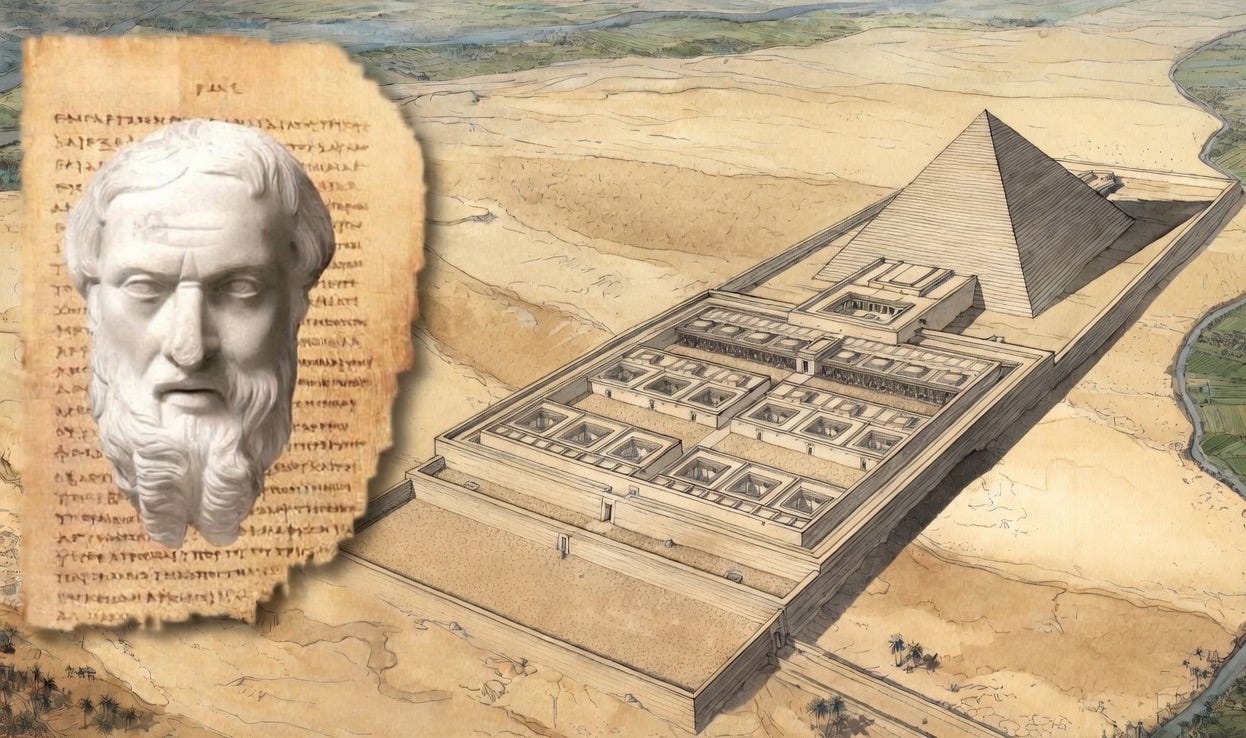
He had already seen the pyramids of Giza. He had talked about them in detail. And yet, on the same journey, he came across a single building so vast and so confounding that he described it as the greatest architectural achievement of all time:
I have seen it myself, and I found it greater than words can say. For if one should put together all the buildings produced by the Hellenes, they would prove to be inferior in labour and expense to this labyrinth. Though the pyramids beggar description, this maze surpasses even the pyramids. […] The Egyptian caretakers would by no means show us the underground chambers, as they were, they said, the burial vaults of the kings who first built it. The upper we saw for ourselves, and they are creations greater than human.
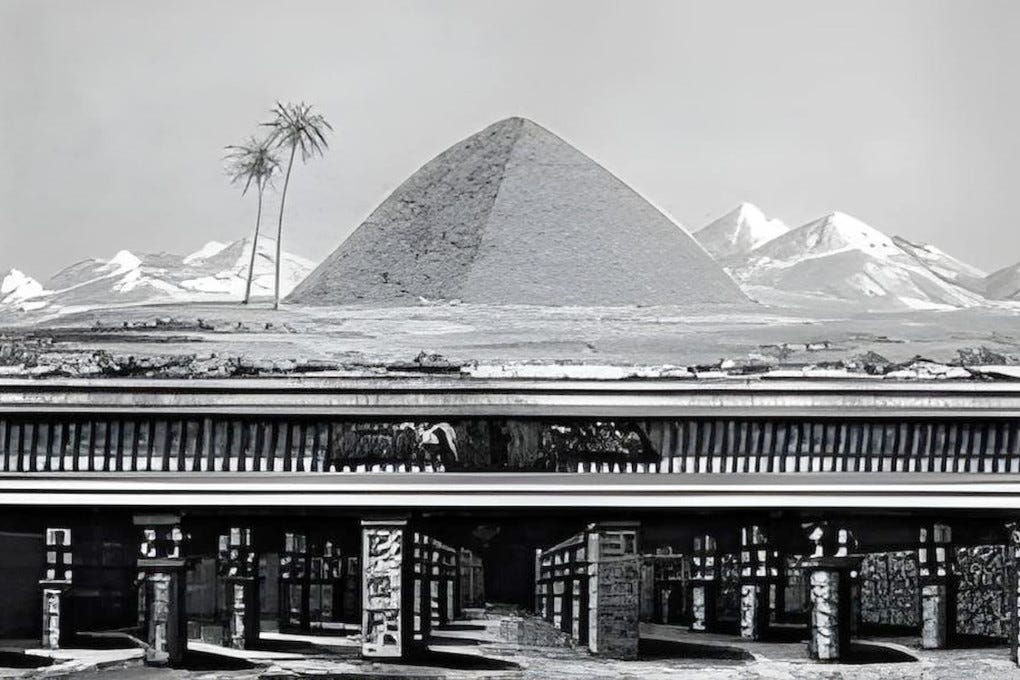
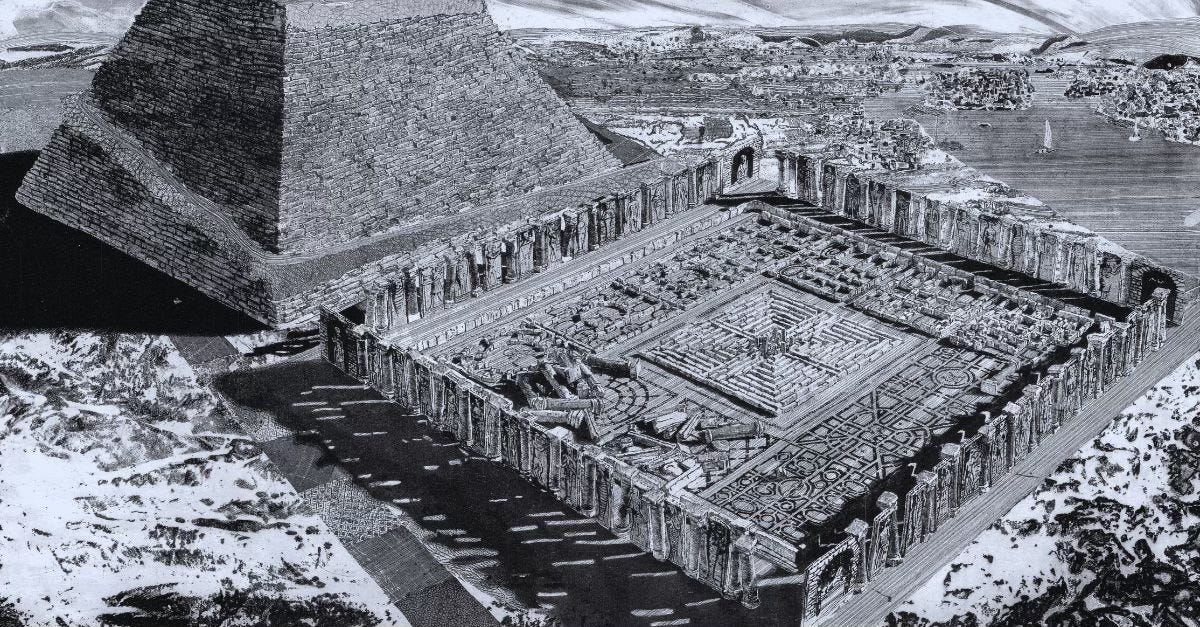
He was talking about the Labyrinth of Hawara, built south of Amenemhat III’s pyramid. According to Herodotus, the structure contained 3,000 rooms — 1,500 above ground and 1,500 below — arranged across twelve roofed courts, surrounded by a single outer wall, with passageways so confusing that visitors could not move through it without a guide.
Two centuries later, the Greek geographer Strabo visited the same building and described immense colonnades, a “great palace made up of many palaces”, and massive chambers, each one roofed with a single colossal stone — no timber, no smaller blocks, just enormous slabs spanning the entire width of each room.
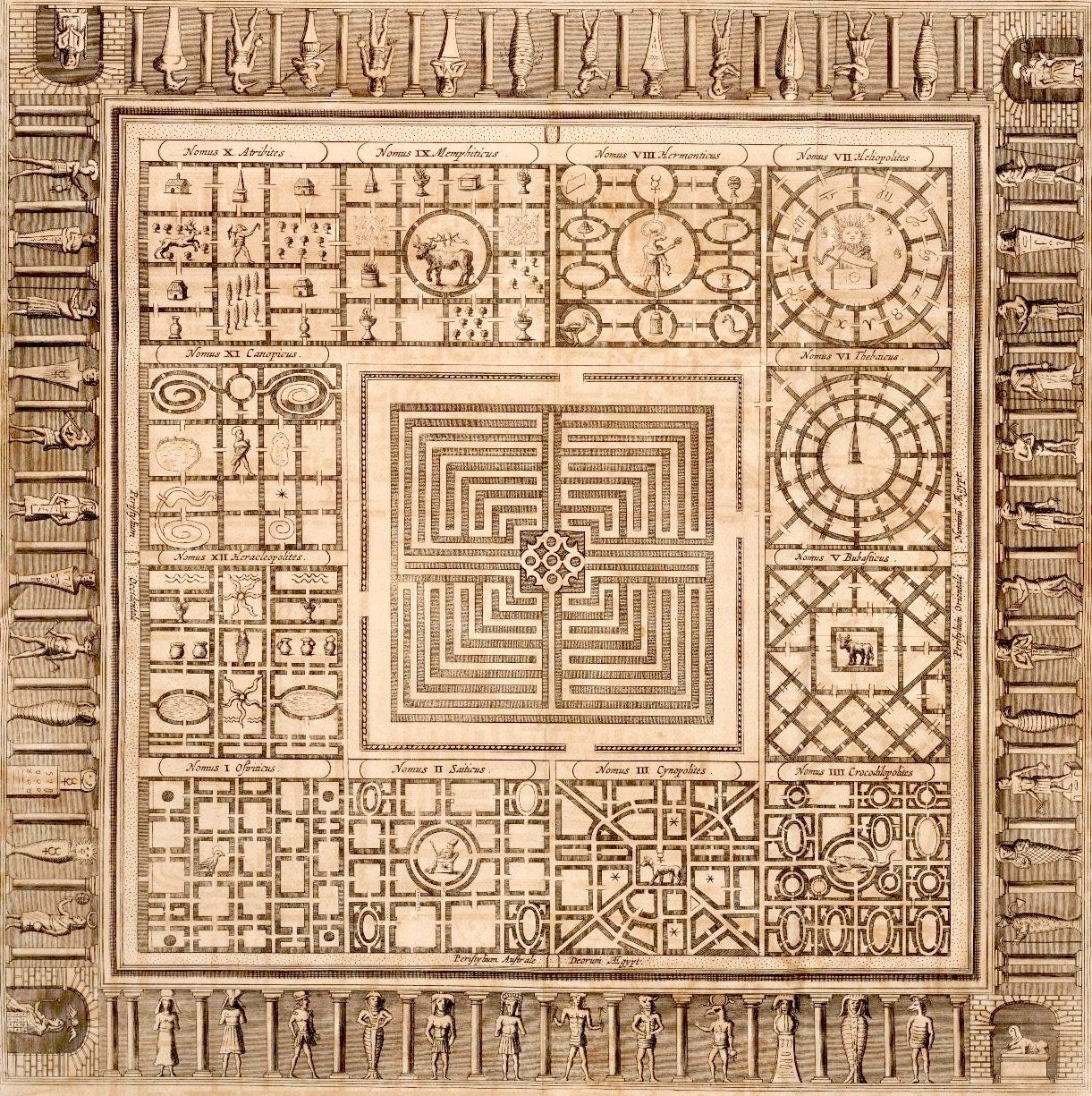
Other ancient writers all referenced the Labyrinth across the centuries that followed. It is mentioned in at least six classical sources. In the 1st century BC, Diodorus Siculus made the following claim:
They left no room for their successors to surpass them. For, when one had entered the sacred enclosure, one found a temple surrounded by columns, 40 to each side, and this building had a roof made of a single stone.
To understand why this matters, imagine what it would mean to do this today. Moving and lifting a single stone slab large enough to roof an entire room is a very serious undertaking. Doing it hundreds of times, with such precision that the slabs sat perfectly flush against the walls and held their own weight without internal supports, would be a logistical challenge of extraordinary complexity even now.
Yet they did it so many times, in a single building, that ancient Greek visitors — who had seen the great temples of the Mediterranean world — wrote that what they had stood inside at Hawara was a work that surpassed the pyramids themselves, and anything their own civilization had produced.
The labyrinth’s construction has been attributed to Amenemhat III, who ruled in 1800 BC. Yet, in Naturalis Historia, Pliny the Elder wrote:
There is still in Egypt a labyrinth, which was the first constructed, three thousand six hundred years ago, they say, by King Petesuchis or Tithöes.
What makes this passage almost surreal is the math. Pliny was writing in the first century AD. “Three thousand six hundred years ago” places the original construction of the Labyrinth somewhere around 3,500 BC, in the late Predynastic period — long before Egypt was even a unified state, and nearly a millennium before modern archaeology dates the pyramids of Giza.
And then, slowly, the Labyrinth disappeared from history.
By the time European Egyptology emerged in the 19th century, it had already become a distant memory. Flinders Petrie excavated the site at Hawara in 1888. He uncovered the outline of an enormous rectangular structure — over 300 meters long and 244 meters wide — and concluded he was looking at the foundation slab of the long-vanished Labyrinth, the rest of which had been quarried away in antiquity for use as building material elsewhere. There is now reason to believe he had it the wrong way around. He was not standing on the floor of the Labyrinth. He was standing on its roof…
For more than a century his interpretation remained largely unchallenged. Until 2008.
That year, the Mataha Expedition — an Egyptian–Belgian collaboration between the National Research Institute of Astronomy and Geophysics in Cairo and Ghent University — conducted a ground-penetrating radar survey of the area south of the Amenemhat III pyramid. What they detected, several meters below the sand, was a grid of vertical structures, several meters thick, consistent with a network of nearly closed rooms at depths of 8 to 12 meters.
A subsequent 2023 study by Mark Carlotto, using space-based synthetic aperture radar, detected anomalies in the same area that aligned with the Mataha findings. Whether or not part of the structure Herodotus described still survives below the surface, the geophysical evidence has changed what scholars believe may still be recoverable about the Labyrinth.
There is, however, one major obstacle standing in the way of uncovering the site: in the late 1820s, a canal known as the Bahr Selah was cut through the southeast corner of the Labyrinth complex, and water has been seeping into the underground chambers ever since.
The Egyptian government has not authorized further excavation. The data exists. The structure, by every available indication, is still down there. And the most accurate description we have of it remains the one written by a Greek historian 2500 years ago — a man who saw it with his own eyes and described it as the single greatest wonder of the ancient world…
2. The Largest Stone Statue in History
In the ruins of an ancient Egyptian temple lies the foot of a shattered statue carved from a single block of red granite, whose true scale, once reconstructed, goes beyond what we thought this civilization was capable of.
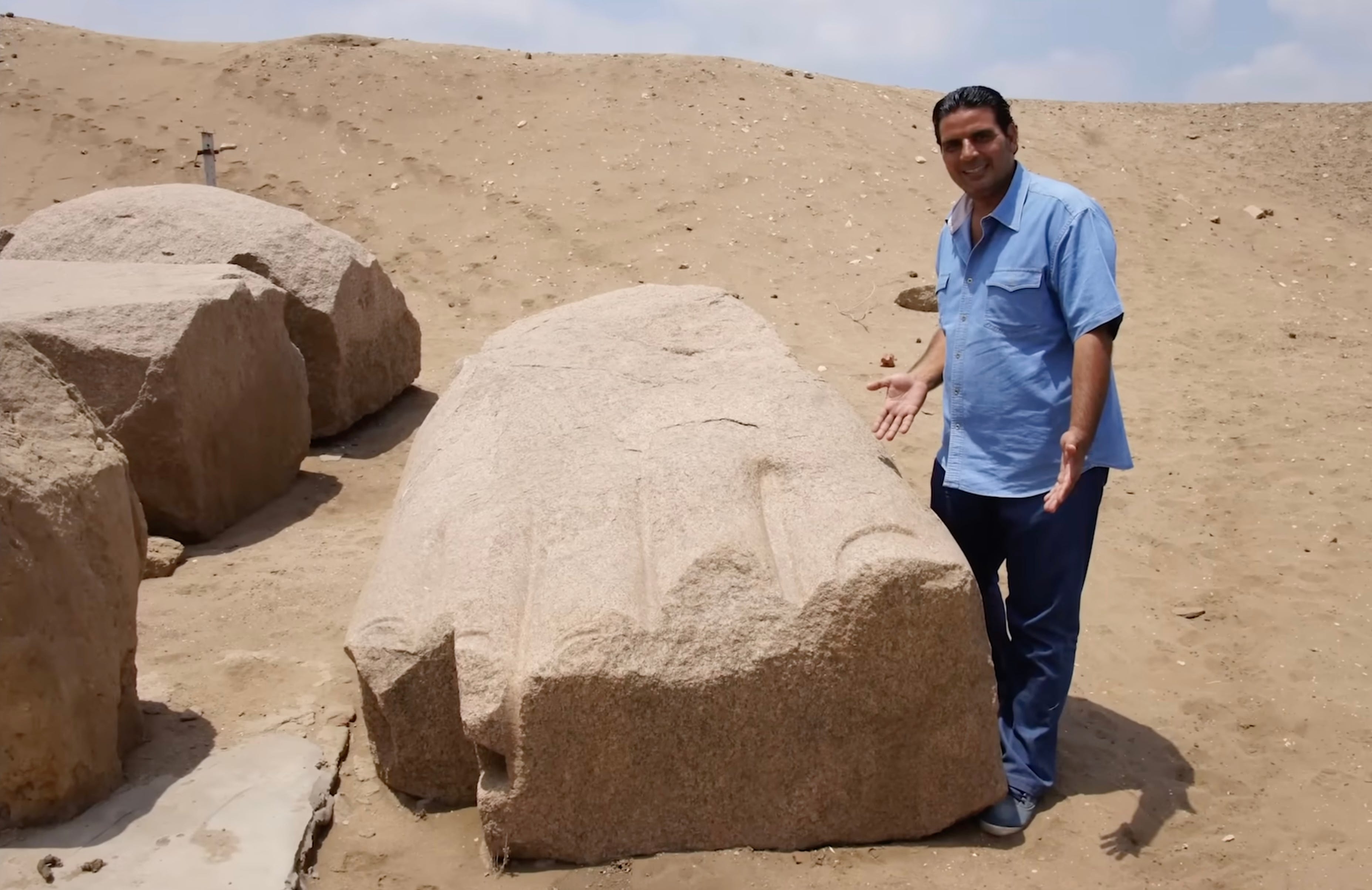
From the size of that foot alone, the implication was unmistakable…